New Breakthrough in High-Power Pouch Cell Thermal Behavior: A 3D Electrochemical-Thermal Coupled Model Reveals the Origin of Temperature Non-Uniformity
High-power lithium-ion batteries play a key role in advanced applications such as eVTOL aircraft and high-performance energy storage systems. However, temperature non-uniformity during high-rate operation remains a major challenge. It can reduce safety, shorten battery life, and limit performance.
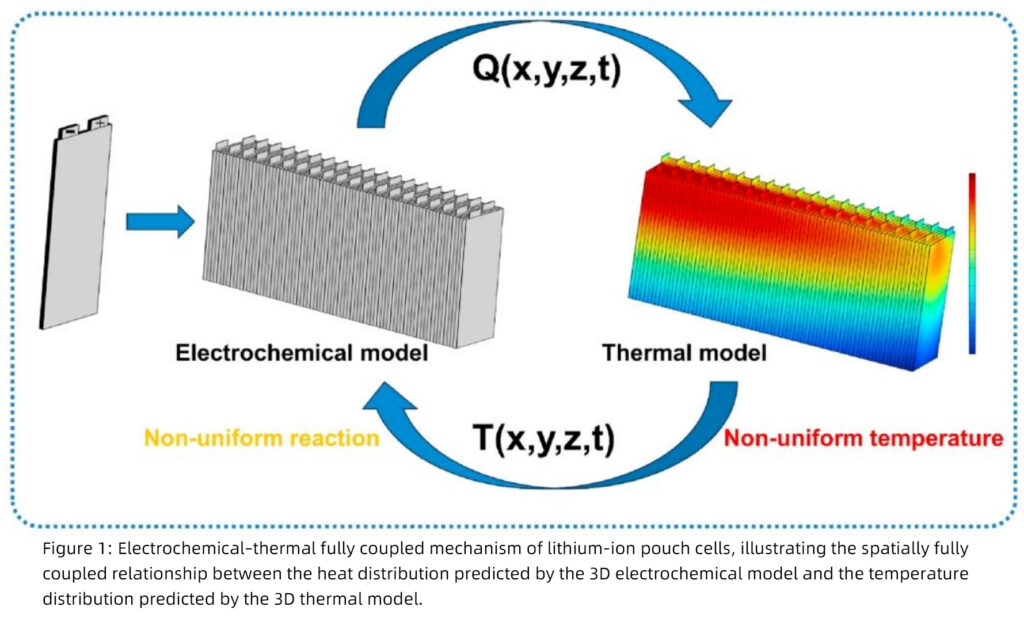
To address this issue, researchers developed a fully three-dimensional electrochemical-thermal coupled model for a commercial 4.4 V LiCoO₂/graphite pouch cell. This model enables more accurate analysis of both electrochemical reactions and temperature evolution inside the battery, offering useful insight for advanced pouch cell lab equipment development and cell design optimization.
Why High-Power Pouch Cell Thermal Behavior Matters
Understanding high-power pouch cell thermal behavior is essential for designing safer and more reliable batteries. Under fast discharge conditions, heat does not distribute evenly across the cell. As a result, some regions become much hotter than others.
This non-uniform temperature distribution can accelerate degradation and increase safety risks. It can also reduce the overall efficiency of modern battery systems and related electrode sheets used in energy storage research.
How the 3D Electrochemical-Thermal Model Works
Unlike conventional P2D electrochemical and 3D thermal models, this fully 3D framework includes all major battery components. These components include the cathode, anode, separator, current collectors, and tabs. The model keeps a consistent spatial resolution across the entire pouch cell.
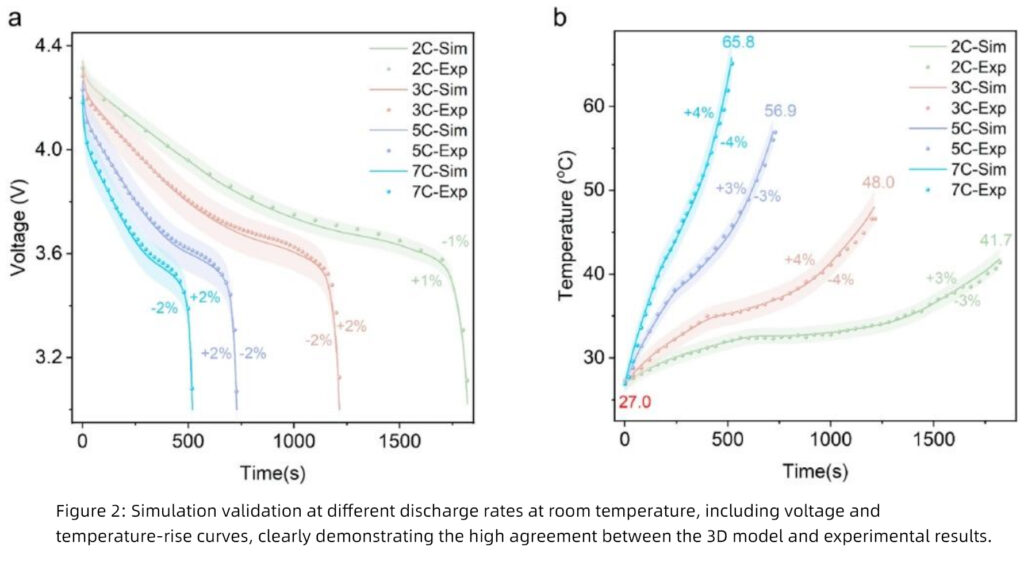
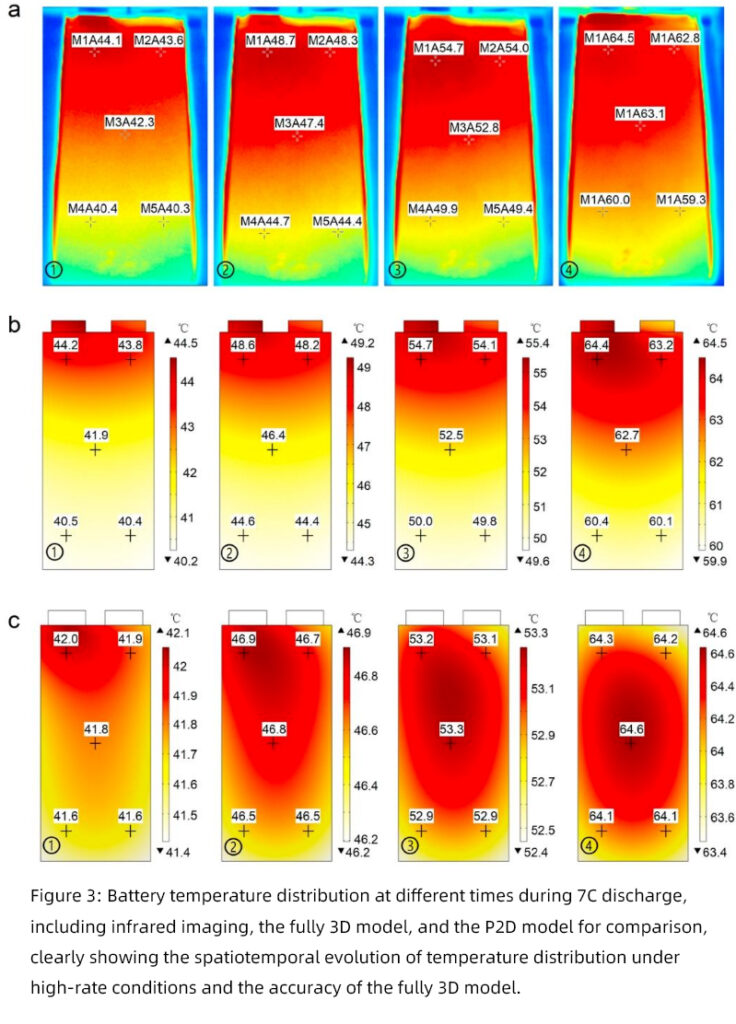
Researchers validated the model with thermocouples and infrared imaging. The results show that it predicts voltage within ±2% and temperature rise within ±4%. This accuracy clearly outperforms traditional approaches and provides practical guidance for advanced battery research equipment and thermal analysis.
What Causes Temperature Non-Uniformity
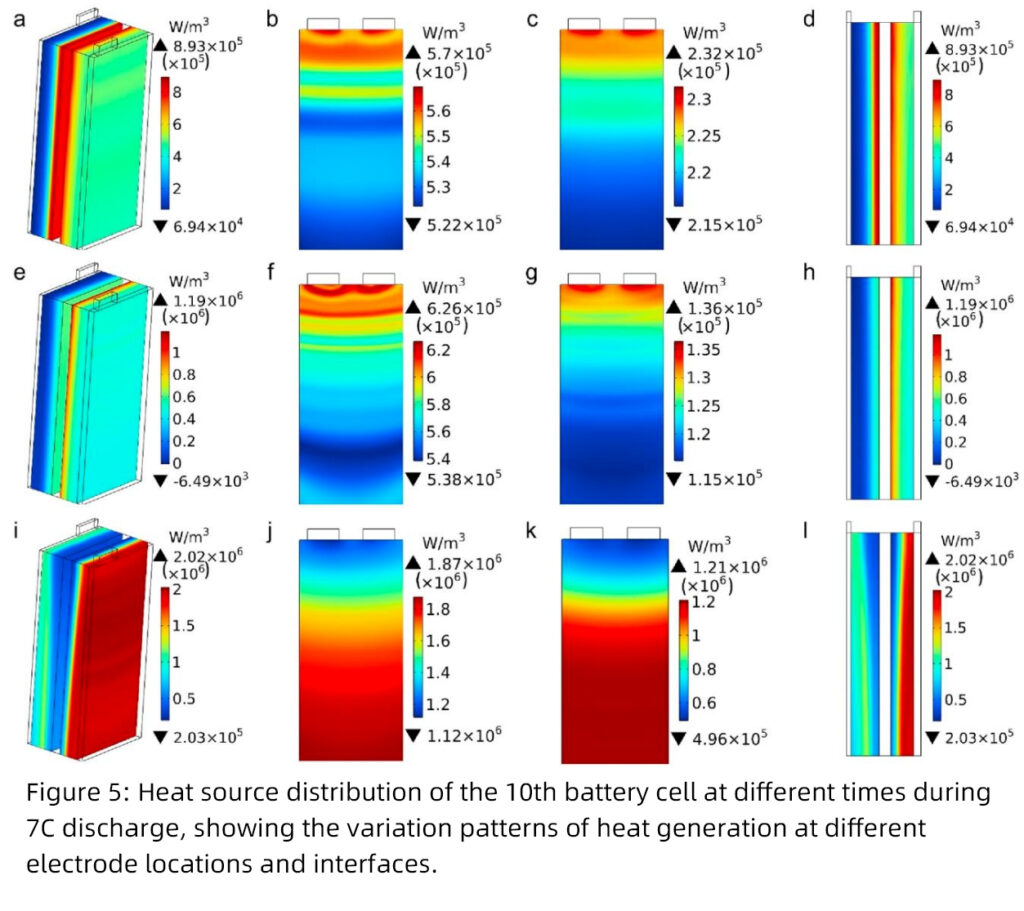
The study points to two main causes of temperature non-uniformity during 7C discharge. The first is the distance effect. The second is heat generation in the current collectors.
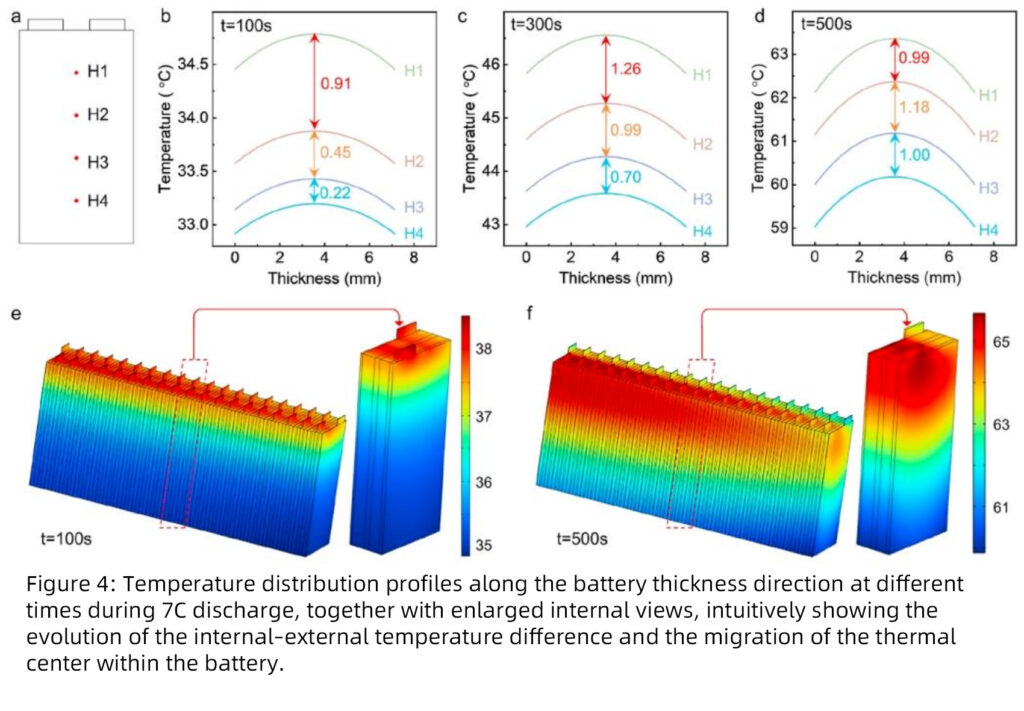
At the early stage of discharge, the distance from the tabs strongly affects current density. This leads to faster reactions and more concentrated heat generation near the tab region. At later stages, lithium-ion concentration redistribution becomes more important. It further increases the non-uniformity and shifts the thermal center from the upper tab side toward the middle and lower parts of the cell.
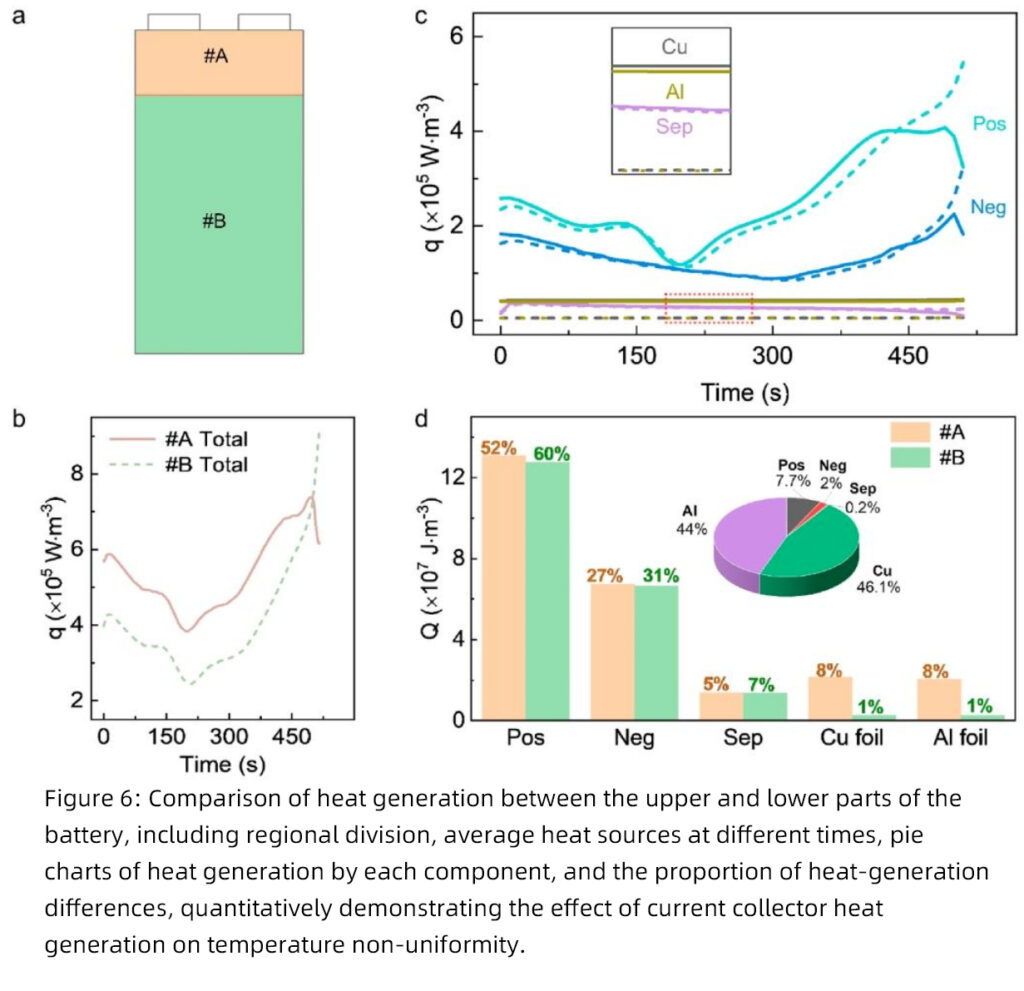
Quantitative analysis shows that the heat-generation difference between the upper and lower current collectors accounts for more than 90% of the total thermal difference across the cell height. This makes the current collectors the main source of temperature non-uniformity.
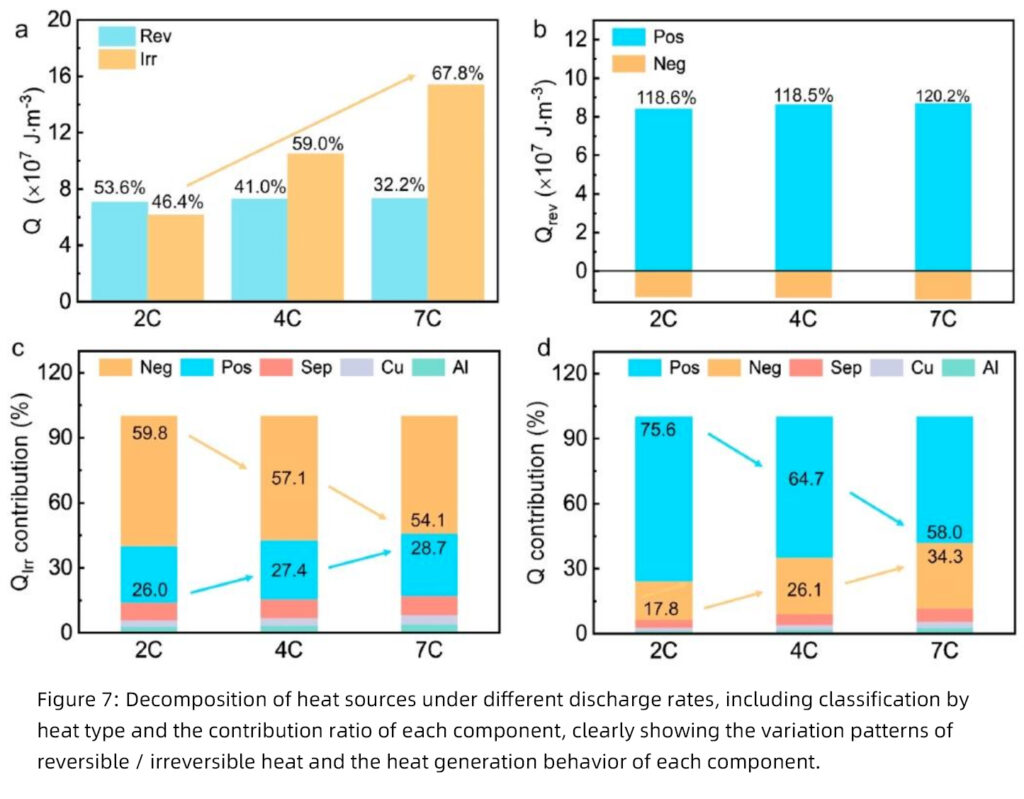
Meanwhile, reaction heat from the cathode and anode contributes more than 84% of the total battery heat generation. This reaction heat dominates the overall temperature rise. As the discharge rate increases from 2C to 7C, irreversible heat becomes the leading heat source.
What This Means for Battery Thermal Management
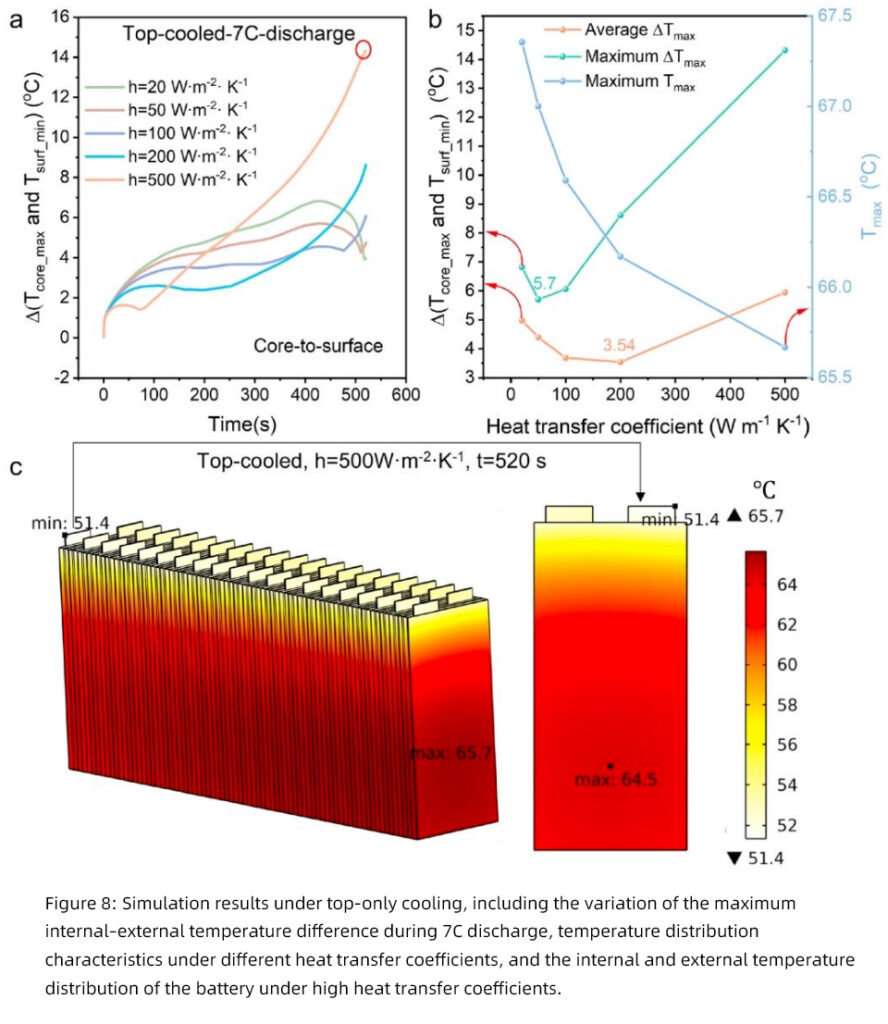
The team also compared top-only cooling, bottom-only cooling, and full-surface cooling. The results show that top-only cooling is the most effective approach for improving temperature uniformity. The best performance appears at a moderate heat transfer coefficient of 100–200 W/(m²·K).
In contrast, bottom-only cooling makes the temperature distribution less uniform. Full-surface cooling can lower the peak temperature, but it offers only limited improvement in overall uniformity.
Overall, this work provides valuable guidance for battery structural optimization and thermal management design. It also supports the development of safer, more reliable, and higher-performance batteries for eVTOL systems and other advanced energy storage applications.
At Xnergy Materials, we support advanced battery research with a wide range of electrode sheets, battery molds, and pouch cell lab equipment for lithium-ion, solid-state, and next-generation battery development. You can also explore more latest battery insights on our website.