
Li3InCl6 (LIC) Halide Solid Electrolyte: A Complete Buyer’s Guide for ASSB Research
An indium-based halide solid electrolyte that bridges the gap between high-conductivity sulfides and moisture-stable oxides — with native compatibility for 4 V-class cathodes. This guide covers two particle-size variants, halide vs sulfide selection, and how to source research-grade Li3InCl6 for your project.
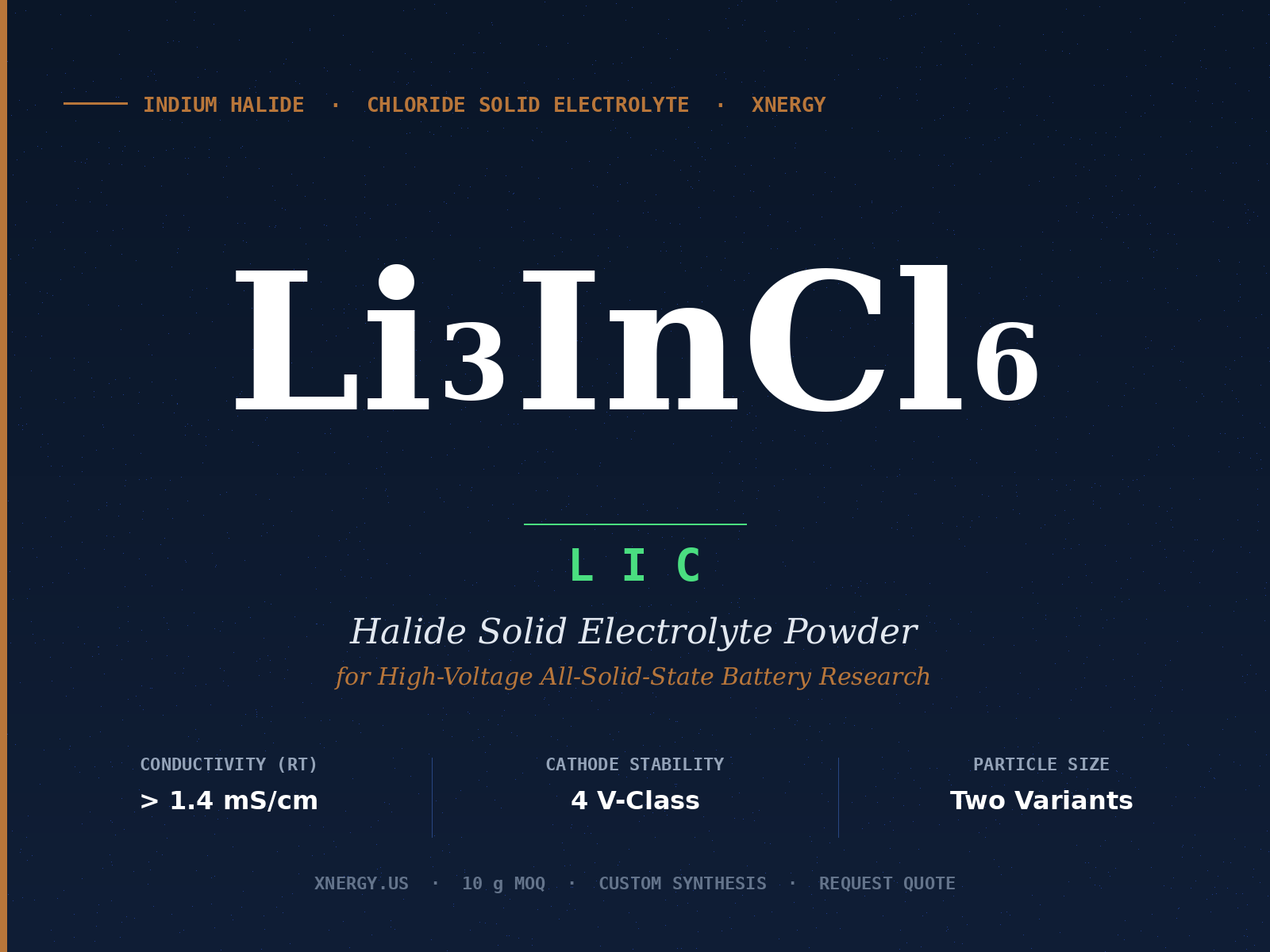
Li3InCl6, abbreviated LIC, is an indium-based halide solid electrolyte that combines high room-temperature ionic conductivity (typically 1–4 mS/cm), wide electrochemical stability against 4 V-class oxide cathodes, and meaningfully better moisture tolerance than sulfide solid electrolytes. It is one of the most widely studied chloride solid electrolytes for all-solid-state lithium battery (ASSB) research. Xnergy Materials — a direct supplier of halide solid electrolytes — supplies LIC in two particle-size variants (>5 µm and <1 µm), with 10 g minimum order quantity, bulk pricing for larger research batches, and custom synthesis on request.
Why Halide Solid Electrolytes Are Reshaping ASSB Research
For the past decade, the all-solid-state lithium battery (ASSB) field has been dominated by two solid electrolyte chemistry families: sulfides (LPSC, LGPS) with the highest ionic conductivity but poor moisture tolerance, and oxides (LLZO, LATP) with excellent stability but limiting grain-boundary resistance and a need for high-temperature sintering. Each has well-documented strengths and well-documented compromises.
Halide solid electrolytes — and particularly chloride-based systems such as Li3YCl6, Li3InCl6, and Li3ScCl6 — have emerged in the past five years as a third route. In recent comprehensive reviews of halide solid-state electrolytes, three core advantages are repeatedly highlighted:
(1) Native compatibility with high-voltage oxide cathodes. Halide electrolytes have higher electrochemical oxidation stability than sulfides — reaching ~4.2 V or more — which means they can pair directly with 4 V-class layered oxide cathodes (NCM, NCA, LCO) without requiring the cathode-coating layers that sulfides demand. This eliminates an entire process step and removes a known source of interfacial degradation.
(2) Moisture tolerance. Several halide compositions, including Li3InCl6, remain stable after exposure to dry or low-humidity air at ambient temperature. This dramatically reduces the cost and complexity of ASSB manufacturing — a glovebox-only assembly environment is no longer strictly required, opening the door to dry-room production scaled from existing lithium-ion infrastructure.
(3) Cold-press fabrication. Halide electrolyte powders are mechanically soft and can be densified by room-temperature uniaxial pressing alone, without the high-temperature sintering required for oxide systems. This makes ASSB cell assembly directly compatible with standard pouch and coin cell formats.
Among the dozens of halide compositions reported in the literature, Li3InCl6 is one of the two or three most widely studied — both in academic publications and in early-stage commercial materials catalogs. It is the focus of this guide.
What Makes Li3InCl6 Different
Li3InCl6 is a lithium indium chloride that crystallizes in a layered monoclinic structure (space group C2/m) with octahedrally coordinated In³⁺ centers and Li⁺ ions occupying mixed octahedral and tetrahedral sites. Three engineered properties define its position among halide solid electrolytes:
1. Among the highest conductivities in the halide family
Standard solid-state synthesis routes yield Li3InCl6 with room-temperature ionic conductivity of 1–2 mS/cm. Recent advances in synthesis chemistry have pushed this further:
Recent first-principles calculations (Wu et al., Applied Physics Letters, 2025) have attributed this high conductivity to the dominant role of native lithium vacancies and lithium interstitial defects, providing a clearer roadmap for further conductivity tuning.
2. Wide electrochemical stability with 4 V-class oxide cathodes
Li3InCl6 exhibits an electrochemical stability window suitable for direct pairing with high-voltage oxide cathodes including NMC622, NCM811, and LCO — a key advantage over sulfide systems that typically require additional cathode-coating layers (often LiNbO3) to prevent oxidative interface degradation. Hf-doped variants such as Li2.7In0.7Hf0.3Cl6 further extend the stability window to 2.68–4.22 V while maintaining ionic conductivity above 1 mS/cm.
3. Stable in dry air at ambient temperature
Unlike sulfide solid electrolytes that release H2S on contact with atmospheric moisture, Li3InCl6 remains structurally stable in dry and low-humidity air. This property is one of the most practically significant advantages of LIC for research workflows that cannot fully isolate cell assembly to glovebox environments. While long-term high-humidity exposure should still be avoided, brief in-air handling for cell stacking, slurry casting, and characterization is acceptable.
The Two Li3InCl6 Variants at Xnergy
Particle size is one of the most underappreciated variables in halide solid electrolyte performance. Particle size influences ionic conductivity (through grain boundary density), mechanical pressability, slurry rheology when LIC is used in composite cathodes, and even moisture stability. For these reasons, Xnergy Materials supplies Li3InCl6 in two clearly distinguished particle-size variants, allowing researchers to match the material to their specific application.
Li3InCl6 > 5 µm
Li3InCl6 < 1 µm
Halide vs Sulfide vs Oxide: Choosing a Solid Electrolyte for Your Cathode
The choice between halide, sulfide, and oxide solid electrolytes depends on which trade-off matters most for your application. The table below summarizes the four main families, with Li3InCl6 highlighted as the representative halide.
| Family | Representatives | Conductivity (RT) | Air/Moisture Tolerance | 4 V Cathode Stability | Cold-Press Friendly |
|---|---|---|---|---|---|
| Sulfide | LPSC, LGPS | 5–25 mS/cm | Poor (releases H2S) | Limited (needs cathode coating) | Yes |
| Oxide (garnet) | LLZO | 0.1–1 mS/cm | Excellent | Good | No (needs sintering >1100 °C) |
| Oxide (NASICON) | LATP | 0.1–1 mS/cm | Excellent | Good | No (needs sintering) |
| Halide (chloride) | Li3InCl6, Li3YCl6 | 1–4 mS/cm | Stable in dry air | Excellent (no coating needed) | Yes |
| Oxychloride (emerging) | LiTaOCl4, LiNbOCl4 | 6–11 mS/cm | Improved vs sulfide | Excellent (4.6 V validated) | Yes |
The halide row makes Li3InCl6's position clear: it sacrifices some peak conductivity vs sulfides in exchange for moisture tolerance, native 4 V cathode compatibility, and processing-route flexibility. For research programs whose primary constraint is working with high-voltage oxide cathodes without coatings, this is often the right trade-off.
Application Spotlight: Where Li3InCl6 Shines
Li3InCl6 has been validated across a range of ASSB research programs. The most actively published use cases include:
NMC622 / NMC811 cathode integration
NMC layered oxide cathodes are the workhorse of EV battery chemistry, and pairing them with halide electrolytes is one of the most active areas of ASSB research. Recent work has demonstrated stable cycling of NMC622-based ASSBs with Li3InCl6 as catholyte at 0.2 C with 155 mAh/g capacity and 85% retention after 1000 cycles at 60 °C (Bonsu et al., 2024).
LCO 4 V research
For high-voltage LCO cathode development, LIC offers a coating-free interface alternative to sulfide systems. The wide electrochemical window allows operation up to ~4.2 V without significant interfacial degradation.
LiNbO3-coated NCM systems
For research groups already using LiNbO3-coated NCM particles (a common cathode coating for sulfide ASSBs), LIC provides a drop-in catholyte replacement that allows studying which interface effects come from the coating vs the electrolyte chemistry.
Composite electrolyte research
Li3InCl6 is increasingly studied in composite formulations — for example LIC/PEO polymer composites for flexible solid-state cells, and LIC/LLZO bilayer architectures targeting both Li-anode stability (LLZO side) and high-voltage cathode stability (LIC side). These hybrid approaches leverage LIC's specific strengths while compensating for its limitations against Li metal.
How to Order Li3InCl6 from Xnergy
Xnergy Materials is a direct supplier of research-grade Li3InCl6 halide solid electrolyte powder, with both particle-size variants supplied on a quote-based pricing model, with bulk pricing available for larger research batches and pilot-scale orders. The supply model is designed to support the full ASSB R&D pipeline — from initial coin-cell evaluation to multi-month pilot programs.
Request a Quote for Li3InCl6
Tell us which particle-size variant you need, your target quantity, and your application. We typically respond within one business day with pricing, lead time, and a technical data sheet.
- Two particle-size variants in stock (>5 µm and <1 µm)
- 10 g MOQ · standard packs at 10/25/50/100/250/500 g
- Bulk pricing for orders 1 kg and above
- Custom particle sizes and doped variants by request
- Per-batch characterization data (XRD, EIS, particle-size analysis)
- MTAs and joint development agreements welcomed
sales@xnergy.us · 1-530-433-0971
Li3InCl6 Technical Specifications
Practical Tips for Working with Li3InCl6
Selecting LIC is the easy part. Getting reproducible cell results from it is harder. Based on our experience supporting ASSB research customers, the formulation and handling principles below separate cells that hit their targets from cells that don't:
1. Match the variant to the cell architecture
The most common formulation mistake is using the same particle-size variant for both the separator pellet and the composite cathode. Don't. Use the >5 µm variant where bulk conductivity matters (the separator), and use the <1 µm variant where intimate solid–solid contact matters (the composite cathode). The performance difference between "right variant" and "wrong variant" can be 30%+ in capacity utilization.
2. Don't over-engineer your glovebox protocol
LIC's air stability is a real practical advantage — use it. Routine cell stacking and short slurry casting can be conducted in a dry room or even on a clean lab bench in a low-humidity (<30% RH) environment. Reserving glovebox time for steps that genuinely need it (Li metal anode handling) frees up workflow.
3. Avoid prolonged exposure to humid air
"Stable in dry air" does not mean "indefinitely stable in any conditions." Prolonged exposure to humidity above ~50% RH will degrade ionic conductivity. Store opened containers under argon, and minimize the time LIC spends outside an inert environment to under one hour where possible.
4. Watch for In-on-Li reduction at low potentials
Li3InCl6 is not stable in direct contact with Li metal — In³⁺ can be reduced to In metal at low potentials, creating a degradation interface. For cells that need direct contact with Li or Li-In alloy anodes, consider a bilayer architecture (e.g., LIC/LLZO or LIC/Li2OHCl) where a more reductively stable layer faces the anode.
5. Cold-press at appropriate pressure
LIC pellets typically reach >90% theoretical density at 200–400 MPa uniaxial pressure for 5–10 minutes at room temperature. Higher pressure does not always help — over-densification can introduce microcracks. Match pressure to your target electrode loading and cell stack architecture.
Frequently Asked Questions
What is Li3InCl6 used for?
Li3InCl6 (LIC) is an indium-based halide solid electrolyte used primarily in all-solid-state lithium battery (ASSB) research. Its main role is as the catholyte — the solid electrolyte phase mixed into composite cathodes — where it provides high room-temperature ionic conductivity (>1 mS/cm), wide electrochemical stability against 4 V-class oxide cathodes (NCM, LCO, high-nickel layered oxides), and meaningfully better moisture tolerance than sulfide solid electrolytes such as LPSC and LGPS.
Where can I buy Li3InCl6 powder for research?
Xnergy Materials, a direct supplier of research-grade Li3InCl6 (LIC), supplies halide solid electrolyte powder in two particle-size variants. Standard pack sizes start at 10 g minimum order quantity, with 25 g, 50 g, 100 g, 250 g, and 500 g packs available. Bulk pricing is offered for larger research batches and pilot-scale orders. Pricing is provided on a per-quote basis — contact sales@xnergy.us with your application and target quantity.
What is the difference between Xnergy's two Li3InCl6 particle-size variants?
Xnergy offers Li3InCl6 in two particle-size variants. The >5 µm primary particle size variant exhibits ionic conductivity >1.4 mS/cm (pressed pellet, 27 °C) and is generally preferred for thicker electrodes and large-format cells where lower interfacial surface area helps moisture stability. The <1 µm sub-micron variant exhibits ionic conductivity >1.0 mS/cm and is preferred for composite cathode formulations where intimate contact between LIC and active material particles is critical, especially in thin-film ASSB designs.
How does Li3InCl6 compare with sulfide solid electrolytes like LPSC?
Li3InCl6 has lower bulk ionic conductivity than top sulfides (1–4 mS/cm vs 5–25 mS/cm for sulfides), but offers two decisive advantages: (1) significantly better moisture tolerance — LIC remains stable in dry-to-low-humidity air, while sulfides release H2S on contact with water; (2) wider electrochemical stability window for high-voltage oxide cathodes — LIC pairs natively with NCM and LCO at >4 V, whereas sulfides require cathode coatings to avoid interface degradation. For research programs prioritizing moisture-tolerant handling and high-voltage cathode compatibility, LIC is often the preferred choice.
Is Li3InCl6 stable in air?
Li3InCl6 is stable in dry and low-humidity air at ambient temperature, which is one of its principal advantages over sulfide solid electrolytes. This property eliminates the need for a strict glovebox-only assembly environment in some research contexts. However, prolonged exposure to high humidity will degrade ionic conductivity, so storage and slurry preparation should still be conducted under inert atmosphere or in a dry room. Brief in-air handling for cell assembly is acceptable.
Which cathodes are compatible with Li3InCl6?
Li3InCl6 is compatible with a wide range of 4 V-class oxide cathodes including LiNi0.6Mn0.2Co0.2O2 (NMC622), LiCoO2 (LCO), high-nickel NMC (NCM811, NCM83), and LiNbO3-coated NCM systems. It is one of the most widely used catholytes in halide-based ASSB research. For very high voltage operation (>4.5 V), Hf-doped variants (Li3−xIn1−xHfxCl6) have been reported with extended stability windows.
What is the room-temperature ionic conductivity of Li3InCl6?
Xnergy's Li3InCl6 exhibits ionic conductivity >1.4 mS/cm (>5 µm variant) and >1.0 mS/cm (<1 µm variant) at 27 °C in pressed pellet form. Literature reports for optimized synthesis routes have reached up to 4 mS/cm for Li3InCl6 — the highest value reported for halide-type solid electrolytes — using aprotic solvent-mediated wet chemistry (Bonsu et al., Advanced Science, 2024). The electronic conductivity is below 1×10⁻⁸ S/cm, ensuring the material functions as a pure ionic conductor.
Can Li3InCl6 be used with cold-press cell assembly?
Yes. Li3InCl6 is a soft, mechanically pressable powder that does not require high-temperature sintering for densification. Cold-press cell assembly is the standard fabrication route for halide-based ASSBs and is one of the practical advantages of LIC over oxide-based solid electrolytes such as LLZO that require sintering at 1100 °C or above.
What is the minimum order quantity for Li3InCl6?
The minimum order quantity is 10 grams. Standard pack sizes are 10 g, 25 g, 50 g, 100 g, 250 g, and 500 g. For larger research batches (1–10 kg) and pilot-scale quantities, custom batch sizes are available with discounted bulk pricing. Contact sales@xnergy.us with your monthly volume estimate for a quote.
Does Xnergy offer custom synthesis or doped Li3InCl6 variants?
Yes. Xnergy supports custom particle size distributions, custom batch sizes, and stoichiometry adjustments within the Li-In-Cl system for research programs studying composition–property relationships. We also welcome long-term supply agreements, joint development collaborations, and Material Transfer Agreements (MTAs) with academic and industrial partners working on halide and chloride solid electrolytes. Doped variants such as Hf-substituted or F-substituted LIC can be produced on a per-project basis.
Selected Literature on Li3InCl6 & Halide Solid Electrolytes
The technical claims in this guide are supported by published research. The references below are useful starting points for further reading on Li3InCl6 synthesis, structure, and ASSB integration:
- Bonsu, J. O., Bhadra, A., Kundu, D. (2024). Wet Chemistry Route to Li3InCl6: Microstructural Control Render High Ionic Conductivity and Enhanced All-Solid-State Battery Performance. Advanced Science. — Reports record 4 mS/cm conductivity from aprotic solvent-mediated wet chemistry.
- Wu, M. et al. (2025). Origin of high ionic conductivity in halide solid electrolyte Li3InCl6: Insights from native defects. Applied Physics Letters. — First-principles study of Li vacancies and interstitials driving conductivity.
- Li, X. et al. Electrochemically Stable Li3−xIn1−xHfxCl6 Halide Solid Electrolytes for All-Solid-State Batteries. ACS Applied Materials & Interfaces. — Hf-doped variants with extended stability window.
- Halide solid-state electrolytes for all-solid-state batteries (2023). Chemical Science, 14, 8693–8722. — Comprehensive review of the halide solid electrolyte field.
- Mei, H., Piccardo, P., Spotorno, R. (2025). Application of Li3InCl6-PEO Composite Electrolyte in All-Solid-State Battery. — LIC-PEO composite with 5.15 V stability window.
- An Insight into Halide Solid-State Electrolytes: Progress and Modification Strategies. Energy Material Advances. — Strategies for halide electrolyte composite design.
Other Solid Electrolytes from Xnergy
Researchers building benchmarking comparisons or hybrid architectures often pair Li3InCl6 with other solid electrolyte families. The following materials are also stocked at Xnergy:
Get Li3InCl6 for your next ASSB experiment
Xnergy Materials is a direct supplier of research-grade Li3InCl6, available in two particle-size variants with bulk pricing for larger research orders and custom synthesis available on request. Whether you are running a coin-cell evaluation, a multi-month NMC ASSB program, or a pilot-line build, our team can support your sourcing roadmap.