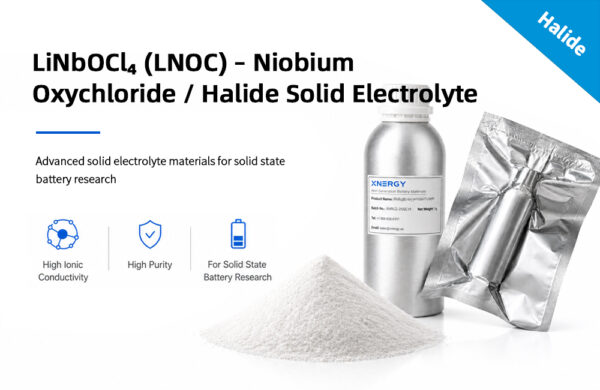
LiNbOCl₄ (LNOC) – Niobium Oxychloride / Halide Solid Electrolyte
SKU: XN-LNOC
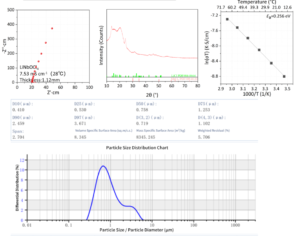
LNOC Niobium-Based Halide Solid-State Electrolyte (LiNbOCl₄) — Xnergy’s flagship solid electrolyte with ~7 mS/cm ionic conductivity at 28 °C and 4.6 V high-voltage stability. Validated in full all-solid-state cells with high-voltage LCO (4.6V, ~180 mAh/g) and Ni83 (~210 mAh/g) cathodes. Activation energy Ea = 0.256 eV.
Need a bulk order? Request a competitive quote today!
Name: LNOC Niobium-Based Halide Solid-State Electrolyte (LiNbOCl₄)
Material Form: Powder
Product Code: XN-LNOC
Description:
LNOC (LiNbOCl₄) is a niobium-based halide-oxide solid-state electrolyte engineered for next-generation high-voltage all-solid-state lithium batteries (ASSLBs). With ~7 mS/cm room-temperature ionic conductivity and stability up to 4.6 V vs Li/Li⁺, this material delivers performance that exceeds both conventional halide and sulfide electrolytes. As a result, LNOC enables direct compatibility with high-voltage LCO (4.6 V) and high-nickel NCM cathodes for maximum energy density. Furthermore, it is the highest-performance solid electrolyte in Xnergy’s product line.
Application:
This material serves as a high-conductivity, high-voltage catholyte for all-solid-state lithium batteries. Especially suitable for 4.6 V LCO ASSLB cells, high-nickel NCM/Ni83 systems, and sulfide-halide composite electrolyte architectures (paired with LPSC as anode-side separator). Additionally, it works well in high-power solid-state pouch cells and pilot-scale ASSLB manufacturing.
Specifications:
| Property | Value |
|---|---|
| Composition | LiNbOCl₄ |
| Ionic Conductivity | ~7 mS/cm @ 28 °C |
| Activation Energy (Ea) | 0.256 eV |
| Test Condition | EIS, 28 °C; Arrhenius 12.6–71.7 °C |
| Crystal Structure | Niobium halide-oxide framework, partially amorphous |
| Electrochemical Window | Stable up to 4.6 V vs Li/Li⁺ |
| Form | Powder |
| Storage | Inert atmosphere (Ar / N₂), sealed, moisture-excluded |
Values measured by Xnergy. Typical values for reference; not guaranteed unless otherwise specified.
Characteristics:
Ultra-high room-temperature conductivity
~7 mS/cm at 28 °C — exceeds most halide electrolytes by an order of magnitude and matches or surpasses leading sulfide electrolytes (e.g., Li₆PS₅Cl ~5 mS/cm), without the cathode interface compatibility issues of sulfides.
4.6 V high-voltage stability
Stable in direct contact with 4.6 V LCO cathodes — enabling access to the high-voltage capacity region (180+ mAh/g) inaccessible to conventional halide and sulfide electrolytes. Critical for maximum-energy-density ASSLB designs.
Low activation energy
Ea = 0.256 eV indicates rapid Li-ion transport with weak temperature dependence, supporting consistent performance across a wide operating temperature range (12.6–71.7 °C validated by Arrhenius analysis).
Validated in high-voltage ASSLB cells
LCO (4.6 V) | LNOC | LPSC | Li-In: ~180 mAh/g, 96.7% coulombic efficiency. Ni83 | LNOC | LPSC | Li-In: ~210 mAh/g, 87.8% coulombic efficiency. Both at 7 mg/cm² loading, 28 °C.
Performance Data:
Packaging & Storage:
The material ships vacuum-sealed under inert atmosphere in moisture-barrier aluminum-laminated bags. Therefore, customers should store sealed in Ar or N₂ glovebox, protected from moisture. Because LNOC is moisture-sensitive, handle exclusively in a dry environment with dew point < –40 °C. Reseal promptly after opening.
Safety:
For research and industrial use only. Wear PPE (gloves, masks, safety goggles). Refer to SDS for complete safety information.
Note: Values listed above are typical and for reference only. Performance may vary depending on cell architecture, cathode selection, electrolyte separator, and test protocol. Compare with our other halide electrolytes: LZCO (Li₂ZrOCl₄) at 1.55 mS/cm, Al-Doped LZC at 0.7 mS/cm, LZC (Li₂ZrCl₆) at 0.3 mS/cm, and LYC (Li₃YCl₆) at 0.3–0.4 mS/cm.