
Passive Ultrasonic Probing and Communication for Internal Hazards in Lithium-Ion Batteries
Lithium-ion batteries are widely used in portable electronic devices, electric vehicles, and renewable energy systems. Real-time monitoring of their internal signals is critical for ensuring operational safety. However, the electromagnetic shielding effect of the metallic battery casing, together with the corrosive internal electrolyte environment, makes reliable internal sensing extremely challenging. Existing wired monitoring approaches either compromise the structural integrity of the battery or consume the battery’s own energy, while conventional electromagnetic wireless methods cannot penetrate the metallic casing to achieve signal transmission. Therefore, there is an urgent need to develop a passive, wireless monitoring system capable of real-time tracking of internal signals in lithium-ion batteries. Ultrasonic technology provides a feasible solution to this challenge because it can effectively penetrate metallic casings.
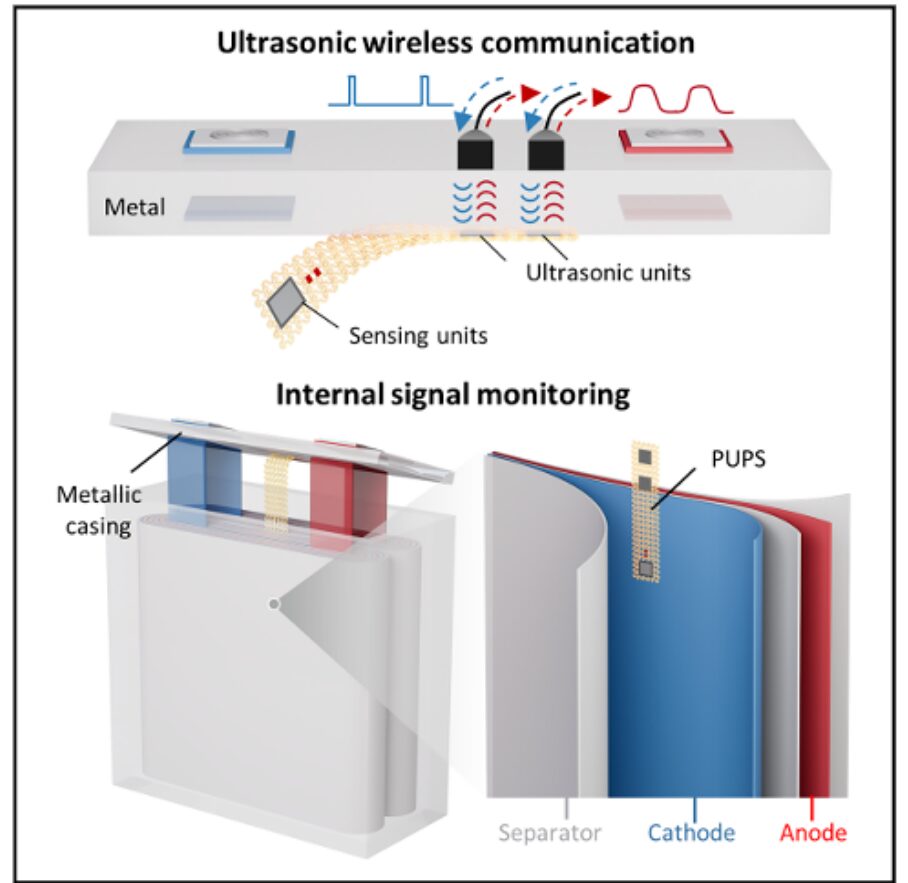
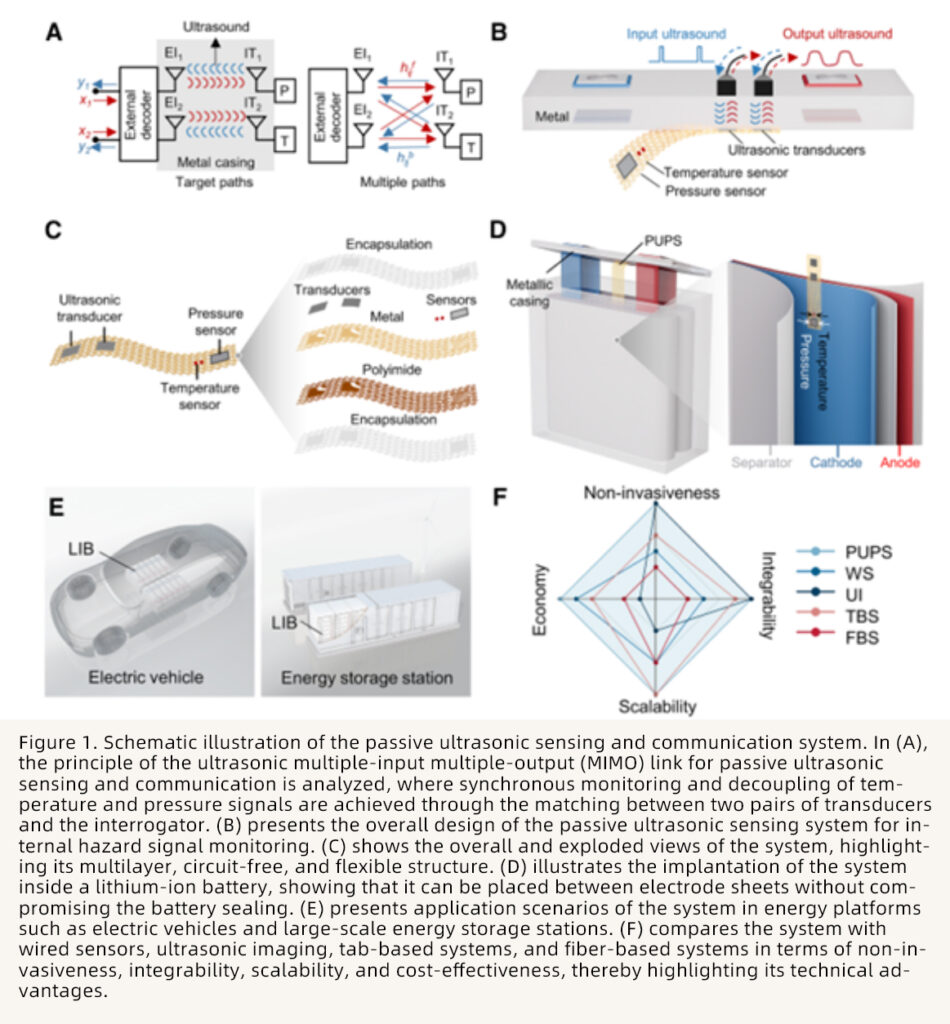
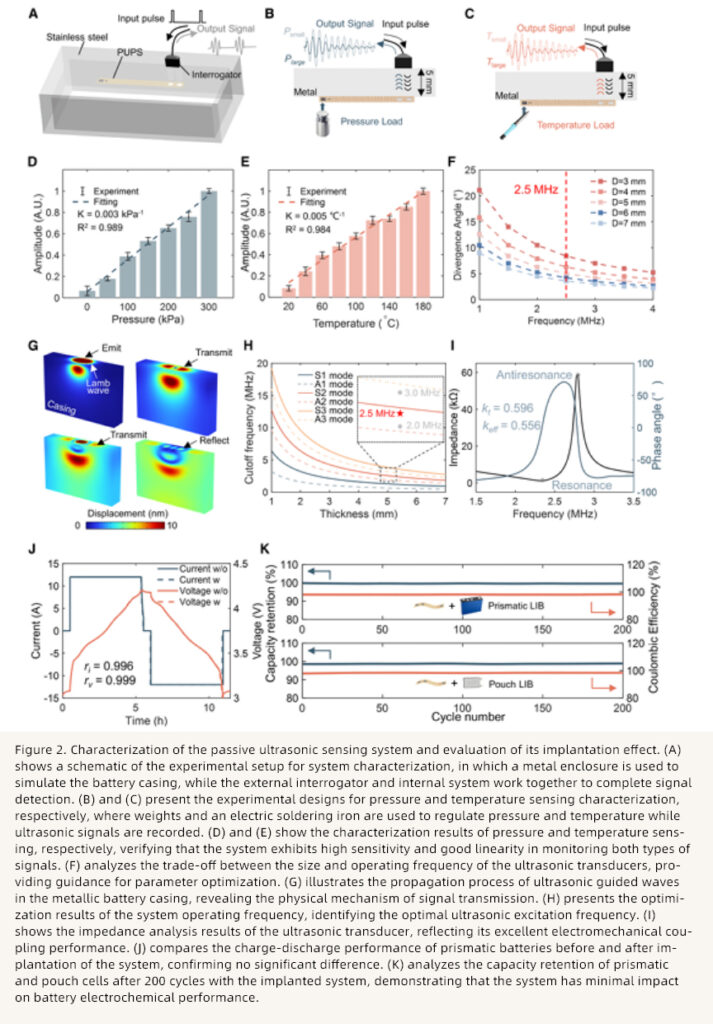
Recently, the teams of Minggao Ouyang and Xue Feng at Tsinghua University developed a passive ultrasonic probing system (PUPS), which enables wireless and synchronous monitoring of multiple internal signals, including temperature and pressure, in lithium-ion batteries based on the principle of an ultrasonic multiple-input multiple-output (MIMO) link. The system adopts a wireless, circuit-free, and flexible structural design. It uses lead zirconate titanate (PZT) as the ultrasonic transducer, combined with a thin-film piezoresistive pressure sensor and a negative temperature coefficient (NTC) thermistor temperature sensor. Encapsulated with parylene, the system exhibits excellent corrosion resistance and can be embedded during battery manufacturing without compromising package integrity. It achieves a temperature monitoring fidelity of 0.1°C, a pressure monitoring fidelity of 0.5 kPa, and a temporal resolution of 100 ms, while maintaining stable operation for more than 2600 h and exerting negligible influence on battery capacity retention. Through in situ monitoring of charge-discharge cycling and thermal runaway in both pouch and prismatic lithium-ion batteries, the researchers found that the sharp increase in internal pressure during thermal runaway occurs about 800 s earlier than the rapid rise in temperature, confirming that pressure is the earliest predictive indicator of battery failure. The system also decoupled the evolution of reversible electrode pressure and irreversible gas pressure inside the battery. This system provides a non-invasive diagnostic platform for lithium-ion battery safety warning and shows broad application prospects in scenarios such as new energy vehicles and large-scale energy storage stations.
[Key Points]
A passive ultrasonic probing system (PUPS) was developed, and an ultrasonic multiple-input multiple-output (MIMO) link principle was established to realize wireless, synchronous monitoring and decoupling of internal battery temperature and pressure signals. The system features a circuit-free and flexible structural design, employing lead zirconate titanate (PZT) as the ultrasonic transducer, together with a thin-film piezoresistive pressure sensor and a negative temperature coefficient (NTC) thermistor temperature sensor. Encapsulated with parylene, it exhibits excellent corrosion resistance and can be embedded during battery manufacturing without damaging the integrity of the battery package. At the same time, it achieves a temperature monitoring fidelity of 0.1°C, a pressure monitoring fidelity of 0.5 kPa, and a temporal resolution of 100 ms, while enabling stable long-term operation for over 2600 h and having minimal impact on battery capacity retention.
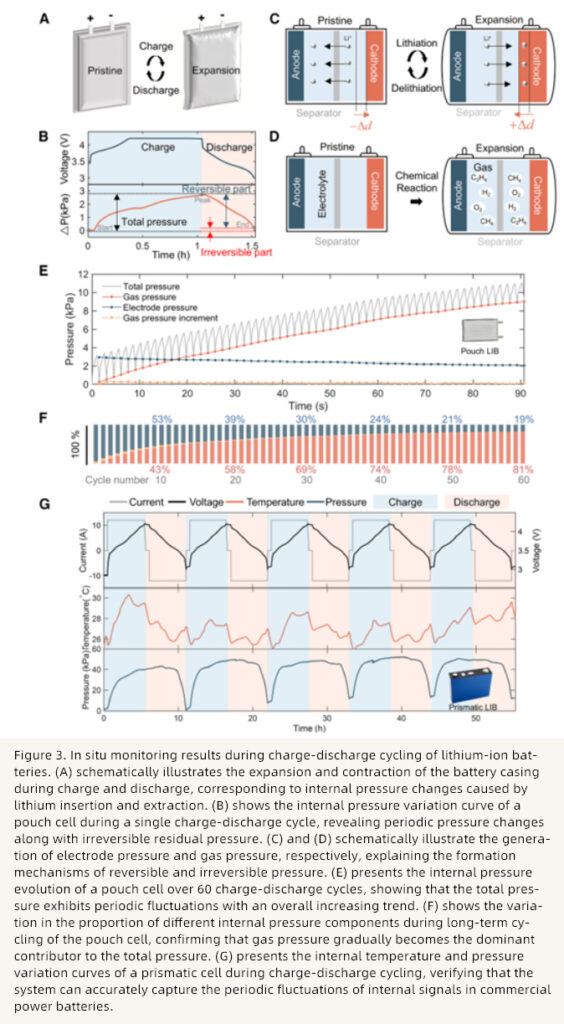
The implantation of PUPS was validated in both pouch and prismatic lithium-ion batteries. Through in situ monitoring during charge-discharge cycling, the reversible and irreversible components of internal battery pressure were successfully decoupled. It was confirmed that electrode pressure is the primary source of reversible pressure, whereas gas pressure generated by electrolyte side reactions is the main source of irreversible pressure. Moreover, during long-term battery operation, gas pressure gradually becomes the dominant contributor to the total internal pressure. The system was also shown to accurately capture the periodic variations of temperature and pressure during battery charge-discharge processes and to be adaptable to commercial lithium-ion batteries with different chemistries.
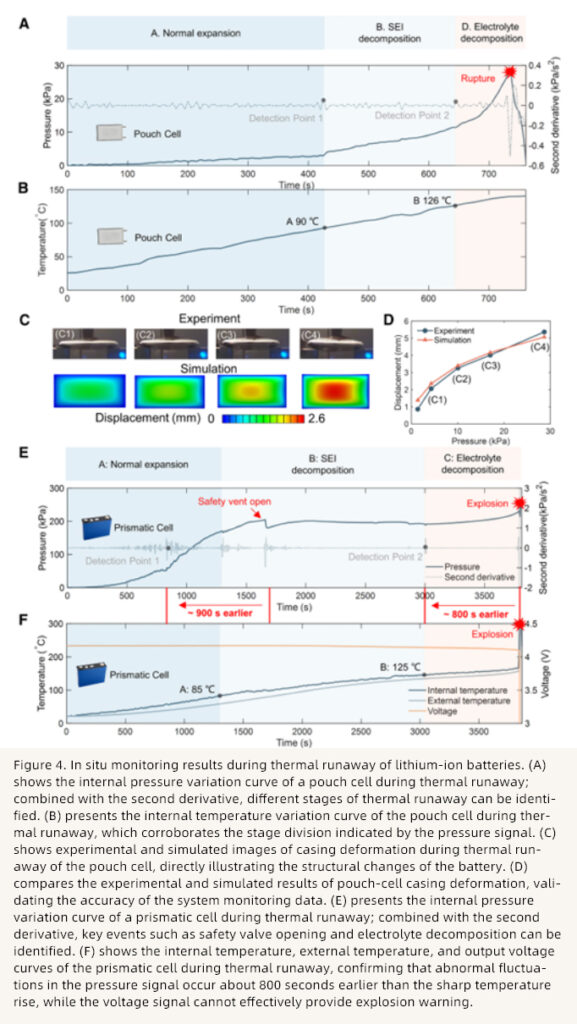
PUPS was further used for in situ monitoring of thermal runaway in both pouch and prismatic lithium-ion batteries. The temperature and pressure variation characteristics at different stages of thermal runaway were clarified. It was found that the sharp increase in internal pressure appears about 800 s earlier than the rapid temperature rise, confirming that pressure is the earliest predictive indicator of battery failure and that its signal response precedes both temperature and voltage signals. The system is able to capture the full evolution of internal battery signals from normal operation to thermal runaway explosion. In particular, the second derivative of the pressure signal can precisely identify early abnormal features of the battery, providing a key basis for early warning of lithium-ion battery thermal runaway and establishing a non-invasive diagnostic platform for battery safety monitoring.
[Conclusion]
This study proposes a passive ultrasonic probing and communication technology for internal hazard monitoring of lithium-ion batteries. By constructing an ultrasonic multiple-input multiple-output link principle, high-signal-to-noise-ratio wireless communication of multiple internal battery signals was achieved. A passive ultrasonic probing system was developed and implanted inside batteries to accomplish signal monitoring and ultrasonic link modulation. Through pouch-cell-related experiments, the pressure evolution during charge-discharge cycling was elucidated, a chemo-mechanical coupling model was established, and the reversible and irreversible components of internal battery pressure were decoupled. Through prismatic-cell-related experiments, the internal temperature and pressure variations during charge-discharge cycling were synchronously recorded.
Using this passive ultrasonic probing system, the internal temperature and pressure during thermal runaway in both pouch and prismatic lithium-ion batteries were monitored. Experimental results showed that the key accelerated pressure surge occurring during battery thermal runaway appears about 800 seconds earlier than the rapid temperature rise. The flexibility and passive nature of the passive ultrasonic probing system endow it with great potential for large-scale applications. The ultrasonic MIMO link principle establishes channel design guidelines for the system, ensuring the optimal signal-to-noise ratio for each channel and providing a theoretical foundation for expanding the system to more monitoring channels. In addition, because the operating energy of the system is supplied by an external interrogator, it does not consume the battery’s own energy and therefore will not encounter an energy bottleneck during scale-up.
Future work will further investigate the long-term stability of the system to ensure sustained operation in lithium-ion batteries for electric vehicles. Since the actual service life of electric vehicles exceeds eight years, improving the durability of the system is a key direction for subsequent research. Studying the impact of system implantation on battery aging is also crucial for enhancing system durability. The system can realize wireless in situ monitoring of multimodal signals inside batteries. In the future, it may further acquire internal battery signals under typical defects such as nail penetration and lithium deposition, establish a defect-signal database, and develop defect identification models using artificial intelligence algorithms to achieve precise detection and early warning of internal battery hazards. Overall, this passive ultrasonic probing system provides a non-invasive and effective solution for internal hazard monitoring of lithium-ion batteries and demonstrates promising prospects for large-scale practical applications.