
Lithium Tantalum Oxychloride (LTOC) Solid Electrolytes: A Selection Guide for LiTaOCl4 and Li2TaOCl5
Both compositions are sold as LTOC. Both deliver 6–8 mS/cm room-temperature ionic conductivity. Both pair natively with 4.6 V high-voltage cathodes. So how do they actually differ — and which one fits your research? This guide compares the two tantalum oxychloride solid electrolytes Xnergy supplies and helps you choose between them.
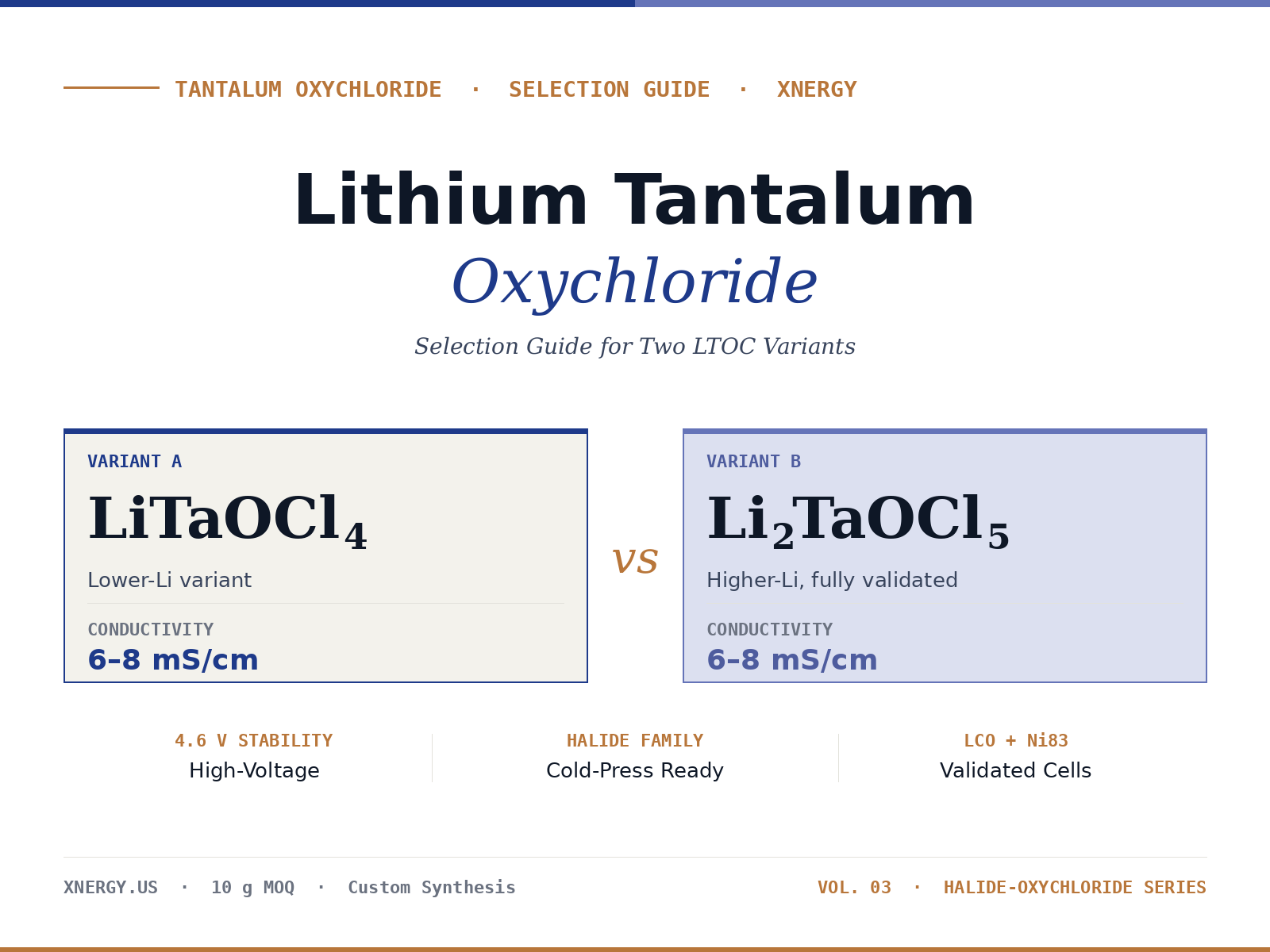
Xnergy Materials — a direct supplier of tantalum oxychloride solid electrolytes — offers two grades, both abbreviated LTOC in the academic literature. LiTaOCl4 is the lithium-poor variant (1:1:1:4 stoichiometry) and the form most often cited in 2024 literature, including Adv. Funct. Mater. and Adv. Mater. Li2TaOCl5 is the lithium-rich variant (2:1:1:5) with deeper in-house validation against 4.6 V LCO and Ni83 cathodes. Both achieve 6–8 mS/cm room-temperature ionic conductivity, both pair directly with 4.6 V layered oxides without coatings, and both use cold-press cell assembly. The right choice depends on whether you prioritize literature alignment (LiTaOCl4) or validated full-cell performance (Li2TaOCl5).
Why Tantalum Oxychloride Solid Electrolytes Matter
For the past two years, the all-solid-state lithium battery (ASSLB) field has been quietly reshaped by a new family of materials: oxychloride solid electrolytes. These materials sit at the intersection of two earlier electrolyte families — halides (Li3InCl6, Li3YCl6) and oxide-incorporating systems — and inherit the strongest properties of both: high room-temperature ionic conductivity from the halide component, and improved electrochemical stability from the oxygen anion.
Among the dozens of oxychloride compositions reported, tantalum and niobium oxychlorides (LiTaOCl4, Li2TaOCl5, and LiNbOCl4) have emerged as the headline materials. They consistently report room-temperature ionic conductivities above 6 mS/cm — matching the best sulfide solid electrolytes — while exhibiting wide enough electrochemical windows to pair directly with 4.6 V LCO and high-nickel NCM cathodes. Recent literature has placed LiTaOCl4 alongside Li10GeP2S12 as one of the few solid electrolytes ever reported above 10 mS/cm:
This combination of sulfide-class conductivity + native high-voltage cathode compatibility + cold-press fabrication is what makes tantalum oxychlorides one of the most actively studied solid electrolyte chemistry families of 2024–2026.
Why Both Compounds Are Called “LTOC”
If you have searched for tantalum oxychloride solid electrolytes online, you have likely noticed that multiple chemical formulas appear under the same abbreviation. The acronym "LTOC" is used in academic literature for any lithium-tantalum-oxychloride composition, with no single universally accepted formula. The most common forms include:
• LiTaOCl4 — the formula most cited in 2024 publications including Adv. Funct. Mater. and Adv. Mater.
• Li2TaOCl5 — the formula Xnergy has validated with full-cell electrochemistry
• 0.5Li2O·TaCl5 — a non-stoichiometric form (Li2O:TaCl5 = 0.5:1) reported with 8.54 mS/cm conductivity
• 1.6Li2O·TaCl5 — another non-stoichiometric form reaching 8.30 mS/cm via amorphization
For supplier-customer communication, the practical recommendation is straightforward: always specify the exact chemical formula, not just "LTOC." Xnergy's two product pages use explicit chemical formulas (LiTaOCl4 and Li2TaOCl5) precisely to avoid this ambiguity. The rest of this guide compares the two grades Xnergy supplies side by side.
The Two LTOC Variants at Xnergy
As a direct supplier of both LTOC variants, Xnergy offers them at 10 g MOQ on a quote-based pricing model with bulk discounts for larger research batches. The key technical and commercial differences:
LiTaOCl4
Li2TaOCl5
| Property | LiTaOCl4 | Li2TaOCl5 |
|---|---|---|
| Chemical formula | LiTaOCl4 | Li2TaOCl5 |
| Li:Ta:O:Cl ratio | 1:1:1:4 | 2:1:1:5 |
| Lithium content | Lower (lithium-poor) | Higher (lithium-rich) |
| Room-temp conductivity | 6–8 mS/cm | 6–8 mS/cm |
| Peak literature conductivity | up to 12.4 mS/cm | ~8 mS/cm (validated) |
| Activation energy (Ea) | ~0.24 eV (lit.) | 0.256 eV (validated) |
| Electrochemical window | 4 V+ stable | 4.6 V validated |
| Cell-level validation | Standard literature data | LCO 4.6V + Ni83 full-cell at Xnergy |
| Crystal structure | Crystalline tantalum oxychloride framework | Tantalum halide-oxide framework, partially amorphous |
| Common literature reference | Adv. Funct. Mater. 2024; Adv. Mater. 2024 | Xnergy in-house data sheet |
| Best fit | Literature-aligned research, novel chemistry exploration | Validated cell architectures, high-V cathode benchmarking |
| Pricing | Quote-based | Quote-based |
| Minimum order | 10 g | 10 g |
Validated Performance: Li2TaOCl5 Full-Cell Data
One of the most useful aspects of choosing a commercially supplied solid electrolyte over an in-house synthesis is access to validation data. Xnergy provides per-batch characterization for Li2TaOCl5 across four measurement categories that together describe both intrinsic conductivity and full-cell performance:
EIS — Electrochemical Impedance Spectroscopy
Pressed-pellet Nyquist plots show low bulk resistance with conductivity of approximately 7 mS/cm at 28 °C. The grain-boundary contribution is small relative to bulk, indicating well-densified pellets after standard cold-press protocols.
XRD — X-Ray Diffraction
XRD patterns of Li2TaOCl5 are compared with reference patterns for LiCl (PDF 04-0664) and NbCl5 (PDF 09-0123) to verify phase composition. The framework is characterized as tantalum halide-oxide, partially amorphous — consistent with broader oxychloride literature suggesting that intermediate amorphization enhances ionic transport.
Arrhenius analysis — Temperature dependence
Conductivity vs temperature data over 12.6–71.7 °C yields an activation energy of Ea = 0.256 eV. The relatively low activation energy indicates rapid Li-ion transport with weak temperature dependence — supporting consistent performance across normal laboratory and elevated-temperature operating windows.
Full-cell electrochemistry — LCO 4.6V and Ni83
Two cell architectures have been validated:
• LCO (4.6 V) | Li2TaOCl5 | LPSC | Li-In — ~180 mAh/g discharge capacity at 96.7% coulombic efficiency, 7 mg/cm² cathode loading, 28 °C.
• Ni83 | Li2TaOCl5 | LPSC | Li-In — ~210 mAh/g discharge capacity at 87.8% coulombic efficiency, same loading and temperature.
Both architectures use Li2TaOCl5 as the cathode-side catholyte and LPSC (Li6PS5Cl) as the anode-side separator — a common halide-sulfide composite electrolyte design that pairs LTOC's high-voltage stability with LPSC's good Li-anode compatibility.
Application Spotlight: Where LTOC Belongs
The combination of high conductivity, native high-voltage cathode compatibility, and cold-press fabrication makes tantalum oxychlorides the right choice for several specific ASSLB research situations:
4.6 V LCO research
Pushing LCO to 4.6 V access the high-voltage capacity region that delivers 180+ mAh/g but is inaccessible to most conventional electrolytes. LTOC is one of the few solid electrolytes that can pair directly with 4.6 V LCO without requiring LiNbO3 cathode coatings.
High-nickel NCM (NCM811, Ni83, NCM9-series)
High-nickel layered oxides operate in similar voltage ranges to high-voltage LCO and benefit from the same coating-free interface that LTOC enables. Validated Ni83 cells reach ~210 mAh/g at usable coulombic efficiency.
Halide-sulfide composite electrolyte architectures
One of the most active areas of ASSLB research in 2024–2026 is the halide-sulfide bilayer design: LTOC on the cathode side (for high-voltage stability) plus LPSC on the anode side (for Li-metal compatibility). This architecture has been demonstrated to outperform either single-electrolyte design at the cell level.
Pilot-scale ASSLB manufacturing R&D
Cold-press fabrication compatibility makes LTOC suitable for pilot lines that already use sulfide solid electrolytes — the equipment, glovebox protocols, and pellet-press workflows transfer almost directly. The improvement over sulfide is on the cathode interface side, not on the manufacturing side.
How LTOC Compares to Other Halide Solid Electrolytes
Tantalum oxychlorides are part of a broader halide solid electrolyte family that Xnergy supplies. Choosing between them depends on your specific cathode chemistry, voltage range, and budget. The table below shows where LTOC fits among Xnergy's halide catalog:
| Material | Formula | Conductivity (RT) | Best Application |
|---|---|---|---|
| LTOC (Variant A) | LiTaOCl4 | 6–8 mS/cm | 4.6 V LCO, literature alignment |
| LTOC (Variant B) | Li2TaOCl5 | 6–8 mS/cm | 4.6 V LCO + Ni83 (validated) |
| LNOC | LiNbOCl4 | ~7 mS/cm | Niobium analog — lower-cost alternative |
| LIC | Li3InCl6 | 1–4 mS/cm | Moisture-tolerant catholyte |
| LZC | Li2ZrCl6 | ~0.3 mS/cm | Cost-effective halide for moderate-voltage cells |
| LYC | Li3YCl6 | 0.3–0.4 mS/cm | Yttrium-based halide for benchmarking |
The LTOC vs LNOC question: tantalum and niobium oxychlorides are direct chemical analogs — both Group 5 transition metals form similar Li-conducting frameworks, both achieve 6–8 mS/cm, both are 4 V+ stable. Tantalum is heavier and more chemically robust under extended cycling, while niobium is more abundant and lower cost. For groups doing initial chemistry exploration, LNOC often makes economic sense. For programs prioritizing long-cycle stability or high-voltage validation, LTOC has the edge.
Common Specifications and Handling Notes
The following specifications apply to both LiTaOCl4 and Li2TaOCl5 grades unless otherwise noted:
Handling tip: dew point matters more than time
The most common processing mistake we see with LTOC is treating "moisture tolerance" as permission to handle the powder in regular lab atmosphere. Moisture tolerance is a comparison against sulfides — LTOC will still degrade in humid air over hours of exposure. The practical guideline is: brief stacking in a low-humidity dry room (dew point < −40 °C, RH < 5%) is acceptable; bench-air cell assembly is not. Argon glovebox storage with brief in-air transfer to the press is the workflow used in most published LTOC papers.
How to Order LTOC from Xnergy
As a direct supplier of research-grade tantalum oxychloride, Xnergy offers both LiTaOCl4 and Li2TaOCl5 on a quote-based pricing model with bulk discounts for larger research batches and pilot-scale orders. The supply model supports the full ASSLB R&D pipeline from initial coin-cell evaluation to pilot-scale cell prototyping.
Request a Quote for LTOC
Tell us which variant you need (LiTaOCl4 or Li2TaOCl5), your target quantity, and your application. We typically respond within one business day with pricing, lead time, and a technical data sheet including XRD, EIS, and (for Li2TaOCl5) full-cell electrochemistry.
- Both LTOC variants in stock
- 10 g MOQ · standard packs at 10/25/50/100/250/500 g
- Bulk pricing for orders ≥ 1 kg
- Custom doping (F-substitution, custom Li content) by request
- Per-batch characterization data available with bulk research orders
- Halide-sulfide composite electrolyte design support
- MTAs and joint development agreements welcomed
sales@xnergy.us · 1-530-433-0971
Frequently Asked Questions
What is the difference between LiTaOCl4 and Li2TaOCl5?
LiTaOCl4 and Li2TaOCl5 are both tantalum oxychloride solid electrolytes — both abbreviated LTOC, both with 6–8 mS/cm room-temperature ionic conductivity, both stable against high-voltage cathodes. The difference lies in lithium content: LiTaOCl4 has a 1:1:1:4 stoichiometry (lower Li content), while Li2TaOCl5 has 2:1:1:5 (higher Li content). Li2TaOCl5 has been validated at 4.6 V vs Li/Li⁺ with full ASSB cell data (LCO 4.6 V at 180 mAh/g, Ni83 at 210 mAh/g). LiTaOCl4 is the form most often referenced in academic literature including Adv. Funct. Mater. 2024 and Adv. Mater. 2024.
What is the ionic conductivity of tantalum oxychloride solid electrolytes?
Both LiTaOCl4 and Li2TaOCl5 exhibit room-temperature ionic conductivity of 6–8 mS/cm in pressed pellet form. Recent literature reports for optimized LiTaOCl4 have reached up to 12.4 mS/cm, placing it among the highest-conductivity oxychloride solid electrolytes ever reported (Energy Material Advances). Li2TaOCl5 has been validated at Xnergy with EIS measurements showing ~7 mS/cm at 28 °C and an activation energy of 0.256 eV via Arrhenius analysis from 12.6 to 71.7 °C.
What cathodes are compatible with LTOC?
LTOC pairs natively with high-voltage oxide cathodes including 4.6 V LCO, NCM811, NCA, and Ni83 systems. Validated full-cell data exists for both compositions: LCO (4.6 V) | Li2TaOCl5 | LPSC | Li-In delivers ~180 mAh/g at 96.7% coulombic efficiency, and Ni83 | Li2TaOCl5 | LPSC | Li-In delivers ~210 mAh/g at 87.8% coulombic efficiency. Unlike sulfide solid electrolytes, LTOC does not require LiNbO3 cathode coatings to operate stably at >4.5 V.
Which LTOC variant should I choose for my research?
Choose Li2TaOCl5 if your research priority is replicating published 4.6 V LCO or Ni83 ASSB cell architectures — this is the variant Xnergy has validated with full-cell electrochemistry, EIS, XRD, and Arrhenius data. Choose LiTaOCl4 if your research is exploring the broader oxychloride composition-property space, comparing against literature reports (Adv. Funct. Mater. 2024, Adv. Mater. 2024), or studying lithium-poor oxychloride chemistry. For most groups starting their first LTOC project, Li2TaOCl5 is the safer default because of the validation depth.
How does LTOC compare to LNOC (LiNbOCl4)?
LTOC and LNOC (LiNbOCl4) are direct chemical analogs — tantalum and niobium are both Group 5 transition metals that form similar oxychloride frameworks. Both achieve 6–8 mS/cm room-temperature conductivity and stable 4 V+ operation. The choice between them often comes down to two factors: tantalum is heavier and more chemically robust under electrochemical cycling (a reason some groups prefer LTOC for long-cycle research), while niobium is more commercially abundant and lower cost. Xnergy supplies both for direct benchmarking studies.
Is LTOC moisture-stable?
LTOC offers improved moisture tolerance compared to sulfide solid electrolytes (LPSC, LGPS) — it does not release H2S on contact with humid air. However, it is not fully air-stable like oxide ceramics. Brief in-air handling for cell stacking is acceptable, but storage and slurry preparation should still be conducted under inert atmosphere or in a low-humidity dry room. Xnergy ships LTOC vacuum-sealed in moisture-barrier bags under argon.
Can LTOC be used with cold-press cell assembly?
Yes. LTOC is mechanically soft and densifies well under uniaxial cold pressing, which is one of its principal advantages over oxide solid electrolytes (LLZO, LATP) that require sintering at 1000+ °C. Standard cold-press protocols at 200–400 MPa room temperature pressure produce pellets at >90% theoretical density. This compatibility with cold-press assembly makes LTOC suitable for laboratory coin-cell and pouch-cell prototyping without specialized sintering equipment.
What is the minimum order quantity for LTOC?
The minimum order quantity is 10 grams for both LiTaOCl4 and Li2TaOCl5. Standard pack sizes scale up to 500 g, with custom batch sizes (1–10 kg) available for pilot-scale research. Bulk pricing is offered for larger research batches and recurring orders. Both grades are quote-based — contact sales@xnergy.us with your application, target quantity, and any custom particle-size requirements.
Why are both compounds called LTOC?
The abbreviation LTOC has been used in the academic literature for several Lithium Tantalum OxyChloride compositions, with no single universally accepted formula. The most common forms are LiTaOCl4 and Li2TaOCl5, which differ in their Li:Ta:O:Cl stoichiometry. Some published work even uses non-stoichiometric forms such as 0.5Li2O·TaCl5 or 1.6Li2O·TaCl5. When ordering or citing LTOC, always specify the exact formula to avoid ambiguity. Xnergy supplies two distinct LTOC compositions and uses explicit chemical formulas in all product documentation.
Does Xnergy offer custom doped LTOC variants?
Yes. Xnergy supports custom synthesis for both LiTaOCl4 and Li2TaOCl5, including custom particle-size distributions, fluorine substitution (LTOC-F type variants), Li-content adjustments outside the standard two compositions, and other anion or cation doping for research programs studying composition-property relationships. We welcome long-term supply agreements, joint development collaborations, and Material Transfer Agreements with academic and industrial partners working on tantalum oxychloride and broader oxyhalide solid electrolytes.
Selected Literature on Lithium Tantalum Oxychloride Solid Electrolytes
The technical claims in this guide are supported by published research on tantalum oxychloride and broader oxyhalide solid electrolytes:
- Li, L. et al. (2024). A rapid synthesis of amorphous LiTaOCl4 solid electrolytes through a two-step reaction pathway for high-rate and long-cycling lithium batteries. Advanced Functional Materials. — Foundational LiTaOCl4 synthesis and electrochemistry paper.
- Wang, X. et al. (2025). Oxychloride Polyanion Clustered Solid-State Electrolytes via Hydrate-Assisted Synthesis for All-Solid-State Batteries. Advanced Materials. — Reports activation energy of 0.24 eV for LiTaOCl4, useful for direct comparison with Li2TaOCl5 at 0.256 eV.
- Crystalline Li-Ta-Oxychlorides with Lithium Superionic Conduction (2025). Crystals, 15(5), 475. MDPI. — Studies series A (Li1+xTaO1+xCl4−x) and series B (LiTaO2+yCl2−2y) compositions, with three-phase samples reaching 5.20–7.35 mS/cm.
- Lithium-poor tantalum oxychloride solid electrolyte (0.5Li2O-TaCl5) (2025). ScienceDirect. Link. — Reports 8.54 mS/cm conductivity in lithium-poor amorphous tantalum oxychloride, paired with LCO/NCM83 cathodes.
- Halide solid-state electrolytes review. Energy Material Advances. — Comprehensive review including LiTaOCl4 at 12.4 mS/cm peak conductivity in the broader halide electrolyte landscape.
- Boosting ionic conductivity via amorphization (2025). Energy Materials. — Studies how degree of amorphization influences conductivity in 1.6Li2O-TaCl5, reaching 8.30 mS/cm.
- Adams, S. (2024). Origin of fast Li⁺-ion conductivity in the compressible oxyhalide LiNbOCl4. Energy Storage Materials. — Theoretical study of LiNbOCl4, useful for understanding the analogous LTOC framework.
Other Solid Electrolytes from Xnergy
Researchers building benchmarking studies, halide-sulfide composite designs, or comparing across oxyhalide chemistries often pair LTOC with other materials in the Xnergy catalog:
Source the right LTOC variant for your research
Whether you are running a 4.6 V LCO ASSB validation, a high-nickel NCM benchmarking program, or an oxychloride composition-property study, Xnergy is a direct supplier of both LiTaOCl4 and Li2TaOCl5 at 10 g MOQ with bulk pricing for larger orders, custom synthesis on request, and full per-batch characterization.