
Solid Electrolytes & Na-Sn Alloy Anodes for Sodium ASSB Research: A Materials Guide
A complete materials reference for sodium-ion all-solid-state battery research — covering both the electrolyte layer (sulfides and oxides) and the anode interface (Na-Sn alloys), with notes on how to pair them for stable cell architectures.
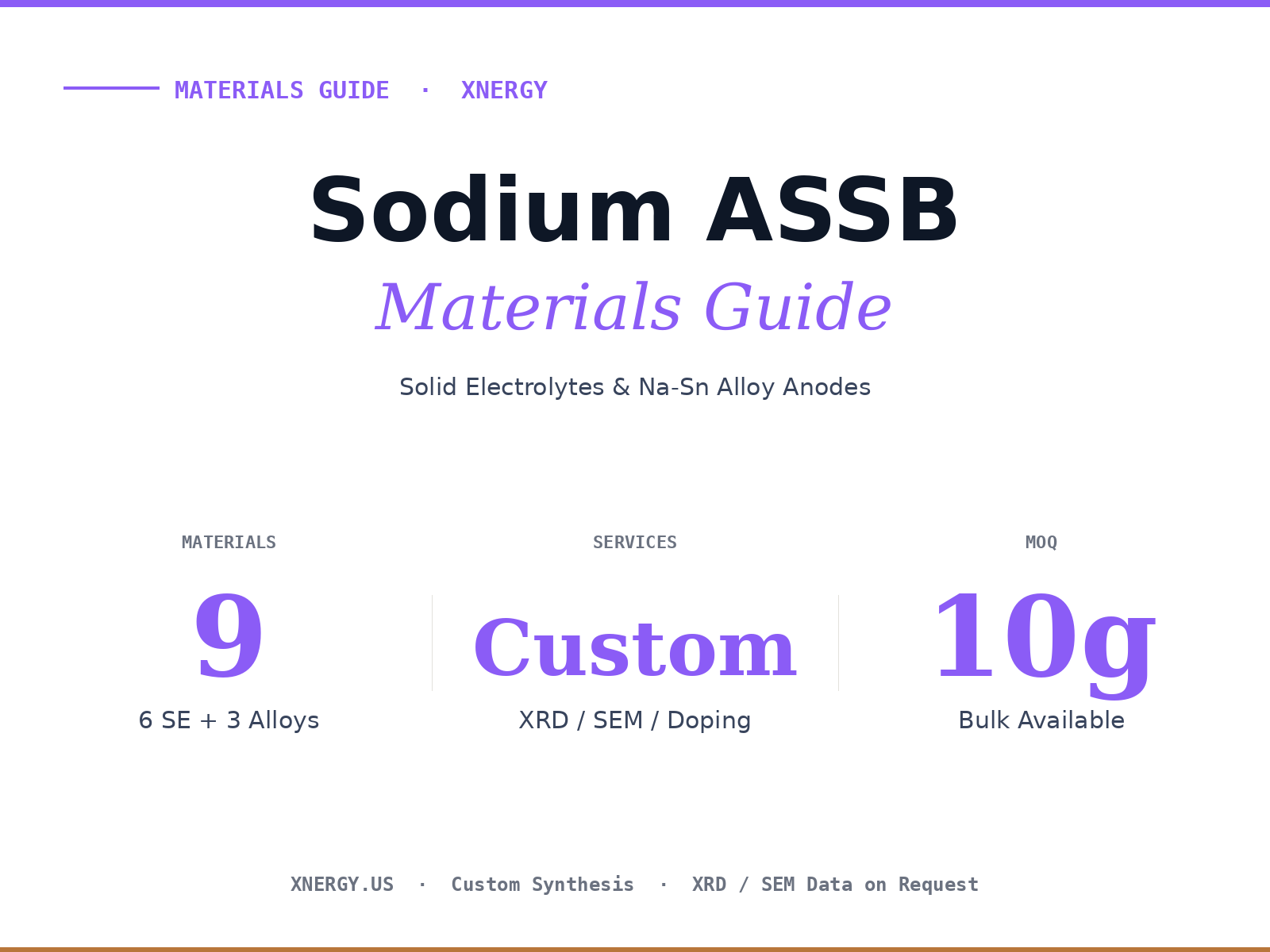
A sodium-ion all-solid-state battery (Na-ASSB) requires two carefully matched material layers: a solid electrolyte (sulfide for highest conductivity, NASICON or β″-Al2O3 for moisture stability) and a sodium anode (most often a Na/Na15Sn4 composite to stabilize the Na/SE interface). Choosing one without considering the other is the #1 source of failed cell builds. Xnergy Materials — a direct supplier of sodium-ion battery materials — supplies six sodium-ion solid electrolytes and three Na-Sn alloy compositions, all in stock with 10 g MOQ, custom synthesis on request, and XRD/SEM/particle-size data available with bulk research orders.
The Na/SE Interface Problem: Why Material Pairing Matters
Sodium-ion all-solid-state batteries (Na-ASSBs) are one of the most active areas of post-lithium battery research in 2026, driven by sodium's natural abundance, low cost, and the maturity of sodium-ion liquid-electrolyte cells already entering commercial production. The promise of Na-ASSBs is clear — lower raw-material cost than Li-ASSBs, intrinsically safer chemistry, and the ability to use abundant earth-stable elements throughout the cell stack.
The reality is that most Na-ASSB cells fail at the same interface: the boundary between the metallic sodium anode and the solid electrolyte. This is not a synthesis problem or an electrolyte conductivity problem. It is an interface engineering problem, and it has three distinct failure modes:
(1) Poor wettability. Molten and solid Na metal does not wet most solid electrolytes well, leading to poor physical contact and high interfacial impedance from the moment the cell is assembled. The contact area is typically only 10–30% of the geometric cell area, even after stack pressure is applied.
(2) Pore formation during desodiation. Sluggish Na+ diffusion within bulk metallic sodium means that during discharge, sodium near the SE interface depletes faster than fresh sodium can replenish it. This creates voids at the interface, growing each cycle until the cell loses contact entirely. Critical current density is typically limited to ~1 mA/cm2 with pure Na anodes against most SEs.
(3) Dendrite penetration during plating. Even at modest current densities, sodium dendrites can nucleate at interface defects and propagate through grain boundaries in the SE, eventually short-circuiting the cell. Suppressing dendrite formation is one of the central challenges of solid-state Na battery research.
All three failure modes have been studied extensively in the literature, and they all point to the same conclusion: the Na anode and the SE must be designed together, not separately. This guide is structured around that principle.
Why You Need Both a Solid Electrolyte and an Alloy Anode
The solid electrolyte alone cannot solve the Na/SE interface problem. Higher conductivity does not improve wettability. Wider electrochemical window does not suppress pore formation. Mechanical hardness alone does not prevent dendrites. The interface needs to be addressed from both sides: the SE side (choosing the right chemistry and microstructure) and the anode side (modifying the metallic sodium itself).
This is where Na-Sn alloy phases — especially Na15Sn4 — have become a central research direction. Adding Na15Sn4 phases into the bulk Na metal anode (typically as a 1–5 at% Sn composite) creates a sodiophilic 3D network that:
• Improves wettability against the SE surface;
• Increases Na+ diffusivity inside the anode layer (the alloy phase has higher Na+ mobility than bulk Na metal);
• Suppresses pore formation during desodiation by accelerating sodium replenishment from the bulk;
• Redistributes Na+ flux at the interface, enabling more uniform plating and dendrite-free cycling at higher current densities.
The rest of this guide walks through the materials available for both layers, then closes with a pairing matrix and three reference cell designs from the published literature.
Solid Electrolytes for Sodium-Ion ASSB
Xnergy Materials — a direct supplier of sodium-ion battery materials — supplies six sodium-ion solid electrolytes spanning two chemistry families. Sulfides deliver the highest room-temperature ionic conductivity but require glovebox handling. Oxides are moisture-stable and can be handled on a benchtop, at the cost of lower bulk conductivity.
Sulfide Solid Electrolytes (Na-ion)
The sulfide family is the workhorse of sodium-ion ASSB research. All four grades below are aqueous-incompatible and ship in argon-sealed packaging.
Na3PS4
The baseline sulfide composition for sodium-ion ASSBs. Tetragonal-phase Na3PS4 with moderate room-temperature conductivity. Most widely cited in the literature as the reference sulfide-Na SE.
NPSCl
Chloride-substituted sodium thiophosphate. Partial Cl on S sites creates a defect structure with significantly enhanced Na+ mobility. A go-to grade for high-rate Na-ASSB research.
W-Doped NPS
Tungsten-substituted variant where partial W on P sites creates additional Na+ vacancies, raising ionic conductivity roughly 5× over baseline Na3PS4. Used in research targeting the upper limits of sulfide-Na ionic conductivity for fast-charge and high-power Na-ASSB cells.
Oxide Solid Electrolytes (Na-ion)
The oxide family trades raw conductivity for handling robustness. Both grades below are stable in ambient air and suitable for benchtop research workflows.
MgO-doped β″-Al2O3
The classical sodium-ion ceramic electrolyte, used for decades in high-temperature Na-S batteries. The MgO-stabilized form has improved phase stability and processing compatibility for room-temperature solid-state research.
NASICON NZSPO
The most actively developed oxide electrolyte for room-temperature Na-ASSB. NASICON-type structure offers a 3D Na+ conduction network with good chemical stability against Na metal — one of the strongest cases for benchtop Na-SSB research.
Custom Solid Electrolytes
For research programs requiring custom doping (F-substitution, W-substitution, Hf-substitution, multi-cation co-doping), specific particle-size distributions, or stoichiometry adjustments outside the standard catalog, custom synthesis is available on a per-project basis.
For a deeper comparison of these chemistry families against lithium-ion systems, see our companion guide on Sulfide vs Halide vs Oxide solid electrolytes.
Na-Sn Alloy Powders for Sodium Anode Engineering
Na-Sn alloy powders are a relatively recent addition to the commercial battery materials market — until 2023, most academic groups synthesized them in-house from Na metal and Sn powder via mechanical milling or thermal alloying. Xnergy is one of the few commercial suppliers of Na-Sn alloy powders for sodium battery research, offering three standard alloy compositions covering the full sodiation range. All grades are synthesized by proportional melt alloying from high-purity sodium and tin metals, achieving >99.9% purity, with custom particle-size targeting on request.
Na2Sn
Intermediate alloy phase appearing during partial sodiation of Sn anodes. Useful for studying multi-step alloying reaction mechanisms and as a reference phase for sodiation pathway research.
Na3Sn
Mid-sodiation alloy phase. Sits between the early-stage NaSn and fully sodiated Na15Sn4 phases, useful for cycling protocols that cap sodiation depth, and for studies of intermediate-phase stability.
Na15Sn4
The fully sodiated Na-Sn phase — and the most actively studied composition for anode interface engineering. Strong sodiophilic character and high Na+ diffusivity make Na15Sn4 the standard choice for Na/Na15Sn4 composite anode designs against solid electrolytes.
Custom Na:Sn ratios
For research programs requiring Na:Sn ratios outside the three standard compositions, or specific particle-size targets for slurry casting and pellet pressing, custom synthesis is available on a per-project basis.
Why Na15Sn4 is the most-studied composition
Among the three standard alloys, Na15Sn4 has received roughly 80% of the published research attention in the past five years. The reason is straightforward: it is the thermodynamically stable end-state of sodium-tin alloying, with the highest Na content (15:4 = 3.75 Na per Sn) and the most pronounced sodiophilic character. When dispersed as 1–5 at% Sn within a metallic Na matrix, Na15Sn4 creates a 3D interpenetrating network that sodium "wants" to fill, dramatically improving wetting against solid electrolytes and enabling stable operation at current densities up to 5 mA/cm2 — an order of magnitude above what pure Na anodes can sustain.
Material Pairing: Which SE Goes with Which Alloy
The two material families do not pair indiscriminately. Some combinations are well-supported by the published literature, others are less explored, and a few are known to be problematic. The matrix below summarizes the current state of the art:
| Solid Electrolyte | Na/Na15Sn4 Composite | Pure Na Metal | Best Application |
|---|---|---|---|
| Na3PS4 | Strongly recommended | Limited (low CCD) | All-solid-state Na-S; cold-pressed lab cells |
| NPSCl | Strongly recommended | Limited | High-rate ASSB; fast-charge research |
| W-doped NPS | Strongly recommended | Limited | Highest-conductivity / highest-rate Na-ASSB cells |
| NASICON NZSPO | Compatible (active research) | Demonstrated — lower CCD | Benchtop room-T Na-SSB |
| β″-Al2O3 | Compatible | Demonstrated (high-T) | High-temperature Na-S; Na-NiCl2 |
Reading the matrix: the four sulfide rows are the most synergistic combinations — sulfides and Na-Sn alloys both cold-press well and have well-matched electrochemical windows, and the alloy is essentially required to hit the rate capabilities the sulfides can theoretically support. NASICON and β″-alumina are more flexible — they can run with pure Na anodes (especially at elevated temperature for β″-alumina), but adding Na15Sn4 still meaningfully extends critical current density.
Three Reference Cell Stacks from the Literature
To make the pairing matrix concrete, the following three designs represent well-documented Na-ASSB architectures published in peer-reviewed work. Each combines materials from this guide and gives a sense of what is achievable today.
Design 1 — Sulfide all-solid-state Na-S battery
Stack: Na/Na15Sn4 composite anode · Na3PS4 separator · S-carbon composite cathode
Reported performance: Stable cycling at 0.5 mA/cm2, sub-100 °C operation, >500 cycles (Tatsumisago group, ScienceDirect 2022)
Key advantage: Cold-press fabrication, no sintering. Best fit for academic groups with limited furnace access.
Design 2 — Room-temperature NASICON Na-ASSB
Stack: Na/Na15Sn4 composite anode · NASICON NZSPO separator (sintered) · Na3V2(PO4)3 cathode
Reported performance: Critical current density up to 2.5 mA/cm2, 500+ cycles in symmetric cells (Oh et al., Adv. Energy Mater. 2021)
Key advantage: Moisture-stable electrolyte enables benchtop work. Higher upfront sintering cost but robust handling.
Design 3 — High-rate research cell with W-doped sulfide
Stack: Na/Na15Sn4 composite anode · W-doped NPS separator (also written W-doped Na3PS4) · layered oxide cathode (NaCrO2, NaNi1/3Mn1/3Co1/3O2)
Reported performance: Fast-charge protocols up to 2–3C; cycle life depends heavily on cathode interface engineering
Key advantage: Pushes the conductivity ceiling of sulfide Na-SEs. Best fit for groups studying rate capability limits.
Characterization & Custom Synthesis Services
Sodium-ion solid electrolyte and Na-Sn alloy quality is highly batch-dependent — particle-size distribution, crystallinity, and exact stoichiometry can vary lot-to-lot, and these variations affect cell performance more than typical-data sheets suggest. Xnergy is a research-grade supplier providing per-batch characterization and custom synthesis to support research customers who need verified materials rather than nominal specifications.
Standard characterization (available on request)
• XRD patterns — verifying phase purity and crystal structure for both SEs and alloys;
• SEM imaging — particle morphology and any agglomeration;
• Particle-size statistics — D10, D50, D90 distributions from laser diffraction;
• EIS data (for solid electrolytes) — pressed-pellet ionic conductivity at specified temperature.
Custom synthesis (per-project)
• Custom particle-size targets — sub-micron, micron-scale, or specific D50/distribution windows;
• Anion-substituted variants — e.g., F-substitution, additional Cl-substitution beyond stock NPSCl;
• Cation-substituted variants — e.g., custom W loading, Hf substitution, multi-cation co-doping;
• Custom Na:Sn molar ratios — alloy stoichiometries outside the standard three;
• Long-term supply agreements and Material Transfer Agreements for sustained research programs.
Building a sodium-ion all-solid-state battery?
Xnergy supplies six sodium-ion solid electrolytes and three Na-Sn alloy compositions, with bulk pricing for larger research orders, custom synthesis on request, and per-batch characterization data available with bulk shipments.
- Sulfide and oxide Na-ion electrolytes in stock
- Na2Sn / Na3Sn / Na15Sn4 alloys at >99.9% purity (melt alloyed)
- 10 g MOQ for both product families
- XRD, SEM, particle-size data on request
- Custom doping and stoichiometry available
- MTAs and joint development agreements welcomed
sales@xnergy.us · 1-530-433-0971
Research Applications Covered by These Materials
The two material families covered in this guide enable a wide range of sodium-ion solid-state battery research, from early-stage chemistry exploration to pilot-scale cell prototyping:
Frequently Asked Questions
What materials do I need to build a sodium-ion all-solid-state battery?
A sodium-ion all-solid-state battery (Na-ASSB) requires three core material layers: (1) a solid electrolyte separator — typically a sulfide (Na3PS4, NPSCl, W-doped variants) for highest conductivity, NASICON (NZSPO) for moisture stability, or β″-Al2O3 for high-temperature applications; (2) an anode — either pure Na metal, or more commonly a Na/Na-Sn alloy composite to stabilize the Na/SE interface; and (3) a cathode active material with appropriate binder. The choice of solid electrolyte and anode are tightly coupled because the Na/SE interface is where most cell failures originate.
Why use Na-Sn alloy with sodium metal anodes?
Pure Na metal anodes suffer from poor wettability against solid electrolytes, sluggish Na+ diffusion within the bulk metal, and dendrite formation during cycling. Adding Na-Sn alloy phases (especially Na15Sn4) into the Na metal matrix creates a sodiophilic 3D network that improves wettability, increases Na+ diffusivity, suppresses pore formation at the anode/SE interface, and helps redistribute Na+ flux to enable dendrite-free plating. This has been demonstrated in published work to extend cycle life by 5–10× compared with pure Na metal anodes.
Where can I buy Na-Sn alloy powder for sodium battery research?
Xnergy Materials supplies Na-Sn alloy powders in three stoichiometries — Na2Sn, Na3Sn, and Na15Sn4 — at >99.9% purity, synthesized by proportional melt alloying from high-purity sodium and tin metals, with 10 g minimum order quantity. Custom particle sizes are available, and characterization data (XRD, SEM, particle-size statistics) can be provided on request. Pricing is quote-based with bulk discounts for larger research batches. Commercial supply of Na-Sn alloy powders is rare — most academic groups synthesize them in-house — so contact sales@xnergy.us with your application and quantity for a quote.
Which solid electrolyte is best for sodium-ion ASSB?
There is no single best choice — the answer depends on which research priority is most important. For highest room-temperature ionic conductivity, sulfide electrolytes (Na3PS4 and W-doped variants) deliver up to 1–10 mS/cm but require glovebox handling. For moisture-stable benchtop research, NASICON-type oxides (NZSPO) and β″-Al2O3 are easier to handle but have lower conductivity. For all-solid-state Na-S batteries specifically, sulfide electrolytes are typically preferred for their compatibility with sulfur-based cathodes.
What is the difference between Na3PS4 and NPSCl?
Both are sulfide solid electrolytes for sodium-ion batteries. Na3PS4 is the baseline composition — a tetragonal sulfide with room-temperature conductivity around 0.1–0.5 mS/cm. NPSCl (Na2.9PS3.9Cl0.1) is a chloride-substituted variant where partial Cl substitution on the S sites creates additional Na+ vacancies, raising ionic conductivity to ~1 mS/cm or higher. For most applications requiring better rate capability, NPSCl is preferred. W-doped Na3PS4 (Na3.1P0.9W0.1S4) achieves similar conductivity gains via cation doping.
Which Na-Sn alloy stoichiometry should I use?
The choice depends on the role of the alloy in your cell design. Na15Sn4 is the fully sodiated phase and is the most common choice for anode interface engineering — it has the highest Na content (15:4 molar ratio) and the strongest sodiophilic character, making it ideal for Na/Na15Sn4 composite anodes against solid electrolytes. Na3Sn and Na2Sn are intermediate alloy phases that appear during sodiation/desodiation cycling and are useful for studying alloy-anode reaction mechanisms or for specific anode-architecture experiments. For a first-time evaluation as an anode interlayer, start with Na15Sn4.
Can Na-Sn alloy be used in all-solid-state Na-S batteries?
Yes. Na-Sn alloy anodes (typically Na15Sn4 composites with metallic Na) have been demonstrated in all-solid-state Na-S batteries paired with sulfide solid electrolytes such as Na3PS4 and NPSCl. The alloy improves Na/SE interface stability, suppresses sodium penetration into the electrolyte, and enables higher critical current densities than pure Na anodes. Recent literature has shown stable cycling for 500+ hours at 2.5 mA/cm2 using Na/Na15Sn4 composite anodes with Na3PS4-type electrolytes.
What is the minimum order quantity for these materials?
The minimum order quantity is 10 grams for both solid electrolytes and Na-Sn alloy powders. Standard pack sizes scale up to 500 g, with custom batch sizes (1–10 kg) available for pilot-scale research. Bulk pricing is offered for larger research batches and recurring orders. Both product families are quote-based — contact sales@xnergy.us with your application, target quantity, and any custom particle-size or composition requirements.
Do you provide characterization data with your materials?
Yes. Xnergy provides XRD patterns, SEM images, and particle-size distribution statistics for both solid electrolytes and Na-Sn alloy powders on request. Characterization data is included with bulk-research orders by default and can be provided as separate technical reports. For research customers requiring batch-specific data (rather than typical-data sheets), per-lot characterization is available on a per-project basis.
Do you offer custom synthesis or doped variants?
Yes. Xnergy supports custom synthesis for both solid electrolytes and Na-Sn alloy powders. For solid electrolytes, this includes custom particle-size distributions, anion or cation doping (e.g., F-substitution, W-substitution, Hf-substitution), and stoichiometry adjustments. For Na-Sn alloys, this includes custom Na:Sn molar ratios outside the standard three compositions and custom particle-size targets. We welcome long-term supply agreements, joint development collaborations, and Material Transfer Agreements with academic and industrial partners.
Selected Literature on Sodium ASSBs & Na-Sn Alloy Anodes
The technical claims in this guide are supported by published research on sodium-ion solid-state batteries and sodium-tin alloy anode chemistry:
- Oh, J. et al. (2021). A Robust Solid–Solid Interface Using Sodium–Tin Alloy Modified Metallic Sodium Anode Paving Way for All-Solid-State Battery. Advanced Energy Materials. — The foundational study showing Na/Na15Sn4 composite anode reaches 2.5 mA/cm2 CCD with NASICON SE.
- Xie, Y. et al. One-Step Synthesis of Na–Sn Alloy with Internal 3D Na15Sn4 Support for Fast and Stable Na Metal Batteries. ACS Applied Energy Materials. — Demonstrates 5 mA/cm2 stable cycling and 90% retention at 300 cycles with Na15Sn4-supported anodes.
- Wang, Y. et al. Synergistic Manipulation of Na+ Flux and Surface-Preferred Effect Enabling High-Areal-Capacity and Dendrite-Free Sodium Metal Battery. — Mechanistic study of how Na15Sn4 regulates Na deposition and suppresses dendrites.
- All-solid-state Na-S battery research with Na-Sn alloys. ScienceDirect 2022. — Documents stable cycling of all-solid-state Na-S batteries using Na-Sn alloy anodes with sulfide SE at low operating temperatures.
- Recent advances in alloying anode materials for sodium-ion batteries. Energy Materials, 2024. — Review of Sn-based and other alloying anodes for SIBs, including Na15Sn4 phase chemistry and capacity-volume change trade-offs.
- Hayashi, A. et al. — Series of foundational papers on Na3PS4 sulfide solid electrolytes and W-doped variants. Available via standard battery materials literature databases.
Other Materials for Sodium Battery Research at Xnergy
Building a complete Na-ASSB also requires cathode materials, binders, and current collectors. The materials below complement the SEs and Na-Sn alloys discussed in this guide:
Sodium Metal & Foil
Pure metallic Na for anode preparation, including thin Na foils and sheets. A dedicated buyer's guide for Na metal anodes is forthcoming.
SEM Transfer Chambers for Air-Sensitive Battery Materials
Aqueous SBR binders for hard-carbon Na-ion anodes (liquid-electrolyte cells). Useful reference for non-solid-state Na-ion work.
Sulfide vs Halide vs Oxide
A practical comparison of three solid electrolyte chemistry families — covering both Li-ion and Na-ion variants of each.
All Solid Electrolytes
Complete Xnergy solid-state electrolyte catalog covering Li-ion (sulfides, halides, oxychlorides, oxides) and Na-ion (sulfides and oxides).
Source both layers from one supplier
Xnergy Materials is a direct supplier of the full sodium ASSB material stack, with — six solid electrolytes and three Na-Sn alloy compositions — with 10 g MOQ on all grades, custom synthesis on request, and per-batch characterization data available with bulk research orders. Whether you are running a coin-cell evaluation, a multi-month NASICON Na-ASSB program, or building cold-pressed Na-S battery prototypes, our team can support your sourcing roadmap.