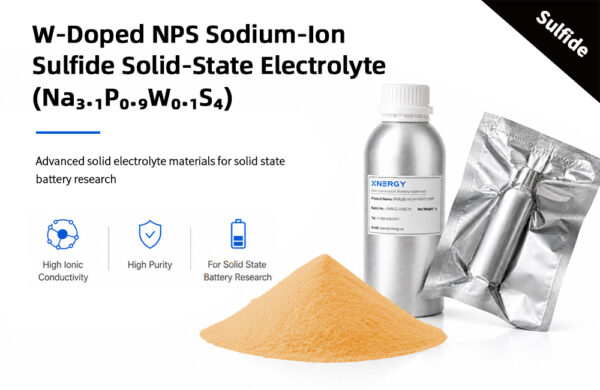
W-Doped NPS Sodium-Ion Sulfide Solid-State Electrolyte (Na₃.₁P₀.₉W₀.₁S₄)
SKU: XN-WNPS
W-Doped NPS Sodium-Ion Sulfide Solid-State Electrolyte (Na₃.₁P₀.₉W₀.₁S₄) — tungsten-doped Na₃PS₄ framework with class-leading sodium-ion conductivity. 4.1 ± 0.5 mS/cm at 25 °C — over 25× higher than Cl-doped NPSCl. Average particle size ~1 μm. Engineered for high-performance all-solid-state sodium-ion battery research and grid storage applications.
Need a bulk order? Request a competitive quote today!
Name: W-Doped NPS Sodium-Ion Sulfide Solid-State Electrolyte (Na₃.₁P₀.₉W₀.₁S₄)
Material Form: Yellow powder
Product Code: XN-WNPS
Description:
W-Doped NPS (Na₃.₁P₀.₉W₀.₁S₄) is a high-conductivity tungsten-doped sodium-ion sulfide solid-state electrolyte derived from the Na₃PS₄ framework. The substitution of W⁶⁺ at the P-site introduces aliovalent doping that creates additional Na⁺ vacancies, dramatically enhancing room-temperature ionic conductivity to 4.1 ± 0.5 mS/cm — among the highest reported for any sodium-ion solid electrolyte. As a result, this material is a leading candidate for all-solid-state sodium-ion batteries (Na-ASSBs) targeting low-cost, large-scale grid energy storage applications.
Application:
This material serves as a high-conductivity sodium-ion solid electrolyte for all-solid-state sodium-ion batteries (Na-ASSBs), Na-S battery research, low-cost grid storage prototypes, and academic studies of fast Na⁺ ion transport in sulfide systems. Furthermore, it can be paired with sulfide or oxide cathodes in composite electrode formulations.
Specifications:
| Property | Value |
|---|---|
| Product Type | Sodium-Ion Sulfide Solid Electrolyte |
| Chemical Formula | Na₃.₁P₀.₉W₀.₁S₄ |
| Ionic Conductivity | 4.1 ± 0.5 mS/cm @ 25 °C |
| Average Particle Size | ~1 μm |
| Crystal Structure | Cubic Na₃PS₄-type framework with W-doping |
| Appearance | Yellow powder |
| Storage | Inert atmosphere (Ar / N₂), sealed, moisture-excluded |
Values measured by Xnergy. Typical values for reference; not guaranteed unless otherwise specified.
Performance Data — XRD & EIS:
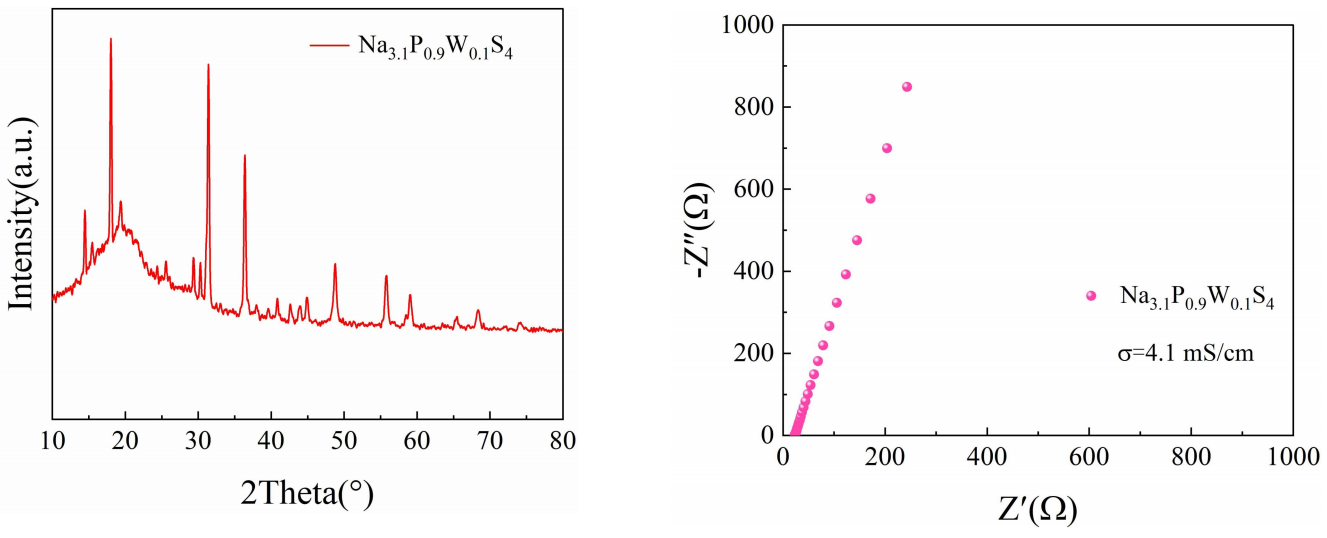
Left: XRD pattern of Na₃.₁P₀.₉W₀.₁S₄ confirming the cubic Na₃PS₄-type crystal structure. Right: EIS Nyquist plot at 25 °C showing low bulk resistance and σ = 4.1 mS/cm ionic conductivity.
Morphology & Particle Size Distribution:
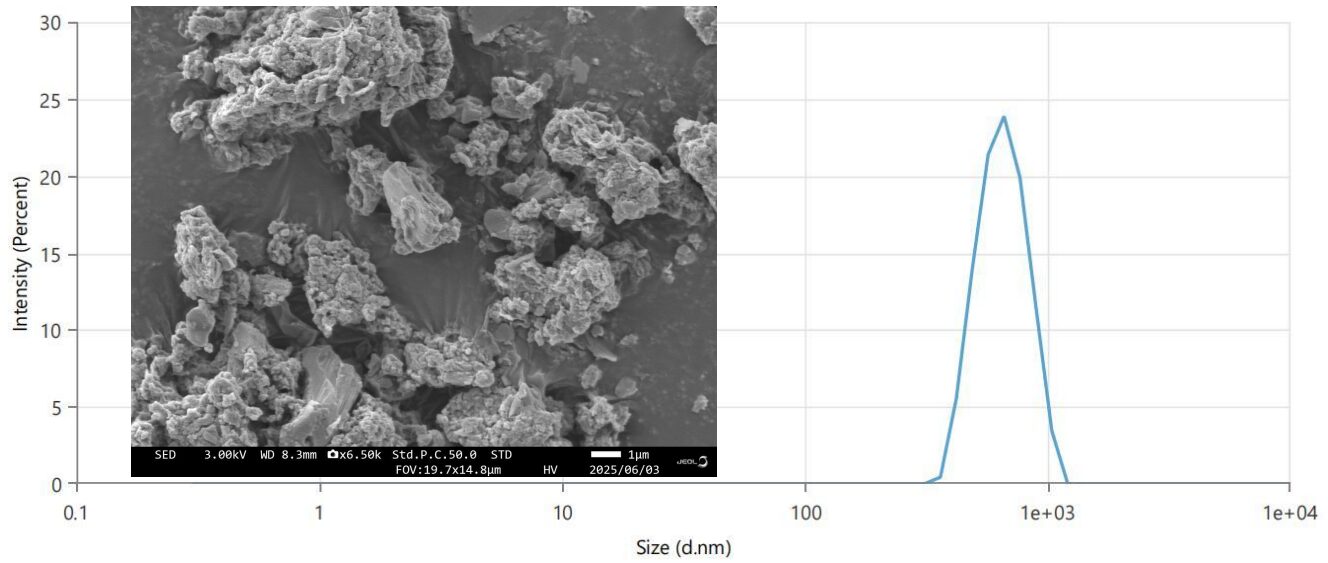
Left: SEM image showing the micron-scale particle morphology of W-doped NPS powder. Right: Particle size distribution centered around ~1 μm.
Characteristics:
Class-leading sodium-ion conductivity (4.1 mS/cm)
At 4.1 ± 0.5 mS/cm at 25 °C, this material delivers among the highest room-temperature ionic conductivities ever reported for sodium-ion solid electrolytes. Moreover, it surpasses Cl-doped NPSCl by an order of magnitude, approaching the performance of leading lithium sulfide electrolytes.
W-doping creates Na⁺ vacancies for fast transport
Substituting W⁶⁺ at the P⁵⁺ site is aliovalent doping that demands charge compensation through additional Na⁺ in the lattice. As a result, the conduction pathway is densified and Na⁺ mobility increases dramatically.
Cubic Na₃PS₄-type framework
X-ray diffraction confirms the target cubic Na₃PS₄ framework with W-substitution. Consequently, the material delivers reproducible electrochemical performance and predictable behavior across cell architectures.
Optimized 1 μm particle size
Average particle size of ~1 μm balances bulk conductivity with composite electrode processability. Therefore, customers achieve good cathode interface contact while maintaining high pellet density in cell assembly.
Low-cost sodium chemistry for grid storage
Sodium-based electrolytes leverage abundant raw materials (Na vs Li). Therefore, W-Doped NPS is well-suited for cost-sensitive, large-scale stationary storage applications where Li-ion economics are unfavorable.
Packaging & Storage:
The material ships vacuum-sealed under inert atmosphere in moisture-barrier aluminum-laminated bags. Therefore, customers should store sealed in an Ar or N₂ glovebox, protected from moisture. Because W-Doped NPS is moisture-sensitive — sulfide electrolytes hydrolyze on contact with water to release H₂S — handle exclusively in a controlled dry environment with dew point < –40 °C. Reseal promptly after opening.
Safety:
For research and industrial use only. Hydrolysis of sulfide electrolytes releases hydrogen sulfide (H₂S), a toxic gas. Handle exclusively in a glovebox or well-ventilated dry environment. Wear full PPE (chemical-resistant gloves, lab coat, safety goggles, respirator if outside glovebox). Refer to SDS for complete safety information.
Note: Values listed above are typical and for reference only. Performance may vary depending on cell architecture, cathode selection, and test protocol. Compare with our other sodium-ion solid electrolytes: NPSCl (Na₂.₉PS₃.₉Cl₀.₁) at 0.15 mS/cm, Na₃PS₄ Sodium-Ion Sulfide Electrolyte, MgO-Doped β″-Al₂O₃, and NASICON NZSPO.