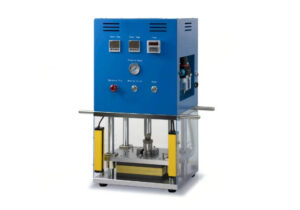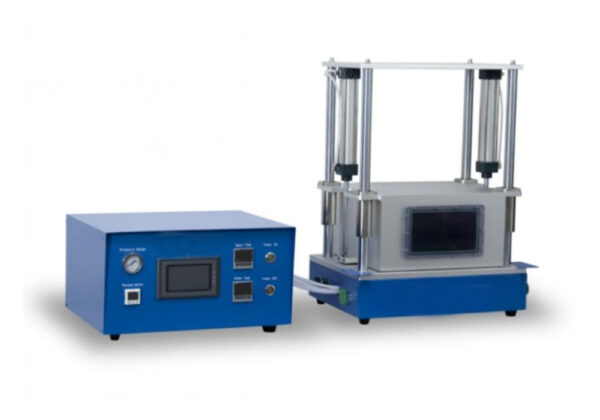
Split-Type Secondary Sealing Machine XN-FVHS-200-F
Need a bulk order? Request a competitive quote today!
Pouch Cell Vacuum Final Sealing Machine
I. Product Introduction
This equipment is mainly used for the puncture-assisted process and secondary vacuum final sealing of pouch lithium batteries.
It adopts a split-type structure, allowing the main working unit to operate inside a glove box or on a production line, while the control box remains outside for convenient operation. The system features PLC touchscreen control, providing automated operation and precise process control.
II. Main Features
-
High-efficiency sealing head
The sealing head is made of copper, offering excellent thermal conductivity, reduced power consumption, and improved energy efficiency. -
Adjustable sealing pressure
The pressure of the upper and lower sealing heads can be adjusted through a pressure regulating valve to meet different process requirements. -
Precise sealing alignment
The sealing heads are driven by cylinders and guided by dual linear guide sleeves, ensuring smooth vertical movement and accurate sealing parallelism. -
Observation window design
A viewing window allows the internal chamber condition to be monitored during operation. -
Stable chamber sealing structure
The chamber lid is driven by a cylinder and guided by a rotating guide sleeve, ensuring flexible movement and reliable sealing performance. -
Automatic puncture function
The system is equipped with an automatic puncture mechanism for pouch cell processing. -
Split-type system design
The main machine and control box are separated, allowing flexible installation for glove box operation or production line integration. -
PLC touchscreen control
Fully automated operation with user-friendly control interface.
III. Technical Parameters
| Parameter | Specification |
|---|---|
| Control system | PLC touchscreen automatic control |
| Chamber material | Aluminum alloy |
| Vacuum degree | ≥ -95 kPa (vacuum pump provided by the buyer) |
| Sealing head temperature | Room temperature – 250 ℃ (adjustable) |
| Temperature control accuracy | ±2 ℃ |
| Heat sealing pressure | 0 – 7 kg/cm² adjustable |
| Heat sealing time | 0 – 999 s adjustable |
| Sealing width | 3 – 15 mm (customizable) |
| Maximum effective sealing length | 190 mm |
| Sealing blade length | 200 mm |
| Sealing thickness range | 60 – 500 μm |
| Sealing thickness accuracy | Thickness difference after sealing < 15 μm |
| Air consumption | Approx. 0.2 L per sealing cycle |
| Power | 1 kW |
| Power supply | AC 110V / 220V ±10% 50 Hz |
| Compressed air pressure | 0.5 – 0.8 MPa |
Note:
When used inside a glove box, the cylinder power source must use the same working gas as the glove box environment.
IV. Equipment Dimensions
| Component | Dimensions |
|---|---|
| Working unit | 510 × 360 × 650 mm |
| Control box | 420 × 325 × 225 mm |
| Equipment weight | Approx. 80 kg |
V. Battery Size Limitation
| Parameter | Specification |
|---|---|
| Maximum battery size | As shown in the reference figure |
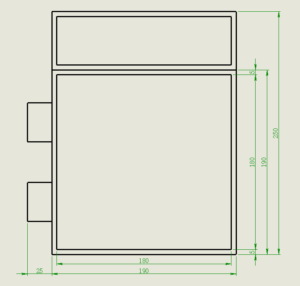
IV. Main Electrical & Standard Component Brands
| Component | Brand |
|---|---|
| Touchscreen | Samkoon |
| Temperature controller | Autonics (Korea) |
| Vacuum pressure electronic gauge | Panasonic |
| Intermediate relay | IDEC (Japan) |
| Solid state relay | Fotek (Taiwan) |
| Switch button | IDEC (Japan) |
| Power supply | Mean Well (Taiwan) |
| AC contactor | CHINT |
| Circuit breaker | CHINT |
| Cylinder | Airtac |
| Solenoid valve | Airtac |
| Pneumatic fittings | Airtac |
| Heating tube | Linzhi |
V. Maintenance Methods and Precautions
Maintenance Methods
-
Regularly clean the upper and lower plates, vacuum chamber, upper and lower sealing blades, and material placing plate to keep the equipment clean.
-
Lubricate the moving parts of the ball guide column and guide sleeve periodically to ensure smooth operation.
-
Regularly inspect screws, nuts, pins, and other fasteners to prevent loosening and avoid equipment failure.
Safety Precautions
-
During operation, it is strictly prohibited to place hands or any part of the body inside the vacuum chamber, the moving parts of the ball guide column and guide sleeve, or other hazardous areas.
-
Only one operator should operate the equipment at a time to prevent accidental injury.
-
Unauthorized or non-technical personnel are not allowed to disassemble or adjust the equipment.