
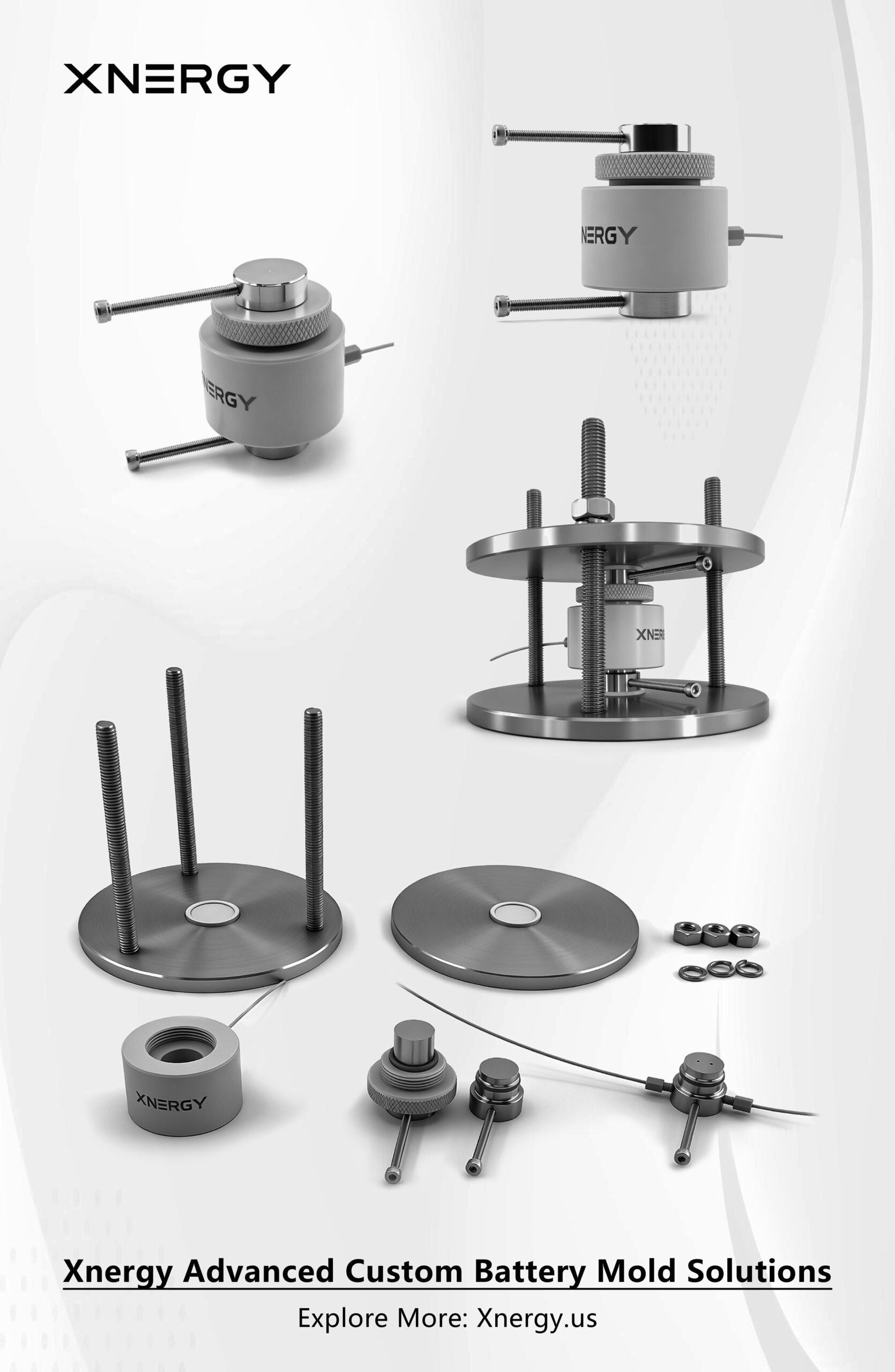

A solid-state battery mold plays an essential role in advanced battery research. Researchers use it to assemble, align, and press battery components under controlled conditions. As a result, they can improve interfacial contact, stabilize cell structure, and achieve more reproducible test results.
As solid-state battery technology continues to develop, research teams now pay attention not only to material performance but also to assembly quality. Even high-performance materials can produce inconsistent results when poor contact, unstable pressure, or layer misalignment affects the cell structure. For this reason, choosing the right solid-state battery molds is critical for laboratory research.
In many cases, research teams also need compatible materials to support efficient testing. Therefore, it often makes sense to combine assembly tools with related solid-state electrolytes when building a complete solid-state battery research workflow.
What Is a Solid-State Battery Mold?
A solid-state battery mold is a precision assembly tool for preparing and testing solid-state battery cells. Researchers use it to press solid electrolyte pellets, assemble layered battery structures, and evaluate electrochemical performance under controlled pressure.
Unlike conventional liquid-electrolyte batteries, solid-state batteries depend on direct contact between solid components such as the cathode, solid electrolyte, and anode. Because no liquid phase fills interface gaps, researchers must maintain strong and uniform contact across the cell stack. A solid-state battery mold helps researchers solve this problem by applying pressure and holding the structure in place during assembly and testing.
In practice, researchers often use solid-state battery molds for:
- pressing solid electrolyte pellets
- assembling symmetric cells
- preparing full solid-state test cells
- maintaining pressure during cycling
- studying interface stability
- supporting glovebox-based assembly
Why Is a Solid-State Battery Mold Important?
A solid-state battery mold is important because interface quality directly affects battery performance. Even excellent materials may underperform when poor contact develops between layers. Small gaps, uneven pressure, or layer misalignment can quickly increase impedance and reduce reproducibility.
For this reason, researchers should treat a solid-state battery mold as an important part of the experimental setup rather than as a simple accessory.
How Solid-State Battery Molds Improve Interfacial Contact
A well-designed mold keeps the solid electrolyte and electrode layers in close contact. Therefore, it helps support stable ionic transport and improves the consistency of electrochemical testing.
How Solid-State Battery Molds Improve Reproducibility
Researchers need repeatable conditions when they compare materials, structures, or batches. A good mold creates more controlled assembly conditions, so teams can generate more reliable and comparable results.
How Solid-State Battery Molds Reduce Mechanical Failure
Uniform pressure helps researchers reduce the risk of pellet cracking, structural misalignment, and local stress concentration. As a result, the cell stack remains more stable during testing.
How Solid-State Battery Molds Simplify Lab Operation
A practical mold design also makes assembly and disassembly easier. This advantage becomes even more important when researchers run repeated tests inside a glovebox.
How Does a Solid-State Battery Mold Work?
A solid-state battery mold works by fixing battery components in a defined geometry and allowing researchers to apply external pressure during assembly or testing. Although mold designs vary, most models include a mold body, punches, spacers, and conductive or insulating components depending on the application.
A typical workflow includes the following steps:
Step 1: Prepare the Materials
First, researchers prepare the solid electrolyte powder or pellet, cathode composite, anode material, and current collectors.
Step 2: Load the Cell Stack
Next, researchers place the components in sequence inside the mold cavity according to the target cell design.
Step 3: Apply Pressure
Then, researchers apply pressure manually or mechanically to improve contact between layers and stabilize the stack.
Step 4: Assemble or Test the Cell
Finally, researchers use the prepared cell for conductivity measurement, electrochemical testing, or interface analysis.
Researchers widely use this method in studies involving oxide, sulfide, and halide electrolytes, as well as lithium metal and composite cathodes. In addition, many teams combine these tools with solid-state electrolytes to support a more complete research setup.
Common Types of Solid-State Battery Molds
Different experiments require different mold designs. Therefore, researchers should choose a mold based on whether they need pellet pressing, pressure-controlled testing, or full cell assembly.
Solid Electrolyte Pressing Molds
Researchers use these molds to press powders into dense pellets for conductivity testing or structural evaluation.
Coin Cell-Type Molds
These molds support compact lab-scale assembly and routine electrochemical testing.
Split Molds
Split molds open more easily and simplify cleaning. For this reason, they work well for fragile pellets and glovebox operation.
High-Pressure Molds
Researchers choose these molds when experiments require stronger and more stable stack pressure.
Custom Molds
Custom molds help researchers handle specialized cell geometries, unusual dimensions, or research setups that standard molds cannot support.
Researchers who want to compare more options can browse Xnergy’s solid-state battery molds to find a more suitable configuration for their experiments.
Recommended Solid-State Battery Mold Options
For researchers looking for practical laboratory solutions, Xnergy offers representative products such as GT01-TC and GT03.
The GT01-TC is a ceramic solid-state battery assembly mold for laboratory research. Researchers can use it for controlled assembly and repeatable testing in solid-state battery studies.
The GT03 is a high-pressure solid-state battery assembly mold. Therefore, it is a better fit for experiments that require stronger pressure control and more stable stack conditions.
These options give battery labs a practical starting point for solid-state cell development, interface evaluation, and pressure-dependent performance studies.
How to Choose the Right Solid-State Battery Mold
Researchers should evaluate several factors before selecting a solid-state battery mold.
Cell Format
First, the mold should match the intended cell design, whether the team plans to build a pellet cell, symmetric cell, full solid-state cell, or custom multilayer structure.
Pressure Requirement
Next, researchers should consider the pressure requirement of the target battery system. Some solid-state battery systems require higher stack pressure to maintain stable contact.
Sample Dimensions
Researchers should also confirm that pellet diameter, layer thickness, and electrode size match the mold design.
Ease of Operation
In addition, labs that run repeated experiments need a mold that simplifies assembly, disassembly, and cleaning.
Customization Needs
Finally, if standard dimensions do not fit the experiment, a custom mold may be the better choice.
Applications in Solid-State Battery Research
Researchers use solid-state battery molds in many areas of battery research, including:
- ceramic electrolyte pellet pressing
- lithium | solid electrolyte | lithium symmetric cells
- full all-solid-state battery assembly
- interface resistance studies
- pressure effect evaluation
- composite cathode testing
- custom cell structure development
For many labs, the mold does more than support assembly. It also influences the quality, stability, and repeatability of the final data.
Supporting Materials for Better Research Efficiency
In many cases, researchers need more than just a mold. For example, solid-state battery development often requires a combination of tools, electrolytes, lithium materials, and compatible components.
That is why many teams prefer to source both solid-state battery molds and solid-state electrolytes from the same supplier. This approach can simplify procurement, improve compatibility, and make research workflows more efficient.
Frequently Asked Questions About Solid-State Battery Molds
What is a solid-state battery mold used for?
Researchers use a solid-state battery mold to press, align, and assemble solid-state battery components under controlled pressure for laboratory testing and research.
Why is pressure important in solid-state battery assembly?
Pressure improves contact between solid layers, reduces interfacial resistance, and helps researchers obtain more reproducible electrochemical results.
How do I choose the right solid-state battery mold?
You should choose the right mold based on cell format, pressure requirement, sample dimensions, ease of operation, and whether your experiment requires customization.
Can a solid-state battery mold be customized?
Yes. Researchers often request custom molds for special pellet diameters, unique cell structures, higher pressure requirements, or glovebox-compatible workflows.
Final Thoughts
A solid-state battery mold plays a vital role in modern battery research. It directly affects cell assembly quality, interfacial stability, and test reproducibility. As solid-state battery research continues to advance, reliable and well-designed molds will become even more important for generating meaningful and publishable results.
If your lab is looking for practical solutions for solid-state cell assembly, you can explore Xnergy’s solid-state battery molds, review GT01-TC and GT03, or contact us for customization support.