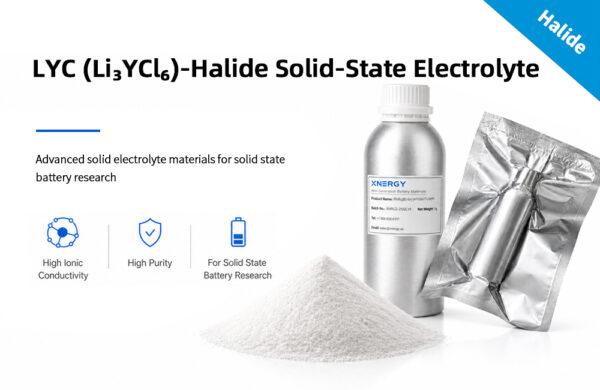
LYC (Li₃YCl₆)-Halide Solid-State Electrolyte
SKU: XN-LYC
LYC Halide Solid-State Electrolyte (Li₃YCl₆) — classic chloride-based halide electrolyte with 0.3–0.4 mS/cm ionic conductivity at 28 °C. Stable against 4 V-class cathodes (LCO, Ni83) without coatings. Validated in full all-solid-state cells delivering ~150 mAh/g (LCO) and ~190 mAh/g (Ni83). Most extensively studied halide electrolyte in literature.
Need a bulk order? Request a competitive quote today!
Name: LYC Halide Solid-State Electrolyte (Li₃YCl₆)
Material Form: Crystalline powder
Product Code: XN-LYC
Description:
LYC (Li₃YCl₆) is a classic chloride-based halide solid-state electrolyte for all-solid-state lithium batteries (ASSLBs). As the first reported high-voltage-stable halide electrolyte system, Li₃YCl₆ delivers 0.3–0.4 mS/cm room-temperature ionic conductivity and intrinsic stability against 4 V-class cathodes — eliminating the need for cathode interface coatings required by sulfide electrolyte systems. LYC remains the most extensively studied halide electrolyte in academic literature, providing a well-characterized benchmark for ASSLB research.
Application:
Catholyte for all-solid-state lithium batteries. Suitable for sulfide-halide composite electrolyte architectures (paired with LPSC or LGPS as anode-side separator), high-voltage cathodes (LCO, NCM/Ni83), solid-state pouch cell prototyping, and halide electrolyte fundamental studies.
Specifications:
| Property | Value |
|---|---|
| Composition | Li₃YCl₆ |
| Ionic Conductivity | 0.3–0.4 mS/cm @ 28 °C |
| Crystal Structure | Li₃YCl₆ phase confirmed by XRD (JCPDS 44-0288) |
| Electrochemical Window | Stable vs 4 V-class cathodes |
| Form | Crystalline powder |
| Storage | Inert atmosphere (Ar / N₂), sealed, moisture-excluded |
Values measured by Xnergy. Typical values for reference; not guaranteed unless otherwise specified.
Characteristics:
High-voltage cathode compatibility
Halide chemistry is intrinsically stable against 4 V-class cathodes (LCO, Ni83). No LiNbO₃ or other interface coatings required, simplifying cell architecture and reducing cathode interface resistance.
Well-characterized academic benchmark
Li₃YCl₆ is the most extensively studied halide solid electrolyte in scientific literature, providing a reliable reference material for ASSLB research, cell architecture studies, and comparative electrochemistry.
Validated in full ASSLB cells
LCO|LYC|LPSC|Li-In: ~150 mAh/g, 97.24% coulombic efficiency. Ni83|LYC|LPSC|Li-In: ~190 mAh/g, 88.64% coulombic efficiency. Both at 7 mg/cm² loading, 28 °C.
Crystalline phase verified
X-ray diffraction confirms target Li₃YCl₆ structure matching reference pattern (JCPDS 44-0288), free of significant secondary phases. LiCl reference (JCPDS 74-1972) included for comparison.
Performance Data:
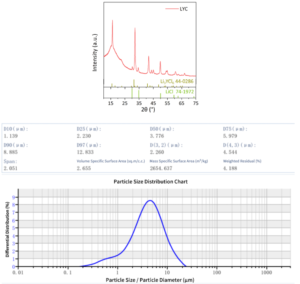
Packaging & Storage:
Vacuum-sealed under inert atmosphere in moisture-barrier aluminum-laminated bags. Store sealed in Ar or N₂ glovebox. LYC is moisture-sensitive — handle in dry environment with dew point < –40 °C. Reseal promptly after opening.
Safety:
For research and industrial use only. Wear PPE (gloves, masks, safety goggles). Refer to SDS for complete safety information.
Note: Values listed above are typical and for reference only. Performance may vary depending on cell architecture, cathode selection, electrolyte separator, and test protocol. Compare with our other halide electrolytes: LZC (Li₂ZrCl₆) at 0.3 mS/cm, Al-Doped LZC at 0.7 mS/cm, and LZCO (Li₂ZrOCl₄) at 1.55 mS/cm.