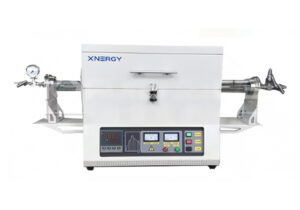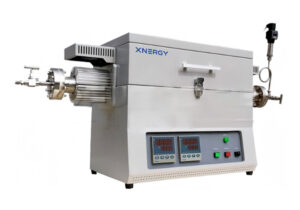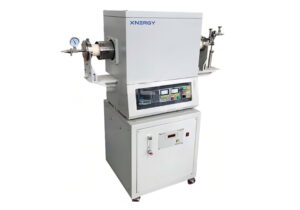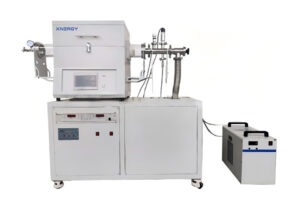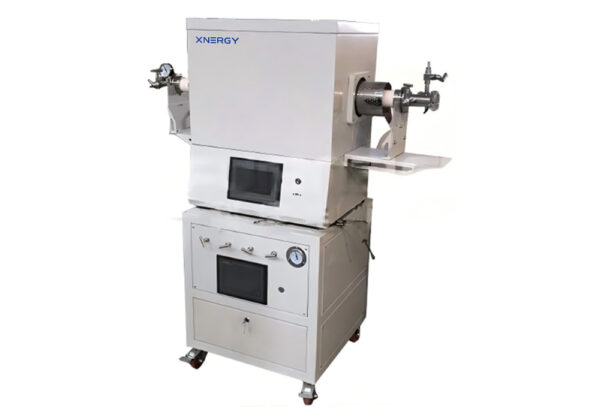
Touch Screen CVD Tube Furnace XN-T1600
SKU: XN-T1600
Touch Screen CVD Tube Furnace XN-T1600 — high-temperature tube furnace configured for chemical vapor deposition (CVD) and diffusion experiments. Max 1600 °C (short time) / ≤1500 °C continuous, ±1 °C accuracy, suggested 0–10 °C/min heating rate, 30-step PID via SCR power control, MoSi₂ heaters, B-type thermocouple, alumina tube OD 80 × L 1000 mm, 300 mm temperature zone. Equipped with 3-channel mass flow meters (MFC 1: 0–100 sccm; MFC 2 & 3: 0–200 sccm each) and gas mixing tank with 3 stainless steel needle valves for manual mixing of up to 3 gases. LCD touch screen, stainless steel vacuum flanges with valves.
Need a bulk order or custom specification? Request a competitive quote today!
Name: Touch Screen CVD Tube Furnace XN-T1600
Equipment Type: Laboratory 1600 °C CVD Tube Furnace with LCD Touch Screen, MoSi₂ Heating & 3-Channel Mass Flow Meter Gas Mixing System
Product Code: XN-T1600 CVD
Product Introduction:
The Touch Screen CVD Tube Furnace XN-T1600 is a high-temperature tube furnace equipped with an 80 mm-diameter alumina tube and a three-channel mass flow meter (MFC) gas flowing system. As a result, the XN-T1600 CVD can mix 1–3 types of gases for chemical vapor deposition (CVD) or diffusion experiments, making it a versatile platform for university, research institute, and industrial R&D environments working with multi-gas thin-film deposition and high-temperature diffusion processes.
Main Features:
- High-temperature CVD operation — maximum 1600 °C (short time); continuous working temperature ≤ 1500 °C
- MoSi₂ heating elements — durable molybdenum disilicide heaters for stable high-temperature operation
- B-type thermocouple with ±1 °C accuracy — high-temperature compatible sensor for precise temperature measurement
- Alumina furnace tube — OD 80 × L 1000 mm (customizable); high purity, high-temperature compatibility
- 300 mm temperature zone — uniform heating region for samples
- LCD touch-screen PID control — 30-step programmable via SCR power control with self-tuning
- 3-channel mass flow meter (MFC) gas mixing system — MFC 1: 0–100 sccm; MFC 2 & 3: 0–200 sccm each (gas flow ranges customizable)
- Gas mixing tank with 3 stainless steel needle valves — bottom-case mixing tank combined with manual needle-valve control of up to 3 gases
- Stainless steel vacuum flanges with valves — vacuum-compatible sealing system at both tube ends
- Fibrous ceramic blocks included — two blocks to insert into the furnace chamber to block heat radiation from inside the tube
Technical Parameters:
| Parameter | Value |
|---|---|
| Model | XN-T1600 CVD with 3 MFC gas channels |
| Display | LCD touch screen |
| Maximum Temperature | 1600 °C (short time only) |
| Continuous Working Temperature | ≤ 1500 °C |
| Heating Rate | Suggested 0 – 10 °C/min |
| Temperature Zone | 300 mm |
| Heating Element | MoSi₂ heaters |
| Thermocouple | B type |
| Temperature Control Accuracy | ±1 °C |
| Tube Size | OD 80 × L 1000 mm (can be customized according to customer needs) |
| Tube Material | Alumina |
| Tube Blocks | Two fibrous ceramic blocks included for blocking heat radiation from inside the tube (ceramic blocks must be fully inserted into the furnace chamber before heating) |
| Temperature Control Method | PID automatic control via SCR power control |
| Program and Ramps | 30-step programmable |
| Vacuum Flange | Stainless steel vacuum flange with valves |
| Power Supply | Configurable according to local electrical standards |
3-Channel Mass Flow Meter Gas Mixing System (LCD Touch Screen):
| Channel | Specification |
|---|---|
| MFC 1 | Gas flow range 0 – 100 sccm |
| MFC 2 | Gas flow range 0 – 200 sccm |
| MFC 3 | Gas flow range 0 – 200 sccm |
| Gas Mixing Tank | 1 gas mixing tank installed on the bottom case |
| Manual Mixing Valves | 3 stainless steel needle valves installed on the left side of the bottom case for manual control of 3-gas mixing |
Gas flow ranges can be customized to customer requirements. Values measured by Xnergy. Typical values for reference; not guaranteed unless otherwise specified.
Customization Options:
The XN-T1600 CVD platform supports broad customization to match specific research requirements:
- Tube outer diameter and length — OD 80 × L 1000 mm standard; other sizes customizable upon request
- Temperature zone length — 300 mm standard; other lengths customizable upon request
- Mass flow meter ranges — standard configurations listed above; flow ranges customizable to match the gas chemistry being delivered (e.g., reactive gases, carrier gases, dopant gases)
- Number of MFC channels — 3 channels standard; additional channels can be configured
- Optional accessories — vacuum pump, additional needle valves, pressure transducers, exhaust scrubber interface
Contact our team for the customization configuration matched to your specific application requirements.
Application Areas:
- Chemical vapor deposition (CVD) — multi-gas thin-film deposition processes up to 1500 °C continuous
- Diffusion experiments — high-temperature diffusion of dopants or species through a host material under controlled gas atmosphere
- Multi-gas reaction research — research requiring controlled mixing of 1–3 reactive or inert gases
- Nano-phase material preparation — synthesis of nano-structured materials via gas-phase reactions
- Battery material preparation — high-temperature processing of cathode and other battery materials with controlled atmosphere
- Vacuum-compatible high-temperature heat treatment — when paired with an external vacuum pump (not included)
- University and research institute heat-treatment laboratories
Recommended Operating Procedure:
1. Verify all electrical, gas, and (if applicable) vacuum connections are properly installed before powering on the XN-T1600 CVD. Verify all gas lines, mass flow meters, gas mixing tank, and stainless steel needle valves are correctly connected to their respective gas supplies. 2. Power on the furnace; the LCD touch screen will display the operating status. Verify the B-type thermocouple, temperature display, MFC readings for all three channels, and over-temperature protection are operating normally. 3. Insert the two fibrous ceramic blocks fully into the furnace chamber to block heat radiation from inside the tube — this step is required before heating. 4. Place the sample in a suitable high-temperature crucible or sample holder, then insert into the alumina tube (OD 80 × L 1000 mm) within the 300 mm heating zone. 5. Close and seal the stainless steel vacuum flanges with valves at both ends of the tube. 6. Configure the gas mixing system on the LCD touch screen: set the target flow rate on each of the 3 mass flow meters (MFC 1: 0–100 sccm; MFC 2 & 3: 0–200 sccm each), and adjust the 3 stainless steel needle valves on the left side of the bottom case to control 3-gas manual mixing. The gas mixing tank on the bottom case combines the gases before they enter the tube. 7. On the LCD touch screen, program the target temperature profile (up to 30 steps), including heating rate (0–10 °C/min), hold temperatures (up to 1500 °C continuous / 1600 °C short time), hold times, and cooling rate. 8. Initiate the program; the PID + SCR power control system manages the temperature profile with ±1 °C accuracy. 9. Monitor the furnace temperature, MFC readings, and gas flow throughout the run. 10. After the program completes, stop the reactive gas flow first, purge with inert carrier gas, then allow the furnace to cool to a safe handling temperature before opening the flanges. The alumina tube and sample remain very hot for an extended period. 11. After the run, clean the tube and any exhaust components as appropriate; inspect MoSi₂ heaters and alumina tube periodically for wear.
Packaging & Storage:
The XN-T1600 CVD ships fully assembled with the alumina tube (OD 80 × L 1000 mm, customizable), MoSi₂ heating elements, B-type thermocouple, LCD touch-screen PID controller (30-step programmable), SCR power control, two fibrous ceramic tube blocks, stainless steel vacuum flanges with valves at both ends, 3 precision mass flow meters (MFC 1: 0–100 sccm; MFC 2 & 3: 0–200 sccm), gas mixing tank, and 3 stainless steel needle valves for manual gas mixing control. Install on a stable laboratory floor or workstation in a clean, dry environment, away from corrosive atmospheres, with adequate clearance for the heating elements, gas plumbing, and operator access. Disconnect the power supply and isolate the gas supplies when the equipment is not in active use. Inspect the MoSi₂ heaters, alumina tube, B-type thermocouple, sealing flanges, MFCs, needle valves, gas mixing tank, and PID controller periodically for wear, contamination, or signs of degradation. MoSi₂ heaters and the alumina tube are consumable parts.
Safety:
For research and industrial laboratory use only. Do not exceed the maximum temperature (1600 °C, and only for short time) or sustain operation above the continuous working temperature (1500 °C) for extended periods — exceeding these limits may damage the MoSi₂ heating elements, alumina tube, and furnace chamber. Always wear appropriate PPE (safety glasses, high-temperature gloves, lab coat) when loading or unloading samples, especially while the furnace is still hot. Allow the furnace to cool to a safe handling temperature before opening the vacuum flanges — surface temperatures up to 1600 °C and post-run residual heat can cause severe burns. CVD experiments frequently involve flammable, toxic, or pyrophoric gases (e.g., H₂, CH₄, NH₃, SiH₄, etc.) — follow strict laboratory protocols for the specific gases used, including proper gas-line installation, leak testing, exhaust to a fume hood or scrubber, gas-monitoring detectors, and emergency shut-off procedures. The ceramic blocks MUST be fully inserted into the furnace chamber before heating to block heat radiation from inside the tube. MoSi₂ heating elements are brittle and temperature-sensitive; handle with care during installation, removal, or replacement to prevent fracture, and avoid rapid thermal cycling that could shorten element service life. Refer to the included user manual for complete safety and operating instructions.
Note: Specifications listed above are typical and for reference only. Actual performance depends on the specific CVD or diffusion chemistry, sample material, atmosphere, heating profile, and ambient operating conditions — consult published literature and our technical team for guidance on specific CVD tube furnace protocols. The XN-T1600 CVD platform supports broad customization (tube size, temperature zone length, MFC ranges, additional channels, optional accessories) to match specific research requirements. For researchers exploring related laboratory heat-treatment equipment, see also Xnergy’s tube furnace lineup: Single-Zone Tube Furnace XN-TG1600-L60CB1W (1600 °C LCD touch-screen version without gas mixing), Mini Gas-Mixing CVD System XN-T1200-S5020-IC (1200 °C, 2-channel MFC, smaller alternative), High Magnetic Field Annealing Tube Furnace XN-1200X-MH4 (300 °C, SS316L non-magnetic, for superconducting magnet bores), High Temperature High Pressure Tube Furnace XN-TH1000-H50LK (1100 °C, 4 MPa positive pressure), Molecular Pump Tube Furnace XN-TG600-S120CK1 (600 °C, high vacuum 6.67×10⁻³ Pa), Mini Rotary Tilting Tube Furnace XN-T1200-S25K1 (1200 °C, rotation 0–54 rpm, tilt 0–45°), Single-Zone Tube Furnace XN-T1200 (1200 °C standard atmosphere/vacuum), Dual Temperature Zone Tube Furnace XN-TG1100-S60LK2W (1200 °C dual-zone), and Vacuum Tube Furnace XN-T1700-80(400mm) (1700 °C, MoSi₂, integrated vacuum pump). For the full Thermal Treatment Equipment category and Tube Furnace equipment category. For complete battery material research systems, see also Cathode Materials, Anode Materials, Solid-State Electrolytes, and Ball Milling equipment.