
KURANODE Plant-Derived Hard Carbon Anode Material
SKU: KURANODE-T3
KURANODE™ is a plant-derived hard carbon anode active material produced by Kuraray, supplied in three grades — Type1, Type2, and Type3 — differing in particle size and specific surface area to suit a range of cell designs.
With a true density of 1.48 g/cm³ and an interlayer spacing (d002) of approximately 0.38 nm, KURANODE delivers a sloping charge–discharge profile, good low-temperature rate performance, and stable cycling. It is compatible with both PVDF and aqueous SBR/CMC binder systems, and features low moisture pickup for easier handling.
Need a bulk order or custom specification? Request a competitive quote today!
Name: KURANODE™ Plant-Derived Hard Carbon
Material Type: Hard Carbon Anode Active Material
Product Code: KURANODE-T3
Brand: Kuraray
Product Introduction:
KURANODE™ is a plant-derived hard carbon anode active material produced by Kuraray. It is manufactured from refined plant-based raw material through crushing and carbonization, and is supplied in three grades — Type1, Type2, and Type3 — that differ in particle size and specific surface area to suit a range of cell designs. KURANODE has a true density of 1.48 g/cm³ and an interlayer spacing (d002) of approximately 0.38 nm, and is compatible with both PVDF-based and aqueous SBR/CMC binder systems as a negative electrode active material.
Key Features:
Plant-derived hard carbon with true density 1.48 g/cm³
Interlayer spacing (d002) approximately 0.38 nm
Three grades (Type1 / Type2 / Type3) covering different particle sizes and surface areas
Sloping charge–discharge profile allows state of charge to be estimated from voltage
Good low-temperature rate performance, suitable for fast-charge applications
Small volume change during charge and discharge, supporting stable cycling
Low moisture pickup for easier handling
Compatible with both PVDF and aqueous SBR/CMC binder systems
Physical Properties:
| Parameter | Type1 | Type2 | Type3 | Unit |
|---|---|---|---|---|
| Average Particle Size (D50) | 9 | 5 | 5 | μm |
| Specific Surface Area | 4 | 7 | 6 | m²/g |
| True Density | 1.48 | 1.48 | 1.48 | g/cm³ |
| d002 | 0.38 | 0.38 | 0.38 | nm |
| Lc(002) | 1.1 | 1.1 | 1.1 | nm |
Note: Type2 is also available in a D50 = 9 μm specification (specific surface area 4 m²/g); the values above for Type2 correspond to the D50 = 5 μm grade. True density measured by the butanol pycnometer method.
Impurities (XRF):
| Element | Type1 | Type2 | Type3 |
|---|---|---|---|
| Al | 40 | 77 | 81 |
| Si | 309 | 323 | 304 |
| P | 214 | 197 | 203 |
| S | 110 | 107 | 109 |
| K | 48 | 36 | 35 |
| Ca | 118 | 152 | 151 |
| Cr | 11 | 9 | 4 |
| Fe | 17 | 16 | 16 |
| Ni | 7 | 7 | 6 |
| Cu | 6 | 6 | 6 |
Unit: ppm. Measured by X-ray fluorescence spectrometry (Rigaku ZSX Primus II), elements Be–U excluding noble gases. Na, Mg, Cl, Zn and all elements not listed were below the detection limit (N.D.).
Particle Size Distribution (PSD):
Type1 has a coarser distribution centered around 9 μm, while Type2 and Type3 share a finer distribution centered around 5 μm.
Particle size distribution curve:
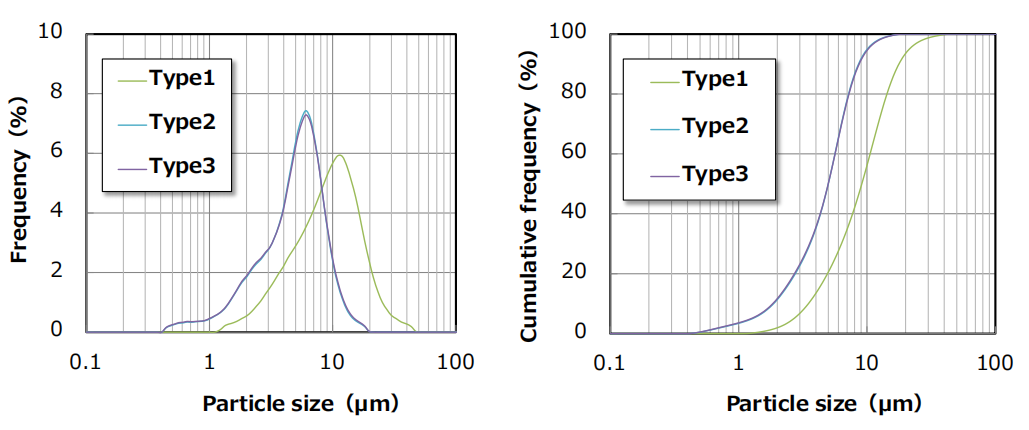
Measured by laser scattering (Microtrack MT3300).
SEM Morphology:
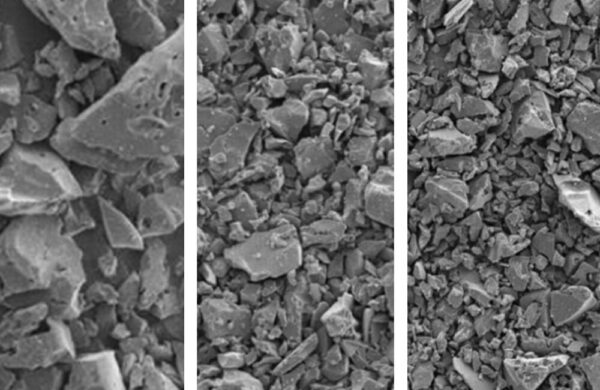
SEM images show that all three grades consist of irregular, angular hard carbon particles. Type1 (D50 = 9 μm) shows larger particles, while Type2 and Type3 (D50 = 5 μm) show finer particles consistent with their particle size distribution.
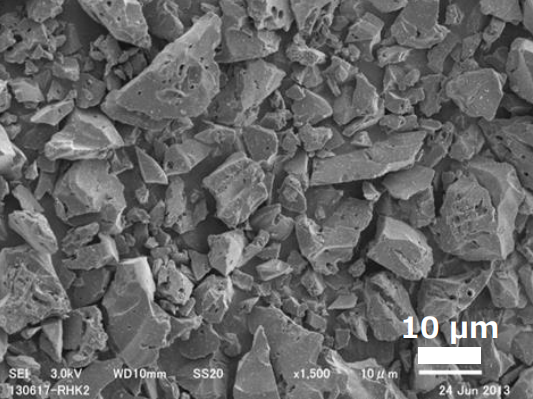
Type1 (D50 = 9 μm)
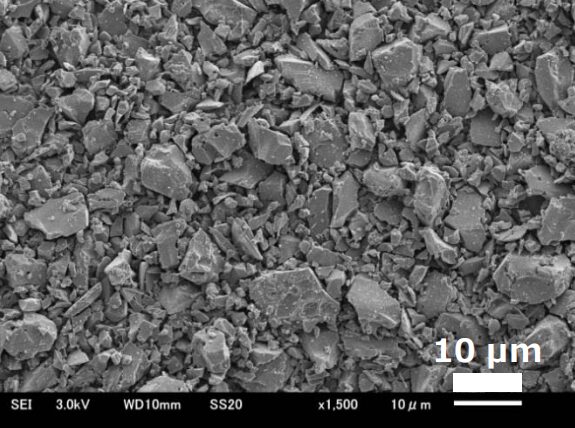
Type2 (D50 = 5 μm)
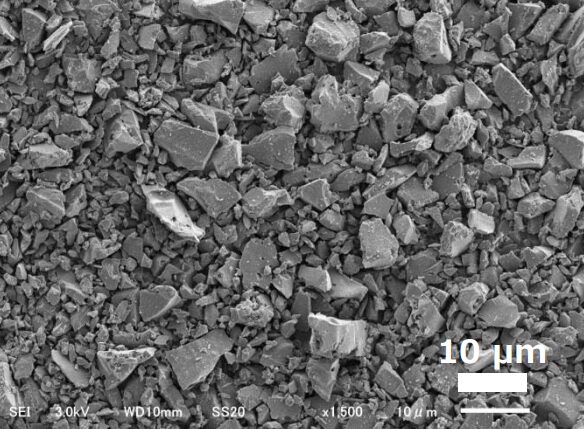
Type3 (D50 = 5 μm)
Electrochemical Performance (Half Cell vs Li, 0.2C):
Initial charge–discharge performance was evaluated in half cells against lithium metal, with an active material/PVDF ratio of 96/4 and an electrolyte of 1.0 M LiClO₄ in PC/DME (1/1 vol), at 0.2C.
| Grade | Charge (mAh/g) | Discharge (mAh/g) | Irreversible (mAh/g) | Efficiency (%) |
|---|---|---|---|---|
| Type1 | 460 | 405 | 55 | 88 |
| Type2 | 391 | 350 | 41 | 89 |
| Type3 | 358 | 320 | 38 | 90 |
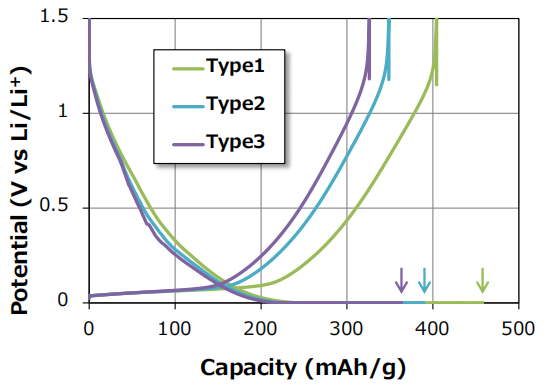
Initial charge–discharge curves (potential vs. capacity).
KURANODE can also be processed with aqueous SBR/CMC binder systems. In half cells using an active material/SBR/CMC ratio of 96/3/1, Type2 delivered a discharge capacity of 332 mAh/g (87% efficiency) and Type3 delivered 306 mAh/g (88% efficiency), confirming that both PVDF and water-based binder systems are applicable.
Electrode Density:
Because KURANODE has a true density of 1.48 g/cm³, an electrode density of approximately 1.0 g/cm³ is reached at a pressing pressure of around 15 MPa. The relationship between pressing pressure and electrode density for the three grades is shown below.
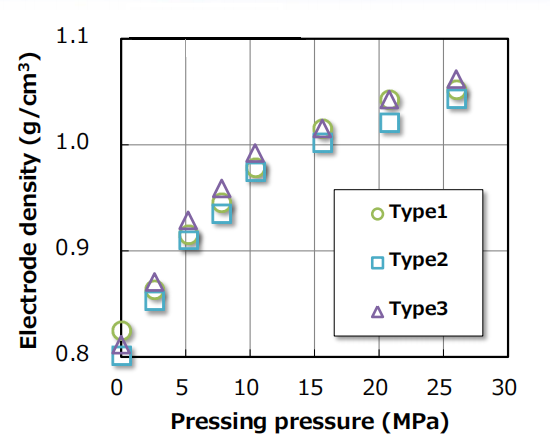
Electrode density vs. pressing pressure (electrode composition: KURANODE/PVDF = 96/4).
Moisture Behavior:
KURANODE shows low moisture pickup under ambient exposure (25°C, 50%RH). Absorbed moisture can be removed by vacuum drying; under drying at 120°C, 2 h and 13.3 Pa, moisture content is reduced to the order of tens of ppm. This makes KURANODE well suited to aqueous SBR/CMC binder processing, where electrode drying conditions are an important consideration.
Values measured by Xnergy. Typical values for reference; not guaranteed unless otherwise specified.
Note: Specifications listed above are typical and for reference only. Actual electrochemical performance depends on the specific cell architecture, electrolyte formulation, binder/conductive-additive composition, coating thickness, calendering parameters, formation protocol, and testing conditions. KURANODE™ is supplied by Xnergy as a negative electrode active material in our Anode Materials category. For complete lithium-ion battery electrode preparation workflows, see also Xnergy’s related products in the Cathode Materials category, Binders category, and Current Collectors category. For electrode-coating equipment, see the Coating equipment category including Automatic Film Coater XN-VC-300, XN-VCH-300, and Slot-Die Coating System XN-SDC. For electrode calendering, see the Calendering equipment category. For mixing and drying, see Planetary Vacuum Mixer and Three-Door Vacuum Drying Oven (XN-DVO-3).
Related products
-

Battery-Grade Lithium Metal Granules for Alloy & Battery Applications
-
Graphite Anode Sheet on Copper Foil for Lithium-Ion Batteries (Multiple Specs)
Free Shipping Price range: $158.00 through $187.50Select options This product has multiple variants. The options may be chosen on the product page -
Ultra-Thin Lithium Metal Foil for Battery Applications
-

Custom Lithium Alloys (Li–Al, Li–Mg, Li–In, Li–Sn, Multi-Element Systems)