
Comparison · Battery Materials
LFP vs NMC: Which Battery Cathode Should You Use?
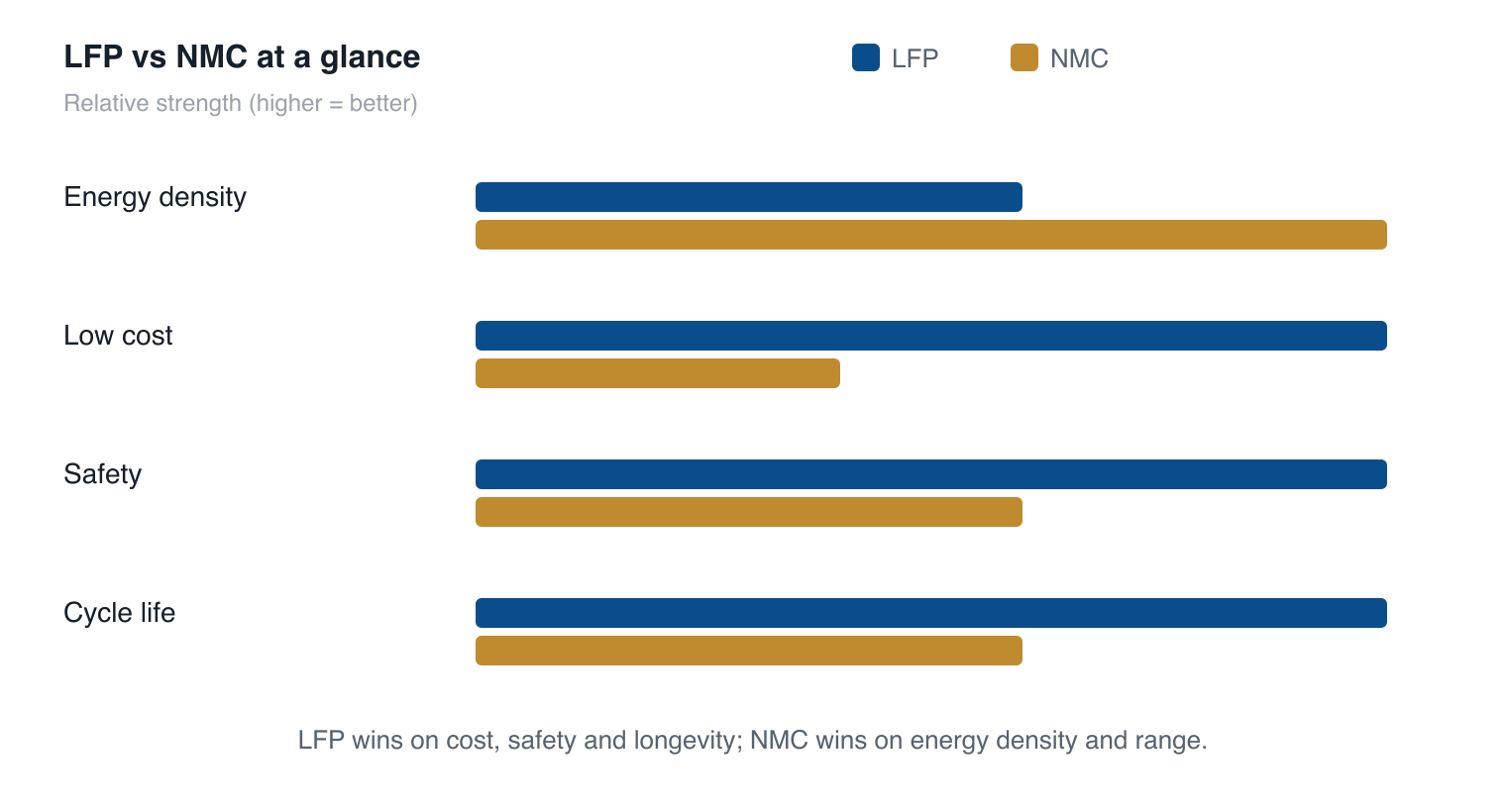
LFP and NMC are the two cathode chemistries that run most of the battery world — and choosing between them is really a choice between cost, safety and longevity on one side and energy density on the other. There is no universal winner; there’s only the right fit for your application.
The short answer: choose LFP for affordable, safe, long-cycle-life cells where range isn’t everything — storage, standard-range EVs, frequent cycling. Choose NMC when you need the most energy and range in the least weight — long-range EVs, premium electronics, power tools.
What are LFP and NMC?
LFP — lithium iron phosphate (LiFePO₄) — is a cathode built from iron and phosphate. It’s prized for stability, safety, long life, and low cost, at the expense of energy density.
NMC — lithium nickel manganese cobalt oxide (and its close cousin NCA) — is a layered oxide using nickel, manganese, and cobalt. It delivers high energy density and good performance, but costs more and is less thermally forgiving. Both are lithium-ion chemistries; only the cathode differs.
LFP vs NMC: head-to-head
| Attribute | LFP (LiFePO₄) | NMC (LiNiMnCoO₂) |
|---|---|---|
| Specific energy | ~150–200 Wh/kg | ~200–300 Wh/kg |
| Cycle life | ~3,000–6,000+ | ~1,000–3,000 |
| Safety / thermal stability | Excellent | Good (less stable) |
| Cost | Lower (no Ni/Co) | Higher (Ni, Co) |
| Cold-weather performance | Weaker | Stronger |
| Cobalt-free | Yes | No |
| Best-fit use | Storage, standard EVs, cycling | Long-range EVs, electronics |
Energy density & range
This is NMC’s home turf. At roughly 200–300 Wh/kg versus LFP’s 150–200 Wh/kg, NMC packs more energy into the same weight and volume — meaning more EV range, or a smaller, lighter pack for the same range. If maximum range or runtime is the priority, NMC leads. (LFP has narrowed the gap at the pack level thanks to cell-to-pack designs, but at the cell level NMC stays ahead.)
Cost & supply
LFP’s decisive advantage. By using iron and phosphate instead of nickel and cobalt, LFP avoids the most expensive and most volatile inputs in the battery supply chain — and sidesteps cobalt’s ethical and geopolitical baggage. That cost gap is the single biggest reason LFP has taken large share of EVs and dominates stationary storage.
Safety
LFP is the safer chemistry. Its phosphate structure is thermally stable and doesn’t release oxygen as readily when abused, so it’s far more resistant to thermal runaway than NMC. NMC is safe in well-engineered packs, but it demands more from the battery-management and thermal systems. For storage and mass-market vehicles, LFP’s safety margin is a major draw.
Cycle life
LFP again. It commonly delivers 3,000–6,000+ cycles against NMC’s 1,000–3,000, which translates to a longer service life and lower total cost of ownership — ideal for daily-cycled storage and high-utilization fleets. NMC’s shorter life is an acceptable trade where energy density rules.
Which should you choose?
Match the chemistry to what the application actually values:
- Choose LFP for: stationary/grid storage, standard-range and city EVs, buses and commercial fleets, anything cycled hard or where safety and cost dominate.
- Choose NMC for: long-range and performance EVs, laptops, phones, drones, power tools — weight- and energy-critical products.
- Also consider: if cost and safety matter even more than LFP can offer, sodium-ion batteries sit one tier below LFP on energy and below it on cost.
What’s changing in 2026
The line between the two is blurring:
- LMFP — manganese-boosted LFP (lithium manganese iron phosphate) raises LFP’s energy density toward entry NMC while keeping its cost and safety.
- High-nickel & single-crystal NMC — pushes energy density higher and cuts cobalt, narrowing NMC’s cost gap.
- Cell-to-pack & blade designs — recover much of LFP’s pack-level energy disadvantage.
- Dual sourcing — most automakers now offer both, matching chemistry to trim rather than picking one.
For the full chemistry landscape, see our cathode materials guide and lithium-ion battery types.
Sourcing and testing LFP and NMC
Whether you’re benchmarking the two or building cells, Xnergy supplies both cathodes — as active powders or pre-coated electrode sheets — plus the binders, electrolytes, and tooling to fabricate and test cells. If you’re optimizing LFP specifically, see our work on next-level LFP coatings. Browse all battery materials to get started.
Frequently asked questions
Is LFP safer than NMC?
Yes. LFP is more thermally stable and far less prone to thermal runaway, because its phosphate structure doesn’t release oxygen as readily when overheated — a key reason it’s favored for storage and mass-market EVs.
Which lasts longer, LFP or NMC?
LFP. It commonly delivers 3,000–6,000+ cycles versus roughly 1,000–3,000 for NMC, making it the better pick where cycle life and total cost of ownership matter.
Which has more energy, LFP or NMC?
NMC — about 200–300 Wh/kg versus ~150–200 Wh/kg for LFP — so it gives more range or runtime in the same weight.
Is LFP cheaper than NMC?
Yes. LFP uses iron and phosphate instead of expensive nickel and cobalt, giving it a structural cost advantage.
Does Tesla use LFP or NMC?
Both — LFP for standard-range and storage products, NMC or NCA for long-range vehicles that need maximum energy density.
Which is better for an EV, LFP or NMC?
It depends: LFP for affordable, long-life, frequently charged vehicles; NMC for long-range and performance. Many lineups now offer both.
Source with Xnergy
Benchmarking LFP and NMC? Get both from one partner
Xnergy supplies LFP and NMC cathodes as powders or pre-coated electrode sheets, plus binders, electrolytes, and cell-fabrication tooling — backed by US-based prototyping and pilot manufacturing.