
Comparison · Battery Materials
Sodium-Ion vs Lithium-Ion: A 2026 Comparison
Sodium-ion and lithium-ion work almost the same way, but they answer different questions. Lithium-ion asks “how much energy can I pack into a kilogram?” Sodium-ion asks “how cheap, abundant and safe can I make it?” Choosing between them is really choosing which of those matters more for your application.
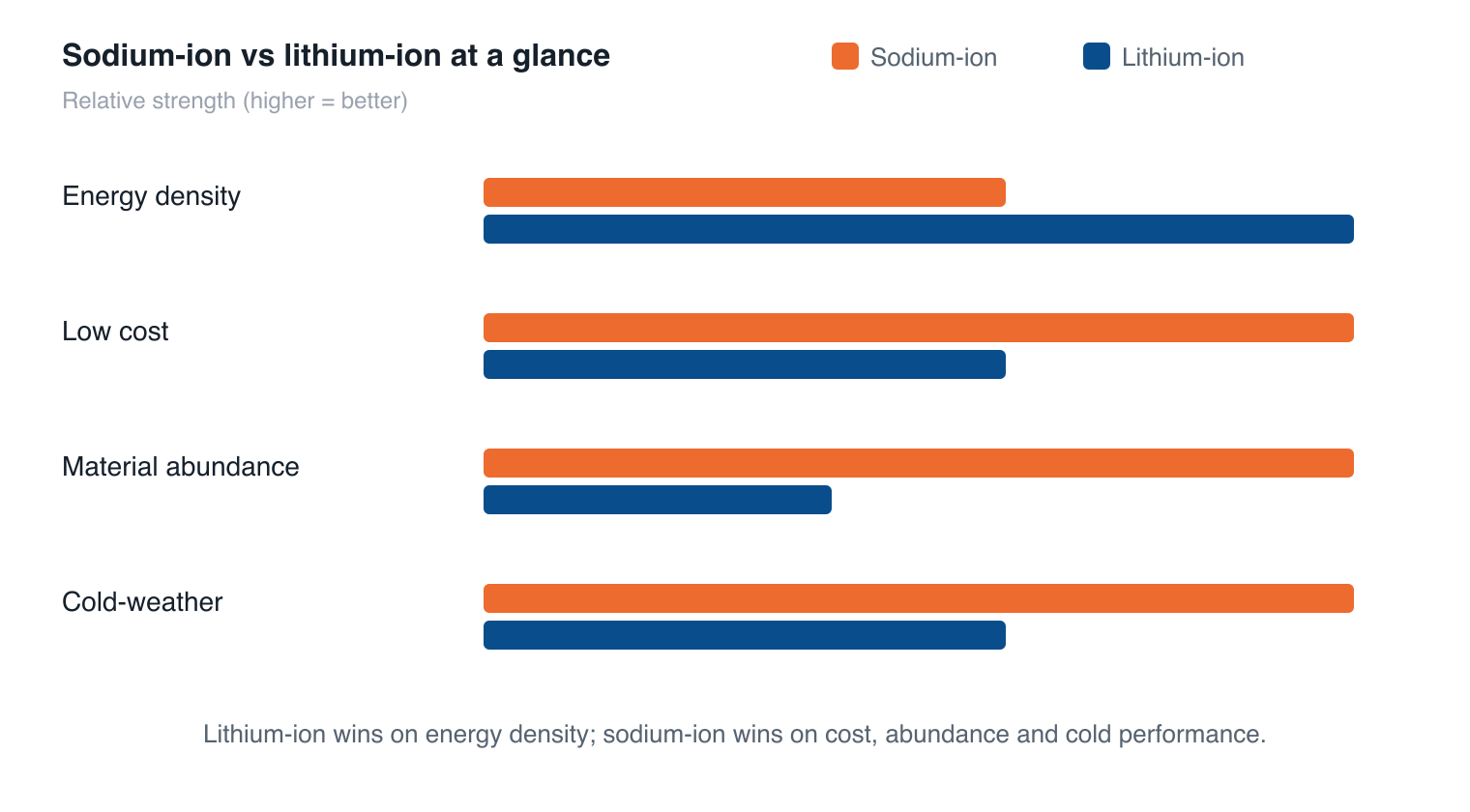
The short answer: pick lithium-ion when energy density and range are the priority; pick sodium-ion when cost, raw-material security, cold-weather performance and safety outweigh maximum range.
What sodium-ion and lithium-ion are
Both are rocking-chair batteries: ions shuttle between two electrodes through an electrolyte. The difference is the charge carrier. Lithium-ion moves lithium ions and usually pairs a graphite anode with an NMC or LFP cathode. Sodium-ion moves sodium ions, with a hard-carbon anode and a sodium-based cathode — and it can use cheap aluminum current collectors on both electrodes. For the full picture, see our sodium-ion battery guide.
Sodium-ion vs lithium-ion: head-to-head
| Attribute | Sodium-Ion | Lithium-Ion |
|---|---|---|
| Specific energy | ~100–160 Wh/kg | ~150–250 Wh/kg |
| Charge carrier | Sodium (Na⁺) | Lithium (Li⁺) |
| Anode | Hard carbon | Graphite |
| Key materials | Sodium, hard carbon, Al | Lithium, graphite, Cu (+ Ni/Co or Fe) |
| Relative cost | Lower (at scale) | Higher |
| Cold-weather | Strong | Moderate |
| Safety / shipping | Ships at 0 V | Good |
| Best-fit use | Storage, entry EVs, backup | Long-range EVs, electronics |
Energy density & range
Lithium-ion’s home turf. At roughly 150–250 Wh/kg versus sodium-ion’s 100–160 Wh/kg, lithium-ion packs more energy into the same weight and volume — meaning more EV range or a smaller, lighter pack. If maximum range or runtime is the priority, lithium-ion leads, and will for the foreseeable future.
Cost & supply security
Sodium-ion’s decisive advantage. Sodium is roughly a thousand times more abundant than lithium and distributed worldwide, with no lithium, cobalt or nickel and cheaper aluminum current collectors on both sides. That gives sodium-ion a structural cost edge at scale — and, just as important, insulates it from the price spikes and geopolitical concentration that affect the lithium supply chain.
Safety & cold-weather performance
Two more points for sodium-ion. Because a sodium-ion cell can be fully discharged to 0 V, it ships and stores more safely, and many sodium chemistries show favorable thermal behavior. Sodium-ion also tends to hold up better at low temperatures than lithium-ion — a real edge for cold climates, grid storage, and start-stop use.
Cycle life
This one is close and chemistry-dependent. The best lithium-ion (especially LFP) delivers very long cycle life; sodium-ion’s longevity varies by cathode — Prussian-blue and polyanionic types cycle well, while some layered oxides trail. For a related cathode comparison on the lithium side, see LFP vs NMC.
Which should you choose?
Match the chemistry to what the application values most:
- Choose lithium-ion for: long-range EVs, laptops, phones, drones, power tools — anything weight- and energy-critical.
- Choose sodium-ion for: grid and stationary storage, two- and three-wheelers, entry-level and city EVs, backup and telecom power, and cold-climate applications.
- Often, both: many makers now deploy sodium-ion alongside lithium-ion — even in hybrid packs — matching chemistry to the use case rather than picking one.
Where they stand in 2026
Lithium-ion remains the mass-market default across EVs, electronics, and storage. Sodium-ion has crossed from labs into real production — CATL, BYD/HiNa, Natron Energy, and Faradion are scaling cells, and sodium-ion power stations and starter batteries are already on the market. The trajectory is clear: sodium-ion isn’t replacing lithium-ion; it’s claiming the cost- and safety-sensitive end of the market that lithium-ion serves least efficiently. If you’re building cells in either chemistry, see our Na-ion cathode sheets and broader cathode materials guide.
Frequently asked questions
Is sodium-ion better than lithium-ion?
Neither is universally better. Sodium-ion is cheaper, uses abundant materials, ships safely, and performs in the cold; lithium-ion stores more energy per kilogram. They complement each other.
Which is cheaper, sodium-ion or lithium-ion?
Sodium-ion, at scale — abundant sodium, no lithium/cobalt/nickel, and cheaper aluminum current collectors on both electrodes.
Which has more energy, sodium-ion or lithium-ion?
Lithium-ion — roughly 150–250 Wh/kg versus ~100–160 Wh/kg for sodium-ion — so it gives more range in the same weight.
Can sodium-ion replace lithium-ion?
Not entirely. It’s a complement, winning where cost, safety and supply security beat range — storage, entry EVs, backup — while lithium-ion stays dominant where energy density rules.
Is sodium-ion safer than lithium-ion?
It can be shipped and stored at 0 V and shows favorable thermal behavior, giving it a handling and transport safety edge.
Which is better for EVs, sodium-ion or lithium-ion?
Sodium-ion for affordable, short-range, and city EVs; lithium-ion for long-range. Some makers now offer both.
Source with Xnergy
Building sodium-ion or lithium-ion cells?
Xnergy supplies cathodes, anodes, electrolytes, and electrode sheets for both chemistries — plus cell prototyping and pilot manufacturing from a US-based team.