
Guide · Battery Materials
LMFP Batteries: The 2026 Guide to Lithium Manganese Iron Phosphate
LFP made batteries safe and cheap. LMFP — lithium manganese iron phosphate — keeps that safety and cost, then adds a slug of manganese to squeeze out 15–20% more energy. It’s the phosphate family’s answer to “more range, please,” without touching nickel or cobalt.
This guide explains what an LMFP battery is, how manganese raises its energy density, how it compares with LFP and NMC, its real trade-offs, and who’s shipping it in 2026.
What is an LMFP battery?
An LMFP battery uses a cathode of lithium manganese iron phosphate — LiMnxFe1-xPO4. It’s the same safe, cobalt-free olivine phosphate structure as LFP, but with manganese partly replacing iron. That single substitution is what gives LMFP its edge.
How manganese adds energy
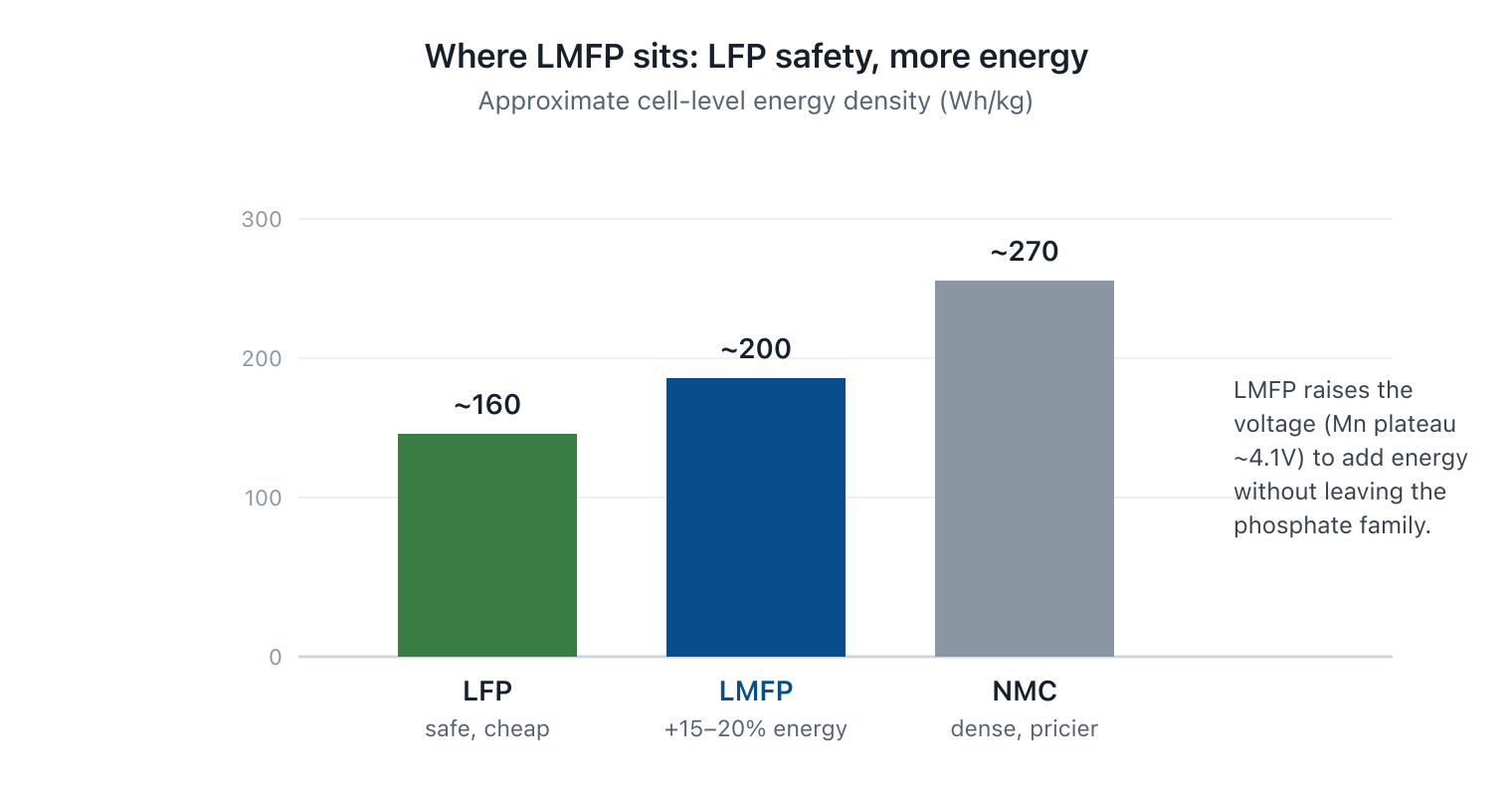
Energy density is voltage × capacity. LFP delivers its charge on a flat plateau at about 3.2 V. Adding manganese introduces a second, higher plateau near 4.1 V. Because the capacity per gram stays similar, that extra voltage translates almost directly into extra energy:
- Higher average voltage. The Mn3+/Mn2+ couple lifts the cell’s working voltage above LFP’s.
- ~15–20% more energy density. At the cell level that’s the difference between roughly 160 and ~200 Wh/kg, meaningful range for the same pack.
- Same phosphate backbone. The strong P–O bonds that make LFP thermally stable are still there, so LMFP keeps that safety.
LMFP vs LFP
Think of LMFP as an energy-boosted evolution of LFP, not a rival chemistry. It trades a little cost and cycle life for range and better cold-weather performance:
- More range. 15–20% higher energy density for the same footprint.
- Better in the cold. The higher voltage helps offset the cold-temperature weakness LFP is known for.
- Still cobalt- and nickel-free. Same low, stable raw-material cost.
- The cost: slightly harder to manufacture and, historically, a bit less cycle life — both improving fast.
LMFP vs LFP vs NMC
| Attribute | LFP | LMFP | NMC |
|---|---|---|---|
| Energy density | Baseline (~160 Wh/kg) | +15–20% (~200) | Highest (~270+) |
| Nominal voltage | ~3.2 V | ~3.7–3.8 V avg | ~3.6–3.7 V |
| Safety | Excellent | Excellent | Moderate |
| Cost | Lowest | Low | High (Ni, Co) |
| Cycle life | Highest | High | Moderate |
| Best for | Cost-first storage & EVs | More range, same safety | Max range / premium |
For the full nickel-based comparison, see our guide to LFP vs NMC batteries. LMFP is increasingly blended with NMC to hit an energy target at lower cost and higher safety than NMC alone.
Trade-offs and how they’re fixed
Manganese isn’t free of downsides, and honest engineering names them:
- Lower conductivity. Manganese-rich phosphate conducts electrons poorly — addressed with nano-sizing and carbon coating so charge moves fast enough for real rate performance.
- Manganese dissolution. Over many cycles some Mn can dissolve and attack the anode — managed with doping, coatings, and electrolyte additives.
- Process complexity. Precise Mn:Fe ratios and particle engineering make LMFP a bit harder to produce than plain LFP.
These are the same materials-engineering levers — particle design, coatings, electrolytes — that decide the performance of any advanced cathode.
Source with Xnergy
Evaluating LMFP or phosphate cathodes?
Xnergy supplies LFP, LMFP and manganese-rich phosphate cathode materials, matched electrolytes and anodes, and cell prototyping from a US-based team — so you can benchmark the energy-vs-cost trade for your application. Tell us your target and we’ll spec the cathode.
Who’s shipping LMFP in 2026
LMFP has moved from lab to production:
- CATL — its M3P / manganese-rich phosphate cells bring LMFP into mainstream EV packs.
- BYD — extending its phosphate leadership toward manganese-boosted chemistries.
- Gotion High-Tech and others — scaling LMFP and LMFP/NMC blends for range-focused, cost-sensitive vehicles.
As automakers chase more range from safe, low-cost cells, LMFP is one of the fastest-growing cathode stories of the mid-2020s.
Frequently asked questions
What is an LMFP battery?
A battery with a lithium manganese iron phosphate (LiMnxFe1-xPO4) cathode — an olivine phosphate like LFP, with manganese added for a higher-voltage plateau near 4.1 V, giving ~15–20% more energy while keeping phosphate safety and cost.
What is the difference between LMFP and LFP?
LFP runs at ~3.2 V; LMFP adds a manganese plateau near 4.1 V to lift average voltage and energy density by ~15–20%. Same safe, cobalt-free structure — LMFP is an energy-boosted evolution of LFP.
Is LMFP better than LFP?
For more range and better cold performance, yes, at a small cost and cycle-life penalty. LFP still wins on raw cost and maximum cycle life.
How does LMFP compare with NMC?
NMC is still denser but relies on costly nickel and cobalt and is more thermally sensitive. LMFP narrows the energy gap while keeping phosphate safety and cost, so the two are often blended.
What are the disadvantages of LMFP?
Lower conductivity and possible manganese dissolution historically hurt rate and cycle life; nano-sizing, carbon coating and doping address them. It’s also slightly costlier to make than plain LFP.
Who makes LMFP batteries?
CATL (M3P), BYD, Gotion High-Tech and other makers have LMFP or manganese-rich phosphate products, often blended with NMC.