
Guide · Battery Materials
Cold-Weather Lithium Batteries: Why They Fade and How to Fix It
Ship a lithium product into a cold climate and the complaints start: short runtime, sluggish power, slow or failed charging. The cell isn’t broken — it’s cold. This guide explains what the cold actually does to a lithium-ion cell, how much you lose, and the materials-level fixes that recover it.
Why cold hurts lithium cells
A lithium-ion cell works by shuttling lithium ions through a liquid electrolyte between the electrodes. When it gets cold, two things happen: the electrolyte gets more viscous, and ion movement slows. Ionic conductivity drops, internal resistance climbs, and the reactions at the electrode surfaces slow down.
The energy is still stored in the cell — the cell just can’t move it in or out easily. That shows up as lower usable capacity, weaker power, and a voltage that sags under load.
How much capacity you lose
The loss is steep, and it depends heavily on the electrolyte:
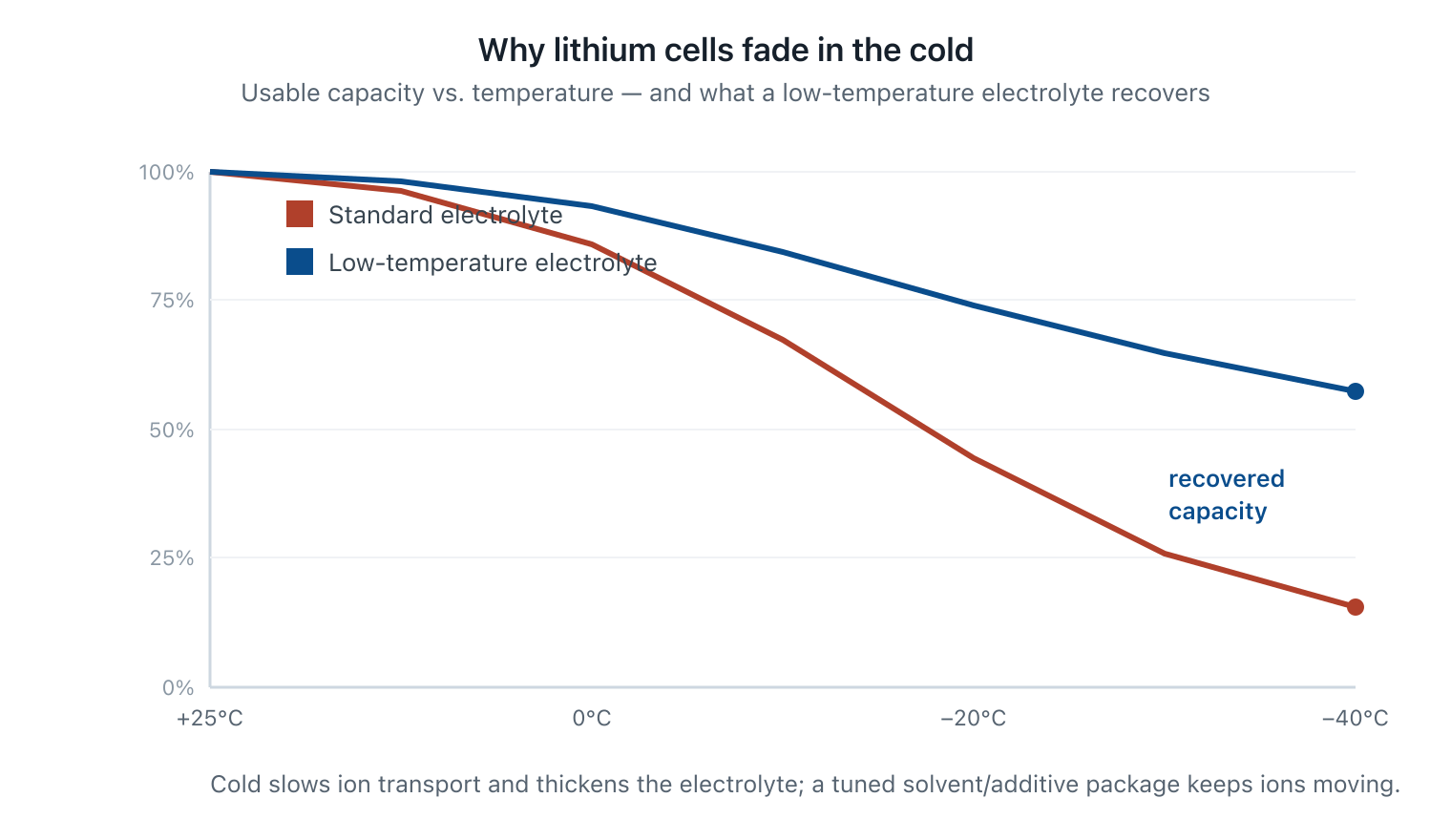
As a rough guide, a standard lithium-ion cell may lose 20–50% of usable capacity by −20°C, and deliver little near −40°C. Power (the ability to deliver current) falls even faster than capacity, which is why a cold pack feels weak before it feels empty.
The real danger: charging when cold
Discharging in the cold mostly costs you range. Charging in the cold can cost you the cell. Below about 0°C, lithium struggles to insert into the graphite anode and instead plates as lithium metal on its surface — causing permanent capacity loss and dendrites that raise a safety risk. This is the single most important rule of cold-weather lithium use: don’t fast-charge a cold cell.
Source with Xnergy
Need a cell that survives the cold?
Xnergy formulates low-temperature electrolytes and matches them to cold-tolerant anodes and cathodes, then validates the result in prototype cells across temperature — from a US-based team. Tell us your low-temperature target (capacity retained, charge/discharge, and how cold) and we’ll spec the materials.
Materials-level fixes (where most of the gain is)
Cold performance is designed into the cell, mostly through the electrolyte:
- Low-temperature electrolyte. Solvent blends (and salts/additives) chosen to stay fluid and conductive when cold — the single biggest lever, as the chart shows.
- Charge-tolerant anode. Anode surfaces and additives that resist lithium plating let a cell accept charge at lower temperatures.
- Lower-resistance cell design. Thinner electrodes and better conductive networks reduce the resistance that cold amplifies.
- Cathode choice. Secondary, but NMC generally tolerates cold better than LFP — worth weighing if the base chemistry is still open.
System-level fixes
Around the cell, the pack can help too:
- Pre-heat before charging — warm the pack above 0°C before accepting charge.
- Insulate and self-heat — keep cells in their working range in the field.
- Limit cold charge current — if you must charge cold, do it slowly to reduce plating.
System tricks buy margin, but they can’t rescue a cell whose electrolyte freezes out. The durable fix is in the materials — which is why cold-climate products are worth specifying at the cell level, not just insulating after the fact.
Frequently asked questions
Why do lithium batteries lose capacity in cold weather?
Cold thickens the electrolyte and slows ion movement, dropping conductivity and raising resistance. The charge is still stored, but the cell can’t deliver it easily — often a 20–50% usable loss by −20°C with a standard electrolyte.
At what temperature do lithium batteries stop working?
Most standard cells lose significant capacity below −20°C and deliver little near −40°C. They usually still discharge slowly, but charging below 0°C is the real risk. Low-temperature cells extend this range.
Can you charge a lithium battery in freezing temperatures?
Charging below 0°C is risky — lithium can plate as metal on the anode, causing permanent loss and dendrites. Pre-heat the pack, charge at very low current, or use low-temperature-tolerant materials.
How do you make a lithium battery work better in the cold?
Use a low-temperature electrolyte, a plating-tolerant anode, and a lower-resistance cell design; at the system level, insulate, pre-heat, and limit cold charge current.
Which battery chemistry is best for cold weather?
NMC generally tolerates cold better than LFP, but electrolyte formulation and cell design matter more than the base cathode for cold performance.
Does cold weather permanently damage lithium batteries?
Being cold usually causes only temporary loss that returns on warming. Permanent damage comes from charging while too cold. Avoid sub-freezing charging or use low-temperature-tolerant materials.