
Guide · Grid Storage
Battery Energy Storage Systems: How to Choose Cell Chemistry and Materials
A battery energy storage system should not begin with the question, “Which battery has the highest energy density?” It should begin with the job the grid needs done. Duration, cycles, response time, temperature, safety case, footprint and supply risk determine the right chemistry — and the chemistry determines the material stack.
That distinction matters because stationary storage is not an electric vehicle parked in a container. Weight often matters less; calendar life, daily throughput, thermal behavior and cost per delivered megawatt-hour matter more. This guide shows how to turn a BESS duty profile into a practical cell and materials specification.
What a battery energy storage system actually includes
A BESS stores electricity in rechargeable cells, then returns it through power-conversion equipment when the grid or a connected load needs it. At utility scale, the system is a chain:
active materials → electrodes → cells → modules → racks → container or building → power-conversion system → grid controls.
The battery management system (BMS) tracks voltage, current, temperature and state of charge. Thermal management keeps cells inside their operating window. The power conversion system (PCS) connects DC battery power to the AC grid, while the energy management system (EMS) dispatches the asset.
Xnergy works at the materials-through-cell portion of that chain: sourcing and tailoring active materials, electrolytes and electrodes, then prototyping and validating cells. Turnkey site integration, PCS/EMS engineering and installation remain separate system-level disciplines. Keeping that boundary clear prevents a common mistake: expecting cell chemistry alone to solve a system design problem.
Start with grid duty, not a chemistry name
The same rack can age very differently under frequency regulation, solar shifting or emergency backup. Before selecting a battery, write down the operating envelope:
- Duration: minutes of high power, two to four hours of energy shifting, or a longer discharge?
- Cycles and throughput: occasional backup, daily full cycles, or repeated partial cycles?
- Power response: is the priority rapid grid support or sustained energy delivery?
- State-of-charge window: will the system use a conservative middle window or frequent deep discharge?
- Temperature: what are the cell, container and ambient extremes?
- Footprint: is land inexpensive, or is energy per rack decisive?
- Safety and permitting: what propagation testing, spacing and emergency-response requirements apply?
- Supply: which materials, cells and replacements can be qualified for the project lifetime?
The market is already moving in this direction. The IEA reports that 108 GW of battery storage was deployed in 2025, about 80% at utility scale. Most projects still cluster around two hours, but four-hour-and-longer systems are becoming more common. A longer duration is not merely “more cells” — it changes the economics of cycle life, energy efficiency, degradation and material cost.
BESS chemistry comparison: LFP, NMC, sodium-ion and flow
| Chemistry | Best fit | Primary strength | Constraint to validate |
|---|---|---|---|
| LFP | Daily-cycled, 2–4+ hour stationary storage | Cost, cycle life and favorable thermal profile | Lower energy density; low-temperature charging |
| NMC | Footprint-constrained or high-energy racks | Higher energy density | Thermal controls, material cost and supply exposure |
| Sodium-ion | Cold climates and supply diversification | Abundant inputs and low-temperature potential | Energy density, first-cycle efficiency and manufacturing maturity |
| Flow battery | Long-duration, high-throughput projects with space | Energy and power can be scaled separately | System complexity, pumps, tanks and technology-specific supply |
No row is a universal winner. LFP and NMC are lithium-ion cell chemistries. Sodium-ion uses a related cell architecture but substitutes sodium-based cathodes, hard carbon and a sodium electrolyte. Flow batteries store active species in external tanks, so they require a different supplier and system-development path. If a project genuinely needs long-duration storage, forcing lithium-ion into the specification before comparing alternatives can optimize the wrong system.
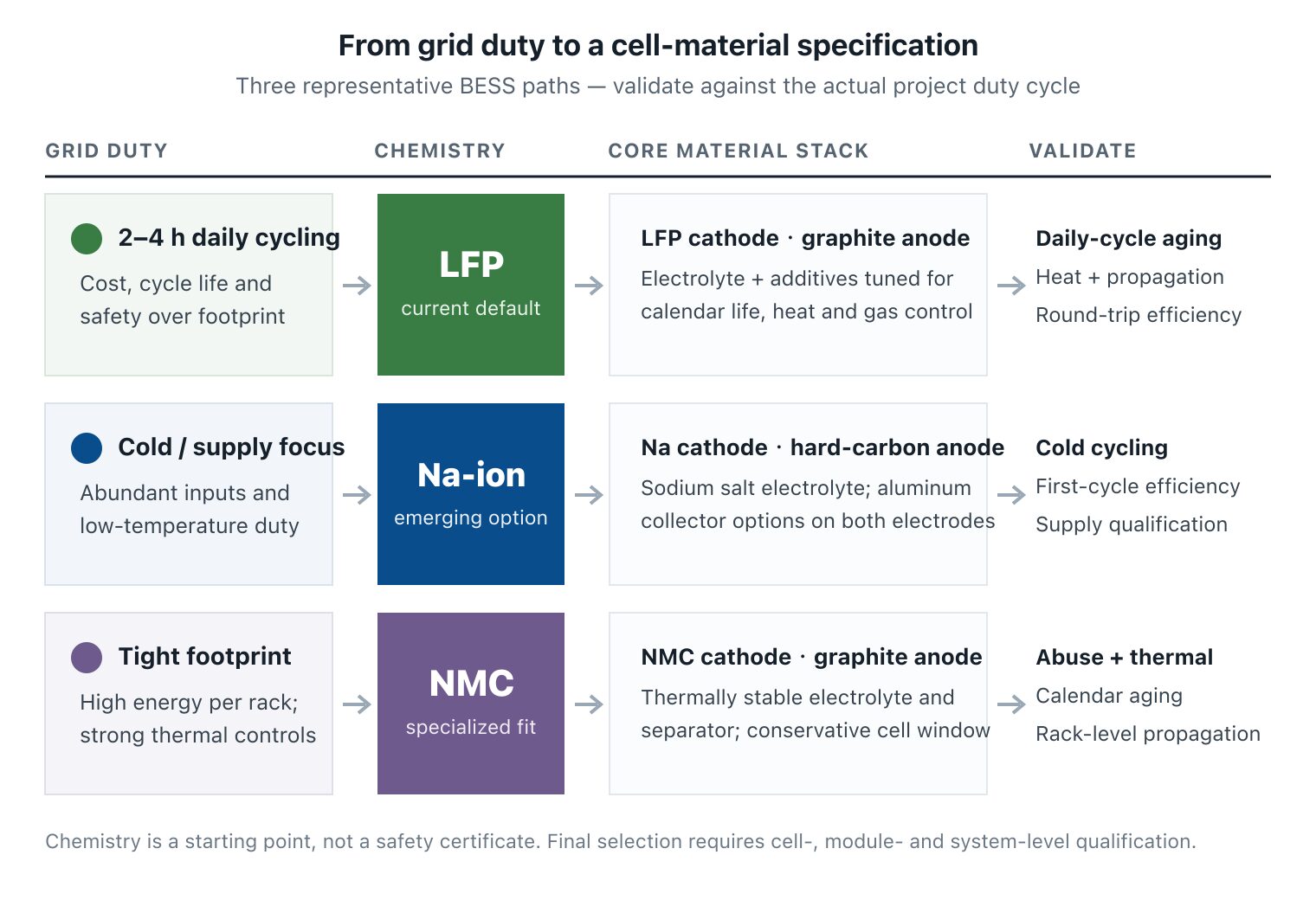
For most short-duration and four-hour projects today, however, the practical choice begins with LFP versus NMC, with sodium-ion entering the discussion where temperature, cost or supply diversification justifies an emerging platform.
Why LFP dominates current battery storage deployments
In an EV, every kilogram competes with driving range. In a stationary BESS, a few extra racks may be acceptable if the cell costs less, cycles longer and simplifies the safety case. That trade favors lithium iron phosphate (LFP).
According to the IEA, LFP accounted for around 90% of battery-storage deployments in 2025. It contains neither nickel nor cobalt and generally offers a more favorable thermal profile than nickel-rich NMC. Its lower energy density is real, but stationary storage often values lifetime energy delivered over minimum weight.
That does not make an LFP cell automatically safe or long-lived. Electrode loading, electrolyte formulation, formation protocol, operating window and thermal design can separate two cells with the same chemistry label. System safety still has to be engineered and tested. Sandia’s energy-storage standards resource distinguishes UL 9540 system certification from UL 9540A thermal-runaway propagation testing — neither can be replaced by a cathode datasheet.
Develop with Xnergy
Turn your BESS duty profile into a cell specification
Send us your discharge duration, cycles per year, state-of-charge window, temperature range, cell format and capacity target. Xnergy can source the cathode, anode, electrolyte and supporting materials, fabricate prototype cells and build a validation plan before you commit to pilot volume.
Translate the chemistry into a material specification
Once the duty profile points to a chemistry, the work becomes more specific. A chemistry name is only the top line of a cell bill of materials.
Cathode and anode active materials
For an LFP cell, specify particle morphology, carbon coating, purity, tap density and electrode performance — not just “LFP powder.” Pair it with graphite selected for life, rate and first-cycle efficiency. For NMC, nickel content and surface treatment change both capacity and stability. A sodium-ion path requires a sodium cathode family and a compatible hard-carbon anode; it cannot be treated as LFP with a different label.
Electrolyte, separator and current collectors
The electrolyte formulation controls conductivity, interphase formation, gas generation and high- or low-temperature behavior. The separator must match thickness, porosity, shutdown behavior and wetting requirements. Aluminum and copper current collectors, binder systems and conductive additives influence resistance, adhesion, manufacturability and cost.
Electrode architecture and formation
Stationary storage may tolerate thicker electrodes to reduce inactive material per kilowatt-hour, but increasing loading can hurt rate capability, wetting and manufacturing yield. Porosity, calendering, coating uniformity and formation therefore belong in the material specification. The U.S. Department of Energy’s grid-storage supply-chain assessment maps this full chain from active materials through electrodes, separators, electrolytes, cells and end use — useful context for why qualification cannot stop at powder chemistry.
Validate the real duty cycle before scale-up
A generic cycle-life test can flatter the wrong design. Validation should recreate the intended BESS operation as closely as the lab format allows:
- Screen materials in coin cells. Confirm compatibility, capacity, efficiency and early degradation mechanisms.
- Move to the intended cell architecture. Pouch or cylindrical prototypes expose loading, wetting, pressure, gas and thermal effects that coin cells can hide.
- Apply the actual duty profile. Match depth of discharge, C-rate, rest periods, state-of-charge window and temperature.
- Measure more than retained capacity. Track coulombic and round-trip efficiency, impedance growth, swelling or gas, self-discharge and heat generation.
- Separate cycle aging from calendar aging. A BESS spends substantial time waiting at a particular state of charge; that idle time still ages the cell.
- Escalate safety testing by level. Cell results inform module and rack design, but do not substitute for system-level propagation, controls and code compliance.
Sandia notes that grid-scale battery assets need to operate for more than a decade, so degradation and safety have to be understood together. A small efficiency or impedance difference in an early prototype can become a major cooling, augmentation or lifetime-cost difference across thousands of racks.
A practical BESS materials procurement checklist
Before requesting samples or a cell-development quote, prepare these inputs:
- Use case and dispatch profile
- Power and energy target, including duration
- Expected cycles per year and depth of discharge
- Operating and storage temperature range
- Maximum cell or rack footprint
- Target cell format and capacity
- Required lifetime, efficiency and warranty assumptions
- Applicable safety tests and jurisdiction
- Domestic-content, traceability or supply-diversification requirements
- Pilot volume, timeline and acceptance criteria
Those inputs let a materials partner propose something testable: a cathode/anode pair, supporting cell materials, an electrode design and a prototype plan. Without them, “send us your best ESS battery” produces a sample, not a defensible engineering decision.
Frequently asked questions
What is a battery energy storage system?
A BESS stores electricity in rechargeable cells and returns it when the grid or a connected load needs it. A complete system includes cells, modules, racks, BMS, thermal management, PCS, controls and safety systems.
Which battery chemistry is best for energy storage?
LFP is the current default for many two- to four-hour stationary systems because it balances cost, cycle life and thermal stability. Sodium-ion can fit cold-climate or supply-diversification goals; NMC remains useful where footprint matters. The duty cycle should decide.
Why is LFP widely used in battery energy storage systems?
Stationary storage is less weight-constrained than an EV, so LFP can trade lower energy density for lower cost, long cycle life and a favorable thermal profile. The IEA reports that LFP represented around 90% of deployments in 2025.
What battery materials are specified for a BESS cell?
Cathode and anode active materials, electrolyte salts/solvents/additives, separator, current collectors, binders and conductive additives. Electrode loading, porosity, thickness and formation protocol are part of the working specification too.
Is sodium-ion better than LFP for grid storage?
Not universally. Sodium-ion offers abundant inputs, low-temperature potential and diversification; LFP currently has greater scale, maturity and energy density. Compare both under the project’s temperature, duration, footprint, cost and life requirements.
How should a BESS cell be validated before scale-up?
Use the intended cell format and reproduce the real state-of-charge window, C-rate, rest periods and temperatures. Measure cycle and calendar aging, efficiency, gas, impedance and thermal behavior before module- and system-level qualification.