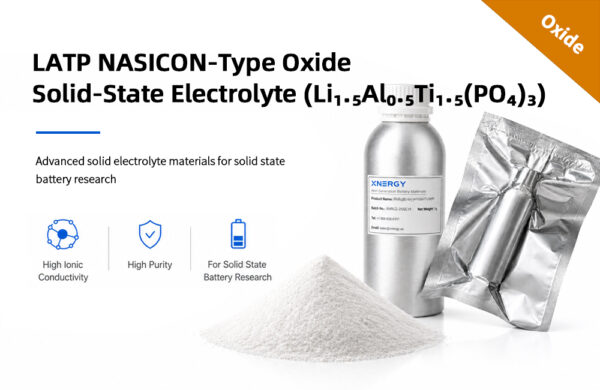
LATP NASICON-Type Oxide Solid-State Electrolyte (Li₁.₅Al₀.₅Ti₁.₅(PO₄)₃)
SKU: XN-LATP
Free Shipping Price range: $318.00 through $398.00
LATP (Li₁.₅Al₀.₅Ti₁.₅(PO₄)₃) is an air-stable, NASICON-structured oxide solid-state electrolyte for all-solid-state lithium battery (ASSB) research.
- Ionic conductivity ≥1.3 mS/cm at 27 °C (after sintering)
- High phase purity (PDF #35-0754), low moisture, white powder
- Three grades: 5 µm / 600 nm / 300 nm — custom on request
Request a quote for research quantities or custom specifications.
Name: LATP NASICON-Type Oxide Solid-State Electrolyte (Li₁.₅Al₀.₅Ti₁.₅(PO₄)₃)
Product Type: NASICON-Structure Oxide Solid Electrolyte Powder
Product Code: XN-LATP
Grades: XN2-05UP (5 µm) / XN2-600P (600 nm) / XN2-300P (300 nm)
Brand: Xnergy
Product Introduction:
LATP (lithium aluminum titanium phosphate, Li₁.₅Al₀.₅Ti₁.₅(PO₄)₃) is an air-stable, NASICON-structured oxide solid-state electrolyte for all-solid-state lithium battery (ASSB) research. Its 3D NASICON framework provides fast Li⁺ migration pathways, delivering an ionic conductivity of ≥1.3 mS/cm (10⁻³ S/cm) at 27 °C after sintering. Unlike sulfide electrolytes, LATP is stable in air and easy to handle, with a wide electrochemical window and good compatibility with NCM and LCO cathodes. It is available as a white powder in three particle-size grades — 5 µm, 600 nm, and 300 nm — so researchers can match particle size to ceramic pellets, composite films, or high-loading composite electrodes.
Key Features:
Air-stable NASICON oxide chemistry — no glovebox required for basic handling, unlike sulfides
High ionic conductivity ≥1.3 mS/cm (10⁻³ S/cm) at 27 °C after sintering
3D Li⁺ migration pathways with a wide electrochemical window
Compatible with NCM and LCO cathodes and polymer-ceramic composite systems
Three particle-size grades (5 µm / 600 nm / 300 nm) for pellets, films, and composites
High phase purity (matches PDF #35-0754) with low moisture and consistent D50
Available Grades:
| Grade | Primary Particle Size | D50 |
|---|---|---|
| XN2-05UP | ~5 µm | 5.0 ± 0.5 µm |
| XN2-600P | ~600 nm | 600 ± 100 nm |
| XN2-300P | ~300 nm | 300 ± 50 nm |
General Specifications:
| Property | Specification |
|---|---|
| Chemical Formula | Li₁₊ₓAlₓTi₂₋ₓ(PO₄)₃ (typ. Li₁.₅Al₀.₅Ti₁.₅(PO₄)₃) |
| Crystal Structure | NASICON-type (matches PDF #35-0754) |
| Appearance | White powder; white after sintering |
| Theoretical Density | 2.94 g/cm³ |
| Ionic Conductivity (sintered) | ≥1.3 mS/cm at 27 °C |
| Moisture | <2000 ppm |
| pH | <8.50 |
| Shelf Life | 1 year (sealed, dry) |
| Particle Size Grades | 5 µm / 600 nm / 300 nm (custom on request) |
Application Areas:
Ceramic separator / electrolyte pellets for all-solid-state lithium batteries (ASSB)
Polymer-ceramic composite electrolyte films
High-loading composite cathodes (with NCM, LCO)
Nanocomposite electrolyte films (sub-micron and nano grades)
University, research-institute, and industrial solid-state battery R&D
Packaging & Storage:
Standard pack sizes 100 g / 200 g; custom quantities available on request
Store sealed in a cool, dry environment, protected from moisture
Reseal promptly after use; 1-year shelf life when sealed
Specifications are provided for reference and may be adjusted to suit specific research requirements. Configuration and options are specified at order time.
Note: LATP is an air-stable, NASICON-structured oxide electrolyte with ≥1.3 mS/cm conductivity, available in 5 µm, 600 nm, and 300 nm grades for solid-state lithium battery research. Explore the full Oxide Solid-State Electrolyte series, including our garnet LLZO/LLZTO electrolytes. For sodium-ion research, the framework-related NASICON NZSPO electrolyte shares the same NASICON structure. Also see our Al-doped LZC and LTOC halide electrolytes.
| Particle Size | 5 µm · XN2-05UP · 100g, 600 nm · XN2-600P · 100g, 300 nm · XN2-300P · 100g |
|---|