
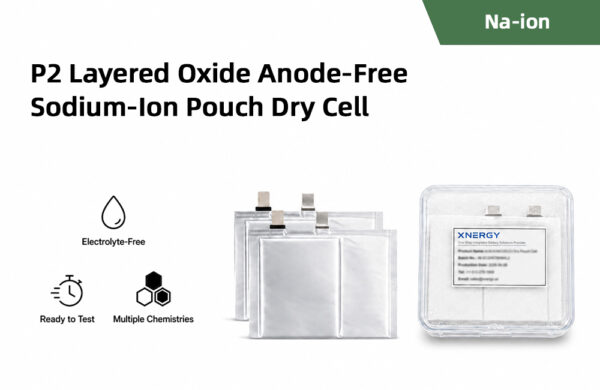
P2 Layered Oxide Anode-Free Sodium-Ion Pouch Dry Cell (Multiple Specs)
Free Shipping$198.00
P2 Layered Oxide Anode-Free Sodium-Ion Pouch Dry Cell — lithium-free, cobalt-free anode-free sodium-ion dry pouch cell pairing P2-type Ti-doped sodium nickel manganese oxide cathode with copper foil current collector — no anode active material. Sodium plates in-situ from cathode during first charge. Wide 2.0–4.2 V voltage window combines P2’s high energy density with anode-free architecture for fundamental sodium-ion plating interface research.
Need a bulk order or custom specification? Request a competitive quote today!
Name: P2 Layered Oxide Anode-Free Sodium-Ion Pouch Dry Cell (Multiple Specs)
Cell Type: P2-Anode-Free Pouch Dry Cell
Product Code: XN-P2-AF
Description:
P2 Layered Oxide Anode-Free Sodium-Ion Pouch Dry Cell pairs P2-type Ti-doped sodium nickel manganese oxide (NaxNiyMn1−y−zTizO2) cathode with a copper foil current collector — no anode active material — in a fully assembled but unfilled (dry) pouch format. As a result, this configuration combines the highest-energy sodium-ion cathode chemistry (P2 layered oxide, 2.0–4.2 V wide window) with the maximum-energy-density anode-free architecture, eliminating the volume and weight overhead of conventional hard carbon anodes. During the first charge, sodium ions plate directly from the P2 cathode onto the copper surface, forming a sodium metal anode in-situ. Note that this configuration uses copper foil as a research-grade current collector specifically for studying P2/copper interface behavior under high-voltage sodium plating conditions — distinct from polyanionic anode-free sodium-ion systems (NFPP, NVP) which use carbon-coated aluminum foil. Furthermore, the dry (unfilled) pouch format allows customers to inject their own electrolyte formulations, making this cell ideal for advanced anode-free sodium-ion electrolyte and plating interface research targeting fundamental degradation mechanisms.
Application:
This dry pouch cell serves as a research platform for high-energy anode-free sodium-ion battery development based on layered oxide cathodes, including sodium-ion electrolyte formulation studies for high-voltage sodium plating (up to 4.2 V upper cutoff), plating/stripping interface research on copper foil under sodium chemistry, advanced electrolyte additive screening for dendrite suppression and SEI stabilization, full-cell prototyping for next-generation high-energy-density sodium-ion battery systems, and academic studies of anode-free P2/copper electrochemistry — particularly the comparison between layered oxide and polyanionic (NFPP, NVP) anode-free chemistries on different current collector substrates.
Cell Specifications (2 Ah Standard Grade):
| Parameter | Value |
|---|---|
| Cell Type | P2-Anode-Free Pouch Dry Cell |
| Design Capacity | 2000 mAh (2 Ah) |
| Cell Dimensions | 6090 (60 × 90 mm) |
| Cell Architecture | Stacked (laminated) |
| Recommended Voltage Range | 2.0 – 4.2 V |
| N/P Ratio | 1.17 |
| Separator | PE 9+3 (composite) |
| Cathode Sheet Count | 16 |
| Current Collector Sheet Count | 17 |
| Recommended Electrolyte Filling | 3–4 g/Ah |
| Recommended Aging | 45 °C, 24 h rest, 8 kgf/cm² pressure |
| Recommended Formation | Stepped multi-current protocol (0.05C 4 h → 0.2C to cutoff, see below) |
| Final Aging | Room temperature, 24 h rest |
Cathode Specifications (P2 Layered Oxide):
| Parameter | Value |
|---|---|
| Active Material | P2-type Ti-doped sodium nickel manganese oxide (NaxNiyMn1−y−zTizO2) |
| Active Material Content | 95.0% |
| Specific Capacity | 100 mAh/g |
| Compaction Density | 2.2 g/cm³ |
| Single-Side Areal Density | 17.7 mg/cm² |
| Electrode Dimensions | 75 × 54 mm |
Current Collector Specifications (Anode-Free):
| Parameter | Value |
|---|---|
| Anode Construction | Copper foil — no active material |
| Sodium Source | From cathode during first charge (in-situ plating) |
| Current Collector | Copper foil (research-grade for sodium-plating interface studies) |
| Electrode Dimensions | 77 × 56 mm |
Values measured by Xnergy. Typical values for reference; not guaranteed unless otherwise specified.
Available Capacity Grades:
| Grade | Capacity | Notes |
|---|---|---|
| 1 Ah | 1000 mAh | Lab-scale R&D, single-cell screening |
| 2 Ah Standard | 2000 mAh | Standard configuration, 6090 dimensions |
| Single-Layer | — | Single-layer construction for fundamental sodium plating studies and SEI characterization on copper |
| Custom Specs | — | Cathode loading, separator, current collector substrate, and electrode dimensions customizable; contact sales |
Characteristics:
Highest energy-density configuration in sodium-ion: P2 + anode-free
P2 layered oxide is the highest-energy sodium-ion cathode chemistry currently in commercial development, and anode-free architecture is the highest theoretical energy-density configuration. As a result, this cell represents the most aggressive energy-density combination available in sodium-ion chemistry — making it a uniquely valuable research platform for next-generation high-energy sodium-ion battery development.
Wide 2.0–4.2 V voltage window
P2 chemistry operates across a 2.0–4.2 V cutoff window — significantly wider than polyanionic sodium-ion anode-free systems (1.5–3.4 V for NFPP-AF, 2.5–3.8 V for NVP-AF). Therefore, this cell delivers higher cell-level energy density than polyanionic anode-free alternatives, while challenging researchers with higher-voltage sodium plating dynamics.
Copper foil current collector for sodium-plating interface research
Unlike polyanionic sodium-ion anode-free systems which use carbon-coated aluminum foil (because copper alloys with sodium under prolonged contact), this P2 anode-free configuration uses copper foil as a research-grade current collector. Consequently, this enables fundamental investigation of Na/Cu interface behavior, sodium plating morphology on copper, and the kinetics of any Cu–Na interaction under operational sodium-ion conditions — research data unavailable from carbon-coated-aluminum-based anode-free systems.
Stepped multi-current formation protocol
The recommended formation uses a stepped current protocol: 0.05C charge for 4 hours, followed by 0.2C charge to cutoff voltage. As a result, this gradual approach builds a stable SEI on the freshly plated sodium and on the copper surface, reducing first-cycle losses and improving long-term cycling stability — a critical practice unique to high-voltage anode-free systems with reactive copper substrates.
Aging under stack pressure for sodium plating uniformity
The recommended aging protocol applies 8 kgf/cm² stack pressure at 45 °C for 24 h. Therefore, this controlled pressure environment promotes uniform sodium plating during formation, suppresses dendrite formation, and improves cycling stability — a critical practice for anode-free sodium-ion systems.
Ti-doped P2 structure for improved cycling stability
The active material is Ti-doped P2 sodium nickel manganese oxide. Titanium doping suppresses the harmful P2-O2 phase transition at high state-of-charge — a key degradation mechanism in undoped P2 systems. Therefore, this Ti-doped formulation delivers improved cycling stability while preserving the high energy density characteristic of the P2 layered framework.
Dry (unfilled) pouch design for sodium-ion electrolyte studies
The cell ships fully assembled but without electrolyte. As a result, customers can inject their own sodium-ion electrolyte formulations to study electrolyte effects on sodium plating efficiency at high voltage, SEI stability on copper, and dendrite suppression — the core challenges of anode-free sodium-ion chemistry that are most strongly influenced by electrolyte design and additive selection.
Multiple capacity grades + single-layer option
Standard 1 Ah and 2 Ah multi-layer grades support full-cell research. Furthermore, the Single-Layer option provides a simplified platform for fundamental anode-free studies — ideal for SEI characterization on copper, sodium plating morphology imaging, and one-electrode interface research.
Recommended Activation Protocol:
1. Inject sodium-ion electrolyte at 3–4 g/Ah ratio. 2. Vacuum-seal the pouch under inert atmosphere. 3. Aging: hold at 45 °C for 24 h under 8 kgf/cm² stack pressure. 4. Pre-formation rest: 12 h. 5. Stage 1: charge at 0.05C for 4 hours (slow nucleation of sodium plating onto copper, builds initial SEI). 6. Stage 2: charge at 0.2C until reaching cutoff voltage (full sodium loading). 7. Final aging: hold at room temperature for 24 h before subsequent cycling tests. Note: protocol provided for reference only; researchers should optimize current rates and durations based on their specific electrolyte system.
Packaging & Storage:
Cells ship vacuum-sealed under inert atmosphere in moisture-barrier packaging. Therefore, customers should store sealed in a cool, dry environment (15
| P2 Anode-Free | 1ah |
|---|
Related products
-
LCO Artificial Graphite Anode Dry Pouch Cell(Multiple Specs)
Free Shipping$102.00Select options This product has multiple variants. The options may be chosen on the product page -
NCM811 / Lithium Metal Pouch Battery Dry Pouch Cell (Unfilled)(Multiple Specs)
Free Shipping Price range: $216.00 through $419.00Select options This product has multiple variants. The options may be chosen on the product page -
NCM90 Artificial Graphite Anode Dry Pouch Cell(Multiple Specs)
Free Shipping Price range: $102.00 through $115.00Select options This product has multiple variants. The options may be chosen on the product page -

High-Voltage NCM613 / Artificial Graphite Anode Dry Pouch Cell(Multiple Specs)
Free Shipping Price range: $82.00 through $107.00Select options This product has multiple variants. The options may be chosen on the product page