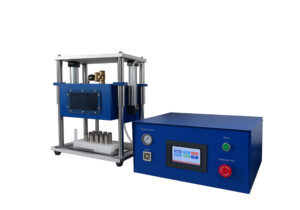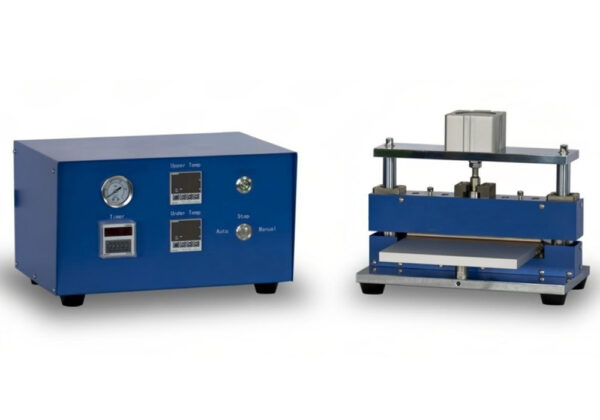
Split-Type Top and Side Sealing Machine XN-HS-200-S
Need a bulk order? Request a competitive quote today!
I. Product Introduction
This equipment is mainly suitable for sealing the top edge and side edges of pouch lithium batteries.
II. Working Principle
The resistance heating tube transfers heat to the copper sealing head. Through thermal conduction, the heat acts on the lithium battery packaging material (aluminum-plastic film). Under a certain pressure, the material is heated until it becomes soft and close to a molten state, thereby completing the pressing and fusion process. The machine can perform both top sealing and side sealing without replacing molds.
III. Main Features
Adopts a split-type structure, making it easy to operate inside a glove box.
Unique safety protection and anti-scalding design. The temperature of the upper and lower sealing heads can be adjusted through the temperature controller panel buttons, and the current temperature is displayed.
The sealing head is made of copper, providing excellent heat transfer performance, reducing power consumption, improving working efficiency, and offering better energy savings compared with similar products.
The pressure of the upper and lower sealing heads can be adjusted through a pressure regulating valve to meet different process parameter requirements.
The upper and lower sealing heads are driven by cylinders and guided by two linear guide sleeves, ensuring flexible movement and accurate guidance to guarantee the parallelism of the sealing edge.
Suitable for batteries of different specifications, with simple adjustment and no need to replace sealing heads.
The machine frame is made of aluminum profiles with an attractive appearance. The sheet metal adopts a three-dimensional geometric design, making it simple and aesthetically pleasing.
Compact size, uniform sealing marks, and neat sealing edges with an attractive appearance.
IV. Technical Parameters
Adopts a split-type structure, making it easy to operate inside a glove box.
Applicable specifications: side sealing ≤ 190 mm, top sealing 190 mm (including gas bag).
Sealing blade length: 200 mm.
Gas bag edge width: 15–90 mm.
Sealing width: standard 5 mm ± 0.4 (3–10 mm optional); sealing blades can be replaced for other widths.
Side sealing thickness: 60–400 μm (depending on aluminum-plastic film thickness).
Top tab sealing thickness: (soft seal) 200–706 μm (depending on aluminum-plastic film thickness); hard sealing can be customized for any thickness.
Heat sealing temperature: room temperature to 250 ℃ (freely adjustable).
Temperature control accuracy: ±2 ℃.
Distance from main body to sealing edge: 1–5 ± 0.4 mm adjustable.
Sealing time: standard 2–3 s (0–99 s adjustable).
Sealing thickness accuracy (mm): thickness difference between any two points after sealing < 15 μm.
Equipped with a protective device to prevent high-temperature burns.
The equipment includes a material placing platform.
The equipment supports both automatic and manual operation modes.
Compressed air: 5–8 kg/cm²; when used inside a glove box, it is recommended to use the same gas as in the glove box.
Compressed air working speed: ≥ 400 cycles per hour.
Power supply: AC 110V/220V ±10% 50 Hz.
Power: 0.5 kW.
Equipment dimensions:
Working unit: L315 × W150 × H290 mm.
Control unit: L320 × W240 × H220 mm.
Equipment weight: 20 kg.
V. Main Electrical and Standard Component Brands
Temperature controller: Autonics (Korea).
Intermediate relay: IDEC (Japan).
Solid state relay: Fotek (Taiwan).
AC contactor: CHINT.
Circuit breaker: CHINT.
Solenoid valve: Airtac.
Linear bearing: MYT.
Heating tube: Linzhi.
VI. Maintenance Method
Frequently wipe the equipment with a soft cloth soaked in alcohol to keep it clean.
Lubricate the moving parts with oil regularly to ensure smooth operation.
If the equipment is not used for a long time, clean the surface of the moving components and apply anti-rust oil for protection.
Regularly inspect the screws, nuts, pins, and other fasteners of the machine to prevent loosening and avoid equipment failure or personal injury.
VII. Precautions
During operation, it is strictly prohibited to place hands or any part of the body into the moving parts or hazardous working areas to avoid personal injury. Only one operator is allowed during operation to prevent accidental injury.
Non-technical personnel and unauthorized personnel are not allowed to disassemble the equipment.