
SEM Transfer Chambers for Air-Sensitive Battery Materials: A Buyer’s Guide
If your SEM image of a freshly cycled lithium electrode shows what looks like SEI but is actually oxide layer that formed in the 30 seconds between glovebox and microscope, you need a vacuum transfer chamber. This guide walks through the 8 Xnergy FB08-series chambers compatible with Zeiss, Thermo Scientific, Hitachi, and JEOL SEMs — with workflow guidance, custom sizing, and bulk pricing for battery research labs.
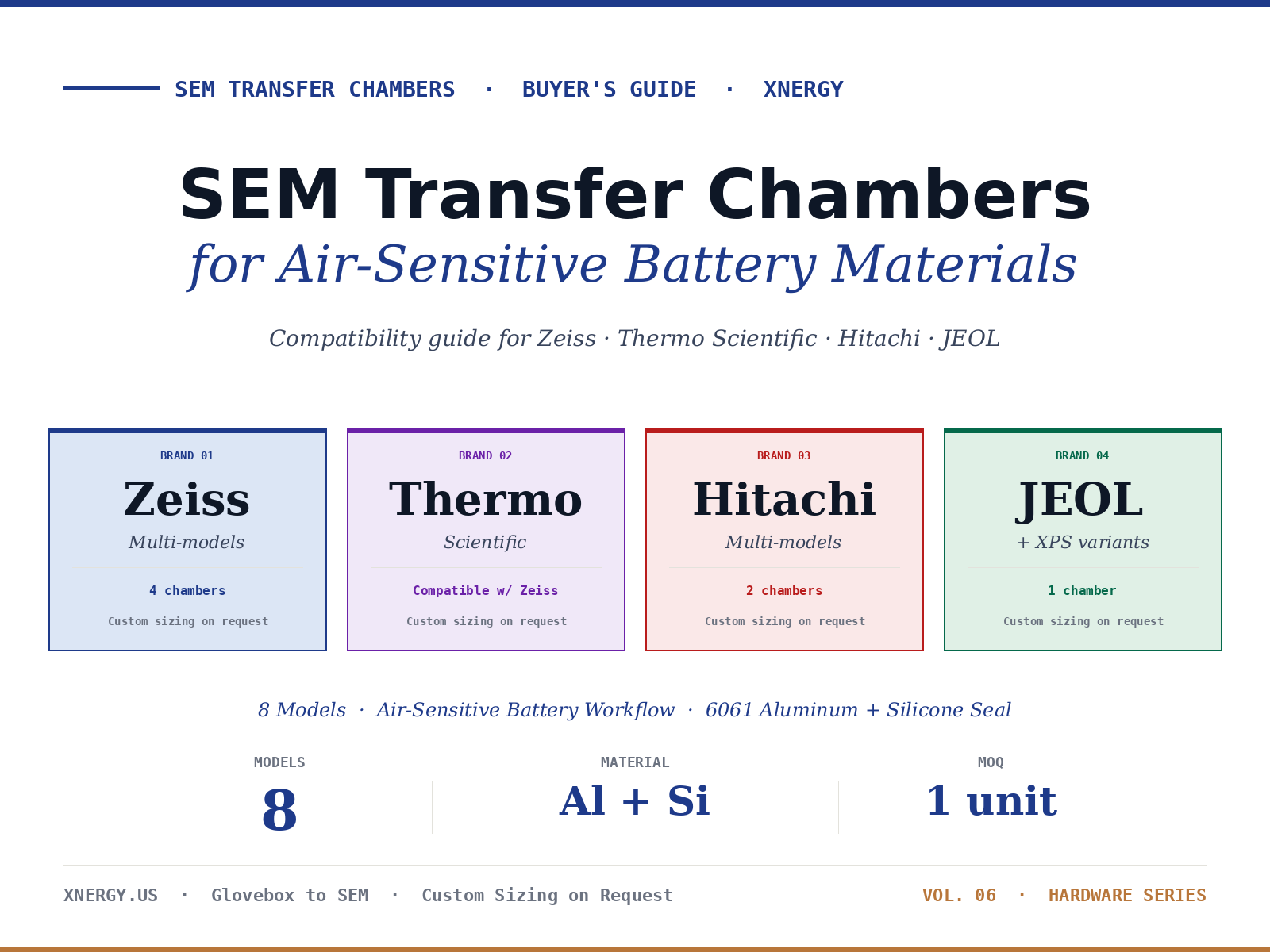
Lithium metal, sodium metal, sulfide solid electrolytes (LPSC, LGPS), and halide solid electrolytes (LZC, LIC, LYC) all oxidize within seconds of ambient-air exposure — making vacuum sample transfer essential for accurate SEM imaging. Xnergy supplies 8 SEM transfer chamber models in the FB08 series, each matched to a specific SEM brand's stub interface: Zeiss, Thermo Scientific, Hitachi, and JEOL. All chambers use 6061 aluminum bodies with silicone seals and ship with multiple-thickness pillow blocks for sample flexibility. Standard models ship within 1 week, custom sizing is supported, and bulk pricing is available for research groups ordering multiple units.
Why Air-Sensitive Battery Materials Need Vacuum Transfer
Walk into any battery research group's SEM facility and ask the senior PhD students about the most frustrating artifact they have seen in their imaging work, and you will hear variations of the same story: "we couldn't tell whether the morphology in our SEM image was the actual sample or an oxide layer that formed in transit."
The mechanism is straightforward. Thermo Fisher's own SEM-for-batteries technical brochure describes it cleanly:
For specific battery materials, the time scales are alarming:
• Lithium metal — Visible oxide layer in seconds; thick oxide layer (>100 nm) within minutes of dry-room air exposure
• Sodium metal — More reactive than lithium; surface chemistry shifts within seconds, dramatic morphology change within minutes
• Sulfide solid electrolytes (LPSC, LGPS) — React with humid air to release H2S; surface degrades within minutes
• Halide solid electrolytes (LZC, LIC, LYC, LTOC) — Slower than sulfides but still degrade within hours of humid-air exposure
• Cycled coin cell components — SEI on Li/Na surfaces is the most reactive thing in the entire cell
Without a vacuum transfer chamber, the standard "open glovebox antechamber, walk to SEM, mount sample" workflow guarantees the sample will see ambient air for 10–60 seconds. For most battery research questions, this is enough to make the SEM image fundamentally unreliable as a record of sample state.
The vacuum transfer chamber solves this by extending the inert atmosphere from inside the glovebox to inside the SEM stage — the sample never sees ambient air at any point in the workflow.
Why You Can't Buy "A Generic SEM Transfer Chamber"
SEM brand fragmentation is the second problem battery researchers face when choosing transfer hardware. Each major SEM manufacturer designed its sample stub interface independently, and these interfaces are not cross-compatible. A transfer chamber designed for a Zeiss Sigma will not fit a Hitachi S-4800. A JEOL JSM-IT300 stub will not seat in a Thermo Scientific Apreo stage.
This means choosing a transfer chamber is fundamentally a two-axis decision: (1) what SEM brand are you using, and (2) what sample size and geometry do you need. The first axis is non-negotiable — the chamber must mate with your specific SEM stub interface. The second axis determines which model within a brand's family you choose.
Xnergy's FB08 series covers the four major SEM brands used in battery research worldwide. The next sections walk through which chamber matches which SEM, with specific model numbers you can quote when ordering.
SEM Transfer Chambers by Brand: The Complete FB08 Series
The 8 chamber models below are organized by their compatible SEM brand. Click any model to view the full product page with specifications, pillow block options, and dimensional drawings.
Zeiss
Zeiss is the most common SEM brand in battery research labs globally. Xnergy supplies four Zeiss-compatible chambers covering different sample size and orientation requirements:
Thermo Scientific
Thermo Scientific SEMs (post-FEI acquisition) use the same stub interface as Zeiss for most models. The FB08-CSYWC01 chamber is dual-compatible — works with both Zeiss and Thermo Scientific platforms. For Thermo Scientific Phenom desktop SEMs:
For Phenom XL G2 in argon-conversion mode (where the SEM itself is in a glovebox), the transfer chamber requirement is reduced — contact us for guidance.
Hitachi
Hitachi SEMs use a distinct stub geometry from Zeiss/Thermo. Two chamber variants cover different Hitachi stage configurations:
JEOL
JEOL SEMs use a unique vertical-orientation stub system. The FB08-XPSSMF01 model is dual-compatible with JEOL SEMs and many XPS instruments — useful for labs that characterize the same sample on both platforms:
JEOL stubs vary across the JSM and JBM series — for non-standard JEOL stages, custom chamber dimensions are available on request.
For battery research labs using a different SEM brand or a non-standard stub geometry, Xnergy's general-purpose SEM Vacuum Sample Transfer Chamber is available for custom-spec orders — we work directly from your SEM stage drawings to design a matched chamber.
Picking the Right Model: A Decision Tree
For most battery research labs, the model selection comes down to two questions:
Question 1: What SEM are you using?
| SEM Brand | SEM Models | Recommended Chambers |
|---|---|---|
| Zeiss | Sigma, Merlin, Crossbeam, GeminiSEM | FB08-CSDS01 / SMFDS01 / CSYWC02 (large samples) FB08-CSYWC01 (compact samples) |
| Thermo Scientific | Phenom, Apreo, Verios | FB08-CSYWC01 (Thermo-Zeiss compatible) |
| Hitachi | S-3400, S-4800, SU-series | FB08-RBDZ01 (large) or FB08-RL01 (compact) |
| JEOL | JSM-IT300, JSM-7000-series | FB08-XPSSMF01 (also XPS-compatible) |
Question 2: What is your sample size envelope?
| Sample Size | Best Use | Recommended Chamber |
|---|---|---|
| Small (≤ 12.7 mm) | Coin cell electrodes (14–16 mm punched, but sample is the active area) | FB08-CSYWC01 (Zeiss/Thermo) FB08-RL01 (Hitachi) |
| Medium (12.7–25 mm) | Pouch cell electrodes, post-cycled coin cell components | FB08-RBDZ01 (Hitachi) FB08-XPSSMF01 (JEOL) |
| Large (25–50 mm) | Cross-sections of cold-pressed pellets, larger pouch electrodes | FB08-CSDS01 / SMFDS01 / CSYWC02 (Zeiss) |
Glovebox-to-SEM Workflow: Step by Step
Using a vacuum transfer chamber correctly is straightforward but demands attention to a few details that determine whether the inert atmosphere is preserved end-to-end. The workflow below applies to all FB08 series chambers:
- STEP 01 Inside the glovebox: mount the sample on the pillow block. Place your sample (electrode disc, pellet cross-section, etc.) on the appropriate pillow block. Use carbon tape or conductive paste to secure the sample. Match pillow block thickness to sample thickness so the SEM working distance is correct.
- STEP 02 Seat the pillow block in the chamber recess. The recess is sized to hold the pillow block without lateral movement. Verify the pillow block sits flush below the silicone sealing surface.
- STEP 03 Close the chamber lid until the silicone seal compresses. The hinged lid clamps down via thumbscrews or a captive fastener. Tighten until you feel firm resistance — the silicone gasket should be compressed by 30–50% to maintain vacuum integrity.
- STEP 04 Transfer the sealed chamber out of the glovebox via antechamber. Standard glovebox antechamber pump-down protocol applies. The chamber's silicone seal holds inert atmosphere inside the chamber while the antechamber pumps to vacuum and back-fills with air.
- STEP 05 Carry to SEM and load into exchange chamber. Place the chamber in the SEM exchange/airlock chamber. Pump the exchange chamber to operating vacuum (typically 10⁻³ to 10⁻⁵ Torr depending on SEM model).
- STEP 06 Open the chamber lid under vacuum. Once the SEM exchange chamber reaches operating vacuum, the chamber lid can be opened (via the integrated hinge mechanism, accessible through the SEM's transfer manipulator). The sample is now exposed to the SEM exchange chamber's vacuum — not ambient air.
- STEP 07 Transfer the pillow block to the SEM main stage. The SEM transfer arm picks up the pillow block from the now-open chamber and moves it to the imaging position. Standard SEM imaging proceeds from this point.
One published methodology paper (SEM characterization technique for air-sensitive all-solid-state lithium battery materials, 2025) describes essentially this same workflow applied to halide solid electrolyte Li2ZrCl6 — demonstrating both the protocol's feasibility and the specific value of the approach for battery research:
Common Specifications Across the FB08 Series
Chamber body: 6061 aluminum alloy
All FB08 series chambers use 6061 aluminum alloy as the body material. 6061 was chosen for its combination of low weight (important for one-handed manipulation in a glovebox), CNC machinability (allows precise dimensional tolerances on the sealing surfaces), dimensional stability across temperature variations (rooms typically 18–25 °C), and electrochemical inertness toward typical battery research samples. Anodized surface finishes are available on request for labs requiring chemical inertness against more aggressive samples.
Sealing: silicone gasket
The red-colored sealing rings visible in product images are silicone elastomer. Silicone provides reliable sealing at the moderate vacuum levels required for SEM transfer (typically 10-3 to 10-5 Torr range during SEM exchange chamber operation). Higher-vacuum applications (10-6 Torr+ for ultra-high-vacuum SEMs or some XPS systems) can use fluoroelastomer (Viton) sealing on request — specify when ordering.
Pillow blocks: matched aluminum sample stubs
Each chamber ships with one or more compatible pillow blocks (sample stubs). The pillow block is the part that holds your actual sample inside the chamber, and is the part that gets transferred onto the SEM stage. Standard pillow block dimensions and thickness options:
| Chamber Model | Pillow Block Size | Available Thicknesses |
|---|---|---|
| FB08-CSDS01 / SMFDS01 / CSYWC02 | 35 × 12.8 mm | 2 mm, 3 mm, 4 mm |
| FB08-CSYWC01 | 12.7 × 11 mm | 2 mm, 3 mm, 4 mm |
| FB08-RBDZ01 | 15 × 10 mm | 10 mm |
| FB08-RL01 | 14 × 7 mm | 2 mm, 3 mm, 4 mm |
| FB08-XPSSMF01 | 23.6 × 15.6 mm | 10.5 mm depth (single block) |
Multiple thickness options let you match sample thickness to SEM stage focal distance without buying a different chamber. Custom pillow block dimensions are available on request — useful for non-standard sample geometries (irregular pellet cross-sections, asymmetric coin cell components, etc.).
Bulk Pricing for Research Labs
All Xnergy SEM transfer chambers are quote-based with bulk discounts for research labs ordering multiple units — particularly common when a single research group operates with multiple SEM platforms or supports multiple PIs working on different battery chemistries. Standard models ship within 1 week, custom-spec chambers within 1–2 weeks.
Request a Quote for SEM Transfer Chambers
Tell us your SEM brand and model number, the type of samples you intend to image (lithium metal, sodium metal, sulfide/halide solid electrolyte, post-cycled electrode, etc.), and how many units you need. We typically respond within one business day with model recommendation, pricing, and lead time.
- 8 standard FB08 series models in stock
- Compatible with Zeiss, Thermo Scientific, Hitachi, JEOL SEMs
- 6061 aluminum body + silicone sealing standard
- Multiple-thickness pillow blocks ship with each chamber
- Custom dimensions available (1–2 week lead time)
- Bulk discounts for research labs ordering 3+ units
- XPS-compatible variant for joint SEM+XPS workflows
- Long-term supply agreements for shared user facilities
sales@xnergy.us · 1-512-270-1908
Research applications supported
Frequently Asked Questions
Why do I need a vacuum transfer chamber for SEM imaging of battery materials?
Lithium metal, sodium metal, and most sulfide and halide solid electrolytes oxidize within seconds to minutes of exposure to ambient air. Without a vacuum transfer chamber, what you see in your SEM is not your actual sample — it's the oxide layer that formed during the few seconds between glovebox-to-SEM stage. This is one of the most common sources of artifacts in published battery SEM images, and the reason why Li metal SEI studies, sodium dendrite morphology research, and solid electrolyte interface characterization all require an airtight transfer workflow. A vacuum transfer chamber holds your sample under inert atmosphere from the glovebox to the moment it enters the SEM exchange chamber.
Which SEM brands are compatible with Xnergy transfer chambers?
Xnergy supplies SEM vacuum transfer chambers compatible with all four major SEM brands used in battery research: Zeiss (Sigma, Merlin, Crossbeam, GeminiSEM series), Thermo Scientific (Phenom, Apreo, Verios — uses same stub system as Zeiss), Hitachi (S-3400, S-4800, SU-series), and JEOL (JSM-IT300, JSM-7000-series, with XPS-compatible variant). Each chamber model is designed to match a specific stub interface — when ordering, specify your SEM model so we can recommend the correct chamber. Custom dimensions are available for non-standard SEM stages on request.
What battery materials require vacuum transfer for SEM imaging?
Air-sensitive battery materials that require vacuum transfer for accurate SEM characterization include: lithium metal anodes (especially after cycling, where SEI morphology is the research target), sodium metal anodes and dendrite formations, sulfide solid electrolytes (LPSC, LGPS, Li7P3S11) which release H2S on humid-air contact, halide solid electrolytes (LZC, LIC, LYC, LTOC) which oxidize and hydrolyze, fresh cathode/electrolyte composite cross-sections from cold-pressed pellets, post-cycled coin cell components (electrodes, separators with deposited Li/Na), and pre-lithiated electrodes. For oxide cathodes (NCM, LCO, LFP) post-cycling, vacuum transfer is recommended but not strictly required.
What is the difference between Xnergy's SEM transfer chamber models?
Each Xnergy chamber model corresponds to a specific SEM stub interface and sample size envelope: FB08-CSDS01 (Zeiss, 50×7mm sample area, supports 35×12.8mm pillow blocks at 2/3/4mm thickness), FB08-CSYWC01 (Zeiss/Thermo Scientific, 20×7mm sample area, 12.7×11mm pillow blocks), FB08-CSYWC02 (Zeiss, 50×7mm with vertical orientation), FB08-RBDZ01 (Hitachi, 25.3×12mm sample area, single 15×10×10mm block), FB08-RL01 (Hitachi, 20×6.5mm sample area, multiple thickness pillow blocks), FB08-SMFDS01 (Zeiss, 50×7mm standard), and FB08-XPSSMF01 (JEOL, 23.6×15.6mm with vertical chamber, also XPS-compatible). All use 6061 aluminum body with silicone sealing rings for vacuum integrity, and all support custom dimensions on request.
Are Xnergy transfer chambers compatible with XPS measurements?
The FB08-XPSSMF01 model is specifically designed to be compatible with both SEM and XPS sample workflows. Most battery research labs use XPS for surface chemistry analysis (SEI composition, oxidation state mapping) in addition to SEM for morphology — having a transfer chamber that bridges both characterization platforms eliminates the need for separate transfer setups and reduces the risk of intermediate exposure. The other FB08 models are SEM-only and not designed for XPS sample geometry.
What materials are the chambers made from?
All Xnergy SEM transfer chambers use 6061 aluminum alloy as the body material, with silicone sealing rings (red colored in product images) for vacuum integrity. 6061 aluminum was chosen for its combination of low weight, machinability, dimensional stability, and electrochemical inertness toward typical battery research samples. Silicone sealing was chosen over fluoroelastomer or metal sealing because it provides reliable sealing at the moderate vacuum levels required for SEM transfer (typically 10-3 to 10-5 Torr range) without the cost or complexity of higher-vacuum sealing systems.
What is the workflow for using a vacuum transfer chamber?
Standard workflow: (1) inside the glovebox, place your sample on the pillow block (sample stub), seat the pillow block in the chamber recess, (2) close the hinged lid until the silicone seal compresses, (3) remove the sealed chamber from the glovebox antechamber, (4) carry to the SEM and place in the SEM exchange/airlock chamber, (5) pump the SEM exchange chamber to vacuum, (6) once at SEM operating vacuum, manually open the chamber lid using the hinge mechanism (this happens inside the SEM under vacuum), (7) the SEM stage transfer arm picks up the pillow block from the now-open chamber and moves it to the imaging position. The sample never sees ambient air during the entire process.
Can I get custom-sized SEM transfer chambers?
Yes. Custom sizing is available for all FB08 series chambers, including non-standard pillow block dimensions, custom chamber depths for thicker samples, modified hinge geometry for specific SEM stage clearance requirements, and adapted sealing surfaces for non-standard SEM exchange chambers. For research groups with newer or non-standard SEM models, we work directly from your stage drawings or sample specifications. Lead time for custom chambers is typically 4-6 weeks; standard models ship within 1 week.
How does the chamber pillow block system work?
The pillow block (also called sample stub or sample pad) is the small aluminum block that holds your actual sample inside the chamber. Standard pillow block sizes range from 12.7×11mm (small, for FB08-CSYWC01) to 35×12.8mm (large, for FB08-CSDS01/CSYWC02/SMFDS01) with thickness variants of 2mm, 3mm, or 4mm. The thickness variant lets you match sample thickness to SEM stage focus distance. Larger samples or non-standard geometries are accommodated by custom pillow block designs. Multiple thickness pillow blocks ship with each chamber, allowing flexibility across different sample thicknesses without buying a new chamber.
Where can I buy SEM transfer chambers for battery research?
Xnergy Materials supplies the complete FB08 series of SEM vacuum transfer chambers for battery research, with models compatible with Zeiss, Thermo Scientific, Hitachi, and JEOL SEM systems. All grades are quote-based with bulk pricing for research labs ordering multiple units, custom sizing available on request, and standard models shipping within 1 week. For ordering, contact sales@xnergy.us with your SEM brand, model number, and any custom dimension requirements. Xnergy also supplies the upstream battery materials these chambers are designed to characterize — lithium metal, sodium metal, halide and sulfide solid electrolytes — making us a single supplier for the full air-sensitive battery research workflow.
Selected Literature on Air-Sensitive Battery SEM Characterization
The methodology and material-specific guidance in this article is supported by published research on SEM characterization of air-sensitive battery materials:
- Wang, Y. et al. (2025). SEM characterization technique for air-sensitive all-solid-state lithium battery materials. Materials Chemistry and Physics. — Documents a movable airtight transfer box methodology applied to halide SSE Li2ZrCl6 with relative density quantification of 87.8%.
- Stephant, N. et al. (2018). New airtight transfer box for SEM experiments: Application to lithium and sodium metals observation and analyses. ScienceDirect. — Foundational paper on airtight transfer box design for Li and Na metal SEM observation, with quantitative Na/O ratio measurements demonstrating extended transfer-time capability.
- Sun, Y. et al. (2018). Coin-Cell-Based In Situ Characterization Techniques for Li-Ion Batteries. Frontiers in Energy Research. — Documents how modified coin cells with Be windows enable in situ SEM-adjacent measurements; complementary to vacuum transfer for ex situ post-mortem work.
- Berkes, B. et al. (2021). Stable and Efficient Lithium Metal Anode Cycling through Understanding the Effects of Electrolyte Composition and Electrode Preconditioning. Chemistry of Materials. — Documents post-cycling Li metal SEM imaging using a hermetic transfer chamber on a JEOL JSM-IT300, demonstrating the practical integration of vacuum transfer into Li metal anode research workflows.
- Thermo Fisher Scientific. SEM for Lithium Battery Research. — Industry technical brochure documenting the unique sample-handling challenges of battery SEM and the role of inert-atmosphere workflows.
- Volta Foundation (2025). Unlocking Insights into Battery Materials Using SEM Analysis. — Industry overview of cross-section polishing and air-isolation workflows from glovebox to CP to SEM for battery research.
What to Image with Your Transfer Chamber
The transfer chamber is the last step in your air-sensitive battery research workflow. The materials below are what you actually image with it — all available from Xnergy:
Single supplier for the full air-sensitive battery research workflow
From the lithium and sodium metal anodes you cycle, to the halide and sulfide solid electrolytes you press into pellets, to the SEM transfer chambers you use to image them post-mortem — Xnergy supplies the entire research pipeline. Specify your SEM model, your sample types, and how many units you need; we respond with model recommendation, lead time, and pricing within one business day.