
The Complete Coin Cell Hardware Buyer’s Guide for Battery Research
From $1.15-per-piece 304SS CR2032 cases to Kapton-window cells for in situ XRD, this guide walks through Xnergy’s 15-product coin cell hardware catalog — cases, spacers, springs, complete sets, and specialty designs — with selection guidance, sale pricing, and bulk options for academic and industrial battery R&D.
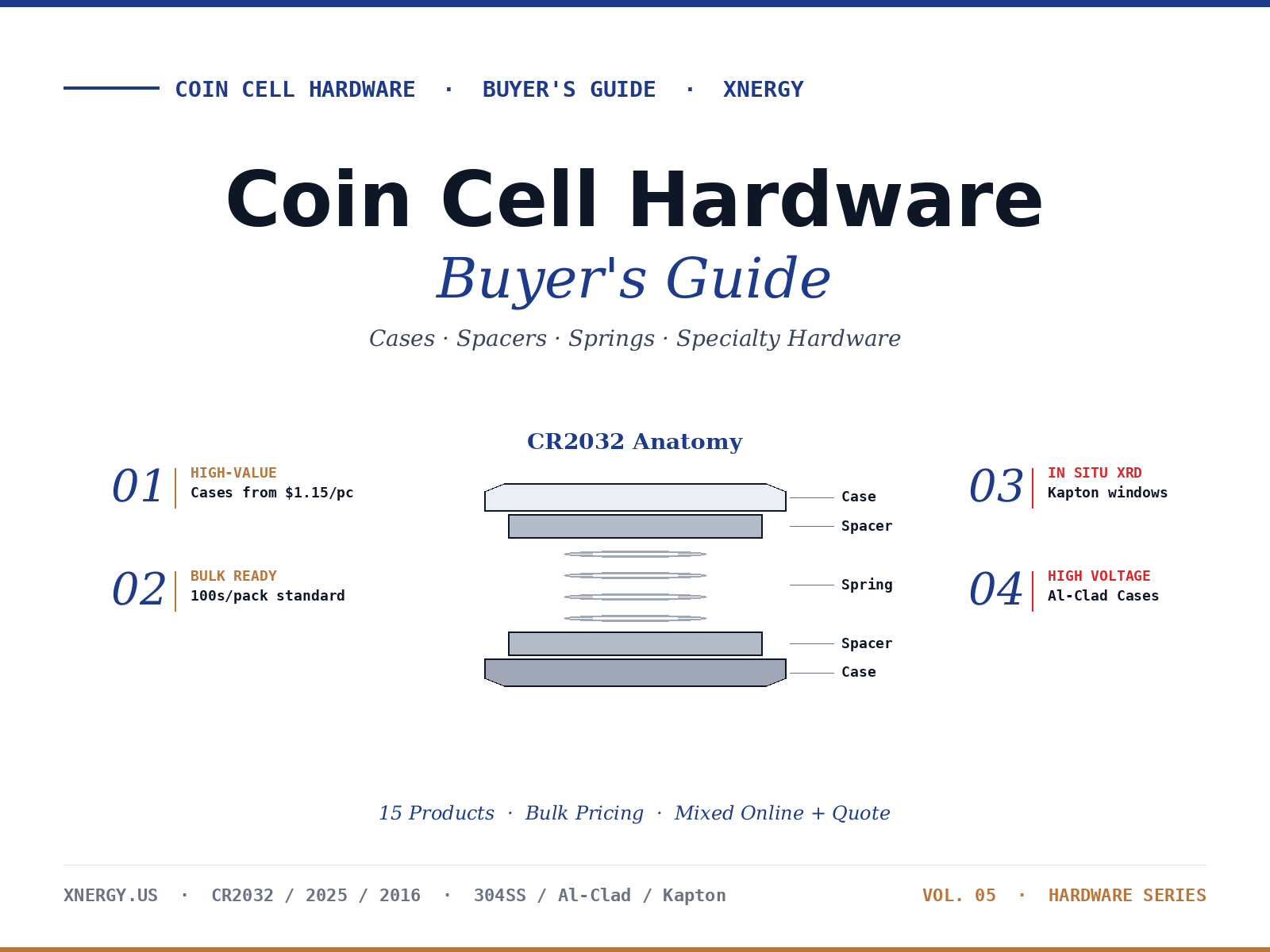
Coin cell hardware is the most fundamental category in battery research — almost every cathode chemistry, electrolyte formulation, and electrode binder gets its first electrochemical evaluation in a coin cell. Xnergy positions coin cell hardware as a high-volume, value-priced supply line: standard 304SS CR2032 cases at $115/100 pcs ($1.15 each, on sale from $225), complete CR2032 case+spring+spacer sets at $199/100 sets ($1.99 per cell), and specialty Kapton-window cells for in situ XRD and high voltage research from $140. Aluminum-clad case sets for high-voltage research and pure-aluminum spacers are quote-based with bulk pricing for kg-scale production research orders.
Why Coin Cells Are the Standard for Battery Research
Walk into any battery research lab anywhere in the world — academic, government, or industrial — and you will find coin cell crimping equipment within ten meters of the glove box. The 20-mm-diameter CR2032 coin cell has been the standard format for electrochemical evaluation of new battery materials since the 1990s, and despite the proliferation of pouch and cylindrical formats for production-relevant testing, the coin cell remains the universal first step in any battery research workflow.
The reasons are practical:
• Low material consumption — A coin cell uses 50–200 mg of active material, compared to 5–50 g for a pouch cell. For early-stage chemistry exploration, this matters.
• Fast assembly — A trained researcher can assemble 50–100 coin cells in a single afternoon, supporting statistical replicates and parametric studies.
• Reproducible geometry — Standard CR2032 dimensions mean cell-to-cell variability is dominated by the chemistry, not by hardware tolerances.
• Compatibility with all major battery cyclers — Arbin, Maccor, Neware, BCS, and others all support coin cell holders.
• Safe handling — The crimped stainless-steel case is mechanically robust and non-leaking.
Modern coin cell research has also evolved beyond simple cycling experiments to include high voltage applications. In situ X-ray diffraction with Kapton-window cells, operando electrochemistry with synchrotron beamlines, and high-voltage cathode testing with aluminum-clad cases have extended the coin cell from a screening tool into a legitimate characterization platform. This guide covers both the standard hardware needed for routine cycling and the specialty hardware needed for these advanced applications.
The Anatomy of a Coin Cell: Five Hardware Components
A complete coin cell stack contains five hardware components surrounding the active battery materials. Each component has specific selection criteria; getting any of them wrong introduces variability that can mask real chemistry effects.
- LAYER 01 Positive Cap (Top Case) The top case, typically 304 stainless steel for standard cells or aluminum-clad for high-voltage research. Holds the cathode current collector.
- LAYER 02 Top Spacer A 0.5–1.0 mm stainless steel disc that fills empty volume above the cathode and ensures consistent stack pressure when crimped.
- LAYER 03 Cathode + Separator + Anode The active battery materials. Cathode disc, separator (Celgard or glass fiber), electrolyte-saturated, then anode (Li or Na metal foil/disc).
- LAYER 04 Spring + Bottom Spacer The conical or funnel spring applies compression; a second spacer below the spring distributes the pressure evenly across the stack.
- LAYER 05 Negative Can (Bottom Case) The bottom case, with integrated polymer gasket. Crimped to the positive cap during cell assembly, sealing the cell hermetically.
The next sections walk through the selection logic for each major component — cases, spacers, and springs — followed by the specialty hardware (Kapton windows, perforated cases) for advanced characterization.
Cases: Choosing CR2032 vs CR2025 vs CR2016, and 304SS vs Al-Clad
Cases are the structural foundation of the coin cell. Two decisions matter: format (CR2032 vs CR2025 vs CR2016, governed by internal volume needs) and material (304SS vs Al-Clad, governed by operating voltage).
Format Selection: Internal Volume Drives the Choice
| Format | Diameter | Thickness | Internal Volume | Typical Use |
|---|---|---|---|---|
| CR2032 | 20 mm | 3.2 mm | Largest | Default for battery R&D — fits 14–16 mm electrodes + spacers + spring |
| CR2025 | 20 mm | 2.5 mm | Medium | Thinner electrode stacks; consumer-electronics-relevant testing |
| CR2016 | 20 mm | 1.6 mm | Smallest | Very thin electrodes; high-density cell testing arrays |
Available Case Products
304SS CR2032 Coin Cell Cases
The default case for most lithium-ion and sodium-ion battery research. Chemically stable up to ~4.3 V, compatible with all standard crimping equipment.
304SS CR2025 Coin Cell Cases
Thinner CR2025 format for thin-electrode stacks or applications where reduced cell height matters. Same 304SS chemistry as CR2032 cases.
304SS CR2016 Coin Cell Cases
The thinnest standard coin cell format. Ideal for very thin electrode stacks, high-density testing arrays, or replicating commercial CR2016 button cell geometries.
Al-Clad CR2032 Case Set (Al Cap + 304SS Can)
For high-voltage cathode research above 4.3 V. The aluminum-clad positive cap prevents 304SS oxidation in contact with high-V cathodes (4.6 V LCO, NCM811, oxychloride electrolyte cells).
Al-Clad CR2032 Coin Cell Case Set (Both-Side Aluminum)
Full aluminum-clad case set for the most aggressive high-voltage research, including 5+ V cathode studies and oxychloride solid-state cells where both case sides need protection.
Spacers: Filling the Stack and Distributing Pressure
Spacers fill the empty volume in the coin cell to ensure consistent stack pressure when the cell is crimped. They also serve as inert current collector extensions on both sides of the active stack. Three thicknesses of 304 stainless steel spacers cover most research workflows; pure aluminum spacers are added for high-voltage cathode-side use.
Thickness Selection Matrix
| Thickness | Best Use | Typical Cell Configuration |
|---|---|---|
| 0.5 mm | Standard CR2032 cells with both electrodes thicker than 100 µm | Half-cell or full-cell with conventional electrode loadings |
| 0.8 mm | Thin-electrode cells (50–100 µm active layer) | Solid-state cells, thin-cathode high-energy research |
| 1.0 mm | Symmetric cells (Li/Li, Na/Na) with one or no active layer | Lithium plating-stripping studies, sodium symmetric cells |
304SS Spacer 0.5 mm
Default spacer thickness for most lithium-ion battery research. One spacer per cell side, matched to electrode thickness around 100–200 µm.
304SS Spacer 0.8 mm
Mid-thickness spacer for thinner-electrode stacks. Common choice for solid-state cell research where active layer thickness is limited.
304SS Spacer 1.0 mm
Thick spacer for symmetric cell experiments where only one or no active electrode is present. Common in Li/Li or Na/Na plating-stripping studies.
Pure Aluminum Spacer
For cathode-side use in high-voltage cells where the spacer contacts the cathode through the catholyte. Pure aluminum prevents corrosion at >4.3 V.
Springs: Applying Consistent Stack Pressure
Springs apply compression to the coin cell stack, ensuring consistent electrical contact and electrolyte distribution during cycling. The default choice for standard CR2032 cells is the 304SS conical spring; for Al-clad high-voltage cells, the matching aluminum-coated funnel spring is used.
304SS Conical Spring for CR2032
The default spring for standard CR2032 cells. Linear compression curve, compatible with all standard CR2032 stack heights using 0.5–1.0 mm spacers.
Aluminum-Coated Funnel Spring
Funnel-shaped spring with aluminum coating for high-voltage Al-Clad cells. Higher initial preload than conical springs, suitable for thick or stiff electrode stacks.
The CR2032 Complete Set: Best Value for Routine Research
For research groups that need cases, springs, and spacers in matched quantities, the complete CR2032 case set bundles all three at a significant discount over buying components separately:
304SS CR2032 Case + Spring + Spacer Set
$199 for 100 complete sets (was $278)
$1.99 per complete cell. Includes 100 cases, 100 springs, 100 spacers, all matched and packaged together.
Why the bundle is the best value: if you buy CR2032 cases ($115), conical springs ($41), and 0.5 mm spacers ($52) separately, the components total $208. The bundle at $199 saves $9 per pack while guaranteeing the components are matched and ready for assembly. For research groups consuming 500+ coin cells per year, the bundle is the default purchase.
Specialty Hardware: Kapton Windows, Perforated Cases & Beyond
Beyond standard cycling research, specialty coin cell hardware enables advanced characterization techniques that have transformed battery research over the past decade. Xnergy supplies three specialty products in this category:
In Situ X-Ray Diffraction with Kapton Windows
X-ray diffraction during electrochemical cycling reveals how cathode and anode materials change in real time — lattice expansion, phase transitions, structural disordering. The standard approach uses a CR2032 case modified with a Kapton-tape window in the case wall, allowing X-rays to penetrate the case while the cell cycles. Both single-window (transmission or reflection mode) and double-window (full-transmission XRD or simultaneous XRD/XAS) variants are available.
CR2032 Case with Double Kapton Windows
Both case sides have X-ray transparent Kapton windows for full-transmission in situ XRD. Designed for synchrotron-based and lab-source operando measurements during cycling. Ideal for cathode lattice evolution studies.
CR2032 Case with Single Kapton Window
Single-side Kapton window (10 mm diameter) for reflection-mode in situ XRD. The most common design for academic synchrotron beamlines and laboratory-source XRD studies of single-crystal or thin-film cathode materials.
NK02 Perforated Coin Cell Case
Perforated case design with calibrated holes for controlled gas exchange, gas-evolution monitoring, in situ pressure measurement, or external probe insertion. Specialty product for advanced electrochemical characterization workflows.
Why specialty hardware matters
The Kapton-window cells are not just another coin cell variant — they enable an entire class of research that ex situ characterization cannot provide. Studying how a cathode material's crystal structure evolves during charge and discharge, in real time, is one of the most powerful techniques in modern battery research. Recent reviews in Carbon Energy document hundreds of studies using exactly this experimental setup.
Putting It Together: A Selection Decision Tree
For most research scenarios, the choice of coin cell hardware reduces to four questions:
Question 1: What is your operating voltage?
• ≤ 4.3 V (LFP, conventional NMC at 4.2 V cutoff, Na-ion liquid electrolyte cells) → 304SS cases, conical springs, 304SS spacers
• 4.3–4.6 V (NCM811 at high cutoff, NCA, oxychloride solid electrolyte cells) → Al-Clad case set + Al-coated funnel spring (cathode side), Al spacer cathode-side
• ≥ 4.6 V (4.6 V LCO, 5 V spinel research, advanced solid-state cells) → Both-side Al-Clad case set, full Al hardware
Question 2: What is your cell architecture?
• CR2032 (default, 90%+ of battery research) → CR2032 cases, 0.5 mm spacers, conical spring
• CR2025 (thinner cells, hybrid testing) → CR2025 cases, 0.5 mm spacer, conical spring
• CR2016 (thinnest stacks, very thin electrodes) → CR2016 cases, 0.5 mm spacer, conical spring
Question 3: How many cells per month?
• < 50 cells/month → Buy components separately, customize as needed
• 50–500 cells/month → Use the CR2032 bundle ($199 per 100 sets) for routine cells
• > 500 cells/month → Contact us for bulk pricing on 1,000+ piece orders
Question 4: Are you doing in situ characterization?
• Standard cycling → Standard 304SS or Al-Clad case
• In situ X-ray diffraction → Kapton window cells (single-side $140 or double-side $240)
• Gas evolution / pressure monitoring → NK02 perforated case
Bulk Pricing for High-Volume Battery Research Programs
Xnergy positions coin cell hardware as a high-value, high-volume supply category. The retail pricing shown above is already aggressively discounted from market rates, but the real value emerges at scale — research groups consuming 1,000+ cells per month, contract research organizations running parallel screening pipelines, and industrial battery R&D labs benefit from significant volume discounts.
Tiered bulk discounts
• 500–1,000 pcs: standard retail pricing applies
• 1,000–5,000 pcs: contact for volume discount
• 5,000–50,000 pcs: tiered bulk pricing with reserved inventory
• 50,000+ pcs (annual contract): long-term supply agreements with custom pricing, custom packaging, and rapid-delivery options
Order Coin Cell Hardware Now
Standard cases, spacers, springs, and bundle sets are available for direct online purchase. Al-Clad high-voltage hardware, pure aluminum spacers, and bulk orders 1,000+ pcs are quote-based with custom pricing. Sale prices currently active — check the catalog for the latest deals.
- 15 products in stock for immediate shipping
- 304SS CR2032 cases at $1.15/piece (sale)
- Complete CR2032 sets at $1.99/cell (best value)
- Conical springs at $0.41/piece (sale)
- Al-Clad cases & pure Al spacers: quote-based
- Kapton-window cells for in situ XRD: from $140
- Bulk pricing for 1,000+ piece orders
- Long-term supply agreements for production-scale research
sales@xnergy.us · 1-512-270-1908
Research applications supported
Frequently Asked Questions
What components do I need to assemble a coin cell?
A complete coin cell assembly requires five hardware components plus your active materials: (1) a positive case and (2) a negative case (typically 304 stainless steel for standard cells, aluminum-coated for high-voltage applications), (3) one or two stainless steel spacers (commonly 0.5, 0.8, or 1.0 mm thick) to fill the empty volume and ensure proper electrical contact, (4) a conical or funnel spring to apply consistent pressure across the stack, and (5) a gasket (sometimes integrated with the case set) to prevent electrolyte leakage. The cathode, separator, electrolyte, and anode go between these hardware layers.
What is the difference between CR2032, CR2025, and CR2016 coin cells?
All three are 20 mm diameter coin cells differing in case thickness: CR2032 is 3.2 mm thick (the most common research format with maximum internal volume), CR2025 is 2.5 mm, and CR2016 is 1.6 mm (the thinnest standard format). For most battery R&D, CR2032 is the default — its larger internal volume accommodates standard 14–16 mm electrode disks, two spacers, and a spring with room for tolerance variation. CR2025 and CR2016 are useful when stacking multiple cells in space-constrained battery testers, or when researchers want to standardize on a particular form factor for consumer-electronics-relevant testing.
When should I use Al-Clad (aluminum-coated) coin cell cases?
Aluminum-clad coin cell cases are required for high-voltage cathode research above approximately 4.3 V vs Li/Li⁺. Standard 304 stainless steel cases are corroded by the cathode side at high potentials, which contaminates the electrolyte and degrades cell performance. The aluminum cladding (typically only on the positive cap, with a 304SS negative can) provides a chemically stable interface up to 5+ V. For 4.6 V LCO research, NCM811/NCA cycling, oxychloride solid electrolyte cells (LTOC, LZCO), and other high-V chemistries, Al-Clad cases are essentially mandatory. For 4.0 V-class cells (LFP, conventional NMC at 4.2 V cutoff), standard 304SS is sufficient.
What thickness spacer should I use in my coin cell?
The total spacer thickness in your coin cell stack should fill the space between your active electrodes and the case+spring assembly so that the stack is firmly compressed when the cell is crimped. For standard CR2032 cells with 14–16 mm electrodes (~100–200 μm thick each), one or two 0.5 mm 304SS spacers, plus a conical spring, typically provide the right compression. Use 0.8 mm or 1.0 mm spacers if your electrodes are particularly thin (<80 μm) or if you only have a single electrode (e.g., symmetric Li/Li or Na/Na cells). Pure aluminum spacers are required for the cathode side in high-voltage cells where the spacer contacts the cathode through the catholyte.
Do you offer Kapton window coin cells for in situ XRD?
Yes. Xnergy supplies two Kapton-window CR2032 coin cell variants for in situ X-ray diffraction and operando characterization: the single-window version (CR2032KAP, 10 mm window, 5 sets/pack at $140) and the double-window version (CR2032KAP2S, two-sided X-ray transparent windows for transmission-mode XRD, 5 pairs/pack at $240). Both are designed for laboratory-source and synchrotron-based XRD measurements during electrochemical cycling, useful for studying cathode lattice evolution, phase transitions, and reaction mechanisms.
What is the price of CR2032 coin cell cases in bulk?
Standard 304 stainless steel CR2032 coin cell cases are priced at $115 for a 100-piece pack ($1.15 per piece) — currently on sale from the original $225. The complete CR2032 case set with case, spring, and spacer included is $199 per 100-set pack ($1.99 per cell). For larger volumes (1,000+ pieces), bulk pricing is available with significant discounts on a quote basis. For high-voltage research, Al-Clad CR2032 case sets are quote-based pricing. Contact sales@xnergy.us for bulk quotes and academic/industrial pricing.
What is the difference between conical and funnel springs?
Both spring types apply pressure to the coin cell stack during cycling, but with slightly different load profiles. Conical springs (also called wave springs) have a single tapered profile and provide a smooth, linear compression curve — best for standard CR2032 cells with the typical electrode + spacer stack. Funnel springs have a cone-within-cone or stepped profile that allows for higher initial preload and is preferred for cells with thicker electrode stacks or stiffer separators. For standard 304SS coin cells, the conical spring is the default choice; for Al-Clad high-voltage cells, the matching aluminum-coated funnel spring is recommended.
What is the NK02 perforated case used for?
The NK02 perforated coin cell case is a specialty design with calibrated perforations that allow controlled gas exchange or external probe access during cell operation. It is used in research applications requiring controlled-atmosphere testing, gas-evolution monitoring, in situ pressure measurement, or external probe insertion for reference electrodes. The perforations are not standard XRD windows — for in situ X-ray applications, the Kapton-window variants are the appropriate choice. NK02 is supplied 10 pieces per pack at $125.
Can I get coin cell hardware in larger bulk quantities for production research?
Yes. Xnergy is positioned for both small-scale lab research and large-scale supply with bulk pricing for orders of 1,000+ pieces, 10,000+ pieces, and pilot-scale volumes (50,000+). For research groups consuming 100+ coin cells per week and industrial labs running cell-level R&D pipelines, long-term supply agreements with reserved inventory and volume-based pricing tiers are available. Custom packaging, custom case markings, and rapid delivery for production-aligned research are supported. Contact sales@xnergy.us with your projected annual volume for a custom quote.
Are these coin cell components compatible with standard crimping equipment?
Yes. All Xnergy coin cell hardware is sized to standard CR2032, CR2025, and CR2016 specifications and is compatible with all standard coin cell crimping equipment, including MTI MSK-110 / MSK-160E, Hohsen, GELON, and similar manual and electric crimpers used in academic and industrial battery research labs. The 304 stainless steel cases use standard sealing dies, and the gasket dimensions are within ISO/IEC 60086-2 tolerances.
Selected Literature on Coin Cell Methodology & In Situ Characterization
The technical guidance in this article is supported by published research on coin cell methodology, in situ X-ray characterization, and high-voltage battery cell design:
- Yang, X. et al. (2018). Coin-Cell-Based In Situ Characterization Techniques for Li-Ion Batteries. Frontiers in Energy Research. — Foundational paper documenting how to modify standard CR2032 coin cells with Kapton or Be windows for in situ XRD and Raman.
- Lee, S. et al. (2024). In situ techniques for Li-rechargeable battery analysis. Carbon Energy. — Comprehensive review of in situ characterization methods including Kapton-window coin cells, with hundreds of cited applications.
- Lin, F. et al. (2018). In situ/operando synchrotron-based X-ray techniques for lithium-ion battery research. NPG Asia Materials. — Review covering modified coin cell design constraints, including discussion of Kapton tape sealing, cell pressure uniformity, and AMPIX cell designs for synchrotron measurements.
- Liang, G. et al. (2021). A Robust Coin-Cell Design for In Situ Synchrotron-based X-Ray Powder Diffraction Analysis of Battery Materials. Batteries & Supercaps. — Reports a robust modified coin cell for high-voltage in situ XRD, with electrochemical performance comparable to standard CR2032.
- Llewellyn, A. et al. (2020). Using In-Situ Laboratory and Synchrotron-Based X-ray Diffraction for Lithium-Ion Batteries Characterization: A Review on Recent Developments. Condensed Matter. — Documents standard CR2032 cells modified with 30 μm Kapton tape for both-side X-ray windows; synchrotron protocols at APS Argonne National Laboratory.
- NCSU Analytical Instrumentation Facility (2025). In Situ and Operando Electrochemistry Capabilities. — Documents how Kapton-window coin cells are integrated into modern synchrotron and in-house XRD characterization infrastructure.
What to Build with Your Coin Cells
Once your coin cell hardware is in stock, the active materials inside the cell determine the research outcome. Xnergy's full materials catalog spans cathodes, anodes, electrolytes, and binders compatible with the hardware in this guide:
Coin cell hardware as a strategic asset
Coin cells are the most-used hardware in any battery research lab, and the cost-per-cell adds up quickly. Xnergy positions this category as a high-volume, value-priced supply line — with sale pricing on standard hardware, complete bundles for routine research, specialty cells for advanced characterization, and bulk pricing for production-scale R&D programs.