
Sodium Metal Foil & Chip for Na-ion Battery Research: A Buyer’s Guide
Sodium metal anodes come in two practical formats — pre-cut chips for coin cell research and customizable foil for pouch cell scale-up. This guide explains the difference, helps you match each format to your research stage, and covers the four-layer protective packaging that keeps both formats stable during handling and storage.
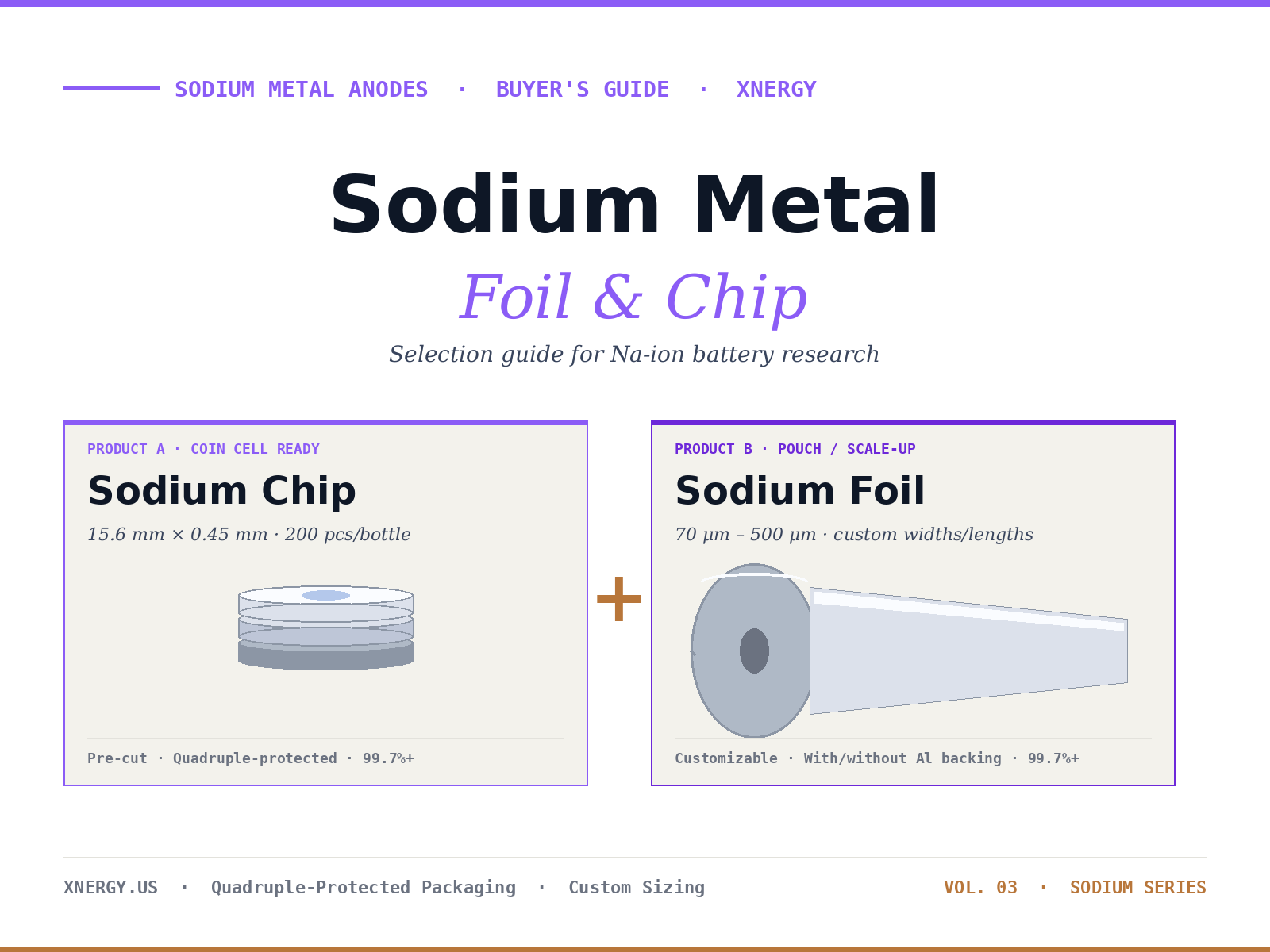
Sodium chip and sodium foil are two formats of the same battery-grade Na metal anode material, both at >99.7% purity. Use sodium chip (15.6 mm × 0.45 mm, 200 pcs/bottle) for coin cell research — pre-cut, ready to insert into CR2032/2025/2016 cases without cutting. Use sodium foil (70 µm–500 µm thickness, customizable widths/lengths) for pouch cell, larger-format cell, and scale-up research where you need to cut your own electrode geometries. Xnergy Materials — a direct supplier of both formats — ships them in identical four-layer protective packaging with bulk pricing and custom sizing on request.
Why Sodium Metal Anodes Matter for Na-ion Battery Research
Sodium ion batteries (Na-ion batteries) are entering commercial production in 2026 driven by their cost advantages, raw-material abundance, and compatibility with existing manufacturing infrastructure. But the version of sodium-ion battery moving into mass production today — with hard-carbon anodes — is only the first generation. The next generation, including sodium-metal anodes and full all-solid-state sodium batteries, is still firmly in research territory, and that research depends on access to battery-grade sodium metal.
Two practical problems make sodium metal hard to work with in the lab:
(1) Reactivity. Sodium oxidizes rapidly in air, reacts violently with water, and even reacts slowly with the trace moisture in dry-room environments. Without proper packaging, fresh sodium metal develops a thick oxide layer within hours of exposure that ruins electrochemical characterization.
(2) Mechanical fragility. Pure sodium is mechanically very soft — below 200 µm thickness, it cannot be handled without distortion. Above 500 µm it becomes wasteful for most coin-cell research, since the excess sodium creates a mismatched anode-to-cathode (N/P) ratio that complicates capacity analysis.
Both problems are solvable with the right material format and packaging. Pre-cut sodium chips solve the handling problem for coin-cell research by eliminating the cutting step entirely. Sodium foil with aluminum backing solves the handling problem for thin-electrode pouch cell research by providing mechanical support. Quadruple-protected packaging solves the reactivity problem for both formats by extending sealed shelf life from days to months.
Sodium Chip vs Sodium Foil at a Glance
Both formats are at >99.7% purity, both are quadruple-protected for shelf-life stability, both are research-ready out of the package. The choice between them depends on cell architecture and research stage:
Sodium Chip
Sodium Foil
| Property | Sodium Chip | Sodium Foil |
|---|---|---|
| Format | Pre-cut disc | Continuous roll |
| Standard dimensions | 15.6 mm × 0.45 mm | 70–500 µm thick × 100–120 mm wide |
| Purity | >99.7% | >99.7% |
| Aluminum backing | Standard (blue film side) | Optional (required ≤100 µm) |
| Pack size | 200 pcs/bottle | By roll length / weight |
| Best cell architecture | CR2032, CR2025, CR2016 coin cells | Pouch cells, custom geometries |
| Customization | Custom diameters by request (10–16 mm) | Width, length, thickness all customizable |
| Assembly time savings | Highest (no cutting) | Cuts as needed |
| Best research stage | Early-stage screening, half-cell, symmetric | Pouch prototyping, scale-up, large cells |
| Pricing | Quote-based, bulk discounts | Quote-based, bulk discounts |
A Typical Research Workflow: Coin Cell → Pouch → Scale-Up
The relationship between sodium chip and sodium foil maps cleanly onto the standard battery research workflow. Most published Na-ion and Na-metal battery research follows this three-stage progression:
Electrochemical Screening
Coin-cell screening of Na metal anode performance, cathode chemistries,, electrolyte formulations, and binder systems against a sodium-metal counter electrode. Pre-cut chips eliminate cutting variability and let researchers build 50–100 cells per day with consistent anode geometry.
Pouch Cell Prototyping
After coin-cell screening identifies promising chemistry, pouch cells (typically 1–5 Ah) validate the design at realistic geometries. 200–300 µm foil provides enough sodium reservoir for multi-cycle testing while remaining thin enough for reasonable energy density.
Scale-Up Validation
For commercial-relevant cell architectures, thin sodium foil (70–100 µm) with aluminum backing approximates the anode geometry of production cells. The aluminum backing also doubles as a current collector, reducing cell complexity.
Many research groups skip directly between stages depending on their goals. Academic studies focused on chemistry mechanism may stay at Stage 1 for the entire project. Industry-aligned research jumps from Stage 1 to Stage 3 to validate manufacturing-relevant geometries early. The key is matching the format to the cell architecture — not over-engineering the anode for an early-stage experiment.
Sodium Foil: Reference Thicknesses and Standard Sizes
Xnergy supplies sodium foil in seven standard reference dimensions covering thicknesses from 70 µm to 500 µm. Custom widths in the 100–120 mm range and custom lengths are available on request. For thinner foil (≤100 µm), aluminum backing is required for handling. For thicker foil (≥200 µm), aluminum backing is optional.
| Thickness | Standard Width | Standard Length | Aluminum Backing |
|---|---|---|---|
| 70 µm | 90 mm | 2300 mm | Required (always supplied with Al) |
| 100 µm | 120 mm | 1500 mm | Required (always supplied with Al) |
| 200 µm | 120 mm | 800 mm | Optional (with or without) |
| 300 µm | 120 mm | 500 mm | Optional |
| 350 µm | 120 mm | 500 mm | Optional |
| 400 µm | 120 mm | 400 mm or 500 mm | Optional |
| 450 µm | 120 mm | 350 mm or 500 mm | Optional |
Note on bare foil handling: for foil supplied without aluminum backing, the transparent protective film on both surfaces must be removed slowly and simultaneously to prevent tearing. Bare sodium below 200 µm is fragile enough that cutting and shaping require careful technique — for most lab workflows, aluminum-backed foil is the more practical choice. Each roll is individually wrapped for ease of use.
Quadruple-Protected Packaging: Why It Matters
Sodium metal’s reactivity with air and moisture is the largest practical barrier to using it in research. Without proper packaging, fresh sodium develops a visible oxide layer within a few hours of exposure to ambient lab air, and within days of exposure to humid conditions, the bulk of the sample is no longer suitable for electrochemistry. Xnergy uses a four-layer protective packaging method to extend usable shelf life from days to months:
This packaging system is the same method used in commercial sodium-ion battery cell production lines, where preventing sodium oxidation during storage and transport between fab steps is a standard process requirement. Adopting it for research-grade sodium reduces variability between experiments — researchers consistently report fresher, brighter sodium surfaces and lower interfacial impedance from quadruple-protected material compared with single-bag-packaged competitors.
Practical Tips for Working with Sodium Metal
Buying high-quality material is the first step. Preserving its electrochemical performance during cell assembly is the second. The handling principles below are based on standard practice in published Na-metal battery research:
1. Always transfer to glovebox before opening the inner seal
The four-layer protective packaging extends shelf life dramatically only as long as the inner seal is intact. Once you open the inner aluminum-plastic bag, the contents need to be inside an argon glovebox (H2O < 1 ppm, O2 < 1 ppm) within minutes. Plan your workflow so that you open the inner seal only when you are ready to use or transfer the material.
2. Use fresh material for cycling-stability research
Even properly packaged sodium develops a thin native oxide layer over time. For routine electrochemistry, the oxide layer is removed during the first few cycles and does not affect long-term results. For cycling-stability research where the SEI formation in the first few cycles is the subject of study, prefer fresh material from a recently opened package.
3. Don't peel both protective films from bare foil simultaneously
For bare foil (without aluminum backing), the two transparent protective films must be removed gently and simultaneously to prevent the foil from tearing. Pull both films at the same rate while supporting the foil edge. Sodium below 200 µm is mechanically fragile enough that an asymmetric peel can rip the metal.
4. Handle chips with PEEK or polyethylene tweezers
For sodium chips, use polymer tweezers (PEEK or polyethylene) rather than metal — trace metal contamination from stainless tweezers can introduce reactivity that affects sensitive cycling experiments. The chip's aluminum-backed side is structurally stable; pick chips up by the aluminum edge rather than the sodium face.
5. Press, don't slide, when assembling coin cells
Sodium is much softer than lithium or graphite. When placing a sodium chip into a coin cell case, press it flat with a polymer-tipped tool rather than sliding the chip across the bottom of the case. Sliding deforms the chip surface and creates microscopic burrs that can puncture the separator during cell crimping.
How to Order Sodium Metal Materials from Xnergy
Both sodium chip and sodium foil are supplied on a quote-based pricing model with bulk discounts for larger research batches and pilot-scale orders. As a direct supplier of battery-grade sodium metal materials, Xnergy supports the full Na-ion battery R&D pipeline from coin-cell screening to pilot-scale cell prototyping.
Request a Quote for Sodium Metal Materials
Tell us which format you need (chip or foil), your target dimensions, and your application. We typically respond within one business day with pricing, lead time, and the relevant specification sheet.
- Both formats in stock at >99.7% purity
- Sodium chip: 15.6 mm × 0.45 mm, 200 pcs/bottle (custom diameters available)
- Sodium foil: 70–500 µm thickness, 100–120 mm width, custom lengths
- With or without aluminum backing (always with for ≤100 µm)
- Quadruple-protected packaging for long-shelf-life shipping
- Bulk discounts for larger research orders
- Long-term supply agreements available
sales@xnergy.us · 1-530-433-0971
Frequently Asked Questions
What is the difference between sodium chip and sodium foil?
Sodium chip and sodium foil are two formats of the same battery-grade sodium metal — the choice between them depends on cell architecture and research stage. Sodium chips are pre-cut circular discs (typically 15.6 mm diameter × 0.45 mm thickness) packaged 200 pieces per bottle, designed for direct insertion into standard coin cells (CR2032, CR2025, CR2016) without further processing. Sodium foil is supplied as continuous rolls (70µm–500µm thickness, customizable widths and lengths) for pouch cell assembly, scale-up research, and applications requiring custom electrode geometries. Both are at >99.7% purity and use the same quadruple-protected packaging.
Which sodium anode format should I use for my coin cell research?
For coin cell research (CR2032, CR2025, CR2016), use sodium chips. The 15.6 mm × 0.45 mm pre-cut format inserts directly into a standard 2032 coin cell case without any cutting, rolling, or shaping, which eliminates the most common sources of variability in coin cell experiments — uneven sodium thickness, surface oxidation from cutting, and burrs that cause separator damage. Pre-cut chips also dramatically improve assembly throughput: a researcher can build 50–100 coin cells in an afternoon with consistent sodium electrodes, versus 10–20 with manually cut foil.
What thicknesses of sodium foil are available?
Xnergy supplies sodium foil from 70 µm (the thinnest standard grade) up to 500 µm. Standard reference dimensions include: 70 µm × 90 mm × 2300 mm (with aluminum backing), 100 µm × 120 mm × 1500 mm (with aluminum backing), 200 µm × 120 mm × 800 mm (optional aluminum), 300 µm / 350 µm / 400 µm / 450 µm × 120 mm × 500 mm (optional aluminum). Custom widths in the 100–120 mm range and custom lengths are available on request. Sub-micron thickness control is available through specialized rolling for academic-grade research.
What is quadruple-protected packaging?
Quadruple-protected packaging is the four-layer preservation method used for all Xnergy sodium metal materials: (1) aluminum foil backing (which doubles as both mechanical support and current collector), (2) protective film on both surfaces to prevent oxidation, (3) plastic bag containment, (4) aluminum-plastic outer bag, with tin can outer container for long-term storage. This packaging system extends shelf life from days (for unprotected sodium) to many months under proper storage conditions, and dramatically reduces oxidation during shipping. It is the same packaging method used in commercial sodium-ion battery production.
Where can I buy sodium chip and sodium foil for battery research?
Xnergy Materials supplies both sodium chip (15.6 mm × 0.45 mm, 200 pcs/bottle) and sodium foil (70µm–500µm, customizable dimensions) for sodium-ion and sodium metal battery research. All grades are at >99.7% purity, ship in quadruple-protected packaging, and are available in research quantities up to industrial volumes. Pricing is quote-based with bulk discounts for larger orders. Contact sales@xnergy.us with your application, target quantity, and any custom dimension requirements for a quote.
What is the purity of Xnergy's sodium metal materials?
All Xnergy sodium metal materials — both chip and foil formats — are supplied at >99.7% purity, suitable for sodium-ion and sodium metal battery research. The aluminum-backed foil grades use a high-purity aluminum substrate that doubles as a current collector. Higher purity grades (>99.9%) are available on a custom-synthesis basis for research programs requiring stricter impurity control, particularly studies of Na metal cycling stability or solid electrolyte interphase formation.
What sodium foil thickness should I use for pouch cell research?
For most pouch cell research, sodium foil in the 100µm–300µm range is the standard choice. Below 100µm, the foil becomes mechanically fragile and harder to handle without aluminum backing. Above 300µm, the sodium content is in excess of what most cathode loadings need, which inflates the anode-to-cathode (N/P) ratio and complicates capacity analysis. For thin-cell or anode-limited research designs, 70µm with aluminum backing is the thinnest practical choice. For thick-electrode or scale-up research, 400–500µm provides ample sodium reservoir.
Do I need aluminum backing on my sodium foil?
Aluminum backing serves two functions: mechanical support during handling, and electrochemical current collection during cycling. For thinner foils (≤100µm), aluminum backing is essentially required because the bare sodium is too soft to handle without distortion. For thicker foils (200–500µm), aluminum backing is optional — bare sodium can be handled with care, and some researchers prefer it for studies of pure Na electrochemistry without the Al substrate's influence. Xnergy supplies both with-aluminum and bare grades for most foil thicknesses, except 70µm and 100µm which always include aluminum.
How should I store sodium metal foil and chip?
Once received, store sodium metal materials inside an argon glovebox with H2O and O2 levels below 1 ppm for indefinite shelf life. For shorter-term storage outside a glovebox, the original quadruple-protected packaging (sealed) extends usable shelf life to several months when kept at room temperature in a dry, dark location. Avoid temperature swings, never expose to liquid water, and do not open the inner aluminum-plastic bag until you are ready to use the material. Once opened, transfer remaining material into the glovebox immediately and seal it under inert atmosphere.
Does Xnergy offer custom sodium foil sizes?
Yes. Xnergy supports custom sodium foil dimensions including non-standard widths in the 100–120 mm range, custom lengths from 200 mm to 2300 mm, custom thickness windows for specialized research, and aluminum-backed vs bare options. We also support custom chip dimensions outside the standard 15.6 mm — including 10 mm, 12 mm, 14 mm, and 16 mm diameters for non-2032 coin cell formats. For pilot-scale and industrial volumes, long-term supply agreements with reserved inventory are available. Contact sales@xnergy.us with your specifications.
Other Sodium Battery Materials at Xnergy
Building a complete sodium battery cell? The materials below pair naturally with sodium chip and foil for various Na-ion and Na-metal battery research programs:
Source the right sodium metal format from one supplier
Whether you are running early-stage coin cell screening, building Na-metal pouch cell prototypes, or validating scale-up architectures, Xnergy supplies both sodium chip (15.6 mm pre-cut) and sodium foil (70µm–500µm customizable) at >99.7% purity, all in quadruple-protected packaging, with bulk pricing and custom sizing on request.