
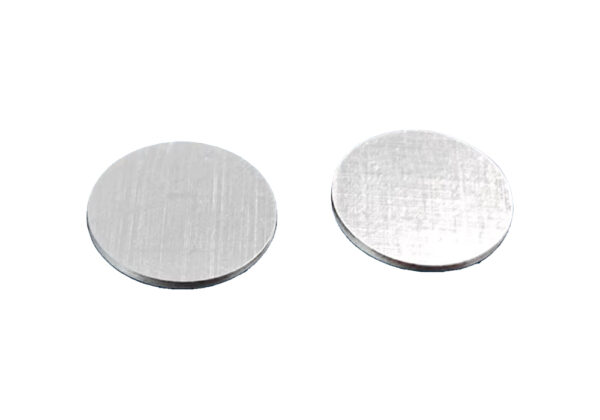
Sodium (Na) Chip, 15.6 mm Diameter × 0.45 mm Thickness, for Sodium-Ion Batteries, 200 pcs/Bottle – SIB-NaC05
SKU: XN-SIB-NaC05
Sodium (Na) Chip — Φ15.6 mm × 0.45 mm × 200 pcs/bottle (SIB-NaC05) — battery-grade sodium chips with 30 μm aluminum substrate serving as support and current collector. Pre-formed for CR2032 coin cell drop-in use — no cutting required. Color-coded dual protective films (blue Al / transparent Na) prevent installation errors. 5-layer protection packaging for extended storage stability.
Need a bulk order or custom specification? Request a competitive quote today!
Name: Sodium (Na) Chip, 15.6 mm Diameter × 0.45 mm Thickness, for Sodium-Ion Batteries, 200 pcs/Bottle – SIB-NaC05
Material: Battery-Grade Sodium Metal Chip with Aluminum Foil Support
Product Code: SIB-NaC05
Description:
Sodium (Na) Chip is a precision-fabricated, battery-grade sodium metal disc engineered specifically for CR2032 coin cell sodium-ion battery research. Each chip combines a Φ15.6 mm × 0.45 mm sodium disc bonded to a 30 μm aluminum foil substrate, delivering a ready-to-assemble electrode that eliminates the manual cutting and trimming steps typically required when working with bulk sodium metal. As a result, researchers achieve consistent disc-to-disc dimensions and reproducible electrochemistry across the entire 200-piece bottle. Furthermore, the 5-layer protective packaging system enables long-term storage stability without surface oxidation or capacity loss.
Application:
Sodium chips are designed for use as the counter and reference electrode in CR2032 sodium-ion coin cell research, including hard carbon and soft carbon anode evaluation, polyanionic and layered oxide cathode characterization (NFPP, NVP, P2-Na, O3-type Na cathodes), electrolyte and additive screening studies, half-cell capacity measurement, and fundamental research into sodium plating/stripping kinetics, SEI formation on Na, and dendrite suppression. Because the Φ15.6 mm dimension corresponds to the standard CR2032 electrode footprint, no additional cutting or punching is needed during cell assembly.
Specifications:
| Parameter | Value |
|---|---|
| Material | Battery-grade sodium metal with aluminum foil substrate |
| Sodium Disc Diameter | Φ15.6 mm (CR2032 standard) |
| Sodium Thickness | 0.45 mm |
| Aluminum Substrate Thickness | 30 μm (with blue protective film) |
| Sodium Surface Protection | Transparent peel-off film |
| Quantity per Bottle | 200 pcs/bottle |
| Packaging | 5-layer protection: Al substrate + dual protective films + plastic bottle + Al-plastic bag + iron can |
| Storage Stability | Designed for long-term storage under inert seal |
| Shipping Classification | Regulated material — special packaging applies |
Values typical for reference. Custom specifications available on request — contact sales.
Characteristics:
Φ15.6 mm precision disc — drop-in CR2032 ready
Each chip is precision-formed to the CR2032 electrode footprint, allowing direct insertion during cell stacking. As a result, researchers eliminate the punching and disc-trimming steps that introduce variability and dimensional drift between cells, particularly for laboratories building large statistical sample sets.
Aluminum substrate: support, current collector, and surface protection
The 30 μm aluminum substrate plays three roles in a single layer: it reinforces the soft sodium against deformation, contacts the cell case to act as the negative current collector, and shields the back face of the sodium disc from atmospheric contact during handling. Therefore, researchers can use flat-tip tweezers without bending or fragmenting the chip — a common failure mode with unsupported sodium foil.
Dual protective films with color coding
The aluminum side carries a blue protective film while the sodium side carries a transparent protective film. Consequently, the orientation of every chip is visually unambiguous during assembly — preventing the common error of installing the chip with the wrong face toward the separator, which would otherwise short the current collector to the working electrode.
Five-layer storage protection
Each bottle is protected at five levels: (1) aluminum substrate behind every chip, (2) dual films on both sodium surfaces, (3) sealed plastic bottle, (4) aluminum-plastic vacuum bag, and (5) outer iron can. As a result, sodium — which would otherwise oxidize within hours of ambient air exposure — remains battery-active for extended storage between use.
Engineered for batch reproducibility
All 200 chips per bottle share controlled thickness, diameter, and surface finish — critical for studies that compare electrolyte additives, separator chemistries, or cathode formulations across many cells. Therefore, cell-to-cell variability traces to the experimental variable rather than to inconsistencies in the sodium electrode.
Part of the Xnergy sodium materials ecosystem
This product is one piece of a complete sodium-ion battery R&D supply chain offered by Xnergy, including sodium metal foil rolls for custom electrode fabrication and a full catalog of sodium-ion dry pouch cells (NFPP, NVP, P2-Na, anode-free configurations). Furthermore, customers building integrated SIB research programs can source compatible electrodes, cells, and materials from a single supplier.
Handling Instructions:
1. Open the iron can only inside an argon-filled glovebox with moisture below 2% RH (or in a dry-room environment with H₂O and O₂ < 5 ppm). 2. Remove the aluminum-plastic outer bag, then take out the inner plastic bottle. After removing the required quantity of chips, immediately re-seal the bottle to protect the remaining chips from atmospheric contact. 3. Pick up each chip with flat-tip tweezers, then peel off the protective films using a sharp tweezer — remove the blue film first (aluminum side), then the transparent film (sodium side) immediately before stacking. 4. Position the chip so that the aluminum side faces the cell case (current collector contact), and the bare sodium side faces the separator. 5. Avoid contact with water, alcohols, ketones, or any protic solvent — sodium reacts violently with all of these.
Packaging & Storage:
Each bottle of 200 chips ships in a 5-layer protection system: aluminum substrate, dual protective films (blue + transparent), sealed plastic bottle, aluminum-plastic vacuum bag, and outer iron can. Therefore, the unopened iron can should be stored in a cool, dry environment, protected from moisture and direct sunlight. Once opened, the remaining chips must be stored exclusively under inert atmosphere (glovebox or sealed dry-room conditions) — ambient air exposure causes rapid surface oxidation. The product is classified as a regulated material requiring specialized packaging and transport.
Safety:
For research and industrial use only. Sodium metal is highly reactive — it reacts violently with water (releasing flammable hydrogen and concentrated NaOH) and oxidizes when exposed to air. Handle exclusively in glovebox or dry-room conditions during cell preparation. Wear full PPE including face shield, fire-resistant gloves, and lab coat. Never expose sodium chips to water, water-containing solvents (alcohols, ketones), oxidizers, or heat. In case of fire, use a Class D dry powder extinguisher only — never water, foam, or CO₂. Refer to SDS for complete safety information and emergency response.
Note: Values listed above are typical and for reference only. Performance may vary depending on storage conditions, handling, and test environment. See related sodium products in our catalog: Sodium Metal Foil for Sodium-Ion Batteries (rolls for custom-shape research). Browse all Sodium Metal Materials and Anode Materials. For sodium-ion battery cell research using these chips, see also our Dry Pouch Cell catalog.
Related products
-
Tube Furnace
-
Silicon–Carbon Anode Electrode Sheet(Multiple Specs)
Free Shipping$237.00Select options This product has multiple variants. The options may be chosen on the product page -

Graphite Anode Disc on Copper Foil for Coin Cell (Single-Sided Coating)
Free Shipping$180.00 -
Ultra-Thin Lithium Metal Foil for Battery Applications