
LZC Halide Solid Electrolytes: A Doping & Oxychloride Variants Selection Guide
Li2ZrCl6 (LZC) is the most cost-effective halide solid electrolyte for ASSB research, but its baseline conductivity (∼0.4 mS/cm) needs engineering to compete with LIC and LTOC. Three engineering strategies have been validated in published literature — cation doping, anion doping, and oxychloride formation — and Xnergy supplies all three product types plus the baseline LZC and a LYC reference.
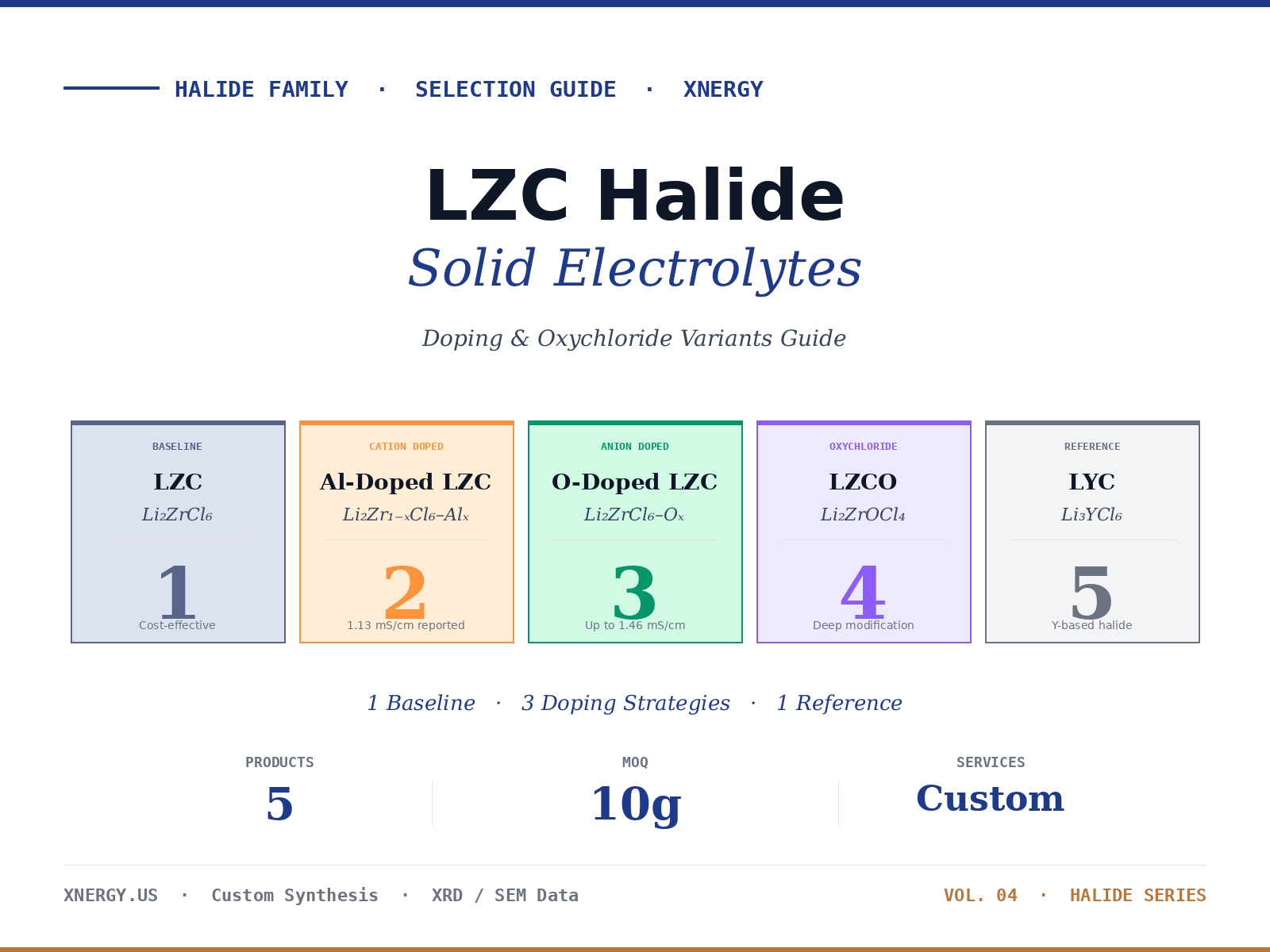
The LZC (Li2ZrCl6) halide solid electrolyte family is the cost-effective option in halide ASSB research. Pristine LZC has moderate ionic conductivity (~0.3–0.4 mS/cm), but three engineering strategies improve it: Al cation doping reaches ~1.13 mS/cm, O anion doping reaches ~1.46 mS/cm, and the LZCO (Li2ZrOCl4) oxychloride form delivers oxychloride-class performance at lower transition-metal cost than Ta-based LTOC. Xnergy — a direct supplier of zirconium halide solid electrolytes — offers all five products in this family — LZC, Al-Doped LZC, O-Doped LZC, LZCO, and LYC reference — at 10 g MOQ with custom synthesis on request.
Why LZC: The Cost-Effective Halide That Needs Engineering
The halide solid electrolyte family is broad — spanning indium-based (LIC), yttrium-based (LYC), tantalum-based oxychlorides (LTOC), niobium-based oxychlorides (LNOC), and zirconium-based (LZC) chemistries. The first four have all reached impressive ionic conductivities of 1–12 mS/cm in optimized form, putting them in direct competition with sulfide solid electrolytes for high-rate ASSB applications. But all four share a problem: they depend on relatively expensive transition metals (In, Y, Ta, Nb), which limits their scalability for commercial-scale production.
LZC sits in a different position. Zirconium is among the most abundant transition metals in Earth's crust, with mature commercial supply chains and prices roughly an order of magnitude lower than tantalum or indium. For commercial ASSB scale-up, LZC is the most economically viable halide candidate.
The catch is that pristine LZC has lower room-temperature ionic conductivity (~0.3–0.4 mS/cm) than its more expensive halide cousins. For LZC to compete in real cell architectures, the conductivity has to be engineered upward through doping or structural modification. The good news: published literature in 2024–2025 has validated multiple successful engineering strategies, each raising LZC conductivity by 3–5× while preserving its cost and high-voltage cathode compatibility advantages.
This guide walks through the three primary engineering strategies, then maps them to the five LZC family products Xnergy supplies.
Three Strategies to Improve LZC Conductivity
The published literature on LZC modification falls into three distinct categories, each addressing the conductivity bottleneck through a different structural mechanism. All three have produced commercially viable variants — and Xnergy supplies a representative product from each category.
Replace Zr with smaller cations
Aliovalent substitution of Zr4+ with Al3+ (or other smaller cations) creates additional Li+ sites for charge balance, raising lithium concentration. The smaller cation also adjusts lattice spacing, providing more efficient Li-ion migration channels.
Replace Cl with O, S, F, or I
Substituting Cl- with O2- requires extra Li+ for charge balance, creating a Li-richened lattice that boosts ion concentration. O-doping is the highest-performing variant; S, F, and I doping each have specific advantages for stability or rate.
Make oxygen a primary lattice atom
When oxygen content reaches stoichiometric levels, the resulting LZCO is no longer a doped halide but a distinct oxychloride structure — closer chemically to LTOC and LNOC than to LZC. This gives oxychloride-class voltage stability at much lower transition-metal cost.
The Five LZC Family Products at Xnergy
As a direct supplier of all five LZC variants, Xnergy offers a complete halide family lineup that maps directly onto the three engineering strategies, plus the baseline LZC and a LYC reference for direct comparison studies:
LZC
The baseline cost-effective halide. Monoclinic Li2ZrCl6 with moderate ionic conductivity, suitable for studies of intrinsic LZC properties, doping baseline comparisons, and budget-constrained early-stage research where conductivity is not the rate-limiting factor.
Al-Doped LZC
Aliovalent Al3+ substitution on the Zr4+ site. The 3× conductivity improvement over baseline LZC has been validated in published literature (Gao et al., 2024; see references). Best general-purpose default for high-rate ASSB research with NCM cathodes.
O-Doped LZC
O2- substitution on the Cl- site creates a Li-richened lattice. Highest pure-doping conductivity in the LZC family. Best for research targeting maximum rate capability while staying within the doped-LZC structural framework.
LZCO
The fully oxychloride form — structurally distinct from LZC, similar to LTOC and LNOC family. Provides oxychloride-class high-voltage stability (4.5+ V) at significantly lower transition-metal cost than Ta or Nb-based oxychlorides. Best for research bridging cost and high-V requirements.
LYC
A different halide chemistry — trigonal Li3YCl6 based on yttrium — provided as a reference for direct LZC vs LYC comparison studies. Used extensively in academic literature as the benchmark halide solid electrolyte. Suitable for benchmarking, selectivity studies, and architecture comparisons.
Side-by-Side Performance Matrix
The five products span a wide range of conductivity, voltage stability, and cost positioning. The table below summarizes their reported properties to help select the right grade for a given research target:
| Product | Formula | Conductivity (RT) | Cost Position | Best Application |
|---|---|---|---|---|
| LZC | Li2ZrCl6 | ~0.3–0.4 mS/cm | Lowest | Baseline studies, doping comparisons, budget-constrained projects |
| Al-Doped LZC | Li2.25Zr0.75Al0.25Cl6 | ~1.13 mS/cm | Low | General-purpose high-rate ASSB, NCM cathodes |
| O-Doped LZC | Li2+xZrCl6-xOx | up to ~1.46 mS/cm | Low | Maximum-rate research within LZC structure |
| LZCO | Li2ZrOCl4 | 1–6 mS/cm | Low-Medium | Cost-effective oxychloride, 4.5+ V cathodes |
| LYC | Li3YCl6 | ~0.3–0.5 mS/cm | Medium-High (Y cost) | Academic benchmarking, comparison studies |
For a complete picture, the table below extends the comparison to other halide and oxychloride electrolytes Xnergy supplies:
| Family | Representative | Conductivity (RT) | Cost | 4.6 V Cathode Stability |
|---|---|---|---|---|
| LZC family (this guide) | Al/O-Doped LZC, LZCO | 1.1–6 mS/cm | Lowest | Yes (LZCO best) |
| LIC family | Li3InCl6 | 1–4 mS/cm | Medium-High | Up to 4.2 V |
| LTOC family | LiTaOCl4, Li2TaOCl5 | 6–12 mS/cm | High | Yes (validated) |
| LNOC family | LiNbOCl4 | ~7 mS/cm | Medium | Yes |
| Sulfide | LPSC, LGPS | 5–25 mS/cm | Low | Limited (needs coating) |
Which LZC Variant for Your Research?
Most research programs benefit from picking a primary LZC variant for their target application, then occasionally benchmarking against alternatives. The decision framework below maps research priorities to specific products:
If your priority is cost minimization for early-stage screening
Use baseline LZC. The ~0.4 mS/cm conductivity is enough to characterize most cathode chemistries, electrolyte compatibility, and cell architectures at 0.1–0.5C rates. Save the higher-cost doped variants for after you have validated your core hypothesis.
If your priority is high-rate ASSB cells with NCM cathodes
Use Al-Doped LZC. The 1.13 mS/cm conductivity supports 1–2C cycling rates in well-engineered cells, while the cost stays low compared to LIC or LTOC alternatives. This is the most common choice for industrial R&D groups developing scalable cell architectures.
If your priority is maximum conductivity within doped-LZC chemistry
Use O-Doped LZC. The 1.46 mS/cm peak puts O-doping at the top of the doped-LZC family, just below where the chemistry transitions to fully oxychloride. Research groups studying composition-property optimization use this as the upper-bound reference for LZC doping.
If your priority is high-voltage cathode operation (≥4.5 V)
Use LZCO. The oxychloride structure provides voltage stability comparable to LTOC at lower cost. For programs targeting next-generation high-voltage NCM (4.5 V+) or 4.6 V LCO research, LZCO is the cost-effective default.
If your priority is academic benchmarking or selectivity studies
Use LYC as a reference alongside any LZC variant. The Li3YCl6 structure is well-characterized in published literature and provides a useful contrast point for understanding Zr-specific vs general halide behaviors.
Common Specifications Across the LZC Family
The following specifications apply broadly to all five LZC family products unless otherwise noted. Per-batch variations can be characterized via XRD, EIS, and particle-size analysis on request.
Material form & characterization
All grades are supplied as fine white powders, vacuum-sealed under argon in moisture-barrier aluminum-laminated packaging. Per-batch characterization (XRD, SEM, particle-size statistics, pressed-pellet EIS) is available on request and included with bulk research orders. Standard pack sizes are 10 g, 25 g, 50 g, 100 g, 250 g, and 500 g, with custom batch sizes (1–10 kg) for pilot-scale research.
Cathode compatibility
All five products pair natively with 4 V-class layered oxide cathodes (NCM, NCA, NMC811, LCO) without the LiNbO3 coatings sulfide systems require. LZCO additionally supports 4.5+ V operation. For Li-metal anode contact, halide solid electrolytes can be reduced at low potentials — a common solution is the bilayer architecture pairing LZC-family halide on the cathode side with LPSC sulfide or LLZO oxide on the anode side.
Mechanical processing
All grades cold-press to high density at 200–400 MPa room-temperature uniaxial pressure, suitable for laboratory coin-cell and pouch-cell assembly without sintering equipment. Pellet density typically reaches >90% theoretical at the standard pressure window.
Air handling guidance
All halide solid electrolytes require inert-atmosphere handling for storage and slurry preparation. Brief in-air handling for cell assembly is acceptable in low-humidity environments (RH < 5%, dew point < −40 °C). LZCO has marginally better moisture tolerance due to its oxychloride structure but should still be handled with the same precautions. Argon glovebox storage with H2O and O2 levels below 1 ppm is recommended for long-term shelf life.
How to Order LZC Family Materials from Xnergy
Xnergy is a direct supplier of all five LZC family halide solid electrolytes, offering them on a quote-based pricing model with bulk discounts for larger research batches and pilot-scale orders.
Request a Quote for LZC Family Materials
Tell us which grades you need, your target quantities, and your application. We typically respond within one business day with pricing, lead time, and the relevant technical data sheets including XRD, EIS, and particle-size statistics.
- All five LZC family products in stock
- 10 g MOQ · standard packs at 10/25/50/100/250/500 g
- Bulk pricing for orders ≥ 1 kg
- Custom doping ratios (cation, anion, co-doping) on request
- Custom particle-size targeting available
- Per-batch characterization data with bulk orders
- MTAs and joint development agreements welcomed
sales@xnergy.us · 1-512-270-1908
Frequently Asked Questions
What is LZC and why is it important for solid-state batteries?
LZC (Li2ZrCl6) is a zirconium-based halide solid electrolyte that has attracted significant research attention for two reasons: cost and high-voltage cathode compatibility. Unlike indium-based halides (LIC) and tantalum-based oxychlorides (LTOC) that depend on expensive transition metals, LZC uses zirconium — abundant, cheap, and chemically stable. LZC pairs well with high-voltage layered oxide cathodes (NCM, NMC811) without the cathode coatings that sulfide electrolytes require. The trade-off is that pristine LZC has lower ionic conductivity (~0.3–0.4 mS/cm at 25 °C) than the more expensive halides, which is why doping and oxychloride variants are an active area of research.
What are the three engineering strategies for improving LZC conductivity?
Three strategies have been validated in published literature: (1) Cation doping — substituting Al3+ or other cations on the Zr4+ site to create lithium vacancies; Al-doping in particular has reached 1.13 mS/cm conductivity (Li2.25Zr0.75Al0.25Cl6). (2) Anion doping — substituting O2-, S2-, or F- on the Cl- site to introduce structural disorder; O-doping reaches 1.46 mS/cm via the Li2+xZrCl6-xOx family. (3) Oxychloride formation — full transformation to Li2ZrOCl4 (LZCO), an oxychloride structure where O is a primary lattice atom rather than dopant. Xnergy supplies all three product types plus the baseline LZC.
What is the difference between Al-Doped LZC and O-Doped LZC?
Both are doped variants of Li2ZrCl6 but with fundamentally different mechanisms. Al-Doped LZC (Li2Zr1-xCl6–Alx) is cation-substituted, where Al3+ replaces Zr4+ on the metal site. This is aliovalent substitution that creates additional Li+ vacancies, raising ionic conductivity to ~1.13 mS/cm at the optimal x = 0.25 composition. O-Doped LZC (Li2ZrCl6–Ox, more accurately Li2+xZrCl6-xOx) is anion-substituted, where O2- replaces Cl- on the halide site, requiring extra Li+ for charge balance. The Li-richened lattice can reach 1.46 mS/cm at higher x values. The choice depends on which property (cost, conductivity ceiling, electrochemical window) matters most for your application.
What is LZCO (Li2ZrOCl4)?
LZCO is the oxychloride form of zirconium halide with stoichiometry Li2ZrOCl4 — where oxygen is incorporated as a primary lattice anion rather than a dopant. Structurally, LZCO is closer to the LTOC (Li2TaOCl5) and LNOC (LiNbOCl4) oxychloride family than to dopant-modified LZC. LZCO offers the high-voltage cathode compatibility characteristic of oxychlorides, combined with the lower cost of zirconium chemistry. It is positioned for research programs that need oxychloride-class performance without the higher transition-metal cost of Ta or Nb.
How does LZC compare with LYC (Li3YCl6)?
LZC and LYC are both moderate-conductivity halides that are often compared in the same research programs. LYC (Li3YCl6) is yttrium-based with conductivity around 0.3–0.5 mS/cm, similar to baseline LZC. The two materials have different crystal structures (LZC is monoclinic, LYC is trigonal) and different cation site chemistries, leading to different doping strategies and different stability against various cathodes. LYC has been extensively studied as a sulfide-free halide alternative and is one of the most-cited halide compositions in academic literature. Xnergy supplies LYC alongside the LZC family for direct benchmarking studies.
Where can I buy LZC, Al-Doped LZC, O-Doped LZC, LZCO, and LYC?
Xnergy Materials supplies all five LZC family halide solid electrolytes — LZC, Al-Doped LZC, O-Doped LZC, LZCO, and LYC — at 10 g minimum order quantity with bulk pricing for larger research batches. All grades are quote-based; characterization data (XRD, SEM, particle-size statistics, EIS) is available on request. For research programs requiring custom doping levels or specific particle-size targets, custom synthesis is supported on a per-project basis. Contact sales@xnergy.us with your application, target quantity, and any custom requirements for a quote.
What is the room-temperature ionic conductivity of these LZC variants?
Approximate room-temperature ionic conductivities reported in the literature: baseline LZC (Li2ZrCl6) ~0.3–0.4 mS/cm; Al-Doped LZC at optimal composition (Li2.25Zr0.75Al0.25Cl6) up to ~1.13 mS/cm with activation energy 0.292 eV; O-Doped LZC at optimal composition (Li2.8ZrCl5.2O0.8) up to ~1.46 mS/cm; LZCO (Li2ZrOCl4) is in the broader oxychloride family with conductivity range 1–6 mS/cm depending on synthesis and amorphization; LYC (Li3YCl6) ~0.3–0.5 mS/cm. Per-batch values from Xnergy are typically validated by EIS at 25 °C in pressed pellet form.
Which LZC variant should I use for high-voltage NCM cathode research?
For 4 V-class NCM cathode research (NCM622, NCM811), all four LZC family members work without the cathode coatings sulfide electrolytes require. The choice depends on rate-capability targets: baseline LZC works for moderate-rate cells where conductivity is not the bottleneck; Al-Doped LZC is the preferred default for higher-rate cells (1.13 mS/cm); O-Doped LZC is for highest-rate cells where conductivity ceiling matters; LZCO is the right choice if you also need oxychloride-class voltage stability above 4.5 V. Most research groups start with Al-Doped LZC as a balanced choice and benchmark the others against it.
Are LZC variants moisture-stable?
All halide solid electrolytes including LZC family members offer improved moisture tolerance compared to sulfide electrolytes (LPSC, LGPS) — they do not release H2S on contact with humid air. However, they are not fully air-stable like oxide ceramics. LZC and its doped variants degrade in humid air over hours of exposure, so storage and slurry preparation should be conducted under inert atmosphere or in a dry room. LZCO has slightly improved moisture tolerance compared to baseline LZC due to its oxychloride structure. Xnergy ships all LZC variants vacuum-sealed in moisture-barrier bags under argon.
Does Xnergy offer custom doping levels and stoichiometries?
Yes. Xnergy supports custom synthesis across the LZC family including custom Al doping ratios (x = 0.05 to 0.40), custom O substitution levels (x = 0.5 to 1.8), additional dopants beyond Al and O (Zn, Ga, Ge, Bi, S, F, I have been reported in literature), custom particle-size targets, and stoichiometry variations of the LZCO oxychloride. We welcome long-term supply agreements, joint development collaborations, and Material Transfer Agreements with academic and industrial partners working on halide and oxychloride solid electrolytes.
Selected Literature on LZC Doping & Oxychloride Variants
The technical claims in this guide are supported by published research on LZC family solid electrolytes. The references below cover the three main engineering strategies plus key context papers:
- Jia, X. et al. (2025). Rare Earth Metal Ion-Doped Halide Solid Electrolytes plus Ta5+ Substitution for Long Cycling All-Solid-State Batteries. Advanced Functional Materials. — Demonstrates 13 rare-earth dopants doubling LZC conductivity, plus co-doping with Ta5+ reaching 1.67 mS/cm.
- Gao, K. et al. (2024). Aliovalent substitution of Al3+ in Li2ZrCl6 solid electrolyte towards large-scale application. Energy Storage Materials. — Foundational study of Al-doped LZC reaching 1.13 mS/cm at x = 0.25, with low activation energy 0.292 eV.
- O2- substituted Li-richened Li2ZrCl6 lattice towards superionic conductivity (2024). Journal of Energy Chemistry. — Reports O-doped LZC family Li2+xZrCl6-xOx reaching 1.46 mS/cm at room temperature.
- Ganesan, P. et al. (2025). In-Depth Analysis of the Origin of Enhanced Ionic Conductivity of Halide-Based Solid-State Electrolyte by Anion Site Substitution. Batteries & Supercaps. — S-doped Li2ZrCl6 (LZCS) reaching 0.64 mS/cm with 96.3% capacity retention against NMC622.
- Zhang, R. et al. (2025). High Ionic Conductivity and Cost-Effective Halide Solid Electrolyte Enabled by Long-Range Cooperative Transport in Bi-Doped Li2ZrCl6. Chemistry of Materials. — Bismuth doping with bromine co-substitution; theoretical and computational analysis of doping mechanisms.
- Innovative doping strategies for Li2ZrCl6 solid electrolytes: A first-principles approach (2024). Journal of Energy Chemistry. — DFT investigation of C, N, O, Na, Mg, Al doping effects on LZC conductivity and stability.
Other Solid Electrolytes from Xnergy
Researchers building benchmarking studies, halide-sulfide composite designs, or comparing across electrolyte chemistries often pair LZC family materials with other electrolyte families:
Source the right LZC variant for your research
Whether you are screening cathode chemistries with baseline LZC, validating high-rate cells with Al-Doped or O-Doped LZC, pushing high-voltage limits with LZCO, or running comparative studies against LYC, Xnergy — a direct supplier of all five grades — offers them at 10 g MOQ with bulk pricing for larger orders, custom doping ratios on request, and per-batch characterization data on request.