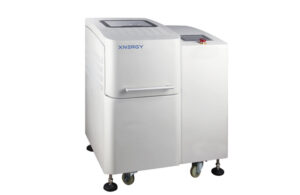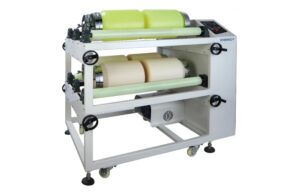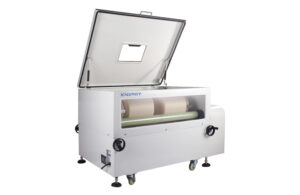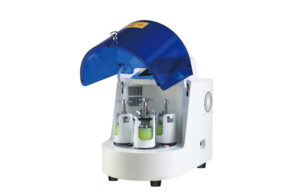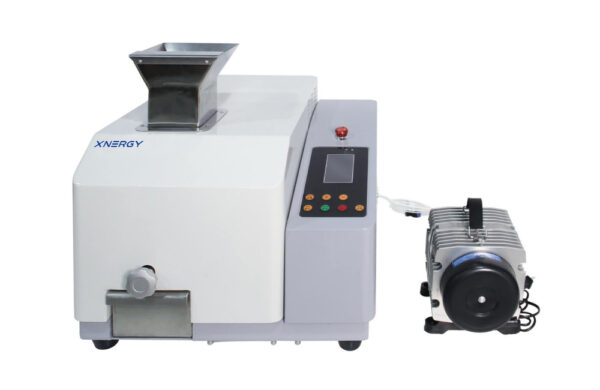
Jaw Crusher XN-MT10 Series
SKU: XN-MT10
Jaw Crusher XN-MT10 Series is a laboratory jaw crusher that uses extrusion and bending between two jaw plates to coarsely or medium-crush materials up to Mohs 9.0. It accepts feed up to 30 mm and produces an adjustable 1–13 mm discharge, with the jaw gap shown on an on-screen display for precise control.
Four jaw-plate materials — corundum, manganese steel, zirconia, and tungsten carbide — let you match the contact surface to sample hardness and contamination limits. A built-in dust-collection design with air pump keeps high-purity samples clean. Capacity 1–300 kg/h.
Need a bulk order or custom specification? Request a competitive quote today!
Name: Jaw Crusher XN-MT10 Series
Equipment Type: Laboratory Jaw Crusher for High-Purity Sample Pre-Crushing
Product Code: XN-MT10
Brand: Xnergy
Product Introduction:
The XN-MT10 Series Jaw Crusher is a laboratory jaw crusher that uses extrusion and bending forces between two jaw plates to coarsely or medium-crush materials of various hardness. As a front-end processing device in the crushing stage, it handles feed up to 30 mm in diameter and produces a freely adjustable discharge size of 1–13 mm. The jaw gap is conveniently adjustable and shown on an on-screen display, letting laboratory staff control feeding and final discharge size precisely. Built for the pre-treatment of high-purity samples, the unit features a built-in dust-collection design that works with an air pump for automatic dust collection, keeping samples free of contamination. Four jaw-plate materials are available — corundum, manganese steel, zirconia, and tungsten carbide — covering feed hardness up to Mohs 9.0.
Key Features:
Adjustable final discharge size of 1–13 mm with on-screen jaw-gap display for repeatable sizing
Four jaw-plate materials available — corundum, manganese steel, zirconia, tungsten carbide — for feed hardness up to Mohs 9.0
Rotation speed up to 620 rpm
Built-in dust-collection design; works with an air pump for automatic dust collection to avoid contamination
Handles feed up to 30 mm; production capacity 1–300 kg/h
Simple, user-friendly operation for laboratory high-purity sample pre-treatment
Configurable according to local electrical standards
Technical Specifications:
| Model | Jaw Plate Material | Feed Opening Size | Feed Particle Size | Jaw Plate Gap | Production Capacity | Power | Weight | Overall Dimension | Crushing Hardness |
|---|---|---|---|---|---|---|---|---|---|
| XN-MT10S | Corundum | 100 × 70 mm | ≤ 30 mm | 1–13 mm | 1–300 kg/h | 0.75 kW | 95 kg | 500 × 600 × 600 mm | ≤ Mohs 5.0 |
| XN-MT10M | Manganese Steel | 100 × 70 mm | ≤ 30 mm | 1–13 mm | 1–300 kg/h | 0.75 kW | 95 kg | 500 × 600 × 600 mm | ≤ Mohs 7.0 |
| XN-MT10Y | Zirconia | 100 × 70 mm | ≤ 30 mm | 1–13 mm | 1–300 kg/h | 0.75 kW | 95 kg | 500 × 600 × 600 mm | ≤ Mohs 7.5 |
| XN-MT10T | Tungsten Carbide | 100 × 70 mm | ≤ 30 mm | 1–13 mm | 1–300 kg/h | 0.75 kW | 95 kg | 500 × 600 × 600 mm | ≤ Mohs 9.0 |
All four configurations share the same drive, dimensions, and process parameters; they differ only in jaw-plate material and the corresponding crushing-hardness rating. Please confirm the appropriate model with sales based on target feed material and contamination requirements.
Application Areas:
Coarse and medium pre-crushing of samples up to 30 mm down to an adjustable 1–13 mm
Front-end size reduction upstream of fine grinding and milling
High-purity sample pre-treatment where contamination must be minimized
Crushing of materials across a wide hardness range up to Mohs 9.0 by selecting the matching jaw-plate material
Laboratory and pilot-scale sample preparation for hard, brittle solids
Battery R&D — breaking down sintered chunks, calcined precursors, and electrode cakes before fine processing
Maintenance:
Clean the jaw plates and crushing chamber regularly with a brush or compressed air
Periodically lubricate moving parts to ensure smooth operation
If the equipment is not used for an extended period, clean the jaw surfaces and apply a protective anti-rust coating
Periodically inspect screws, nuts, pins, and other fasteners to prevent loosening
Inspect jaw-plate wear regularly and replace at end of life to maintain discharge size
Verify the dust-collection connection and air pump are working before each run
Safety Notes:
Do not place hands or other body parts in the feed hopper or near the jaw plates during operation
Do not feed metal foreign objects (bolts, tools, fragments) into the hopper — jaw-plate damage is unrecoverable
Operation should be performed by a single trained operator
Disassembly should only be performed by qualified technicians
Verify the electrical installation and stable placement before commissioning
Connect the dust-collection system and air pump before crushing — uncontrolled dust release is both an environmental and an inhalation hazard
Specifications are provided for reference and may be adjusted to suit specific process requirements. Jaw-plate material and wear-part configuration are specified at order time.
Note: Specifications listed above are typical and for reference only. Actual crushing performance depends on feed material hardness, size, moisture content, and operating parameters. The XN-MT10 Series is the coarsest, front-end stage in Xnergy’s size-reduction line — it accepts bulk feed up to 30 mm and reduces it to an adjustable 1–13 mm, with four jaw-plate materials so the contact surface can be matched to sample hardness up to Mohs 9.0 and to contamination limits. The natural workflow is: bulk feed (≤ 30 mm) → XN-MT10 jaw crush to 1–13 mm → finer reduction downstream. For the medium-to-fine stage that follows, the XN-PM-200 Disc Crusher takes the 1–13 mm output down to ~100 μm – 0.5 mm; for sub-micron or nano fineness after that, choose a planetary ball mill — general-purpose XN-YXQM Series for ambient grinding, XN-MAX1600 for mechanical alloying and rapid sub-micron grinding, or XN-XH-XQM for heat-sensitive materials held at 1–30 °C. For the high-purity active materials commonly pre-crushed on this unit, see our Cathode Materials range.