
Guide · Battery Materials
Lithium-Sulfur Batteries: The 2026 Guide to Chemistry, Challenges, and Sourcing
Lithium-sulfur (Li-S) batteries have been called the “next big thing” in energy storage for the better part of two decades. The pitch is hard to ignore: two to three times the energy density of today’s lithium-ion cells, built from sulfur — one of the cheapest, most abundant, and least toxic elements on Earth. No cobalt. No nickel. No fragile supply chain.
So why isn’t your phone running on a Li-S battery yet?
This guide answers that question the way a materials supplier sees it — not just the textbook chemistry, but the practical reasons Li-S has been so hard to commercialize, what changed by 2026, and exactly what you need to source if you want to build and test a working lithium-sulfur cell today.
Why lithium-sulfur matters
Every conversation about Li-S starts with one number: sulfur’s theoretical specific capacity is 1,675 mAh/g — roughly an order of magnitude higher than the ~150–200 mAh/g of conventional layered oxide cathodes like NCM. Pair that sulfur cathode with a lithium-metal anode and the theoretical specific energy of the full cell reaches around 2,500 Wh/kg (for the underlying electrochemistry, see the lithium–sulfur battery reference).
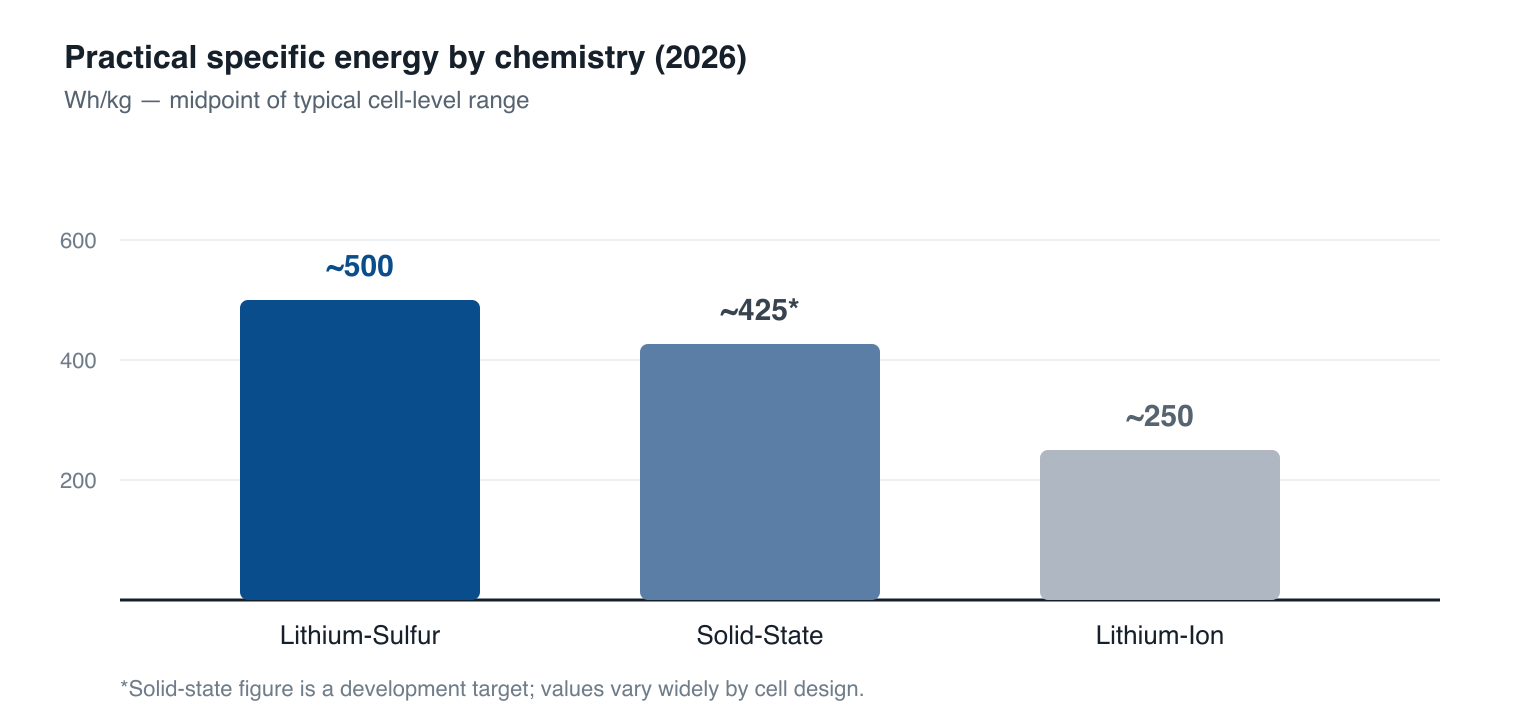
Real cells don’t hit theoretical numbers — but even practical Li-S prototypes today reach 400–600 Wh/kg, comfortably ahead of the ~250–300 Wh/kg ceiling of commercial lithium-ion. For any application where weight is the binding constraint, that gap is transformational.
The other half of the story is materials. Sulfur is:
- Abundant and cheap — a byproduct of petroleum refining, available at commodity scale.
- Cobalt- and nickel-free — sidestepping the ethical, geopolitical, and price-volatility problems that haunt the lithium-ion cathode supply chain.
- Low toxicity — simplifying handling and end-of-life.
Put bluntly: Li-S promises more energy, less weight, and a cleaner, cheaper bill of materials. The catch is everything that happens inside the cell.
A 60-year history: why Li-S took so long
Lithium-sulfur is not a new idea. The chemistry was first patented in the 1960s, and for decades it stayed stranded in the lab for one stubborn reason: the cells died too fast. The same dissolved-polysulfide behaviour that gives Li-S its enormous capacity also bled that capacity away within a few dozen cycles, and no electrolyte tweak fully fixed it.
The revival came from materials science, not chemistry. In the late 2000s, researchers showed that hosting sulfur inside nanostructured conductive carbons — ordered mesoporous carbon, then graphene and hollow-carbon frameworks — could trap polysulfides and dramatically improve cycling. That single insight turned Li-S from a curiosity back into a commercial target.
The 2010s brought the first serious commercialization attempts (Sion Power, Oxis Energy and others), much of it aimed at aviation and defense. Some of those ventures stumbled, but they proved the application fit. By the 2020s, a new wave — backed by sustained public research funding through bodies like the U.S. Department of Energy’s Vehicle Technologies Office — pushed Li-S into pilot production. The story of Li-S is really the story of slowly engineering the shuttle problem into submission.
How a lithium-sulfur battery actually works
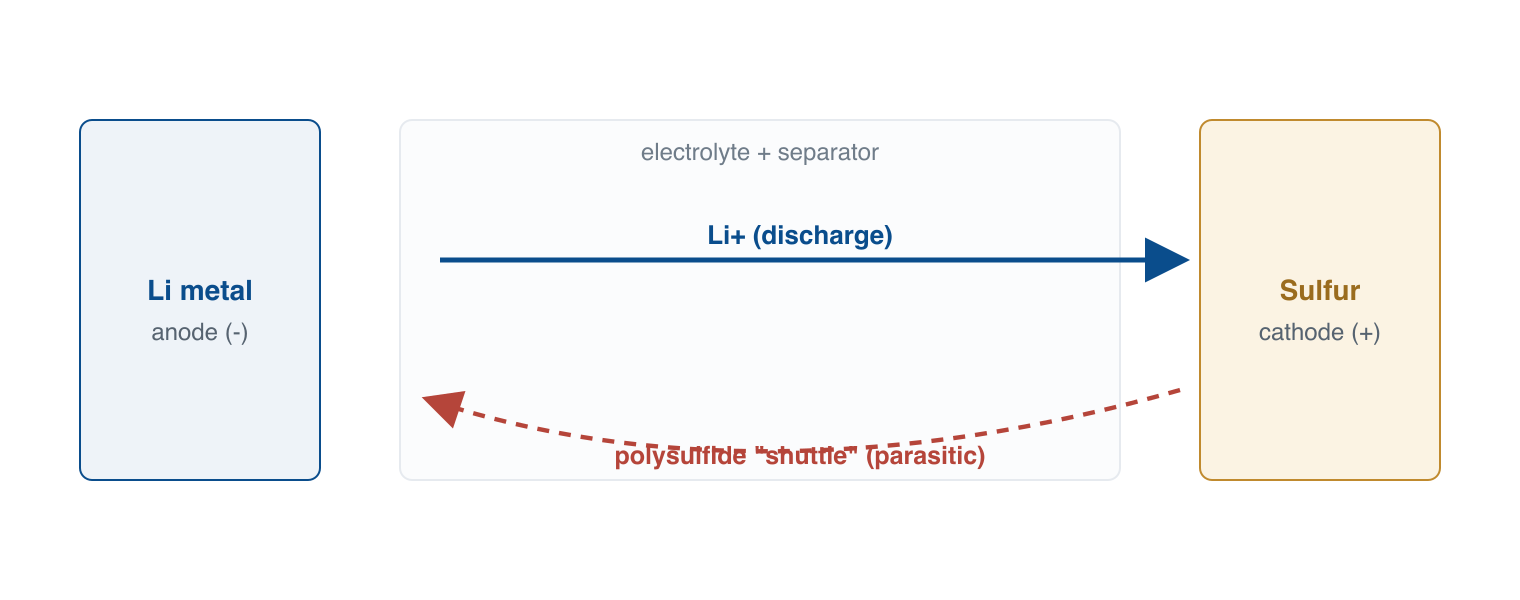
A Li-S cell looks deceptively simple. The cathode is sulfur (usually elemental S₈ hosted in a conductive carbon matrix). The anode is lithium metal. Between them sits an electrolyte and separator. The chemistry is a conversion reaction, not the intercalation reaction that defines lithium-ion:
S₈ + 16 Li → 8 Li₂S
During discharge, lithium ions travel to the cathode and progressively reduce sulfur through a cascade of intermediate lithium polysulfides — long-chain Li₂S₈ and Li₂S₆, then shorter Li₂S₄, Li₂S₂, and finally solid lithium sulfide (Li₂S). On charge, the process reverses.
That intermediate cascade is the source of both the high capacity and nearly every problem Li-S has. Which brings us to the hard part.
The four problems holding lithium-sulfur back
If Li-S were easy, it would already be in your laptop. Four interlocking failure modes have kept it in the lab.
1. The polysulfide shuttle effect
The long-chain polysulfides formed during cycling are soluble in most liquid electrolytes. Once dissolved, they diffuse across the separator to the lithium anode, react there, and drift back — a parasitic “shuttle” that wastes active material, corrodes the anode, and bleeds capacity every cycle. The shuttle effect is the single most-cited reason Li-S cells lose capacity quickly.
2. Insulating active material
Both elemental sulfur and the discharged product Li₂S are electrical and ionic insulators. Without a conductive host, much of the sulfur simply never participates in the reaction. This is why practical cathodes pair sulfur with conductive carbons or, increasingly, lock it into a conductive polymer backbone.
3. Large volume change
Converting S₈ to Li₂S comes with a volumetric expansion of roughly 80%. Repeated swelling and contraction cracks the electrode, breaks electrical contacts, and shortens cycle life — a mechanical problem layered on top of the chemical ones.
4. The lithium-metal anode
The high energy density depends on a lithium-metal anode, which carries its own well-known issues: dendrite growth, unstable solid-electrolyte interphase (SEI), and safety risk. Solving the cathode side only gets you so far if the anode is the part that fails.
The honest summary: Li-S isn’t blocked by one breakthrough, but by four problems that have to be managed simultaneously. Progress has come from attacking them together — and the most important materials-level answer is a cathode that designs the shuttle problem out from the start.
Electrolytes for lithium-sulfur: ether, carbonate, and solid-state
The electrolyte decides whether the shuttle problem is manageable or fatal — and Li-S forces a choice that lithium-ion never has to make.
Ether-based electrolytes (the lab standard)
Conventional elemental-sulfur cells use ether solvents (DOL/DME) with a lithium salt and a lithium nitrate (LiNO₃) additive that helps passivate and protect the lithium anode. Ethers tolerate polysulfides and deliver high capacity, but they are volatile, and the very fact that they dissolve polysulfides keeps the shuttle alive. This is the system most academic Li-S papers report.
Carbonate-based electrolytes (and why they usually fail)
The cheap, manufacturing-friendly carbonate electrolytes that power every lithium-ion cell normally cannot be used with elemental sulfur — the carbonate solvents are attacked by the dissolved polysulfides and the cell dies almost immediately. This incompatibility is a major reason elemental-sulfur Li-S has been hard to manufacture at scale — and, as we’ll see, it’s exactly the problem SPAN solves.
Toward solid-state Li-S
Replacing the liquid with a solid electrolyte attacks the shuttle at the root: with no liquid to dissolve them, polysulfides can’t migrate. Solid-state Li-S is early, but it’s one of the most promising long-term directions. (If you’re exploring this route, see our guide to sulfide vs halide vs oxide solid electrolytes and the basics of how electrolytes work.)
SPAN: the cathode that designs out the shuttle problem
The most practical path around the polysulfide shuttle isn’t a better electrolyte additive — it’s a better cathode. Sulfurized polyacrylonitrile (SPAN) covalently bonds sulfur into a conductive, nitrogen-rich polymer matrix instead of leaving it as free S₈. Because the sulfur is chemically bound, the soluble long-chain polysulfides that drive the shuttle never form in the same way — so capacity retention improves dramatically, and crucially the cathode works with the standard carbonate electrolytes that the rest of the industry already manufactures at scale.
For research teams, SPAN has become the pragmatic way to get a working, repeatable Li-S cell on the bench. We cover the material in depth in our dedicated guide — see SPAN cathode powder for lithium-sulfur batteries for the full breakdown, specifications, and global supply.
Why cycle life is the real bottleneck
Energy density gets the headlines, but cycle life is what actually decides where Li-S can ship. Early cells faded within tens of cycles; good lab cells today run for hundreds to over a thousand, and the commercial target for most applications is a stable thousand-plus. Closing that gap is the central engineering fight.
Capacity fades through several overlapping mechanisms: active-material loss as polysulfides shuttle away, lithium-anode degradation and accumulation of inactive “dead lithium,” passivation of the electrode by insulating Li₂S, and electrolyte depletion.
The deeper tension is between energy density and durability. To hit real-world Wh/kg, a cell needs high sulfur loading and a lean electrolyte (a low electrolyte-to-sulfur, or E/S, ratio). But high loading worsens the volume-change and conductivity problems, and a lean electrolyte gives the shuttle less room to be diluted — so the very choices that raise energy density tend to shorten cycle life. Managing that trade-off, cell by cell, is most of what Li-S development actually is.
Lithium-sulfur in 2026: where it actually stands
Li-S has quietly moved from “perpetually five years away” to early commercial deployment in niches where its strengths matter most. The pattern is consistent: Li-S wins first where gravimetric energy density is worth a premium and cycle-life requirements are moderate.
- Aviation and eVTOL — every kilogram saved extends range or payload.
- Drones and UAVs — lightweight, high-energy packs for endurance-critical flight.
- Defense and aerospace — where performance and weight outrank cost-per-cycle.
- High-altitude platforms and satellites — extreme weight sensitivity.
Several companies have built real momentum — Lyten, Zeta Energy, and Theion among the most visible names attaching “lithium sulfur battery company” to actual product roadmaps and pilot lines. The remaining gap to mass-market EVs and consumer electronics is cycle life: Li-S still trails lithium-ion on the number of charge cycles before noticeable degradation, though the best cells now reach the hundreds-to-low-thousands range and keep improving.
Safety, cost, and the sustainability case
Safety
Li-S safety is a mixed picture. On the cathode side it has a genuine advantage: unlike nickel-rich oxide cathodes, the sulfur cathode does not release oxygen as it heats, which removes one of the main drivers of thermal runaway. The risk concentrates on the lithium-metal anode — dendrites and reactivity — which is exactly where SPAN cells and solid-state designs improve the picture.
Cost
The raw-material case is compelling: sulfur is a commodity-cheap refining byproduct, and eliminating nickel and cobalt removes the most expensive, most volatile inputs in the lithium-ion cathode. Today that advantage is partly offset by lithium-metal anodes, specialized electrolytes, and low manufacturing yields — so Li-S’s cost win is a scale story, realized as production matures, not an automatic one.
Sustainability
Cobalt-free, nickel-free chemistry built on an abundant byproduct means a materially lighter mining and supply-chain footprint than nickel-rich lithium-ion. End-of-life recycling for Li-S is still early-stage, but the simpler, lower-value-metal chemistry changes the economics of recovery compared with today’s cells.
How to build and test a lithium-sulfur cell today
If you’re moving from “interested in Li-S” to “running cells,” here’s the practical materials path.
Core bill of materials for a research Li-S cell:
- Cathode: SPAN powder for repeatable results, or an elemental sulfur/carbon composite, plus binder and conductive additive. Pre-coated cathode electrode sheets save you the slurry-and-coating step.
- Anode: lithium metal foil or chip — purity and thickness matter for cycling and safety.
- Electrolyte: carbonate-based for SPAN systems; ether-based (with LiNO₃ additive) for elemental-sulfur systems.
- Separator: standard or functionalized to further suppress polysulfide crossover.
- Cell format: coin cells (CR2032) for fast screening; dry pouch cells for energy-density validation.
A typical workflow goes: screen the chemistry in coin cells, confirm capacity and cycling, then move to pouch cells to validate real-world energy density — and finally to a small pilot batch once the formulation is locked.
This is exactly the lab-to-pilot path Xnergy is built to compress. Rather than sourcing materials from five vendors and figuring out fabrication yourself, you can source validated battery materials and have cells prototyped and pilot-built under one roof — turning months of integration work into weeks.
Lithium-sulfur vs lithium-ion vs solid-state: a 2026 comparison
| Attribute | Lithium-Sulfur (Li-S) | Lithium-Ion (NCM/LFP) | Solid-State |
|---|---|---|---|
| Practical specific energy | ~400–600 Wh/kg | ~150–300 Wh/kg | ~350–500 Wh/kg (target) |
| Cathode cost / supply | Very low (sulfur, abundant) | High (Ni/Co/Mn) | Varies |
| Cobalt-free | Yes | Only LFP | Often |
| Main weakness | Cycle life, polysulfide shuttle | Energy-density ceiling, cost | Manufacturing maturity |
| Cycle life | Hundreds → low thousands | 1,000–6,000+ | High (target) |
| 2026 maturity | Early commercial (niche) | Mature, mass-market | Pilot / pre-commercial |
| Best-fit applications | Aviation, drones, defense | EVs, electronics, grid | EVs, premium electronics |
The honest read: Li-S isn’t a drop-in replacement for lithium-ion — it’s a specialist that wins decisively where weight is king. If you’re weighing it against other emerging chemistries, see our guide to sulfide vs halide vs oxide solid electrolytes and our sodium-ion materials guide.
Frequently asked questions
What is the energy density of a lithium-sulfur battery?
Theoretical specific energy is about 2,500 Wh/kg. Practical cells in 2026 reach roughly 400–600 Wh/kg — about double the best commercial lithium-ion — though real numbers depend heavily on cell design.
Are lithium-sulfur batteries rechargeable?
Yes. Rechargeable Li-S cells are the focus of nearly all current development. The historical challenge has been how many cycles they last before capacity fades, which is improving steadily with cathode designs like SPAN.
Why aren’t lithium-sulfur batteries used everywhere yet?
Four linked problems — the polysulfide shuttle effect, insulating active material, ~80% volume change, and lithium-metal anode instability — historically limited cycle life. They’re being solved together, and Li-S is now in early commercial use in weight-critical niches.
What is SPAN cathode and why does it matter?
SPAN (sulfurized polyacrylonitrile) binds sulfur into a conductive polymer matrix, suppressing the polysulfide shuttle and enabling standard carbonate electrolytes. It’s the most practical way to build repeatable Li-S cells in the lab today.
Which companies are commercializing lithium-sulfur batteries?
Companies such as Lyten, Zeta Energy, and Theion are among the most active, with pilot lines and roadmaps targeting aviation, defense, and other weight-sensitive applications.
Where can I buy materials to build lithium-sulfur cells?
Xnergy supplies SPAN cathode, lithium-metal anodes, electrolytes, and the full materials set for Li-S research — plus cell prototyping and pilot manufacturing as a service. Request a quote or sample to get started.
Source with Xnergy
Sourcing lithium-sulfur materials? Start here
Get from “interested” to “validated cell” faster by starting with a cathode that designs out the hardest problem. Xnergy supplies ultra-high-performance SPAN and the complete Li-S materials set, backed by US-based prototyping and pilot manufacturing.