
NCM Dry Pouch Cells without Electrolyte for Battery R&D
Twenty-seven research-grade SKUs covering five NCM cathode chemistries (NCM613, 523, 622, 811, 90) paired with four anode architectures — graphite, silicon-carbon, lithium metal, and anode-free. All shipped dry (without electrolyte) so researchers inject their own liquid, solid-state, or polymer electrolyte. In stock. Ships within one week.
Looking for NCM dry pouch cells without electrolyte?
Xnergy Materials supplies 27 research-grade NCM dry pouch cells without electrolyte, in stock, shipping within one week. All cells are delivered dry (no electrolyte injected), also called "unfilled" pouch cells, so researchers can inject their own custom electrolyte formulation. Cathodes span NCM613 (4.4V high-voltage), NCM523 (mid-nickel), NCM622 (standard), NCM811 (high-nickel), and NCM90 (ultra-high-nickel). Anode options include graphite, silicon-carbon (450 or 600 mAh/g), lithium metal, and anode-free. Capacities range from 0.5 Ah to 5 Ah. Prices start at $82 per cell.
Need matching electrolyte? We've got you covered. For solid-state battery research, we supply the matching solid-state electrolytes (LPSCl, LLZO, LATP, and more) to pair with these dry cells. If you need liquid electrolyte for your pouch cells, browse our battery electrolyte catalog — from 500 g research samples to tonne-scale production. Either way, we provide matched cell + electrolyte packages that help you hit better data, faster. Contact us for bulk pricing (50+ cells), custom specs, or a complete matched package. Talk to our team →
01 / What They AreWhat Are Dry Pouch Cells without Electrolyte — and Why Researchers Need Them
A dry pouch cell without electrolyte — also known as an unfilled pouch cell — is a pouch-format lithium battery cell manufactured and sealed without electrolyte. The cathode, anode, separator, and current collectors are all pre-assembled inside the aluminum-laminated pouch, but the electrolyte-injection step is left to the end user. This format is purpose-built for battery research groups studying custom electrolytes — including liquid, solid-state, polymer, and hybrid systems — where the electrolyte itself is the experimental variable.
The alternative — buying pre-filled cells — works fine when you're evaluating electrode chemistry or cell design, but it falls apart the moment your research focus shifts to the electrolyte. Any pre-injected solvent leaves residual signatures that contaminate your measurements. With an unfilled cell, the cell arrives as a clean platform: you inject exactly what you want to test, seal it inside your glove box, and cycle it against your own formulation.
Xnergy's dry pouch cell catalog is organized around four anode architectures — graphite, silicon-carbon, lithium metal, and anode-free — because that's how most battery research programs think about their cell platform. Each architecture serves a different research path: standard Li-ion benchmarking, high-capacity work, solid-state and beyond-Li-ion, and next-generation energy-density frontiers respectively.
The representative cell geometry across the catalog is approximately 85 × 65 mm for the active electrode area and 85 × 115 mm overall (including the heat-seal borders and electrode tabs). Exact dimensions scale with capacity — a 5 Ah cell is larger than a 0.5 Ah cell — and specific dimensions are listed on each product page.
All NCM dry pouch cell SKUs in one place.
Browse specifications, compare chemistries, and order direct — ships within one week.
02 / GraphiteFor Li-ion Research: NCM Pouch Cells with Graphite Anode
Graphite-anode pouch cells are the workhorse platform for standard lithium-ion battery research — benchmarking new cathode formulations, testing electrolyte additives against a stable anode reference, and running cycle-life studies where you want the anode variable held constant. Xnergy offers three graphite-anode NCM unfilled pouch cell product lines, spanning three cathode voltage windows.
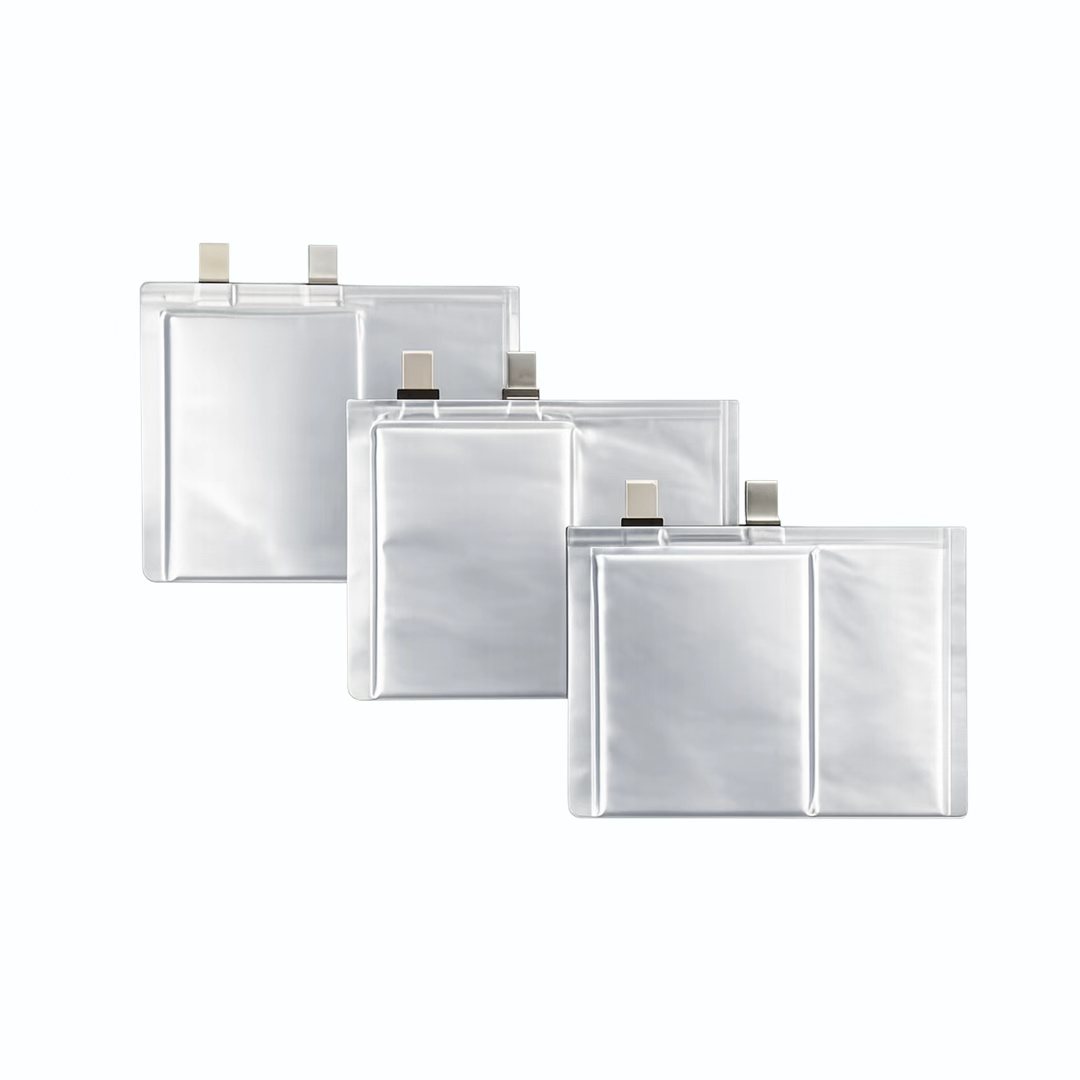
High-Voltage NCM613 / Artificial Graphite Anode Pouch Dry Cell
A 4.4V high-voltage cathode paired with artificial graphite anode. The elevated voltage window delivers ~10% more energy per charge compared to standard 4.2V NCM cells, while the NCM613 chemistry (low cobalt content) offers good thermal and structural stability at high voltage.
4.4V · 1 Ah — $82
4.4V · 1.5 Ah — $94
4.4V · 2 Ah — $107
NCM622 / Artificial Graphite Anode Pouch Dry Cell
The most-ordered graphite-anode cell in the catalog. NCM622 is the industry-standard high-nickel cathode — balanced cycle life, energy density, and thermal behavior. Graphite anode provides the reference electrode against which most electrolyte-additive studies are normalized.
1 Ah — $89
1.5 Ah — $102
2 Ah — $115
NCM90 / Artificial Graphite Anode Pouch Dry Cell
Ultra-high-nickel (≥90% Ni) cathode paired with graphite anode. This is the highest-energy-density graphite-anode cell in the catalog — suitable for programs benchmarking the cathode frontier while keeping the anode variable held constant for cleaner cathode-focused electrochemistry.
1 Ah — $102
2 Ah — $115
03 / Silicon-CarbonFor High-Capacity Research: NCM Pouch Cells with Silicon-Carbon Anode
Silicon-carbon composite anodes deliver 20-65% higher specific capacity than graphite (450-600 mAh/g vs ~370 mAh/g) while the carbon matrix accommodates the volume expansion that makes pure-silicon anodes mechanically impractical. Xnergy's silicon-carbon line pairs NCM811 cathode with two grades of silicon loading — 450 and 600 mAh/g — across three capacity points.
NCM811 / Silicon-Carbon Anode Pouch Dry Cell
The most versatile silicon-carbon line in the catalog — six SKUs covering 1 Ah, 2 Ah, and 5 Ah capacities, each in both 450 mAh/g and 600 mAh/g silicon loading. The 450 mAh/g grade prioritizes cycle-life reproducibility; the 600 mAh/g grade pushes toward maximum capacity for programs optimizing silicon content. Both use the same NCM811 cathode platform.
1 Ah · 450 mAh/g Si-C — $115
1 Ah · 600 mAh/g Si-C — $127
2 Ah · 450 mAh/g Si-C — $140
2 Ah · 600 mAh/g Si-C — $153
5 Ah · 450 mAh/g Si-C — $165
5 Ah · 600 mAh/g Si-C — $178
The 450 mAh/g grade is the default for new silicon-anode programs — broader cycle-life stability and easier baseline behavior. The 600 mAh/g grade is for programs that already have silicon-anode experience and want to push capacity further, usually with custom electrolyte additives (FEC, VC) that they inject themselves.
04 / Lithium MetalFor Solid-State & Beyond-Li-ion: Lithium Metal Pouch Cells (Unfilled)
This is the core of Xnergy's unfilled-cell lineup — eleven SKUs across four NCM cathode chemistries (NCM523, 622, 811, 90) paired with lithium metal anode, all shipped factory-sealed but without electrolyte. For any battery research program focused on the electrolyte itself — solid-state, polymer, gel, hybrid, or next-generation liquid — this is the cell platform you want.
The lithium metal anode pushes theoretical energy density beyond what graphite can reach (Li metal has roughly ten times the specific capacity of graphite), but it's also the anode most punished by poor electrolyte matching. Dendrite formation, SEI instability, and coulombic-efficiency losses all come back to the electrolyte chemistry. These cells give you a clean, factory-prepared Li-metal platform to test your own electrolyte against.
These unfilled lithium-metal pouch cells are also the standard base platform for building solid-state pouch cell prototypes. Researchers inject their solid electrolyte — sulfide (LPSCl, LGPS), oxide (LLZO), or polymer — into the dry cell to create a complete solid-state assembly, then heat-seal and cycle under controlled stack pressure. The cell body, separator, and Li-metal foil arrive pre-aligned, which removes the variables that make ground-up solid-state cell construction so difficult for smaller labs.
If you're running solid-state battery research with sulfide electrolytes, pair these Li-metal cells with our solid electrolyte catalog. For liquid-electrolyte programs, see our battery electrolyte supplier page covering grams to tonne-scale orders.
NCM523 / Lithium Metal Pouch-Type Dry Cell
Mid-nickel NCM523 cathode with Li metal anode, unfilled. NCM523 offers a balanced tradeoff for new Li-metal research programs — easier baseline behavior than NCM811 while still achieving meaningful energy-density gains over graphite-anode reference cells. Good starting point for groups new to lithium metal cell work.
0.5 Ah — $165
1 Ah — $292
1.5 Ah — $242
NCM622 / Lithium Metal Pouch Battery Dry Cell (Unfilled)
Standard NCM622 cathode with Li metal anode, shipped unfilled. A popular configuration for solid-state research groups running cathode-side optimization studies while keeping the Li-metal anode as the baseline. Compatible with sulfide, oxide, and polymer electrolyte systems.
0.5 Ah — $165
1 Ah — $242
1.5 Ah — $292
NCM811 / Lithium Metal Pouch Battery Dry Cell (Unfilled)
High-nickel NCM811 cathode with Li metal anode, unfilled. The highest-energy-density non-anode-free cell in the catalog — theoretical specific energy above 400 Wh/kg when paired with a well-matched electrolyte. Widely used in solid-state battery frontier programs.
0.5 Ah — $216
1 Ah — $292
1.5 Ah — $343
2 Ah — $419
NCM90 / Lithium Metal Pouch Battery Dry Cell (Unfilled)
Ultra-high-nickel (≥90% Ni) cathode paired with lithium metal anode, unfilled. The frontier energy-density configuration in the catalog — combines the highest-capacity cathode chemistry with the highest-capacity anode. Recommended for advanced programs that have already validated their electrolyte on lower-nickel cells.
1 Ah — $343
2 Ah — $445
05 / Anode-FreeFor Next-Gen Frontier: Anode-Free Pouch Cells
Anode-free pouch cells take the energy-density argument to its logical extreme — remove the anode material entirely. The cell ships with just a bare copper current collector where the anode would normally be. During the first charge, lithium plates directly from the cathode onto the copper foil, forming a thin lithium metal anode in-situ. The result: no inactive anode mass, maximum theoretical energy density, and a simpler manufacturing path.
The tradeoff is technical difficulty. Without pre-deposited lithium reservoir, every coulomb lost to SEI formation or dendrite trapping is a coulomb the cell cannot recover. Coulombic efficiency becomes the decisive variable, which is why anode-free cells are primarily an electrolyte-development platform — getting above 99.5% coulombic efficiency on plating-stripping cycles is the gate that decides whether the chemistry is viable.
NCM811 Anode-Free Pouch Dry Cell
NCM811 cathode with bare copper foil on the anode side, shipped unfilled. The single-layer variant provides the simplest cell geometry for electrochemistry studies on anode-free plating-stripping dynamics. The 1 Ah and 3 Ah variants are stacked cells for programs evaluating scale-up behavior.
Single-Layer — $82
1 Ah — $94
3 Ah — $115
Three primary research directions: (1) next-generation electrolyte additive screening where coulombic efficiency is the measured endpoint; (2) solid-state battery research where in-situ lithium plating onto a collector replaces the handling hazards of pre-deposited lithium foil; (3) energy-density ceiling studies benchmarking maximum theoretical specific energy achievable in a pouch-cell format.
06 / Selection GuideCathode Selection Guide — NCM613 vs 523 vs 622 vs 811 vs 90
The numbers after "NCM" encode the ratio of nickel, cobalt, and manganese. Higher nickel means higher specific capacity but faster degradation and more thermal sensitivity. Lower nickel means better cycle life and safety margins but less energy per cell. Cobalt adds structural stability; manganese improves thermal behavior. Every research program has its own point on that tradeoff curve — here's how Xnergy's five cathode chemistries map onto it:
- NCM613 (high-voltage 4.4V): Approximately 60% Ni, 10% Co, 30% Mn — the low-cobalt variant operated at an elevated voltage window. Best for programs where reducing cobalt content is a constraint, or where the 10% energy bump from 4.4V charging is useful. Lower cost per cell ($82-107).
- NCM523: 50% Ni, 20% Co, 30% Mn — the mid-nickel balanced chemistry. Highest cycle life in the lineup, easiest baseline behavior. A good starting platform for new research groups or for groups where cycle-life reproducibility matters more than absolute energy density.
- NCM622: 60% Ni, 20% Co, 20% Mn — the industry-standard high-nickel cathode. Widest SKU selection (graphite and Li-metal options), most-ordered in the catalog, best-understood electrochemistry in published literature. Default choice if you don't have a strong reason to pick a different chemistry.
- NCM811: 80% Ni, 10% Co, 10% Mn — the high-energy workhorse. Broadest anode pairings (graphite, Si-C, Li metal, anode-free), widest capacity range. The go-to platform for energy-density optimization, silicon-anode research, and most solid-state programs.
- NCM90 (≥90% Ni): The ultra-high-nickel frontier. Highest specific capacity in the lineup, but with correspondingly tighter demands on electrolyte stability and cycling protocol. Recommended only after you've validated your electrolyte on NCM811 or lower-nickel platforms first.
07 / Pricing MatrixComplete Pricing Matrix — All 27 SKUs
Every Xnergy NCM unfilled pouch cell SKU, organized by anode architecture and cathode chemistry. All prices in USD per cell, shipped within one week of order confirmation. Bulk pricing available — see the next section for ordering 10+ cells.
27 SKUs · 5 cathodes · 4 anode types
| Configuration | Spec | Price (USD) |
|---|---|---|
| NCM613 / Graphite (4.4V High-Voltage) | ||
| NCM613 / Graphite | 4.4V · 1 Ah | $82 |
| NCM613 / Graphite | 4.4V · 1.5 Ah | $94 |
| NCM613 / Graphite | 4.4V · 2 Ah | $107 |
| NCM523 / Lithium Metal (Unfilled) | ||
| NCM523 / Li Metal | 0.5 Ah | $165 |
| NCM523 / Li Metal | 1 Ah | $292 |
| NCM523 / Li Metal | 1.5 Ah | $242 |
| NCM622 / Graphite | ||
| NCM622 / Graphite | 1 Ah | $89 |
| NCM622 / Graphite | 1.5 Ah | $102 |
| NCM622 / Graphite | 2 Ah | $115 |
| NCM622 / Lithium Metal (Unfilled) | ||
| NCM622 / Li Metal | 0.5 Ah | $165 |
| NCM622 / Li Metal | 1 Ah | $242 |
| NCM622 / Li Metal | 1.5 Ah | $292 |
| NCM811 / Silicon-Carbon | ||
| NCM811 / Si-C | 1 Ah · 450 mAh/g Si-C | $115 |
| NCM811 / Si-C | 1 Ah · 600 mAh/g Si-C | $127 |
| NCM811 / Si-C | 2 Ah · 450 mAh/g Si-C | $140 |
| NCM811 / Si-C | 2 Ah · 600 mAh/g Si-C | $153 |
| NCM811 / Si-C | 5 Ah · 450 mAh/g Si-C | $165 |
| NCM811 / Si-C | 5 Ah · 600 mAh/g Si-C | $178 |
| NCM811 / Lithium Metal (Unfilled) | ||
| NCM811 / Li Metal | 0.5 Ah | $216 |
| NCM811 / Li Metal | 1 Ah | $292 |
| NCM811 / Li Metal | 1.5 Ah | $343 |
| NCM811 / Li Metal | 2 Ah | $419 |
| NCM811 / Anode-Free | ||
| NCM811 / Anode-Free | Single-Layer | $82 |
| NCM811 / Anode-Free | 1 Ah | $94 |
| NCM811 / Anode-Free | 3 Ah | $115 |
| NCM90 / Graphite | ||
| NCM90 / Graphite | 1 Ah | $102 |
| NCM90 / Graphite | 2 Ah | $115 |
| NCM90 / Lithium Metal (Unfilled) | ||
| NCM90 / Li Metal | 1 Ah | $343 |
| NCM90 / Li Metal | 2 Ah | $445 |
08 / Bulk OrdersBulk Pricing & Custom Configurations
Research groups running multi-month cycling studies or early-stage pilot programs typically order cells in batches of 10 to 200+ units. Xnergy Materials offers bulk-purchase pricing on all 27 SKUs for orders of 10 cells or more, with tiered discounts depending on chemistry, capacity, and total order value.
Ordering 10+ cells? Contact us for bulk pricing.
Bulk discounts available on every SKU in the catalog for orders of 10 cells or more. Specific discount rates depend on chemistry and total order value — contact our sales team with your requirements for a custom quote. Ongoing supply agreements and pilot-scale partnerships also available for research programs needing recurring shipments.
Beyond the 27 standard SKUs, Xnergy also offers custom dry pouch cell configurations — specific capacities outside the standard range, non-standard dimensions, alternate electrode loadings, or custom tab arrangements. Custom orders typically require 4-6 weeks lead time from specification confirmation. Contact us with your target specifications for a custom quote.
09 / FAQNCM Dry Pouch Cells without Electrolyte: Frequently Asked Questions
What is a dry pouch cell without electrolyte?
An unfilled pouch cell — also known as a dry pouch cell or a pouch cell without electrolyte — is a pouch-format lithium battery cell manufactured and sealed without electrolyte. The electrodes (cathode, anode, separator, current collectors) are fully assembled inside the aluminum-laminated pouch, but the electrolyte-injection step is left to the end user. This allows battery research groups to study their own custom electrolyte formulations — including liquid, solid-state, polymer, and hybrid systems — in a professionally manufactured cell platform.
Why buy dry pouch cells without electrolyte instead of pre-filled cells?
Battery researchers studying new electrolytes need a clean, factory-assembled cell without any pre-injected liquid. Unfilled pouch cells let you inject your own formulation — liquid, solid-state, polymer, or gel — without worrying about residual solvent contamination from a supplier's standard electrolyte. This is essential for solid-state battery research, electrolyte-additive studies, and any program where the electrolyte is the experimental variable.
Which NCM dry pouch cell is best for solid-state battery research?
For solid-state battery research, Xnergy recommends the lithium-metal anode unfilled pouch cells — NCM523, NCM622, NCM811, or NCM90 paired with Li metal. These cells arrive factory-sealed with cathode, separator, and pre-assembled lithium foil anode, but with no electrolyte. Researchers then inject their custom solid-state electrolyte (LPSCl, LLZO, LGPS, polymer, or hybrid).
The NCM811 Li-metal option delivers the highest energy density for frontier research. NCM523 Li-metal is easier for groups new to Li-metal cell work. NCM90 Li-metal represents the absolute cathode frontier but requires validated electrolyte chemistry.
What's the difference between NCM613, NCM523, NCM622, NCM811, and NCM90?
The numbers after NCM indicate the ratio of nickel, cobalt, and manganese in the cathode active material:
- NCM613 — approximately 60% Ni, 10% Co, 30% Mn, operated as a high-voltage (4.4V) variant
- NCM523 — 50% Ni, 20% Co, 30% Mn, a balanced mid-nickel chemistry
- NCM622 — 60% Ni, 20% Co, 20% Mn, the industry-standard high-nickel platform
- NCM811 — 80% Ni, 10% Co, 10% Mn, high-energy chemistry requiring careful thermal management
- NCM90 — 90%+ Ni, ultra-high-nickel for frontier energy-density research
What is a silicon-carbon anode pouch cell?
A silicon-carbon (Si-C) anode pouch cell uses a composite anode combining silicon nanoparticles with a carbon matrix. Silicon provides substantially higher specific capacity (typically 450 to 600 mAh/g versus approximately 370 mAh/g for pure graphite), while the carbon matrix accommodates the volume expansion that pure silicon cannot handle alone. Xnergy offers NCM811/Si-C pouch cells in both 450 and 600 mAh/g silicon-carbon grades, in capacities from 1 Ah to 5 Ah.
What is an anode-free pouch cell?
An anode-free pouch cell has no pre-deposited anode material — just a bare copper current collector where the anode would normally be. During the first charge, lithium from the cathode plates directly onto the copper foil, forming a thin lithium metal anode in-situ. This approach maximizes energy density (no inactive anode mass) and simplifies cell manufacturing, but is technically demanding because of dendrite and coulombic-efficiency challenges. Xnergy supplies NCM811 anode-free pouch cells for researchers pushing this frontier.
Are Xnergy dry pouch cells without electrolyte in stock?
Yes. All NCM dry pouch cells listed in the Xnergy catalog are in stock at our California warehouse and ship within one week of order confirmation. Bulk orders of 10 cells or more or custom configurations may extend lead time to 2-4 weeks. Contact us for expedited shipping options on urgent orders.
How much does an NCM dry pouch cell without electrolyte cost?
Xnergy NCM dry pouch cell prices start at $82 per cell for basic NCM613 graphite-anode configurations and range up to $445 per cell for NCM90 lithium-metal cells. Silicon-carbon NCM811 cells run $115-178 per cell. Anode-free NCM811 starts at $82. Bulk-order discounts are available — contact us for quantities of 10 cells or more.
Do you offer bulk discounts on dry pouch cells without electrolyte?
Yes. Xnergy Materials offers bulk-purchase pricing for dry pouch cell orders of 10 cells or more. Discount tiers vary by chemistry and capacity. Contact us for a custom quote on large orders or ongoing supply agreements. Research programs requiring recurring shipments may also qualify for pilot-partnership pricing.
Can I customize dry pouch cell specifications?
Yes. While the 27 standard SKUs cover most research applications, Xnergy offers custom dry pouch cell configurations including specific capacities, dimensions, electrode loadings, and tab arrangements. Custom orders typically require 4-6 weeks lead time. Contact us with your target specifications for a custom quote.
27 dry NCM pouch cell without electrolyte SKUs. Four anode architectures. In stock. One click away.
Browse the full dry pouch cell catalog to compare specifications, order direct, or request a custom configuration. In-stock items ship within one week.