
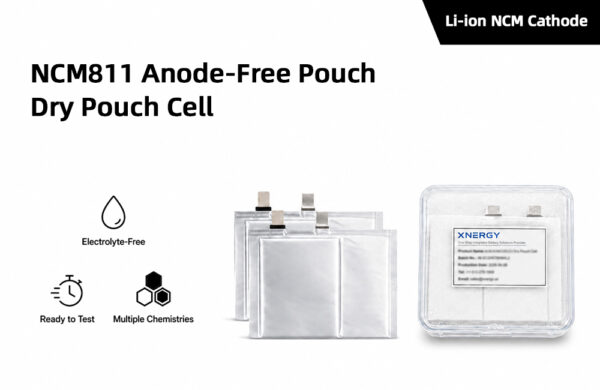
NCM811 Anode-Free Pouch Dry Pouch Cell(Multiple Specs)
Free Shipping Price range: $82.00 through $115.00
NCM811 / Anode-Free Pouch Dry Pouch Cell — ultra-high-energy-density dry pouch cell with high-nickel NCM811 (Ni80) cathode and bare copper current collector — no anode active material. Lithium plates in-situ from cathode during first charge. Validated 90% capacity retention at 88 cycles with near-100% coulombic efficiency. Available in 1 Ah / 3 Ah / Single-Layer grades. Pressure-assisted aging protocol (8 kgf/cm²).
Need a bulk order or custom specification? Request a competitive quote today!
Name: NCM811 / Anode-Free Pouch Dry Pouch Cell (Multiple Specs)
Cell Type: NCM811-Anode-Free Pouch Dry Cell
Product Code: XN-NCM811-AF
Description:
NCM811 / Anode-Free Pouch Dry Pouch Cell pairs high-nickel NCM811 (Ni80) cathode with a bare copper current collector — no anode active material — in a fully assembled but unfilled (dry) pouch format. As a result, this configuration represents the most aggressive energy-density architecture in lithium battery research: during the first charge, lithium is plated directly from the cathode onto the bare copper foil, eliminating the volume and weight overhead of conventional graphite or silicon-carbon anodes. Validated cycling demonstrates 90% capacity retention at 88+ cycles with near-100% coulombic efficiency — a remarkable result for anode-free chemistry. Furthermore, the dry (unfilled) pouch format allows customers to inject their own electrolyte formulations for advanced anode-free electrolyte and lithium plating interface research targeting next-generation 400+ Wh/kg battery systems.
Application:
This dry pouch cell serves as a research platform for anode-free lithium battery development, including electrolyte formulation studies for anode-free systems, lithium plating/stripping interface research on bare copper, advanced electrolyte additive screening, full-cell prototyping for ultra-high-energy-density applications (UAV, eVTOL, advanced EV, aerospace), and academic studies of anode-free cell degradation mechanisms (dendrite formation, dead lithium accumulation).
Cell Specifications (1 Ah Standard Grade):
| Parameter | Value |
|---|---|
| Cell Type | NCM811-Anode-Free Pouch Dry Cell |
| Design Capacity | 1000 mAh (1 Ah) |
| Cell Dimensions | 6090 (60 × 90 mm) |
| Cell Architecture | Stacked (laminated) |
| Recommended Voltage Range | 3.0 – 4.2 V |
| Separator | PE 9+3 (composite) |
| Cathode Sheet Count | 4 |
| Current Collector Sheet Count | 5 |
| Recommended Electrolyte Filling | 3 g/Ah |
| Recommended Aging | 45 °C, 24 h rest under 8 kgf/cm² pressure |
| Recommended Formation | 0.1C charge–discharge cycle (3.0–4.2 V), 1 cycle |
| Final Aging | Room temperature, 24 h rest |
Cathode Specifications (NCM811):
| Parameter | Value |
|---|---|
| Active Material | NCM811 (Ni80 high-nickel NCM) |
| Active Material Content | 97.0% |
| Specific Capacity | 200 mAh/g |
| Single-Side Areal Density | 18 mg/cm² |
| Electrode Dimensions | 75 × 54 mm |
Current Collector Specifications (Anode-Free):
| Parameter | Value |
|---|---|
| Anode Construction | Bare copper foil — no active material |
| Lithium Source | From cathode during first charge (in-situ plating) |
| Current Collector | Copper foil |
| Electrode Dimensions | 77 × 56 mm |
Values measured by Xnergy. Typical values for reference; not guaranteed unless otherwise specified.
Available Capacity Grades:
| Grade | Capacity | Notes |
|---|---|---|
| 1 Ah Standard | 1000 mAh | 6090 dimensions, lab-scale R&D |
| 3 Ah | 3000 mAh | Mid-scale prototyping |
| Single-Layer | — | Single-layer construction for fundamental anode-free studies and SEI characterization |
| Custom Specs | — | Cathode loading, separator, and electrode dimensions customizable; contact sales |
Cycle Life Performance:
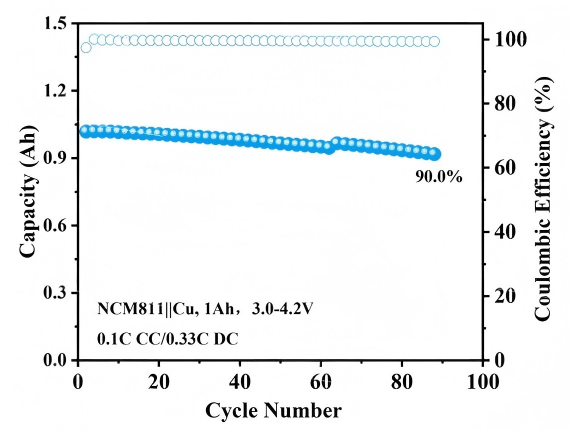
Cycle life of NCM811‖Cu anode-free pouch cell (1 Ah, 3.0–4.2 V, 0.1C CC charge / 0.33C DC discharge). Capacity retention 90.0% at 88 cycles (left axis), with coulombic efficiency consistently near 100% (right axis) — exceptional performance for an anode-free system, indicating highly reversible lithium plating/stripping on the copper substrate.
Characteristics:
Industry-leading anode-free cycle life (90% @ 88 cycles)
Validated cycle testing demonstrates 90% capacity retention through 88 cycles with near-100% coulombic efficiency — a remarkable result for anode-free chemistry, where most reported systems show rapid degradation within 50 cycles due to dendrite formation and dead lithium accumulation. As a result, this cell delivers a stable, reproducible research platform for long-term anode-free studies.
Highest theoretical energy density architecture
The anode-free design eliminates anode active material and binder — the volume and weight typically allocated to graphite or silicon-carbon. Therefore, this architecture offers the highest theoretical energy density of any lithium battery configuration, making it the leading research platform for next-generation 400+ Wh/kg systems targeting UAV, eVTOL, and aerospace applications.
In-situ lithium plating from cathode
During the first charge, lithium ions migrate from the NCM811 cathode and plate directly onto the bare copper current collector, forming the lithium metal anode in-situ. Therefore, customers can study lithium plating morphology, SEI formation on bare Cu, and reversible plating/stripping efficiency without the complications of pre-deposited lithium handling.
Pressure-assisted aging protocol
The recommended aging protocol applies 8 kgf/cm² pressure at 45 °C for 24 hours. Consequently, this stack pressure improves lithium plating uniformity on the bare copper substrate — a critical processing parameter for anode-free cell performance that distinguishes this product from conventional cell formats.
Dry (unfilled) pouch design for electrolyte studies
The cell ships fully assembled but without electrolyte. Therefore, customers can inject their own electrolyte formulations to study electrolyte effects on lithium plating efficiency, dendrite suppression, and dead lithium accumulation — the core challenges of anode-free chemistry that are most strongly influenced by electrolyte design.
Multiple capacity grades + single-layer option
Standard 1 Ah and 3 Ah multi-layer grades support full-cell research. Furthermore, the Single-Layer option provides a simplified platform for fundamental anode-free studies — ideal for SEI characterization, lithium plating morphology imaging, and one-electrode interface research.
Recommended Activation Protocol:
1. Inject electrolyte at 3 g/Ah ratio. 2. Vacuum-seal the pouch under inert atmosphere. 3. Apply 8 kgf/cm² stack pressure on the cell. 4. Aging: hold at 45 °C for 24 h under pressure. 5. Formation: charge at 0.1C constant current to 4.2 V (lithium plates from cathode onto copper). 6. Discharge at 0.1C constant current to 3.0 V (1 cycle). 7. Final aging: rest for 24 h at room temperature before subsequent cycling tests.
Packaging & Storage:
Cells ship vacuum-sealed under inert atmosphere in moisture-barrier packaging. Therefore, customers should store sealed in a cool, dry environment, protected from moisture. Open packaging in a dry-room or glovebox environment immediately before electrolyte filling. Note that no lithium metal is present in the cell as shipped — anode-free cells in their pre-formation state are significantly less hazardous than pre-deposited lithium-metal cells, but standard lithium-ion cell handling applies once electrolyte is added and formation begins.
Safety:
For research and industrial use only. Once electrolyte is added and formation initiated, lithium metal is plated onto the copper — at this point the cell becomes a lithium-metal battery and must be handled accordingly. Activated cells contain flammable electrolyte and lithium metal; handle in glovebox or dry-room conditions during electrolyte filling and formation. Wear full PPE. Never short-circuit, overcharge, overdischarge, puncture, or expose cells to high temperatures (> 60 °C). Refer to SDS for complete safety information.
Note: Values listed above are typical and for reference only. Performance may vary depending on electrolyte choice, formation protocol, applied stack pressure, cycling conditions, and test environment. Anode-free chemistry is highly sensitive to electrolyte design — consult published literature for guidance on electrolyte formulations targeting high coulombic efficiency. See also other dry pouch cells in our catalog: NCM811 / Silicon-Carbon, NCM811 / Lithium Metal, NCM811 / Artificial Graphite, NCM90 / Silicon-Carbon, NCM90 / Lithium Metal, NCM622 / Artificial Graphite, NCM622 / Lithium Metal, NCM613 / Artificial Graphite, NCM523 / Lithium Metal, LCO / Artificial Graphite, LCO / Lithium Metal, LFP / Artificial Graphite, LFP / Lithium Metal, LFP Anode-Free, and LMFP / Artificial Graphite. Browse the full Dry Pouch Cell category for all configurations.
| NCM811 / Anode-Free | (1Ah), (3Ah), Single-Layer |
|---|
Related products
-
NCM90 Silicon-Carbon Anode Pouch Dry Pouch Cell (Multiple Specs)
Free Shipping Price range: $127.00 through $267.00Select options This product has multiple variants. The options may be chosen on the product page -
NCM523–Lithium Metal Pouch-Type Dry Pouch Cell(Multiple Specs)
Free Shipping Price range: $165.00 through $292.00Select options This product has multiple variants. The options may be chosen on the product page -
NVP Anode-Free Pouch Dry Pouch Cell(Multiple Specs)
Free Shipping$102.00Select options This product has multiple variants. The options may be chosen on the product page -
NFPP Polyanionic Sodium-Ion Battery Dry Pouch Cell(Multiple Specs)
Free Shipping$89.00Select options This product has multiple variants. The options may be chosen on the product page