
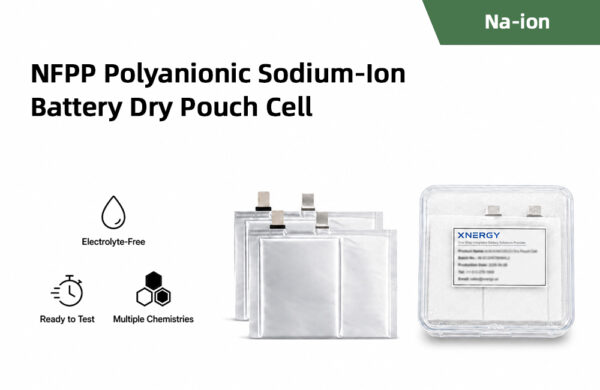
NFPP Polyanionic Sodium-Ion Battery Dry Pouch Cell(Multiple Specs)
Free Shipping$89.00
NFPP Polyanionic Sodium-Ion Battery Pouch Dry Cell — lithium-free, cobalt-free sodium-ion dry pouch cell pairing NFPP (sodium ferric pyrophosphate) cathode with hard carbon anode. Features ~91% capacity retention after 3000 cycles at 1C and exceptional structural stability from the polyanionic framework. Standard 1 Ah grade with custom specs available. Ships unfilled for custom electrolyte studies.
Need a bulk order or custom specification? Request a competitive quote today!
Name: NFPP Polyanionic Sodium-Ion Battery Pouch Dry Cell (Multiple Specs)
Cell Type: NFPP-Hard Carbon Pouch Dry Cell
Product Code: XN-NFPP-HC
Description:
NFPP Polyanionic Sodium-Ion Battery Pouch Dry Cell pairs sodium ferric pyrophosphate (Na₄Fe₃(PO₄)₂P₂O₇) cathode with hard carbon anode in a fully assembled but unfilled (dry) pouch format. As a result, this configuration delivers exceptional long-term cycle stability — approximately 91% capacity retention after 3000 cycles at 1C — together with the intrinsic thermal and structural stability of the polyanionic framework. The strong P–O covalent bonds in the pyrophosphate structure provide superior safety and resistance to oxygen release compared to layered oxide sodium-ion cathodes. Furthermore, the dry (unfilled) pouch format allows customers to inject their own electrolyte formulations, making this cell ideal for advanced sodium-ion electrolyte and additive research targeting next-generation lithium-free, cobalt-free energy storage systems.
Application:
This dry pouch cell serves as a research platform for sodium-ion battery development, including sodium-ion electrolyte formulation studies (the cell ships unfilled, allowing customers to inject their own electrolyte), NFPP polyanionic cathode performance evaluation, hard carbon SEI and additive screening studies, full-cell prototyping for stationary energy storage, grid-scale storage, and low-speed electric mobility applications, and academic studies of NFPP/hard carbon electrochemistry under low-temperature and long-duration cycling conditions.
Cell Specifications (1 Ah Standard Grade):
| Parameter | Value |
|---|---|
| Cell Type | NFPP-Hard Carbon Pouch Dry Cell |
| Design Capacity | 1000 mAh (1 Ah) |
| Cell Dimensions | 6090 (60 × 90 mm) |
| Cell Architecture | Stacked (laminated) |
| Recommended Voltage Range | 1.5 – 3.4 V |
| N/P Ratio | 1.2 |
| Separator | PE 9+3 (composite) |
| Cathode Sheet Count | 10 |
| Anode Sheet Count | 11 |
| Recommended Electrolyte Filling | 8–10 g/Ah |
| Recommended Aging | 45 °C, 24 h rest, 8 kgf/cm² pressure |
| Recommended Formation | 0.1C constant-current charge to 3.4 V (see below) |
| Final Aging | Room temperature, 24 h rest |
Cathode Specifications (NFPP):
| Parameter | Value |
|---|---|
| Active Material | NFPP (Na₄Fe₃(PO₄)₂P₂O₇, sodium ferric pyrophosphate) |
| Active Material Content | 95.0% |
| Specific Capacity | 108 mAh/g |
| Double-Side Areal Density | 30 mg/cm² |
| Electrode Dimensions | 75 × 54 mm |
Anode Specifications (Hard Carbon):
| Parameter | Value |
|---|---|
| Active Material | Hard Carbon |
| Active Material Content | 94.0% |
| Specific Capacity | 260 mAh/g |
| Double-Side Coating Areal Density | 15.18 mg/cm² |
| Electrode Dimensions | 77 × 56 mm |
Values measured by Xnergy. Typical values for reference; not guaranteed unless otherwise specified.
Available Capacity Grades:
| Grade | Capacity | Notes |
|---|---|---|
| 1 Ah Standard | 1000 mAh | 1.5–3.4 V window, lab-scale R&D |
| 2 Ah | 2000 mAh | Mid-scale prototyping |
| 5 Ah | 5000 mAh | Pre-production validation, stationary storage testing |
| Custom Specs | — | Voltage window, separator, and electrode dimensions customizable; contact sales |
Cycling Specific Discharge Capacity:
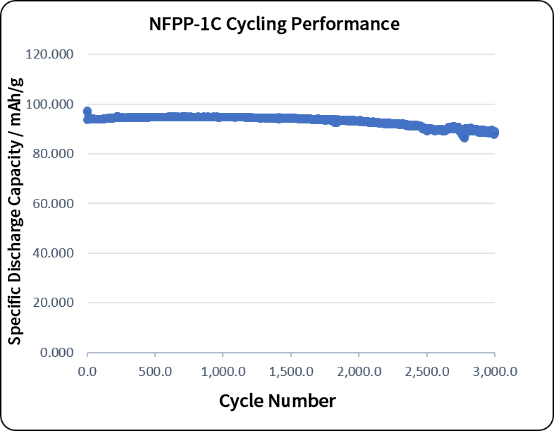
Specific discharge capacity of NFPP-Hard Carbon pouch cell at 1C over 3000 cycles. The cell starts near 95 mAh/g and stabilizes around 88–90 mAh/g after 3000 cycles, demonstrating the outstanding structural reversibility of the polyanionic NFPP framework.
Cycling Capacity Retention:
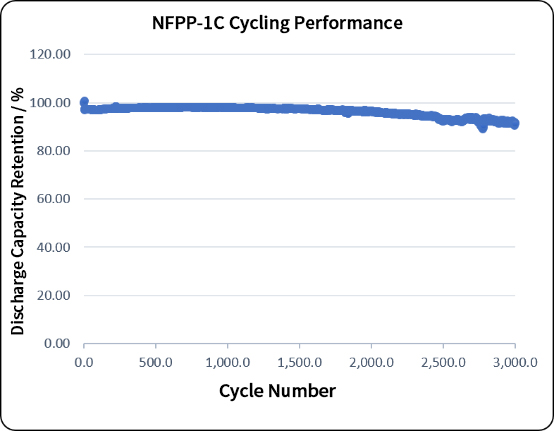
Capacity retention of NFPP-Hard Carbon pouch cell at 1C over 3000 cycles. The cell retains approximately 91% of its initial capacity after 3000 cycles — significantly outperforming most layered oxide sodium-ion chemistries and approaching LFP-class cycle life in a completely lithium-free chemistry.
Characteristics:
Exceptional long-term cycle life (~91% @ 3000 cycles)
The polyanionic NFPP framework demonstrates outstanding structural reversibility, retaining approximately 91% of initial capacity after 3000 cycles at 1C. As a result, this cell approaches LFP-class cycle life while remaining completely lithium-free — ideal for stationary storage applications where long calendar and cycle life dominate cost-of-ownership.
Lithium-free, cobalt-free, nickel-free chemistry
NFPP is built entirely on earth-abundant sodium and iron. Therefore, this cell eliminates dependence on lithium, cobalt, and nickel supply chains, offering a more sustainable and cost-effective alternative for grid-scale and stationary energy storage applications.
Superior thermal and structural stability
The strong P–O covalent bonds in the pyrophosphate framework provide intrinsic thermal stability and resistance to oxygen release. Consequently, NFPP exhibits substantially better safety in abuse scenarios than layered oxide sodium-ion cathodes such as Na-NCM or P2-type oxides.
Wide operating temperature range
NFPP-hard carbon systems retain functional performance across a broader temperature window than typical lithium-ion chemistries. Therefore, this cell is well-suited for outdoor stationary storage, cold-climate backup power, and other applications where temperature extremes challenge conventional lithium-ion systems.
Dry (unfilled) pouch design for sodium-ion electrolyte studies
The cell ships fully assembled but without electrolyte. As a result, customers can inject their own sodium-ion electrolyte formulations to study electrolyte effects on the NFPP cathode interface, hard carbon SEI formation, and additive performance — critical capabilities for advancing sodium-ion battery technology.
Standardized stacked pouch architecture
Stacked-electrode (laminated) construction with PE 9+3 composite separator. Therefore, results are reproducible across labs and comparable with industry benchmarks for sodium-ion pouch cells.
Multiple capacity grades + custom specifications
Standard grades cover 1 Ah / 2 Ah / 5 Ah. Furthermore, custom voltage windows, alternative separators, and electrode dimensions are available on request to match specific sodium-ion research requirements.
Recommended Activation Protocol:
1. Inject sodium-ion electrolyte at 8–10 g/Ah ratio. 2. Vacuum-seal the pouch under inert atmosphere. 3. Aging: hold at 45 °C for 24 h under 8 kgf/cm² stack pressure. 4. Pre-formation rest: 12 h. 5. Formation: charge at 0.1C constant current to 3.4 V (1 cycle). 6. Final aging: hold at room temperature for 24 h before subsequent cycling tests.
Packaging & Storage:
Cells ship vacuum-sealed under inert atmosphere in moisture-barrier packaging. Therefore, customers should store sealed in a cool, dry environment (15–25 °C, RH < 30 %), protected from moisture and direct sunlight. Open packaging in a dry-room or glovebox environment immediately before electrolyte filling.
Safety:
For research and industrial use only. Activated sodium-ion cells contain flammable electrolyte and reactive electrode materials. Wear PPE during cell handling and electrolyte filling. Never short-circuit, overcharge, overdischarge, puncture, or expose cells to high temperatures (> 60 °C). Always operate within the specified voltage range (1.5 – 3.4 V). Compared to lithium-ion systems, NFPP polyanionic cells benefit from inherently safer cathode chemistry due to the strong P–O bonds — but standard sodium-ion cell handling protocols still apply once electrolyte is added. Refer to SDS for complete safety information.
Note: Values listed above are typical and for reference only. Performance may vary depending on electrolyte choice, formation protocol, applied stack pressure, cycling conditions, and test environment. Sodium-ion chemistry is sensitive to electrolyte formulation — consult published literature for guidance on electrolytes optimized for NFPP/hard carbon systems. See also other dry pouch cells in our catalog: NFPP Anode-Free, NVP / Hard Carbon, NVP Anode-Free, P2 Layered Oxide, Sodium Metal Single-Layer Pouch, LFP / Artificial Graphite, LFP / Lithium Metal, LFP Anode-Free, NCM811 / Artificial Graphite, NCM811 / Silicon-Carbon, and LMFP / Artificial Graphite. Browse the full Dry Pouch Cell category for all configurations.
| NFPP / Na-Ion | (1ah) |
|---|
Related products
-
NCM811 / Lithium Metal Pouch Battery Dry Pouch Cell (Unfilled)(Multiple Specs)
Free Shipping Price range: $216.00 through $419.00Select options This product has multiple variants. The options may be chosen on the product page -
P2 Layered Oxide Sodium-Ion Battery Dry Pouch Cell(Multiple Specs)
Free Shipping Price range: $89.00 through $102.00Select options This product has multiple variants. The options may be chosen on the product page -
NCM90 Lithium Metal Pouch Battery Dry Pouch Cell(Unfilled)(Multiple Specs)
Free Shipping Price range: $343.00 through $445.00Select options This product has multiple variants. The options may be chosen on the product page -
LCO Artificial Graphite Anode Dry Pouch Cell(Multiple Specs)
Free Shipping$102.00Select options This product has multiple variants. The options may be chosen on the product page