
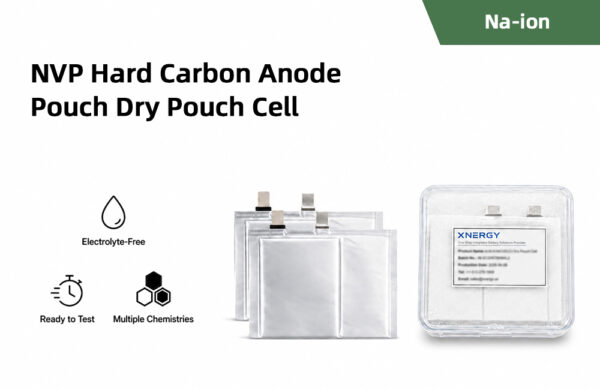
NVP Hard Carbon Anode Pouch Dry Pouch Cell(Multiple Specs)
Free Shipping Price range: $102.00 through $140.00
NVP Hard Carbon Sodium-Ion Pouch Dry Cell — lithium-free, cobalt-free sodium-ion dry pouch cell pairing NVP (Na₃V₂(PO₄)₃) NASICON-type cathode with hard carbon anode. Features ~93% capacity retention after 2900 cycles at 1C and a 3.4 V voltage plateau enabled by NVP’s NASICON 3D ion-conduction framework. Standard 1.25 Ah grade with custom specs available. Ships unfilled for custom electrolyte studies.
Need a bulk order or custom specification? Request a competitive quote today!
Name: NVP Hard Carbon Sodium-Ion Pouch Dry Cell (Multiple Specs)
Cell Type: NVP-Hard Carbon Pouch Dry Cell
Product Code: XN-NVP-HC
Description:
NVP Hard Carbon Sodium-Ion Pouch Dry Cell pairs sodium vanadium phosphate (Na₃V₂(PO₄)₃, NASICON-type) cathode with hard carbon anode in a fully assembled but unfilled (dry) pouch format. As a result, this configuration delivers exceptional long-term cycle stability — approximately 93% capacity retention after 2900 cycles at 1C — together with the high operating voltage (3.4 V plateau, 2.5–3.8 V window) and excellent rate capability enabled by the NASICON 3D ion-conduction framework. The crystallographically open NASICON structure provides three-dimensional sodium-ion diffusion pathways, resulting in higher power density and better rate performance than olivine-type or layered oxide sodium-ion cathodes. Furthermore, the dry (unfilled) pouch format allows customers to inject their own electrolyte formulations, making this cell ideal for advanced sodium-ion electrolyte and additive research targeting next-generation lithium-free, cobalt-free energy storage systems.
Application:
This dry pouch cell serves as a research platform for sodium-ion battery development based on NASICON-type cathodes, including sodium-ion electrolyte formulation studies (the cell ships unfilled, allowing customers to inject their own electrolyte), NVP NASICON cathode performance evaluation, hard carbon SEI and additive screening studies, full-cell prototyping for stationary energy storage, grid-scale storage, and low-speed electric mobility applications, and academic studies of NVP/hard carbon electrochemistry — particularly the comparison between NVP’s 3.4 V voltage plateau and lower-voltage polyanionic chemistries such as NFPP.
Cell Specifications (1.25 Ah Standard Grade):
| Parameter | Value |
|---|---|
| Cell Type | NVP-Hard Carbon Pouch Dry Cell |
| Design Capacity | 1250 mAh (1.25 Ah) |
| Cell Dimensions | 6090 (60 × 90 mm) |
| Cell Architecture | Stacked (laminated) |
| Recommended Voltage Range | 2.5 – 3.8 V |
| N/P Ratio | 1.17 |
| Separator | PE 9+3 (composite) |
| Cathode Sheet Count | 11 |
| Anode Sheet Count | 12 |
| Recommended Electrolyte Filling | 8–10 g/Ah |
| Recommended Aging | 45 °C, 24 h rest, 8 kgf/cm² pressure |
| Recommended Formation | 0.1C constant-current charge to 3.8 V (see below) |
| Final Aging | Room temperature, 24 h rest |
Cathode Specifications (NVP):
| Parameter | Value |
|---|---|
| Active Material | NVP (Na₃V₂(PO₄)₃, NASICON-type sodium vanadium phosphate) |
| Active Material Content | 95.0% |
| Specific Capacity | 100 mAh/g |
| Compaction Density | 2.2 g/cm³ |
| Double-Side Areal Density | 30 mg/cm² |
| Electrode Dimensions | 75 × 54 mm |
Anode Specifications (Hard Carbon):
| Parameter | Value |
|---|---|
| Active Material | Hard Carbon |
| Active Material Content | 93.7% |
| Specific Capacity | 305 mAh/g |
| Compaction Density | 0.9 g/cm³ |
| Double-Side Coating Areal Density | 11.6 mg/cm² |
| Electrode Dimensions | 77 × 56 mm |
Values measured by Xnergy. Typical values for reference; not guaranteed unless otherwise specified.
Available Capacity Grades:
| Grade | Capacity | Notes |
|---|---|---|
| 1.25 Ah Standard | 1250 mAh | 2.5–3.8 V window, lab-scale R&D |
| 2 Ah | 2000 mAh | Mid-scale prototyping |
| 5 Ah | 5000 mAh | Pre-production validation, stationary storage testing |
| Custom Specs | — | Voltage window, separator, and electrode dimensions customizable; contact sales |
Cycling Specific Discharge Capacity:
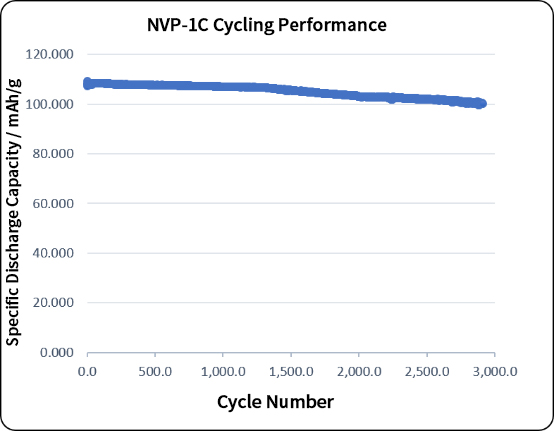
Specific discharge capacity of NVP-Hard Carbon pouch cell at 1C over 2900 cycles. The cell starts near 108 mAh/g and stabilizes around 100 mAh/g after 2900 cycles, demonstrating the outstanding structural stability of the NASICON polyanionic framework.
Cycling Capacity Retention:
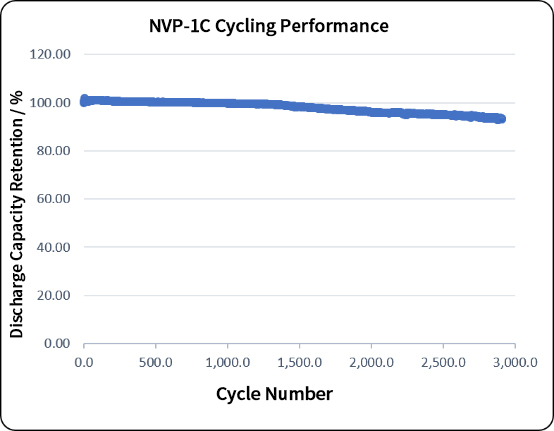
Capacity retention of NVP-Hard Carbon pouch cell at 1C over 2900 cycles. The cell retains approximately 93% of its initial capacity after 2900 cycles — among the best long-term cycle stability reported for sodium-ion chemistries, approaching LFP-class cycle life in a completely lithium-free system.
Characteristics:
Exceptional long-term cycle life (~93% @ 2900 cycles)
The NASICON-type NVP framework demonstrates outstanding structural reversibility, retaining approximately 93% of initial capacity after 2900 cycles at 1C. As a result, this cell delivers among the best long-term cycle stability reported for sodium-ion chemistries — approaching LFP-class cycle life while remaining completely lithium-free, ideal for stationary storage applications where long calendar and cycle life dominate cost-of-ownership.
Higher voltage plateau (3.4 V) for higher cell-level energy
NVP delivers a flat 3.4 V voltage plateau with a 2.5–3.8 V cutoff window — significantly higher than NFPP polyanionic chemistry (which operates at 1.5–3.4 V). Therefore, NVP-based cells deliver higher cell-level energy density than NFPP at the same capacity, making NVP the preferred choice when energy density is prioritized over absolute thermal stability.
NASICON 3D ion-conduction framework for high rate capability
The NASICON crystal structure of NVP provides three-dimensional sodium-ion diffusion pathways, resulting in excellent rate capability and high power density. Consequently, this cell is well-suited for high-rate cycling studies and applications requiring fast sodium-ion transport — characteristics that distinguish NVP from olivine-type and layered oxide sodium-ion cathodes.
Lithium-free, cobalt-free, nickel-free chemistry
NVP is built entirely on earth-abundant sodium and vanadium. Therefore, this cell eliminates dependence on lithium, cobalt, and nickel supply chains, offering a more sustainable and cost-effective alternative for grid-scale and stationary energy storage applications.
High-capacity hard carbon anode (305 mAh/g)
The hard carbon anode delivers a specific capacity of 305 mAh/g — significantly higher than the typical 260 mAh/g hard carbon used in lower-voltage sodium-ion systems. As a result, this NVP/hard carbon configuration achieves higher overall cell energy density while maintaining excellent cycling stability and forming a robust SEI compatible with sodium-based electrolytes.
Dry (unfilled) pouch design for sodium-ion electrolyte studies
The cell ships fully assembled but without electrolyte. Therefore, customers can inject their own sodium-ion electrolyte formulations to study electrolyte effects on the NVP cathode interface, hard carbon SEI formation, and additive performance — critical capabilities for advancing sodium-ion battery technology.
Multiple capacity grades + custom specifications
Standard grades cover 1.25 Ah / 2 Ah / 5 Ah. Furthermore, custom voltage windows, alternative separators, and electrode dimensions are available on request to match specific sodium-ion research requirements.
Recommended Activation Protocol:
1. Inject sodium-ion electrolyte at 8–10 g/Ah ratio. 2. Vacuum-seal the pouch under inert atmosphere. 3. Aging: hold at 45 °C for 24 h under 8 kgf/cm² stack pressure. 4. Pre-formation rest: 12 h. 5. Formation: charge at 0.1C constant current to 3.8 V (1 cycle). 6. Final aging: hold at room temperature for 24 h before subsequent cycling tests.
Packaging & Storage:
Cells ship vacuum-sealed under inert atmosphere in moisture-barrier packaging. Therefore, customers should store sealed in a cool, dry environment (15–25 °C, RH < 30 %), protected from moisture and direct sunlight. Open packaging in a dry-room or glovebox environment immediately before electrolyte filling.
Safety:
For research and industrial use only. Activated sodium-ion cells contain flammable electrolyte and reactive electrode materials. Wear PPE during cell handling and electrolyte filling. Never short-circuit, overcharge, overdischarge, puncture, or expose cells to high temperatures (> 60 °C). Always operate within the specified voltage range (2.5 – 3.8 V). NVP’s vanadium-based chemistry requires standard sodium-ion handling protocols once activated. Refer to SDS for complete safety information.
Note: Values listed above are typical and for reference only. Performance may vary depending on electrolyte choice, formation protocol, applied stack pressure, cycling conditions, and test environment. Sodium-ion chemistry is sensitive to electrolyte formulation — consult published literature for guidance on electrolytes optimized for NVP/hard carbon systems at the 3.4 V plateau. See also other dry pouch cells in our catalog: NVP Anode-Free, NFPP Polyanionic / Hard Carbon, NFPP Anode-Free, P2 Layered Oxide, Sodium Metal Single-Layer Pouch, LFP / Artificial Graphite, LFP / Lithium Metal, LFP Anode-Free, NCM811 / Artificial Graphite, NCM811 Anode-Free, and LMFP / Artificial Graphite. Browse the full Dry Pouch Cell category for all configurations.
| NVP / Hard Carbon | (1ah), (2Ah) |
|---|
Related products
-
LCO Lithium Metal Pouch Battery Dry Pouch Cell (Unfilled)(Multiple Specs)
Free Shipping Price range: $216.00 through $343.00Select options This product has multiple variants. The options may be chosen on the product page -

High-Voltage NCM613 / Artificial Graphite Anode Dry Pouch Cell(Multiple Specs)
Free Shipping Price range: $82.00 through $107.00Select options This product has multiple variants. The options may be chosen on the product page -
NVP Anode-Free Pouch Dry Pouch Cell(Multiple Specs)
Free Shipping$102.00Select options This product has multiple variants. The options may be chosen on the product page -
NCM622 / Lithium Metal Pouch Battery Dry Pouch Cell (Unfilled)(Multiple Specs)
Free Shipping Price range: $165.00 through $292.00Select options This product has multiple variants. The options may be chosen on the product page