
Guide · Battery Materials
Sodium-Ion Batteries: The 2026 Guide to Chemistry, Cost, and Status
For years, sodium-ion was the battery chemistry everyone filed under “interesting, someday.” That changed fast: by 2026 sodium-ion cells are rolling off real production lines, going into cars, grid storage, and consumer power stations — not because they beat lithium-ion on performance, but because they sidestep its single biggest weakness: cost and supply.
This guide explains what a sodium-ion battery is, how it works, why it’s cheaper than lithium, the materials inside it, who’s actually building it in 2026 — and, from a materials supplier’s view, how to build and test sodium-ion cells today.
What is a sodium-ion battery?
A sodium-ion battery (Na-ion) is a rechargeable battery that works on exactly the same “rocking-chair” principle as lithium-ion — ions shuttle back and forth between two electrodes through an electrolyte — except the charge carrier is a sodium ion (Na⁺) instead of lithium. A typical cell pairs a hard-carbon anode with a sodium-based cathode in a sodium-salt electrolyte.
Sodium sits directly below lithium in the periodic table, so the chemistry is closely related. The crucial difference isn’t how it works — it’s where the raw material comes from. Sodium is roughly a thousand times more abundant than lithium, found in ordinary salt and distributed all over the planet. For the underlying science, the sodium-ion battery reference is a solid starting point.
How a sodium-ion battery works
On charge, sodium ions leave the cathode, travel through the electrolyte, and insert into the hard-carbon anode; on discharge they flow back. Graphite — the standard lithium-ion anode — doesn’t store sodium well, which is why hard carbon (a disordered carbon) became the anode of choice.
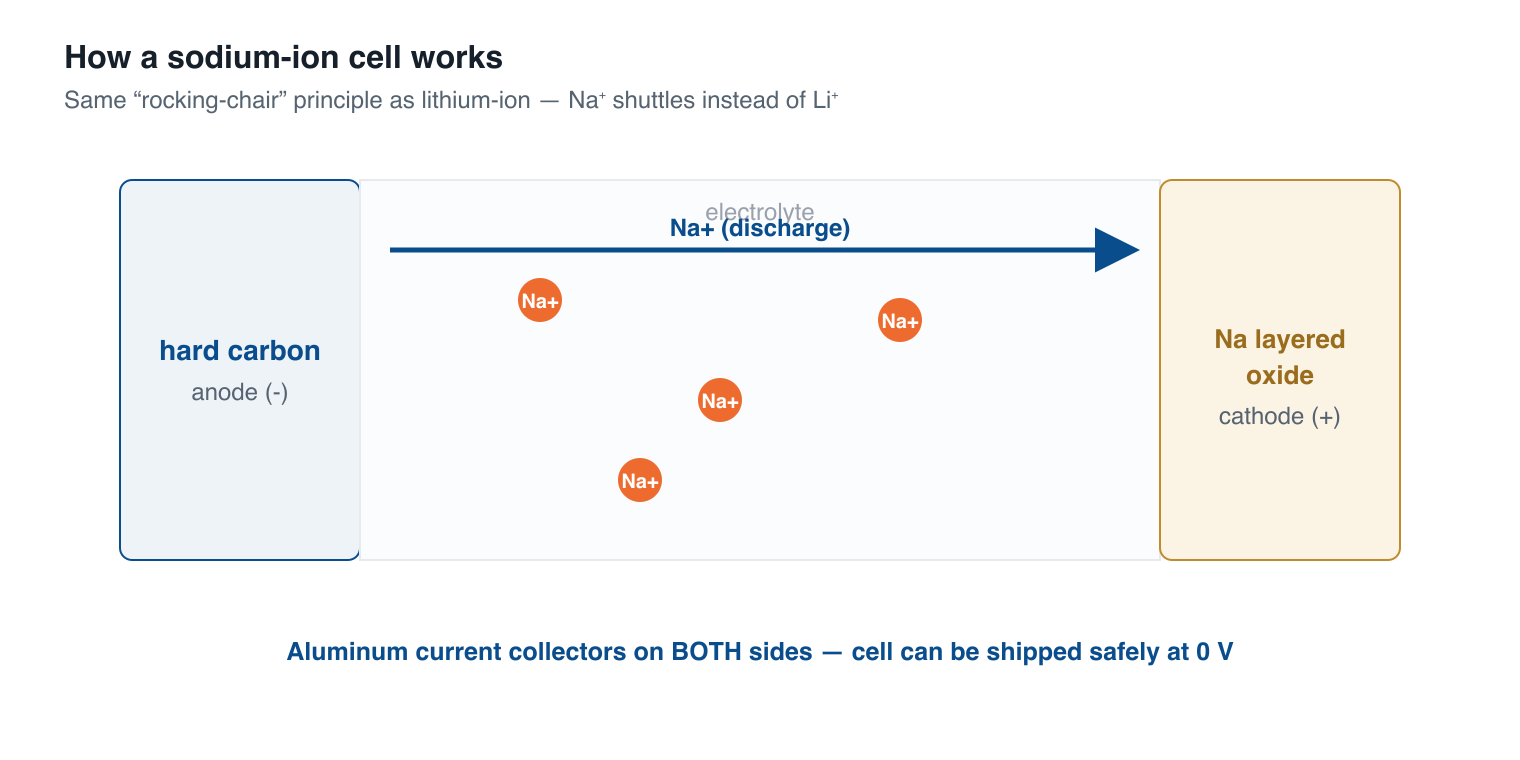
One detail carries outsized importance: because sodium doesn’t alloy with aluminum (the way lithium does), Na-ion cells can use cheap aluminum current collectors on both electrodes instead of copper on the anode. That trims cost — and lets the cell be fully discharged to 0 V for safe, simple transport.
Why sodium-ion matters now
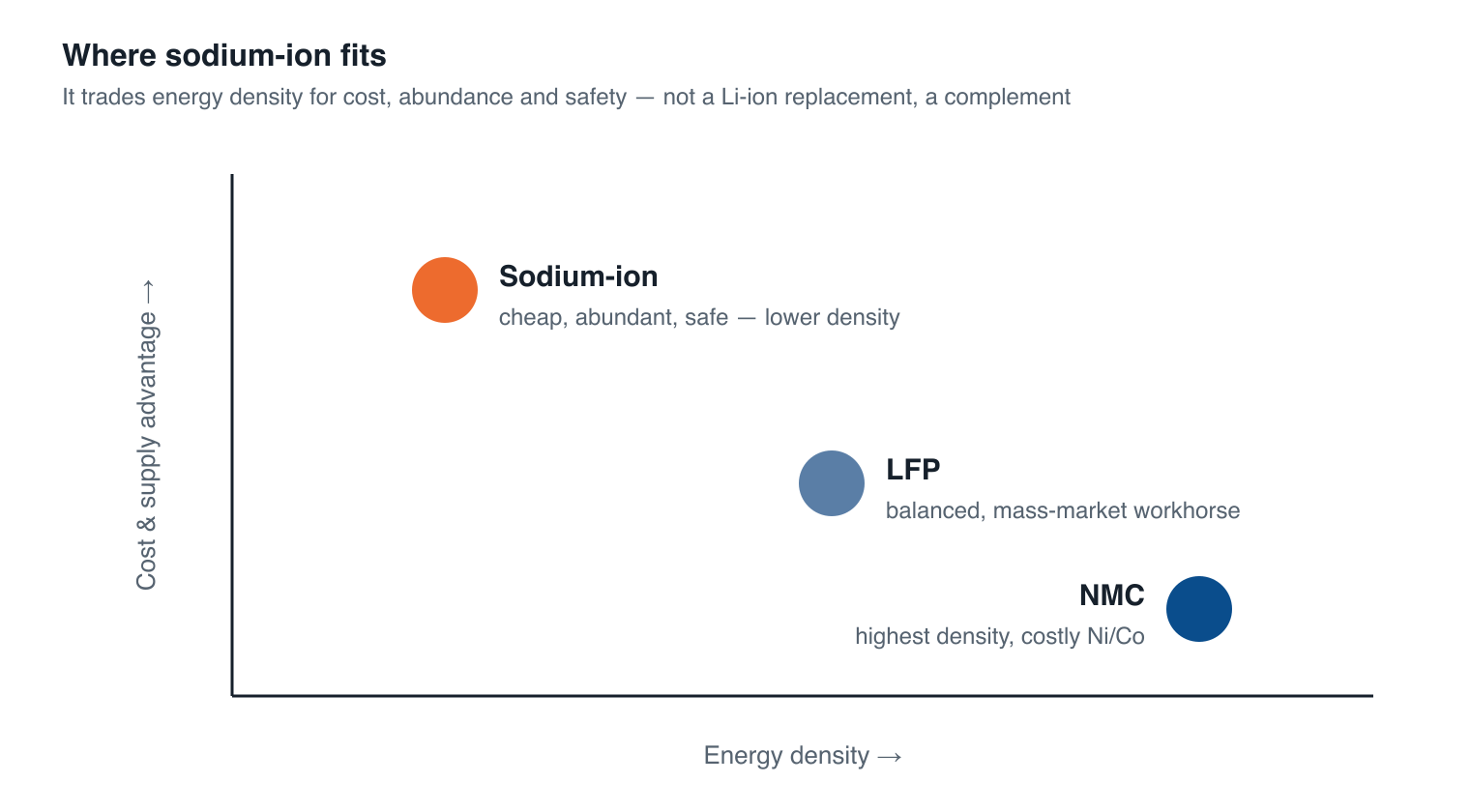
Sodium-ion isn’t chasing lithium-ion on energy density. Its case is built on everything around the cell:
- Abundant, cheap, local raw materials. No lithium, no cobalt, no nickel — the most expensive and geopolitically fraught inputs in a lithium-ion cathode are simply gone.
- Lower cost. Cheaper active materials plus aluminum current collectors give sodium-ion a structural cost advantage at scale.
- Safety. Cells can be shipped at 0 V, and many sodium chemistries show favorable thermal behavior.
- Cold-weather and fast-charge performance. Sodium-ion typically holds up better at low temperatures than lithium-ion — a real edge for cold climates and grid use.
In short, sodium-ion is a complement to lithium-ion, not a replacement — it wins where cost, safety, and supply security matter more than maximum range.
The materials inside a sodium-ion cell
Sodium-ion is really a family of chemistries, defined mostly by the cathode:
- Layered transition-metal oxides — the highest-energy option and the route most large makers have taken; analogous to lithium NMC but sodium-based.
- Prussian blue analogues (PBA) — very cheap and fast, favored for power and stationary applications.
- Polyanionic compounds (e.g. vanadium phosphates) — extremely stable and long-cycling, the sodium cousins of LFP.
On the other side sits the hard-carbon anode, plus a sodium-salt electrolyte (commonly NaPF₆ in carbonate solvents). For Xnergy’s sodium materials in depth, see our guides to Na-ion cathode electrode sheets, sodium metal foil & chips (for half-cell testing), and sodium solid-state materials, electrolytes & alloy anodes.
The trade-offs
Sodium-ion is genuinely useful, not magic. The honest limitations:
- Lower energy density. Commercial cells reach roughly 100–160 Wh/kg versus ~150–250 Wh/kg for lithium-ion — fine for storage and small vehicles, limiting for long-range EVs.
- Cycle life and first-cycle efficiency. Hard-carbon anodes can lose capacity on the first cycle, and some chemistries trail LFP on longevity — though polyanionic and PBA cathodes are closing the gap.
- Young supply chain. Materials, formats, and manufacturing are far less standardized than lithium-ion, which is exactly where early movers gain an edge.
Who’s building sodium-ion in 2026
Sodium-ion has crossed from labs into factories:
- CATL — the largest battery maker, scaling sodium-ion for vehicles and storage and folding it into hybrid packs.
- BYD / HiNa — sodium-ion lines aimed at micro-EVs and stationary storage in China.
- Natron Energy — US maker focused on Prussian-blue cells for high-power and data-center backup.
- Faradion (Reliance) — layered-oxide technology being industrialized in India.
- Consumer brands — sodium-ion power stations and starter batteries are already on the market.
Public research programs — including the U.S. Department of Energy’s Vehicle Technologies Office — continue to fund the underlying materials work.
Where sodium-ion wins first
Follow the logic of its strengths and the early markets are obvious:
- Grid and stationary storage — where cost per kWh and safety beat energy density.
- Two- and three-wheelers, micro-EVs, and city cars — short range, high price sensitivity.
- Backup, telecom, and data-center power — especially Prussian-blue cells built for high power.
- Cold-climate and start-stop applications — leaning on low-temperature performance.
How to build and test sodium-ion cells today
The lab workflow mirrors lithium-ion, which makes sodium-ion easy to start on existing equipment:
- Pick a cathode chemistry — layered oxide for energy, PBA for power/cost, polyanionic for cycle life.
- Source the materials — cathode active material or pre-coated Na-ion cathode sheets, hard carbon, sodium-salt electrolyte, and aluminum collectors; use sodium metal foil/chips for half-cell baselines.
- Screen in coin cells, then move to pouch — see our sodium-ion dry pouch cell for a validation format, and how electrolytes work for formulation basics.
This is where Xnergy fits: we supply the full sodium-ion materials set — cathodes, hard carbon, electrolytes, sodium foil — plus cell prototyping and pilot manufacturing, so you can move from chemistry choice to a cycling cell without assembling a supply chain. Browse our battery materials to start.
Sodium-ion vs lithium-ion (LFP & NMC)
| Attribute | Sodium-Ion | LFP (Li-ion) | NMC (Li-ion) |
|---|---|---|---|
| Specific energy | ~100–160 Wh/kg | ~150–200 Wh/kg | ~200–300 Wh/kg |
| Key raw materials | Sodium, hard carbon, Al | Lithium, iron, phosphate | Lithium, nickel, cobalt |
| Relative cost | Lowest (at scale) | Low | High |
| Cold-weather performance | Strong | Moderate | Moderate |
| Safety / shipping | Ships at 0 V | Good | Moderate |
| Best-fit use | Storage, micro-EVs, backup | EVs, storage | Long-range EVs, electronics |
If you’re exploring the next tier of sodium chemistry, note that sodium solid-state is an active research direction too — see our guide to solid-state batteries and our broader cathode materials guide.
Frequently asked questions
What is a sodium-ion battery?
A rechargeable battery that shuttles sodium ions (Na⁺) instead of lithium, typically with a hard-carbon anode, a sodium-based cathode, and aluminum current collectors on both sides — which lets it ship safely at 0 V.
Are sodium-ion batteries better than lithium-ion?
Different, not better. Sodium-ion is cheaper, uses abundant materials, ships safely, and performs in the cold, but stores less energy per kilogram. It complements lithium-ion where cost and safety outweigh range.
What is the energy density of a sodium-ion battery?
Commercial cells in 2026 reach roughly 100–160 Wh/kg — below lithium-ion but overlapping with entry-level LFP, and still improving.
Which companies make sodium-ion batteries?
CATL, BYD/HiNa, Natron Energy, and Faradion (Reliance) are among the most active, and consumer brands have begun shipping sodium-ion power stations.
What are sodium-ion batteries used for?
Grid and stationary storage, two- and three-wheelers, entry-level and city EVs, backup and telecom power, and cold-climate uses where cost and safety beat range.
Do sodium-ion batteries use lithium or cobalt?
No — no lithium, cobalt, or nickel, and aluminum replaces copper current collectors, which is a big part of the cost and supply-chain advantage.
Source with Xnergy
Building sodium-ion cells? Start with the right materials
Xnergy supplies sodium-ion cathodes, hard carbon, electrolytes, and sodium foil — plus cell prototyping and pilot manufacturing from a US-based team. Go from chemistry choice to a cycling cell without assembling a supply chain.