
Guide · Battery Materials
Solid-State Batteries: The 2026 Guide to Chemistry, Challenges, and Status
Solid-state batteries are the most hyped idea in energy storage — the supposed “holy grail” that finally makes batteries safer, longer-lasting, and dense enough to give electric cars 1,000 km of range. Strip away the press releases and the picture is more interesting: solid-state is real, it works, and it’s genuinely hard to manufacture at scale.
This guide explains what a solid-state battery actually is, how it works, the three families of solid electrolyte that make it possible, why it’s taken so long, who’s building it in 2026 — and, from a materials supplier’s point of view, exactly what you need to build and test solid-state cells today.
What is a solid-state battery?
A solid-state battery is a battery in which the liquid electrolyte and porous separator of a conventional lithium-ion cell are replaced by a single solid ion-conducting material. That solid electrolyte does two jobs at once: it carries lithium ions between the electrodes, and it physically separates them — so there is no flammable liquid and no plastic separator inside the cell.
That one swap cascades into everything that makes solid-state attractive. A good solid electrolyte is mechanically strong and electrochemically stable enough to sit against a lithium-metal anode — the highest-capacity anode there is — which is exactly the part conventional liquid cells struggle to use safely. For the underlying science, the solid-state battery reference is a good primer.
How a solid-state battery works
In a working cell, lithium ions shuttle from the cathode, through the solid electrolyte, and plate onto the lithium-metal anode during charge; on discharge they travel back. The solid electrolyte must conduct Li⁺ quickly while blocking electrons and resisting the growth of lithium dendrites that would short the cell.
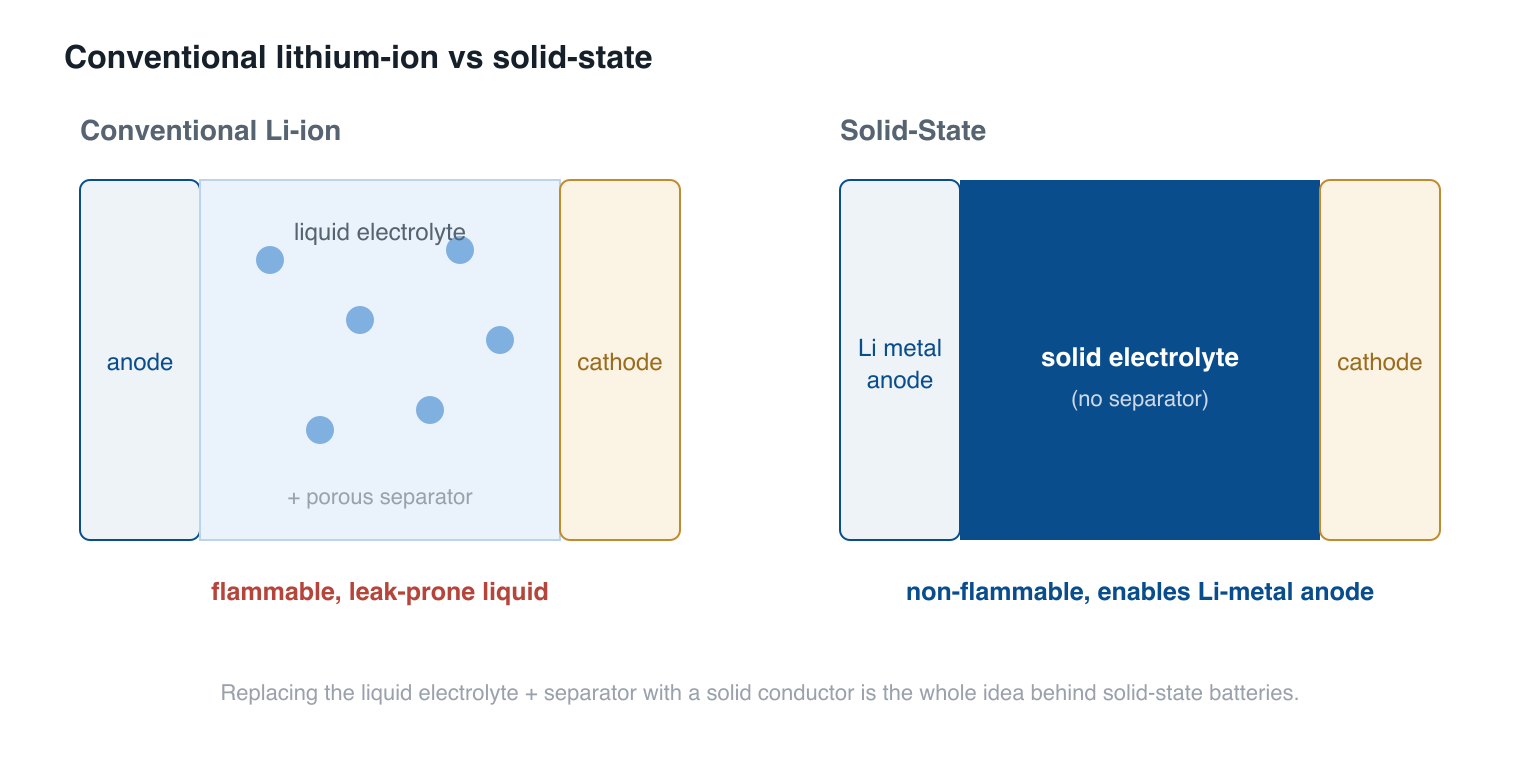
Because the solid electrolyte is also the separator, a solid-state cell can be physically simpler and thinner than a liquid cell — but only if the solid stays in intimate contact with both electrodes through thousands of charge cycles. That contact problem, as we’ll see, is where most of the difficulty lives.
Why everyone wants solid-state
Three benefits drive the entire field:
- Higher energy density. Enabling a lithium-metal anode (and dropping the inactive separator and excess electrolyte) can lift both gravimetric and volumetric energy density well above today’s lithium-ion — the route to longer EV range in the same pack.
- Safety. Solid electrolytes are non-flammable and don’t leak, removing the organic liquid that fuels thermal runaway in conventional cells.
- Longevity and temperature range. The right solid electrolyte can be chemically stable across a wide voltage and temperature window, with the potential for long cycle life.
None of these are guaranteed in any given cell — they’re the promise of the architecture, and realizing them is an engineering fight at the materials interface.
The three solid-electrolyte families
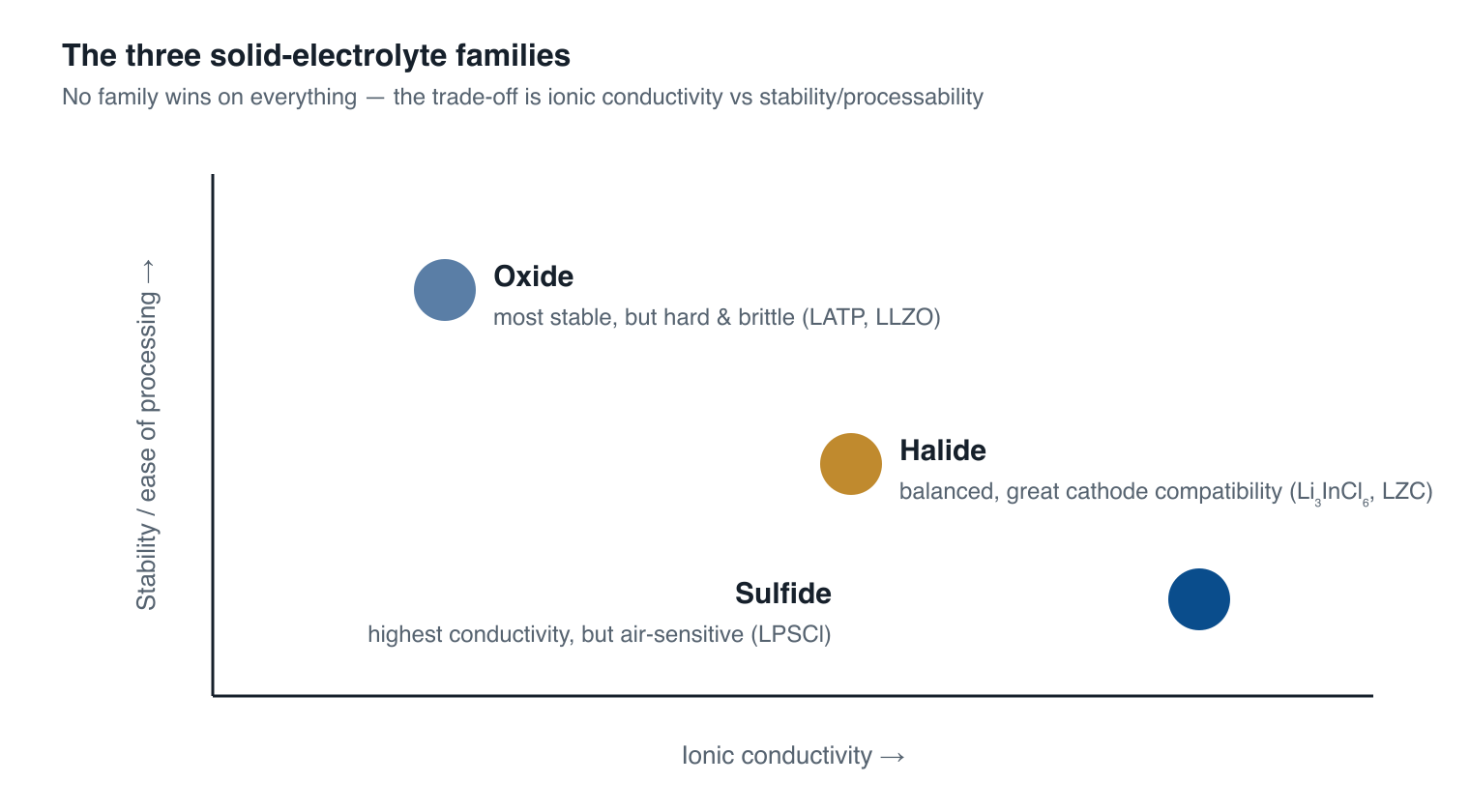
There is no single “solid electrolyte.” The field is organized around three material families, and the central truth is that no family wins on every metric — each trades ionic conductivity against stability and processability.
Sulfides — highest conductivity
Sulfide electrolytes (such as argyrodite LPSCl and LGPS-type materials) reach ionic conductivities that rival liquid electrolytes, and they’re soft enough to form good electrode contact under pressure. The catch is air sensitivity — they react with moisture and can release H₂S — so they demand dry-room handling. See our deep dive on LPSCl argyrodite sulfide electrolytes.
Oxides — most stable
Oxide electrolytes (garnet LLZO, NASICON-type LATP) are the most chemically and electrochemically stable, with a wide voltage window. The trade-off is that they’re hard, brittle ceramics that need high sintering temperatures and don’t easily make conformal contact. See high-conductivity LATP.
Halides — the balanced newcomer
Halide electrolytes (Li₃InCl₆, Li₃YCl₆, and doped LZC families) sit in between: moderate conductivity, mechanically deformable, and — crucially — excellent oxidative stability against high-voltage cathodes. They’ve become one of the most active research areas. See our guides to Li₃InCl₆ halide electrolyte and LZC halide variants.
For a side-by-side of all three, see our dedicated comparison: sulfide vs halide vs oxide solid electrolytes.
Why solid-state is so hard
If the chemistry works in a beaker, why isn’t solid-state already in your car? Four engineering problems.
1. Interfaces and contact resistance
A solid can’t flow into every pore the way a liquid does. Keeping the solid electrolyte in intimate, low-resistance contact with the cathode and anode — and keeping it there as the electrodes expand and contract — is the central challenge of the entire field.
2. Dendrites still happen
It was once assumed a hard solid would stop lithium dendrites. In practice, lithium can still creep through grain boundaries, voids, and cracks in the electrolyte and short the cell. Suppressing it requires careful materials, density, and pressure control.
3. Stack pressure
Many solid-state cells only perform well under significant external stack pressure to maintain contact. Designing that pressure into a real pack — without adding weight and cost — is non-trivial.
4. Manufacturing and cost
Producing thin, defect-free solid-electrolyte layers at gigafactory scale — especially air-sensitive sulfides in dry rooms, or high-temperature-sintered oxides — is the gap between a working lab cell and an affordable product. This, more than chemistry, is what gates commercialization.
Who’s building solid-state in 2026
Solid-state is one of the most heavily funded areas in batteries, and the major players are pursuing different chemistries:
- Toyota — long-running sulfide-based program, targeting EV deployment in the late 2020s.
- QuantumScape — an anode-free design built around a proprietary oxide separator; shipping sample cells to automakers.
- Samsung SDI — pilot-line sulfide cells aimed at premium applications first.
- Solid Power — sulfide electrolyte and a focus on supplying electrolyte material, not just cells.
- BYD and others — public roadmaps for staged introduction later in the decade.
Public research funding — for example through the U.S. Department of Energy’s Vehicle Technologies Office — continues to push the underlying materials science. The honest summary: lots of momentum, lots of pilot cells, no mass-market product yet.
Solid-state and the EV timeline
The most-searched question is simply when will my car have one. As of 2026, solid-state sits at the pilot and pre-commercial stage. Expect first appearances in limited, premium, or specialty vehicles in the late 2020s, with mass-market EVs following once manufacturing cost and yield catch up. Announced dates have slipped repeatedly across the industry, so treat any specific year as a target, not a promise. The nearer-term reality is that solid-state will likely win first in smaller, higher-value cells — wearables, medical, defense — before it reaches a 60 kWh EV pack.
How to build and test solid-state cells today
You don’t need a gigafactory to start working with solid-state — researchers build and screen cells at lab scale every day. The practical path:
- Choose an electrolyte family to match your goal: sulfide for conductivity, oxide for stability, halide for cathode compatibility (see the families above).
- Source the solid electrolyte plus a cathode active material, a lithium-metal or anode-free current collector, and any catholyte/binder.
- Press pellet or coin cells — solid-state screening usually means pressing the electrolyte and electrodes into a die and testing under controlled stack pressure, which is why purpose-built molds matter. See our solid-state battery mold guide and how to build better solid-state cells with the right molds.
- Cycle under pressure, measure interfacial resistance, and iterate on contact and density.
This is exactly where Xnergy fits: we supply solid-electrolyte materials across the sulfide, halide, and oxide families, the cathodes and anodes to pair with them, and the molds and tooling to fabricate test cells — so you can go from material selection to a cycling cell without assembling a supply chain first.
Solid-state vs lithium-ion vs lithium-sulfur
| Attribute | Solid-State | Lithium-Ion (NCM/LFP) | Lithium-Sulfur |
|---|---|---|---|
| Electrolyte | Solid (sulfide/halide/oxide) | Liquid (carbonate) | Liquid (ether) or SPAN |
| Practical specific energy | ~350–500 Wh/kg (target) | ~150–300 Wh/kg | ~400–600 Wh/kg |
| Flammability | Low (non-flammable solid) | Higher (organic liquid) | Moderate |
| Main weakness | Interfaces, manufacturing cost | Energy-density ceiling | Cycle life, shuttle |
| 2026 maturity | Pilot / pre-commercial | Mature, mass-market | Early commercial (niche) |
Solid-state and lithium-sulfur are often pitched as rivals, but they overlap: a solid electrolyte is one of the cleanest ways to tame the polysulfide shuttle. For that story, see our guide to lithium-sulfur batteries, and the basics of how electrolytes work.
Frequently asked questions
What is a solid-state battery?
A battery that replaces the flammable liquid electrolyte and porous separator of a lithium-ion cell with a solid ion-conducting material, which carries lithium ions and lets the cell use a high-capacity lithium-metal anode.
Are solid-state batteries safer than lithium-ion?
Generally yes on the electrolyte side — solid electrolytes are non-flammable and don’t leak, removing the main fuel for thermal runaway. The remaining risk is the lithium-metal anode, which is why dendrite control and stack pressure still matter.
When will solid-state batteries be in electric cars?
In 2026 they’re at the pilot/pre-commercial stage. Expect limited or premium EV deployment in the late 2020s and mass-market later. Specific dates have slipped repeatedly, so treat them with caution.
Which companies are developing solid-state batteries?
Toyota, QuantumScape, Samsung SDI, Solid Power, and BYD are among the most visible, with approaches spanning sulfide, oxide, and anode-free designs.
What are the three types of solid electrolyte?
Sulfides (highest conductivity, air-sensitive), oxides (most stable, hard and brittle), and halides (balanced, with excellent cathode compatibility). The best choice depends on the cell design.
Do solid-state batteries exist yet?
Yes — they work in labs and pilot lines, and small cells ship for sampling and niche use. What doesn’t exist yet is low-cost, high-volume manufacturing for mass-market EVs.
Source with Xnergy
Building solid-state cells? Start with the right materials
Xnergy supplies sulfide, halide, and oxide solid electrolytes, matched cathodes and anodes, and the molds and tooling to fabricate and test solid-state cells — backed by US-based prototyping and pilot manufacturing.