
Guide · Battery Materials
High Energy Density Batteries: How to Get More Wh/kg
More range, longer runtime, lighter packs — almost every battery ask reduces to one number: energy density. This guide shows what really moves Wh/kg, the realistic ceiling for each chemistry, and the three material levers an engineer can pull to get there.
What energy density actually means
Gravimetric energy density (Wh/kg) is energy stored per unit weight; volumetric (Wh/L) is per unit volume. Weight usually drives EV range and aircraft endurance; volume drives phones and compact devices. Energy density is not the same as power density (how fast the energy comes out) — a cell can be strong on one and weak on the other.
One more distinction that trips up buyers: cell-level vs pack-level. A pack adds housing, cooling and electronics, so its Wh/kg is always lower than the bare cell. The numbers below are cell-level.
Energy density by chemistry (the ladder)
Here is roughly how far today’s and tomorrow’s chemistries reach:
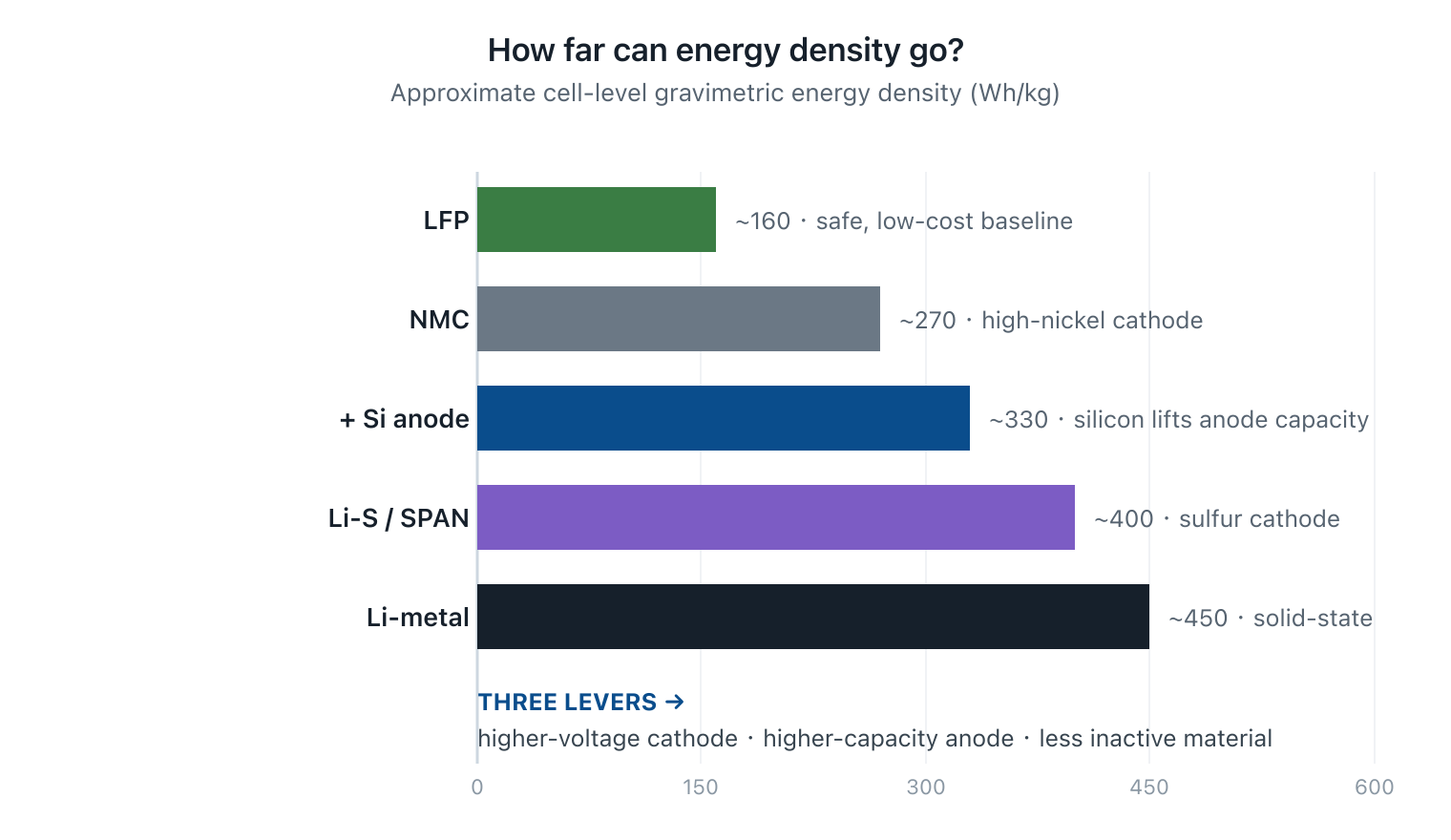
The jump from LFP to NMC is a cathode move; adding silicon is an anode move; lithium-sulfur / SPAN and lithium-metal combine a new cathode or anode with aggressive cell design.
The three levers that raise energy density
Every energy-density gain is one (or a mix) of these:
- 1. A stronger cathode. Higher voltage or higher capacity — high-nickel NMC, LMFP, or a sulfur cathode. The cathode is usually the heaviest active component, so this matters most.
- 2. A higher-capacity anode. Replace graphite (~372 mAh/g) with silicon (up to ~10×) or lithium-metal (the ultimate). This is the biggest single lever, and the hardest on cycle life.
- 3. Less inactive material. Thicker electrodes, thinner foils and casing, or anode-free construction remove weight that stores no energy. Pure cell-design engineering.
The trade-offs to plan for
Energy density is never free. Pushing it usually costs something you must manage:
| Lever | Gains | Costs to manage |
|---|---|---|
| High-nickel cathode | More capacity & voltage | Thermal stability, cycle life |
| Silicon anode | Big capacity jump | Swelling, first-cycle loss |
| Lithium-metal / anode-free | Highest density | Dendrites, plating efficiency |
| Sulfur cathode | High capacity, low cost | Polysulfide shuttle, cycle life |
| Aggressive cell design | Free density on paper | Rate, manufacturability |
This is exactly where materials engineering earns its keep — coatings, tailored electrolytes, and solid or semi-solid designs exist to keep the gains while taming the costs.
Source with Xnergy
Chasing a Wh/kg target?
Xnergy supplies the high-energy building blocks — high-nickel and sulfur (SPAN) cathodes, silicon and lithium-metal anodes, and tailored electrolytes — plus cell prototyping from a US-based team to prove the number in a real cell. Tell us your target Wh/kg and constraints, and we’ll propose a materials path.
How to pick a path to higher density
Rather than chase the highest number on the chart, work backward from your constraints:
- Need modest gains with proven safety? Move LFP → high-nickel NMC, or add a little silicon to the anode.
- Need a big jump and can invest in cycle life? Silicon-dominant anodes or lithium-sulfur / SPAN cathodes.
- Chasing the ceiling for a specialty application? Lithium-metal or anode-free, ideally with a solid or semi-solid electrolyte.
- Always: validate in real coin or pouch cells on your own electrodes before scaling — datasheet Wh/kg and your Wh/kg are rarely the same.
Frequently asked questions
What is a high energy density battery?
One that stores more energy per unit weight (Wh/kg) or volume (Wh/L) than a typical cell. LFP is ~160 Wh/kg and high-nickel NMC ~250–300, while lithium-sulfur and lithium-metal target well beyond that.
What is the energy density of a lithium-ion battery?
Cell-level, about 160 Wh/kg for LFP up to ~250–300 for high-nickel NMC. Silicon-anode, lithium-sulfur and lithium-metal designs target 330–500+ Wh/kg. Pack-level is lower.
How do you increase a battery’s energy density?
Three levers: a higher-voltage/capacity cathode, a higher-capacity anode (silicon or lithium-metal), and removing inactive material through cell design. Most real gains combine them.
Which battery has the highest energy density?
Lithium-metal and lithium-sulfur cells have the highest potential, then silicon-anode lithium-ion and high-nickel NMC. Lithium-metal with a solid electrolyte is the current ceiling.
What is the difference between energy density and power density?
Energy density (Wh/kg) sets runtime or range; power density (W/kg) sets how fast energy is delivered. Cells are often tuned toward one.
Does higher energy density mean less safety?
Often there’s a trade-off, but coatings, tailored electrolytes and solid/semi-solid designs exist to raise energy density while managing safety. The two must be balanced deliberately.