
Guide · Battery Materials
Lithium-Metal Batteries: The 2026 Guide to the Anode That Changes Everything
The lithium-metal anode is the most powerful and most frustrating idea in batteries. Pure lithium stores roughly ten times more energy per gram than the graphite in today’s lithium-ion cells — it’s the key that unlocks lithium-sulfur and solid-state. The catch is that lithium metal fights back, growing dendrites and losing capacity every cycle.
This guide explains what a lithium-metal battery actually is, why the lithium-metal anode is such a prize, the four problems that have kept it out of your car, where it stands in 2026, and — from a materials supplier’s view — how to handle and test it.
What is a lithium-metal battery?
The phrase “lithium-metal battery” actually points to two different things, and it’s worth separating them:
- Primary (disposable) lithium cells — the coin cells and lithium AA batteries in cameras and smoke detectors. These use a lithium-metal anode but are not rechargeable.
- Rechargeable lithium-metal-anode batteries — the next-generation cells that replace the graphite anode of a lithium-ion battery with pure lithium metal. This is the high-energy frontier, and it’s what this guide is about.
For the rest of this page, “lithium-metal battery” means the rechargeable kind: a cell whose anode is lithium metal itself, paired with a conventional or next-generation cathode.
Why the lithium-metal anode matters
Everything comes back to one number: lithium metal has a theoretical specific capacity of about 3,860 mAh/g and the lowest electrochemical potential of any anode. That’s roughly ten times the ~372 mAh/g of the graphite anode used in lithium-ion today.
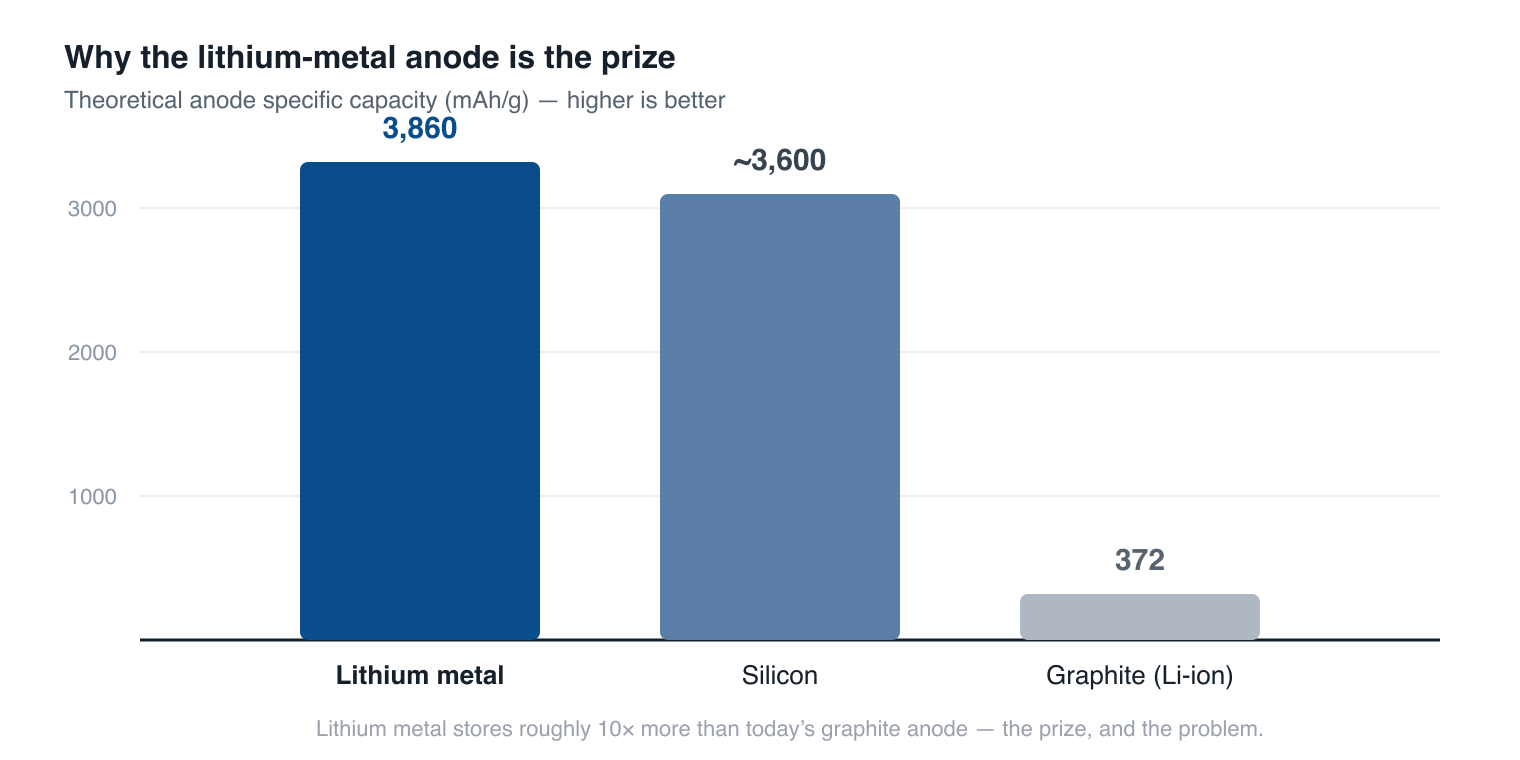
That capacity, plus the ability to drop the heavy graphite host entirely, is what lets lithium-metal cells reach far higher energy density. It’s also the anode that makes the two most exciting next-gen chemistries work: see our guides to lithium-sulfur batteries and solid-state batteries, both of which depend on taming lithium metal.
How a lithium-metal battery works
A lithium-ion battery intercalates lithium — ions slot into the layers of a graphite host. A lithium-metal battery instead plates and strips: on charge, lithium ions are reduced and deposited as metallic lithium on the anode; on discharge, that lithium dissolves back into the electrolyte. There’s no host material — the lithium is the anode.
Taken to its limit, this enables an “anode-free” design: the cell is built with just a bare copper current collector, and all the lithium is plated from the cathode on the first charge. That’s the lightest, highest-energy configuration of all — and the most demanding to keep stable.
The four problems
If plating lithium were easy, every EV would already use it. Four linked failure modes stand in the way.
1. Dendrites
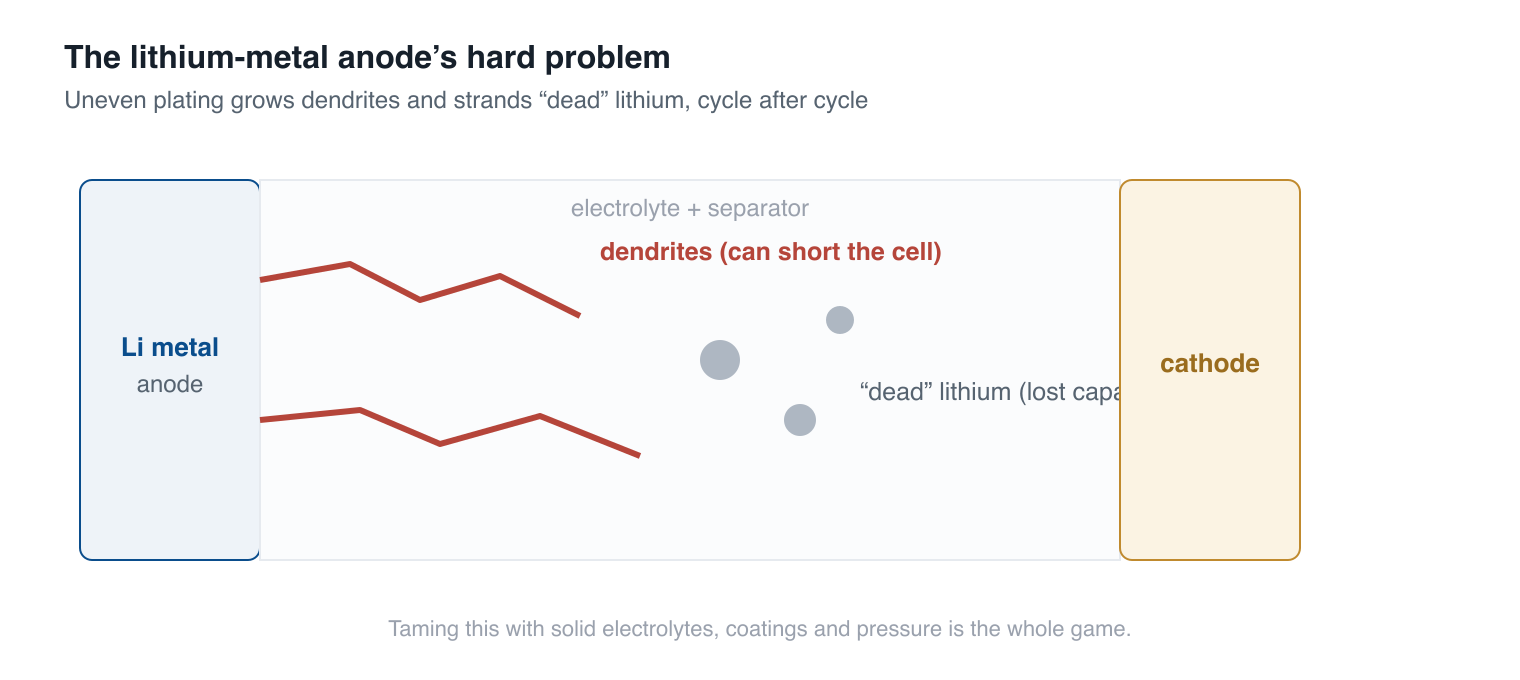
Lithium rarely plates as a smooth film. It grows needle-like dendrites that can pierce the separator, reach the cathode, and short the cell — a safety and reliability problem that has defined the field for decades.
2. Unstable SEI
Lithium metal is so reactive that it continuously breaks down the electrolyte at its surface, forming an unstable solid-electrolyte interphase (SEI). Every cycle consumes fresh lithium and electrolyte rebuilding it.
3. “Dead” lithium and low efficiency
As lithium strips unevenly, pieces get electrically disconnected and stranded as inactive “dead” lithium. This drags down Coulombic efficiency — the share of lithium recovered each cycle — which must reach ~99.9%+ for a long-lived cell.
4. Volume change
Because the anode is plated and stripped in full, it effectively expands and contracts enormously each cycle, stressing the cell mechanically and making stable contact hard to maintain.
How researchers are taming it
There’s no single fix — progress comes from stacking several:
- Solid electrolytes. A mechanically strong solid can resist dendrites and replace the flammable liquid — the route most solid-state battery programs take.
- Protective coatings and artificial SEI. Engineered surface layers on the lithium (or on the current collector) guide even plating and stop runaway reactions — see our work on an LiI-coated Li-Sn alloy composite anode.
- Advanced electrolytes. High-concentration and localized high-concentration electrolytes, plus fluorinated and gel-polymer systems, build a tougher SEI — as in this study on solvation-structure regulation in fluorinated gel-polymer electrolytes. (For the basics, see how electrolytes work.)
- Stack pressure and anode-free design. Controlled external pressure keeps plating uniform; anode-free cells minimize excess lithium for maximum energy density.
Where it stands in 2026
Lithium-metal has moved from pure research into pilot and pre-commercial production, usually through one of two doors: anode-free / solid-state cells, and lithium-metal “hybrid” cells with engineered electrolytes. Names such as QuantumScape (anode-free, solid separator), SES, and Sion Power are among the most visible, alongside many of the solid-state players. The honest status: real cells, real pilot lines, strong energy-density numbers — but cycle life and cost still gate mass-market EVs. Lithium-metal will likely win first in aviation, drones, and premium applications where energy density per kilogram is worth the most.
How to handle and test lithium metal
Working with lithium metal is as much about handling as chemistry. The practical path:
- Source battery-grade lithium. Use high-purity ultra-pure lithium foil or chips; purity and surface quality directly affect plating behaviour and cycle life.
- Handle in a controlled atmosphere. Lithium reacts with air and moisture, so assembly happens in a dry room or argon glovebox.
- Screen with symmetric and full cells. Li∣∣Li symmetric coin cells probe plating/stripping and dendrite behaviour; full cells and Coulombic-efficiency tests measure real cycle life.
- Apply and control pressure during cycling to keep deposition uniform.
This is exactly where Xnergy fits: we supply battery-grade lithium foil and chips, protective-anode materials, electrolytes, and the cathodes to pair them with — plus cell prototyping — so you can move from material to a cycling lithium-metal cell without assembling a supply chain. Browse our battery materials to start.
Lithium-metal vs lithium-ion vs solid-state vs Li-S
| Attribute | Lithium-Metal | Lithium-Ion | Solid-State | Lithium-Sulfur |
|---|---|---|---|---|
| Anode | Lithium metal | Graphite | Li metal (often) | Lithium metal |
| Anode capacity | ~3,860 mAh/g | ~372 mAh/g | ~3,860 mAh/g | ~3,860 mAh/g |
| Main weakness | Dendrites, cycle life | Energy-density ceiling | Manufacturing cost | Polysulfide shuttle |
| 2026 maturity | Pilot / pre-commercial | Mature | Pilot | Early commercial |
Note the overlap: solid-state and lithium-sulfur are, in large part, strategies for making the lithium-metal anode work. Tame lithium metal and you unlock all three.
Frequently asked questions
What is a lithium-metal battery?
Two things share the name: disposable primary lithium cells (coin cells, lithium AA) and the next-generation rechargeable battery that uses a lithium-metal anode instead of graphite. This guide covers the rechargeable kind.
Are lithium-metal batteries rechargeable?
Primary lithium-metal cells are not. The rechargeable lithium-metal-anode battery is the focus of current R&D — it works in labs and pilot lines but isn’t yet mass-market, mainly due to dendrites and cycle life.
Why are lithium-metal batteries so hard to make?
Uneven plating and stripping of lithium grows dendrites that can short the cell, forms an unstable SEI, and strands inactive “dead” lithium that lowers Coulombic efficiency. They have to be solved together.
What is the difference between lithium-metal and lithium-ion?
Both shuttle lithium ions, but lithium-ion stores lithium in a graphite anode while lithium-metal uses pure lithium as the anode — about ten times more capacity per gram, hence much higher energy density.
When will lithium-metal batteries be in electric cars?
In 2026 they’re at the pilot/pre-commercial stage, often via anode-free or solid-state designs. Expect premium or specialty vehicles first in the late 2020s, mass-market later.
Is lithium metal dangerous to handle?
Lithium metal is highly reactive with air and moisture and must be handled in a dry room or argon glovebox. Battery-grade lithium foil and chips are supplied packaged for safe lab use.
Source with Xnergy
Working with lithium metal? Start with the right material
Xnergy supplies ultra-pure lithium foil and chips, protective-anode and electrolyte materials, and the cathodes to pair them with — backed by US-based prototyping and pilot manufacturing.