
Guide · Battery Materials
Graphene Batteries: Hype vs Reality
Every couple of years a headline promises that a “graphene battery” will charge your phone in seconds, triple your EV range, and make lithium obsolete. Graphene really is a remarkable material — but the story batteries tell is quieter and more useful than the hype. Here’s what graphene actually does inside a cell, and how to read the marketing.
What is a “graphene battery”?
Start with the honest answer: there is no single thing called a graphene battery. The phrase is used loosely to describe any cell that contains some graphene — a one-atom-thick sheet of carbon with extraordinary electrical conductivity and strength. In almost every real product, that graphene is an additive inside an otherwise conventional lithium-ion, lithium-polymer, or supercapacitor cell. The battery still stores its energy through lithium chemistry; the graphene just makes parts of it work better.
The hype
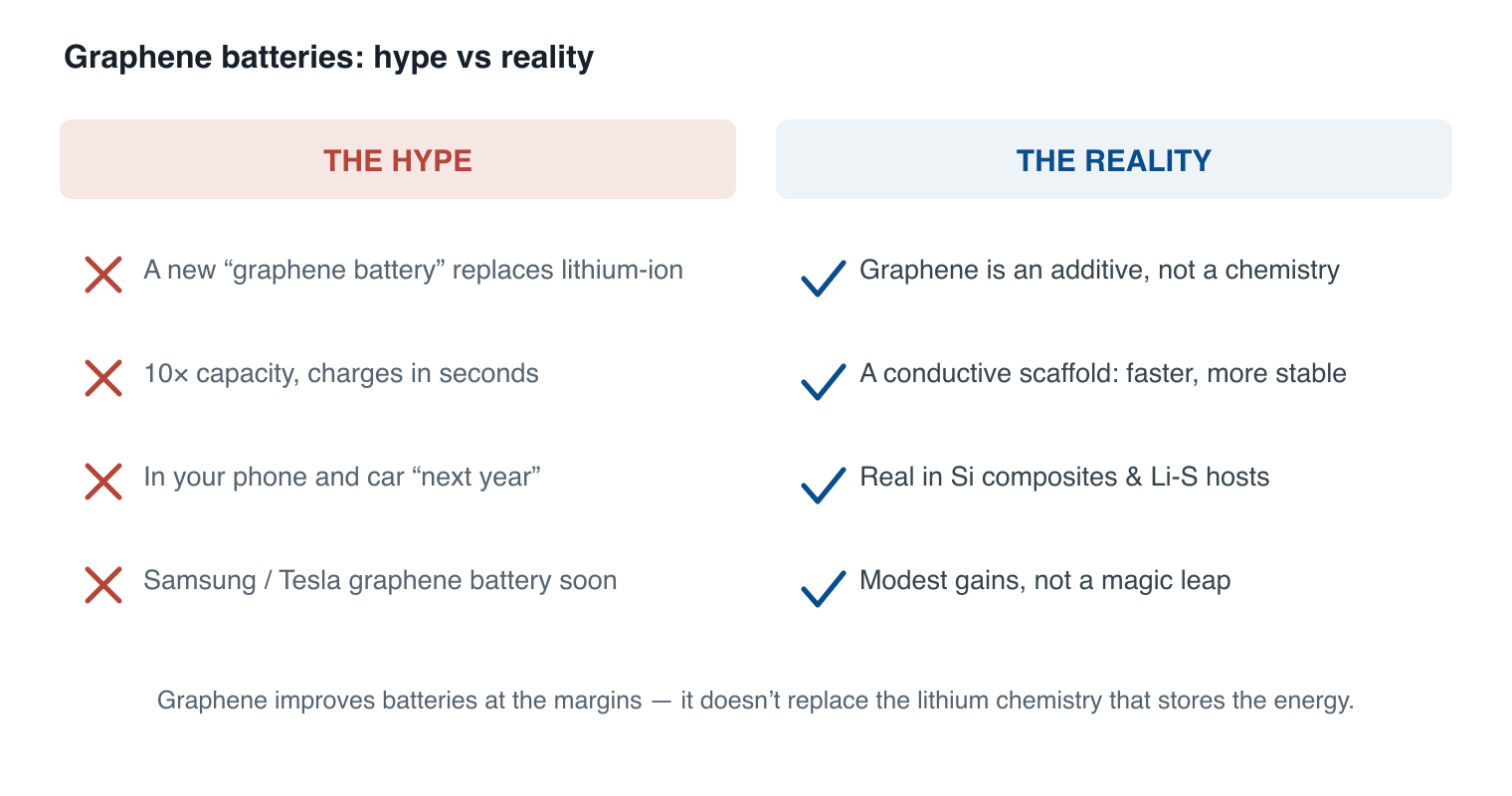
The graphene-battery narrative recycles the same claims: ten times the capacity, charging in seconds, coming to your phone next year, a secret Samsung or Tesla graphene cell about to change everything. These make great headlines and terrible predictions. Graphene doesn’t store much lithium itself, so it can’t multiply capacity; and no mass-market standalone “graphene battery” has shipped, despite a decade of announcements.
What graphene really does
Graphene’s superpower in a battery is conductivity, not capacity. Added in small amounts as a conductive additive or a thin coating, it builds a highly conductive scaffold around the active material. That lowers internal resistance, which can improve fast-charging, rate capability, and cycle life, and helps with thermal management. What it generally does not do is store meaningful amounts of lithium on its own — so it raises performance around the edges rather than rewriting the energy equation.
Where graphene genuinely helps
Strip away the marketing and there are real, valuable roles for graphene and graphene-like carbons:
- Conductive networks in electrodes — a little graphene can replace more carbon black, improving conductivity and power.
- Silicon-anode composites — graphene buffers the large volume change of silicon and keeps it connected, a genuine enabler for high-capacity anodes (see our silicon anode guide).
- Lithium-sulfur cathode hosts — 3D graphene frameworks trap sulfur and polysulfides; this is the approach behind companies like Lyten. See our lithium-sulfur battery guide.
- Supercapacitors — graphene’s huge surface area shines in high-power supercapacitors, a different device from a battery.
- Emerging chemistries — graphene appears in research on aluminum-ion and other systems, though these remain early.
Does graphene replace lithium-ion?
No. This is the single most important thing to understand. Graphene is an enhancement layered onto existing chemistries, not a new chemistry that stores energy by itself. A “graphene battery” that charges faster is still a lithium-ion cell — a better one, perhaps, but the lithium is doing the work. The genuinely disruptive next-generation batteries are solid-state and lithium-sulfur; graphene often plays a supporting role within those, but it isn’t the headline.
How to read “graphene battery” marketing
When you see a product sold as a graphene battery, translate it:
- A “graphene” LiPo pack (popular in RC and drones) is a lithium-polymer battery with a graphene additive — better internal resistance, same chemistry.
- A “graphene” car battery is usually a lead-acid or lithium battery with graphene in the electrodes for durability.
- A “graphene” power bank is a normal lithium cell with graphene marketing, sometimes with better heat handling.
None of this is fraud — graphene can add real, modest value — but the word signals a tweak, not a revolution. Judge the cell by its actual specs (energy density, cycle life, C-rate), not the buzzword.
Graphene and conductive additives in cell development
If you’re building cells, the practical question isn’t “should I make a graphene battery” — it’s “where does a conductive carbon earn its place in my electrode.” That means matching the right conductive additive, coating, or host to your chemistry, whether that’s a silicon composite, a Li-S cathode, or a fast-charge design. Xnergy supplies battery materials — cathodes, anodes, conductive additives, and electrolytes — plus cell prototyping, so you can test what a given additive actually buys you. (For fundamentals, see cathode materials and how electrolytes work.)
Frequently asked questions
Are graphene batteries real?
There’s no mass-market battery that stores energy in graphene alone. Real products use graphene as an additive inside conventional lithium-ion or supercapacitor cells, where it improves conductivity, fast charging and stability. The chemistry storing the energy is still lithium.
Does graphene replace lithium-ion?
No. Graphene is an enhancement, not a replacement. It can make a lithium-ion cell charge faster or last longer, but the lithium chemistry still does the energy storage.
What does graphene do in a battery?
Mainly it acts as a conductive scaffold — speeding electron transport, improving rate and cycle life, buffering silicon anodes, and hosting sulfur in Li-S cathodes. It rarely stores much lithium itself.
Do graphene batteries charge faster?
They can, because added conductivity lowers internal resistance. The gain is real but incremental — not the seconds-long charging of the headlines.
Is there a Samsung or Tesla graphene battery?
Despite recurring rumors, no commercial standalone one exists. Companies use graphene additives, and Li-S makers like Lyten use 3D graphene as a cathode host, but these are graphene-enhanced cells, not a new graphene chemistry.
Are graphene LiPo or car batteries actually graphene?
Usually they’re conventional cells with a little graphene added. A graphene LiPo is still lithium-polymer; a graphene car battery is often lead-acid or lithium with graphene in the electrodes.
Source with Xnergy
Building high-performance cells?
Xnergy supplies cathodes, anodes, conductive additives, and electrolytes — plus cell prototyping and pilot manufacturing from a US-based team — so you can test what actually improves your cell, buzzwords aside.