
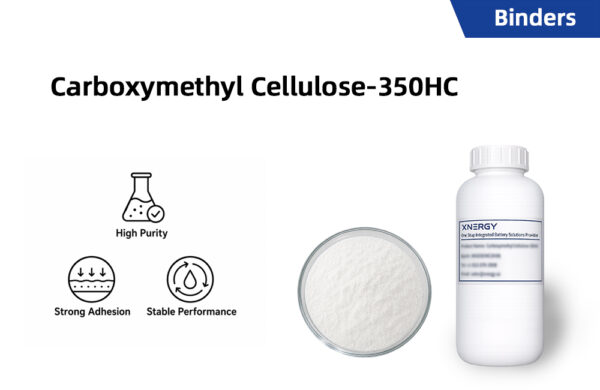
Carboxymethyl Cellulose-350HC
SKU: XN-BD-MAC350HC
Free Shipping$316.67
Nippon Paper MAC350HC Carboxymethyl Cellulose Binder — premium high-purity CMC co-binder from Nippon Paper Industries for lithium-ion battery anode slurries. High-viscosity grade (2,500–5,000 mPa·s, 1% solution) with ≥ 99.5% purity and tightly controlled NaCl content (≤ 0.5%). Engineered to improve dispersion stability of water-insoluble active materials, modify slurry flow properties, and enhance auxiliary binding performance. Ideal for high-purity SBR + CMC water-based anode binder systems. Available in 1 kg packaging.
Need a bulk order? Request a competitive quote today!
Name: Nippon Paper MAC350HC Carboxymethyl Cellulose Binder for Lithium-Ion Batteries
Manufacturer: Nippon Paper Industries (Japan)
Product Code: XN-BD-MAC350HC
Product Introduction:
Nippon Paper MAC350HC is a premium high-purity carboxymethyl cellulose (CMC) binder engineered for lithium-ion battery electrode formulations — particularly water-based anode slurry systems where it serves as the standard co-binder partner with SBR (styrene-butadiene rubber) latex. As a result, this CMC grade plays three critical roles in modern aqueous anode formulations: improving dispersion stability of water-insoluble active materials (graphite, silicon-carbon, silicon-oxide), modifying slurry flow properties (rheology control for consistent coating quality), and enhancing auxiliary binding performance (mechanical reinforcement of the SBR-based binder network). The defining characteristics of MAC350HC include its high-viscosity grade (2,500–5,000 mPa·s for a 1% solution at 25 °C), ≥ 99.5% purity, and tightly controlled NaCl content (≤ 0.5%) — a combination that makes MAC350HC the preferred choice for high-purity research applications and demanding production environments where binder-induced contamination must be minimized. MAC350HC is supplied with tightly controlled specifications: moisture ≤ 10%, degree of substitution 0.78–0.88, pH 6.0–8.5. Available in 1 kg packaging.
Key Features:
Nippon Paper MAC350HC — sodium CMC (CMC-Na), high-viscosity grade
Viscosity 2,500–5,000 mPa·s (1% solution, 25 °C); purity ≥ 99.5%; NaCl ≤ 0.5%; moisture ≤ 10%; pH 6.0–8.5
Degree of substitution 0.78–0.88 — well-controlled for maximum dispersion stability
Water-based co-binder — improves dispersion stability, rheology control, and auxiliary binding in SBR + CMC systems
Compatible with graphite, Si-C, SiOₓ, hard carbon, and LFP cathode slurries
Manufacturer: Nippon Paper Industries (Japan); 1 kg packaging
Application:
Nippon Paper MAC350HC is designed for high-purity water-based lithium-ion battery anode slurry preparation, including premium graphite anode formulations using the industry-standard SBR + CMC water-based binder system, silicon-carbon (Si-C) and silicon-oxide (SiOₓ) anode formulations where high CMC viscosity stabilizes silicon-containing dispersions, hard-carbon anode formulations for sodium-ion batteries, lithium iron phosphate (LFP) cathode formulations using water-based coating processes, slurries requiring high-viscosity rheology control for thick electrode coatings, high-end research applications where binder purity directly impacts cell-level performance metrics, and academic studies of binder-driven electrochemistry phenomena requiring tight contamination control.
Physical Properties:
| Specification | Typical Value (Unit) |
|---|---|
| Manufacturer | Nippon Paper Industries (Japan) |
| Model | Nippon Paper MAC350HC |
| Material Type | Sodium carboxymethyl cellulose (CMC-Na) |
| Application Type | Lithium-ion battery anode co-binder, dispersant, and rheology modifier (water-based) |
| Appearance | Naturally colored powder |
| Viscosity (1% solution at 25 °C, as produced) | 2,500 – 5,000 mPa·s (high-viscosity grade) |
| Moisture | Below 10% |
| pH (1% solution) | 6.0 – 8.5 |
| Degree of Substitution (M/C6) | 0.78 – 0.88 |
| Sodium Chloride (NaCl) Content | Below 0.5% |
| Purity | 99.5% and above |
| Solvent System | Water (dissolves to form clear viscous solution) |
| Recommended Co-Binder | SBR latex (typical SBR : CMC ratio 1:1 to 2:1 by weight) |
| Compatibility | Graphite, silicon-carbon (Si-C), silicon-oxide (SiOₓ), hard carbon, LFP cathodes |
| Packaging | 1 kg per unit |
| Storage | Dry place, room temperature |
Values measured by Nippon Paper Industries. Typical values for reference; not guaranteed unless otherwise specified.
Characteristics:
High-purity grade (≥ 99.5%) for premium battery research
MAC350HC delivers exceptional purity (≥ 99.5%) — substantially higher than industrial-grade CMC products and well-suited for high-end battery research and production where binder-induced contamination must be minimized. As a result, this CMC grade supports research applications where minor impurities would distort cell-level performance measurements, including academic studies of binder-electrolyte interactions, comparative studies of trace-element effects on cycling, and high-energy-density cell development.
Tightly controlled NaCl content (≤ 0.5%)
The NaCl content specification of below 0.5% is significantly tighter than the 1.0% maximum typical of standard-grade CMC products — minimizing residual chloride contamination that could interfere with electrochemical performance through electrolyte side reactions, current collector corrosion, or SEI layer modification. Therefore, MAC350HC is the preferred choice for cells where chloride-driven artifacts must be eliminated.
Improves dispersion stability of water-insoluble active materials
MAC350HC’s high molecular weight, well-controlled degree of substitution (0.78–0.88), and high purity provide excellent dispersion stability for water-insoluble active materials including graphite particles, silicon-carbon composite particles, silicon-oxide particles, and hard-carbon particles. Consequently, slurries formulated with MAC350HC maintain uniform active-material distribution throughout extended storage and coating operations — preventing settling artifacts that compromise electrode uniformity.
Modifies slurry flow properties for consistent coating
The high-viscosity profile of MAC350HC (2,500–5,000 mPa·s for 1% solution) provides robust rheology control for water-based electrode slurries — particularly valuable for thick electrode coatings, dense active-material loadings, and slurries containing silicon-rich anodes that would settle out with lower-viscosity binders. Therefore, this CMC grade enables consistent coating quality across slot-die, comma-bar, and gravure coating processes.
Enhances auxiliary binding performance with SBR systems
MAC350HC partners seamlessly with SBR latex binders (such as ZEON BM-430B and ZEON BM-451B) in the industry-standard SBR + CMC water-based binder system. As a result, the CMC component contributes auxiliary mechanical binding, electrode flexibility, and inter-particle bridging that complements the elastomeric properties of SBR — delivering composite binder performance that neither component achieves alone.
Well-controlled degree of substitution (0.78–0.88)
The narrow degree-of-substitution range (0.78–0.88) ensures consistent ionic-character behavior across batches — critical for reproducible water solubility, dispersion behavior, and inter-particle interactions. Furthermore, this tighter control enables more consistent batch-to-batch slurry behavior compared to standard-grade CMC products with broader D.S. tolerances.
Aqueous (water-based) chemistry for environmental compliance
MAC350HC dissolves directly in water — eliminating the need for organic solvents in slurry preparation when paired with SBR latex for the SBR + CMC water-based anode binder system. Consequently, this binder supports environmentally compliant manufacturing operations, reduces solvent recovery costs, and aligns with the industry-wide transition toward water-based electrode coating processes.
Industry-standard Nippon Paper quality and consistency
Nippon Paper Industries is a leading global supplier of cellulose-based industrial chemicals, with deep expertise in CMC chemistry derived from decades of paper-industry experience. Therefore, MAC350HC delivers consistent batch-to-batch performance backed by Nippon Paper’s quality control systems — supporting reliable scale-up from R&D laboratory experiments to industrial production.
Recommended Use Procedure:
1. Pre-dissolve MAC350HC in deionized water before adding to slurry. Add CMC powder slowly to vigorously stirred water (avoid forming clumps/lumps that resist hydration). 2. Continue stirring for 1–4 hours at moderate speed until the CMC is fully dissolved as a clear viscous solution. Note: high-viscosity CMC grades take longer to fully hydrate compared to lower-viscosity grades. 3. Prepare anode slurry using the standard SBR + CMC co-binder protocol — typical formulation: anode active material (94–97 wt%), conductive additive (1–2 wt%), CMC MAC350HC (1 wt%), SBR latex (1.5–2 wt% on dry basis). 4. First mix the active material and conductive additive with the pre-dissolved CMC solution to disperse the active material. 5. Add the SBR latex last, stirring gently to avoid disrupting the SBR latex stability. 6. Filter the final slurry through a fine-mesh filter to remove any aggregates. 7. Coat onto copper current collector foil using standard coating equipment. 8. Dry the coated electrode at recommended temperatures (typically 80–120 °C) and roll-press to target porosity. 9. Reseal the CMC container tightly between uses to prevent moisture absorption.
Packaging & Storage:
Nippon Paper MAC350HC is supplied in 1 kg packaging, sealed for shipment and storage. Therefore, store in a dry place at room temperature, protected from moisture, heat, and direct sunlight. CMC powder is hygroscopic — moisture absorption from humid air will alter the moisture content specification and may affect dissolution behavior and final solution viscosity. After opening, reseal the container tightly between uses to maintain product specifications.
Safety:
For research and industrial laboratory use only. CMC is a generally low-hazard cellulose derivative (food-grade across multiple industrial applications). Always wear appropriate PPE (safety glasses, gloves, lab coat) when handling CMC powder, especially when measuring large quantities — fine CMC powder can become airborne and cause minor respiratory irritation. Use in a well-ventilated area, particularly when weighing larger amounts. Do not store near oxidizers, strong acids, or strong bases. Refer to the Nippon Paper Material Safety Data Sheet (MSDS) for complete safety and handling information.
Note: Specifications listed above are typical values provided by Nippon Paper Industries and are for reference only. Actual performance depends on the specific anode active material, slurry formulation, coating process parameters, and downstream cell manufacturing conditions — consult published literature for guidance on optimal CMC + SBR binder formulation protocols for specific anode chemistries (graphite, silicon-carbon, silicon-oxide, hard carbon). For researchers exploring complete lithium-ion battery binder workflows, see also Xnergy’s related products: Nippon Paper MAC500HC, DAICEL CMC 2200, ZEON SBR BM-430B (water-based anode binder for graphite anodes), ZEON SBR BM-451B (water-based anode binder for Si-C/SiOₓ anodes with expansion suppression), Polyvinylidene Fluoride (PVDF) 5130 (NMP-based cathode binder), Polyvinylidene Fluoride (PVDF) 900, Daikin PTFE Dispersion Binder D-210C, PTFE Binder Powder, and the full Binders category. For complete electrode formulation systems, see also Anode Materials (graphite, silicon-carbon, silicon-oxide), Cathode Materials, Conductive Additives, and Current Collectors.
| Carboxymethyl-350HC | 1kg |
|---|
Related products
-
Aqueous Binder, LA136DL
-
Daikin PTFE Dispersion Binder D-210C (60% Solids) – Battery-Grade PFOA-Free
Free Shipping Price range: $358.97 through $364.10Select options This product has multiple variants. The options may be chosen on the product page -
Daikin PTFE Dispersion Resin F-208 / F-208H
-
Styrene-Butadiene Rubber (SBR) binder, TRD104A