
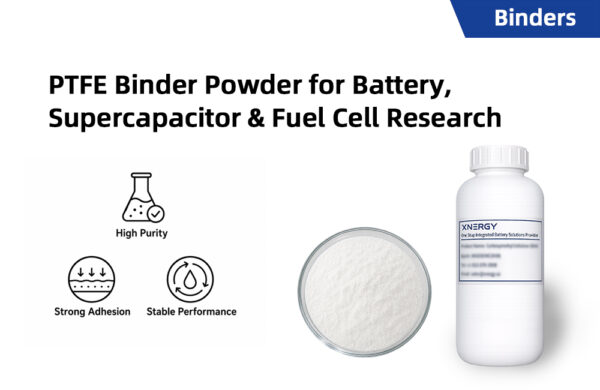
PTFE Binder Powder for Battery, Supercapacitor & Fuel Cell Research
SKU: XN-BD-PTFE
Free Shipping$423.08
PTFE Binder Powder for Battery, Supercapacitor & Fuel Cell Research — high-performance polytetrafluoroethylene (PTFE) powder engineered as a versatile electrode binder for lithium-ion batteries, supercapacitors, and fuel cell research. Superior chemical and thermal stability compared to PVDF — particularly suitable for alkaline electrolyte environments where PVDF degrades through dehydrofluorination. Particle size ~480 μm, glass transition temperature 326–328 °C, relative density 2.14–2.20 g/cm³. Available in 1 kg packaging.
Need a bulk order? Request a competitive quote today!
Name: PTFE Binder Powder for Battery, Supercapacitor & Fuel Cell Research
Material Type: Polytetrafluoroethylene (PTFE) Powder
Product Code: XN-BD-PTFE
Product Introduction:
This is a high-performance PTFE (polytetrafluoroethylene) binder powder engineered as a versatile electrode binder for lithium-ion batteries, supercapacitors, and fuel cell research. As a result, this PTFE powder serves as the foundational binder for electrochemical energy storage and conversion systems where chemical inertness, thermal stability, and electrolyte compatibility are critical requirements. Polytetrafluoroethylene (PTFE) is a synthetic fluoropolymer of tetrafluoroethylene, consisting solely of carbon and fluorine atoms — its stable –CF₂–CF₂– molecular structure delivers superior chemical and thermal stability compared to PVDF (polyvinylidene fluoride). Therefore, PTFE binders are particularly well-suited to applications in alkaline electrolyte environments, where PVDF tends to degrade significantly through dehydrofluorination — a critical capability for alkaline-electrolyte systems including aqueous batteries, alkaline fuel cells, and certain supercapacitor formulations. Furthermore, published research has shown that supercapacitors utilizing PTFE binders deliver enhanced capacity and improved cycling performance compared to PVDF-based formulations. This PTFE binder is widely used in the preparation of electrode materials across batteries, fuel cells, and supercapacitors. Available in 1 kg packaging.
Key Features:
PTFE binder powder — CAS 9002-84-0; particle size ~480 μm
Relative density 2.14–2.20 g/cm³; glass transition temperature 326–328 °C
Superior chemical stability — fully inert against virtually all battery electrolytes
Stable in alkaline electrolyte environments — resistant to dehydrofluorination (unlike PVDF)
Water-based or solvent-free processing — no organic solvents required
Suitable for batteries, supercapacitors, and fuel cell electrode applications
1 kg packaging
Application:
This PTFE binder powder is designed for laboratory and industrial-scale electrochemical electrode preparation, including supercapacitor electrode formulations (carbon-based electrodes for symmetric and asymmetric supercapacitor research), alkaline-electrolyte battery electrode binder applications where PVDF degradation is a concern, fuel cell catalyst layer binder applications including PEMFC and high-temperature PEMFC research, lithium-ion battery cathode formulations where PTFE thermal stability is required (high-voltage cathodes, thermal-runaway studies), filler-loaded composite electrode formulations where PTFE serves as the matrix binder, dry electrode manufacturing research workflows, and academic studies of binder effects on electrochemical performance.
Physical Properties:
| Specification | Typical Value |
|---|---|
| CAS Number | 9002-84-0 |
| Material Type | Polytetrafluoroethylene (PTFE) homopolymer |
| Appearance | White powder |
| Particle Size | ~480 μm |
| Glass Transition Temperature | 326 – 328 °C |
| Relative Density | 2.14 – 2.20 g/cm³ |
| Apparent Density | ~600 g/L |
| Solvent Compatibility | Water and other common laboratory solvents (used as wetting agents during mixing) |
| Compatibility | Lithium-ion battery cathodes, supercapacitor electrodes, fuel cell catalyst layers, alkaline-electrolyte battery electrodes |
| Packaging | 1 kg per unit |
Values for reference; not guaranteed unless otherwise specified.
Why Choose PTFE Over PVDF?
| Property | PTFE Binder | PVDF Binder |
|---|---|---|
| Molecular Structure | –CF₂–CF₂– (fully fluorinated) | –CH₂–CF₂– (partially fluorinated) |
| Chemical Stability | Superior — fully chemically inert | Good (but susceptible to dehydrofluorination) |
| Alkaline Environment | Excellent — stable in concentrated alkaline electrolytes | Degrades through dehydrofluorination |
| Thermal Stability | Higher (Tg 326–328 °C) | Lower (Tm ~170–180 °C) |
| Solvent Requirement | Water (or solvent-free for dry electrode) | NMP (organic solvent required) |
| Best Use Case | Supercapacitors, alkaline batteries, fuel cells, dry electrode | Lithium-ion battery cathodes (NMP-based wet coating) |
Characteristics:
Superior chemical and thermal stability
The PTFE molecular structure consists solely of carbon and fluorine atoms in the stable –CF₂–CF₂– chain, delivering exceptional chemical inertness against virtually all battery electrolytes, fuel cell membranes, and supercapacitor systems. As a result, PTFE binder maintains structural integrity across the full operating range of electrochemical research applications — including extreme pH (alkaline and acidic), high voltage, and elevated temperature.
Excellent compatibility with alkaline electrolyte environments
Unlike PVDF, which degrades significantly through dehydrofluorination in alkaline environments, PTFE remains chemically stable in concentrated alkaline electrolytes (KOH, NaOH solutions). Therefore, this binder is the preferred choice for alkaline-electrolyte battery research (zinc-air, nickel-zinc, alkaline batteries) and alkaline fuel cell electrode formulations.
Enhanced supercapacitor performance
Studies have shown that supercapacitors utilizing PTFE binders deliver enhanced capacity and improved cycling performance compared to PVDF-based formulations — likely due to PTFE’s chemical stability, lower electrochemical interference, and ability to form a stable fibrillated network within the carbon electrode microstructure. Consequently, PTFE is the binder of choice for high-performance supercapacitor electrode research.
High glass transition temperature (326–328 °C)
The PTFE glass transition temperature of 326–328 °C is substantially higher than PVDF (~170–180 °C melting point), supporting electrode operation and processing at elevated temperatures without binder softening or thermal degradation. As a result, this PTFE binder enables high-temperature electrochemistry research and elevated-temperature processing workflows.
Wide application compatibility (batteries, supercapacitors, fuel cells)
This PTFE binder powder is suitable for use across the full spectrum of electrochemical energy storage and conversion research — including lithium-ion battery cathodes, alkaline batteries, supercapacitor electrodes, fuel cell catalyst layers, and gas diffusion electrodes. Therefore, this single binder serves as a versatile platform across multiple research workflows, simplifying material inventory for multi-disciplinary electrochemistry laboratories.
Solvent-free or water-based processing
Unlike PVDF (which requires NMP organic solvent), PTFE binder can be processed with water alone or used in solvent-free dry-electrode manufacturing workflows. As a result, this binder supports environmentally friendly electrode manufacturing, reduces VOC emissions, and aligns with the industry-wide transition toward water-based and solvent-free electrode coating processes.
Coarse particle size (~480 μm) for fibrillation
The ~480 μm particle size is well-suited to mechanical fibrillation processes used in dry-electrode manufacturing, where high-shear mixing develops the PTFE fiber network that binds the electrode components. Furthermore, this particle size provides sufficient binder distribution coverage when ground or fibrillated with electrode active materials.
Cost-effective alternative for general research applications
This PTFE binder powder serves as a cost-effective alternative to premium PFOA-free PTFE dispersions (such as Daikin D-210C) for general research applications where the latest regulatory compliance and tightly engineered surfactant systems are not strictly required. Therefore, this product supports academic research, prototype development, and educational laboratory applications at attractive cost.
Use Instructions:
Method 1 — Solid Electrode Preparation (Dry-Process Approach): 1. Mix the active material (cathode powder, anode powder, or supercapacitor carbon) with the PTFE binder powder in the recommended weight ratio. 2. Grind the mixture using a mortar-and-pestle, planetary ball mill, or high-shear mixer to form a homogeneous dry mixture. 3. Add several drops of water (or other solvent) to improve homogeneity and initiate PTFE fibrillation. 4. Continue mixing until the mixture forms a cohesive, fibrillated mass that can be roll-pressed into a self-supporting electrode film.
Method 2 — Slurry Electrode Preparation (Wet-Process Approach): 1. Add the active material and PTFE binder powder into a suitable amount of water (or other solvent compatible with the active material). 2. Stir vigorously to form a homogeneous slurry. 3. Coat onto current collector foil using standard coating equipment. 4. Dry the coated electrode at recommended temperatures.
Recommended Formulation: Typical PTFE binder loading for batteries, supercapacitors, and fuel cell electrodes ranges from 5–15 wt% (relatively higher than PVDF binder loading due to PTFE’s mechanical fibrillation mechanism). Consult specific application protocols for optimized binder loading.
Reference Literature:
- Effects of Various Binders on Supercapacitor Performances, Int. J. Electrochem. Sci., 11 (2016) 8270–8279.
- Effect of binder on the performance of carbon/carbon symmetric capacitors in salt aqueous electrolyte, Electrochimica Acta, 140 (2014) 132–138.
- Role of Binders in High Temperature PEMFC Electrode, J. Electrochem. Soc., 158 (6) B675–B681 (2011).
Packaging & Storage:
This PTFE binder powder is supplied in 1 kg packaging, sealed for shipment and storage. Therefore, store in a dry environment (15–25 °C, RH < 60 %) protected from heat, direct sunlight, and moisture absorption. After opening, reseal the container tightly between uses to prevent moisture absorption that could affect binder performance during dry-process electrode manufacturing.
Safety:
For research and industrial laboratory use only. When PTFE resins are heated to temperatures above 260 °C, minor amounts of decomposition products are given off — these decomposition products may be harmful, and inhalation of these fumes must be avoided. Ovens, process equipment, and the working area must be adequately ventilated when working with hot PTFE-containing electrodes. Always wear appropriate PPE (safety glasses, chemical-resistant gloves, lab coat) when handling PTFE binder powder, and use respiratory protection if working in poorly ventilated areas with heated PTFE materials. Avoid prolonged inhalation of PTFE powder dust during weighing and mixing operations. Do not store near oxidizers, strong acids, or strong bases. Refer to the Material Safety Data Sheet (MSDS) for complete safety and handling information.
Note: Specifications listed above are typical values and are for reference only. Actual performance depends on the specific electrode active material, formulation, manufacturing process parameters (wet-coating, dry-electrode fibrillation, lamination, etc.), and downstream cell manufacturing conditions — consult published literature for guidance on optimal binder-formulation protocols for specific battery, supercapacitor, and fuel cell applications. For researchers exploring complete binder workflows, see also Xnergy’s related products: Daikin PTFE Dispersion Binder D-210C (premium PFOA-free PTFE for dry electrode manufacturing), ZEON SBR BM-451B (water-based anode binder for Si-C/SiOₓ anodes), ZEON SBR BM-430B (water-based anode binder for graphite anodes), Carboxymethyl Cellulose (CMC) BM-500HC (CMC co-binder for SBR systems), Carboxymethyl Cellulose (CMC) BM-350HC, Carboxymethyl Cellulose (CMC) 2200, Polyvinylidene Fluoride (PVDF) 5130 (NMP-based cathode binder), Polyvinylidene Fluoride (PVDF) 900, and the full Binders category. For complete electrode formulation systems, see also Cathode Materials, Anode Materials, Conductive Additives, and Current Collectors.
| PTFE Binder | 1kg |
|---|
Related products
-
Polyvinylidene Fluoride(PVDF)-5130
Free Shipping$589.74Select options This product has multiple variants. The options may be chosen on the product page -
Carboxymethyl Cellulose-350HC
Free Shipping$316.67Select options This product has multiple variants. The options may be chosen on the product page -
Aqueous Binder, LA136D
-
Aqueous Binder, LA133