
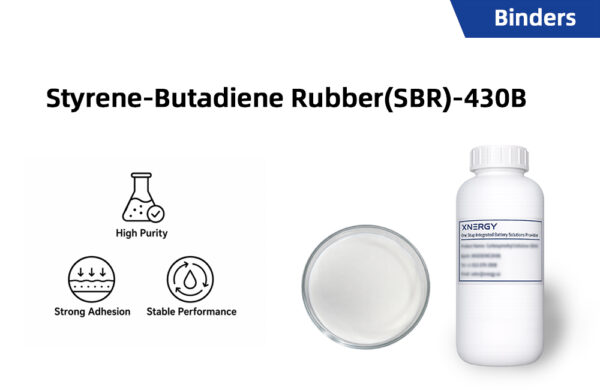
Styrene-Butadiene Rubber(SBR)-430B
SKU: XN-BD-SBR430B
Free Shipping$409.00
ZEON SBR BM-430B Aqueous Anode Binder — premium water-based styrene-butadiene rubber (SBR) binder from ZEON Corporation, engineered for lithium-ion battery anode formulations. Delivers high peel strength, improved cycle performance, enhanced lithium-ion conductivity, and superior low-temperature slurry performance. Compatible with graphite, silicon-carbon (Si-C), and silicon-oxide (SiOₓ) anode chemistries. Available in 1 kg packaging.
Need a bulk order? Request a competitive quote today!
Name: ZEON SBR BM-430B Aqueous Anode Binder for Lithium-Ion Batteries
Manufacturer: ZEON Corporation (Japan)
Product Code: XN-BD-SBR430B
Product Introduction:
ZEON BM-430B is a premium aqueous anode binder for lithium-ion batteries — a water-based styrene-butadiene rubber (SBR) latex engineered to deliver consistent slurry processing, robust electrode adhesion, and reliable cycling performance across graphite, silicon-carbon, and silicon-oxide anode chemistries. As a result, BM-430B is the industry-standard anode binder for lithium-ion battery production lines, used by leading cell manufacturers worldwide for both consumer electronics and EV battery applications. The defining performance characteristics of BM-430B include high peel strength (ensuring durable electrode-current-collector adhesion that resists delamination during cycling), improved cycle performance (maintaining capacity retention through hundreds of charge-discharge cycles), enhanced lithium-ion conductivity (supporting high-rate cycling without binder-induced impedance growth), and superior low-temperature slurry performance (preventing slurry instability and gelation in cold-coating environments). BM-430B is supplied as a stable aqueous latex with 39.0–41.0 wt% solid content, 5–100 mPa·s viscosity, and pH 7.0–9.0. Available in 1 kg packaging.
Key Features:
ZEON BM-430B — aqueous SBR latex, water-based anode binder
High peel strength; improved cycle performance; enhanced lithium-ion conductivity; superior low-temperature slurry performance
Solid content 39.0–41.0 wt%; viscosity 5–100 mPa·s; pH 7.0–9.0
Compatible with graphite, silicon-carbon (Si-C), silicon-oxide (SiOₓ), hard carbon, and LTO anodes
Recommended co-binder: CMC (SBR : CMC ratio 1:1 to 2:1 by weight)
Shelf life 12 months from production date (sealed container)
Manufacturer: ZEON Corporation (Japan); 1 kg packaging
Application:
ZEON BM-430B is designed for laboratory and industrial-scale lithium-ion battery anode slurry preparation, including graphite anode coating formulations (typically 1–2 wt% SBR + 1 wt% CMC binder system), silicon-carbon (Si-C) composite anode formulations where high peel strength is required to accommodate Si volume expansion, silicon-oxide (SiOₓ) anode formulations for high-energy-density lithium-ion cells, hard-carbon anode formulations for sodium-ion batteries, lithium titanate (LTO) anode formulations for high-rate and long-cycle-life applications, and academic research into binder-electrode-electrolyte interface phenomena.
Physical Properties:
| Specification | Typical Value (Unit) |
|---|---|
| Manufacturer | ZEON Corporation (Japan) |
| Model | ZEON BM-430B |
| Material Type | Styrene-butadiene rubber (SBR) aqueous latex |
| Application Type | Lithium-ion battery anode binder (water-based) |
| Solid Content | 39.0 – 41.0 wt% |
| Viscosity | 5 – 100 mPa·s |
| pH | 7.0 – 9.0 |
| Solvent System | Water (aqueous latex) |
| Recommended Co-Binder | CMC (carboxymethyl cellulose) — typical SBR : CMC ratio 1:1 to 2:1 by weight |
| Compatibility | Graphite, silicon-carbon (Si-C), silicon-oxide (SiOₓ), hard carbon, lithium titanate (LTO) |
| Packaging | 1 kg per unit |
| Shelf Life | 12 months from production date (sealed container) |
| Storage | 5 – 40 °C, dark cool place, away from heat sources and direct sunlight |
Values measured by ZEON Corporation. Typical values for reference; not guaranteed unless otherwise specified.
Characteristics:
High peel strength for durable electrode adhesion
ZEON BM-430B delivers exceptional peel strength between the anode coating and the copper current collector — a critical performance characteristic for cells that experience volumetric expansion during cycling (graphite, silicon-carbon, silicon-oxide). As a result, electrodes formulated with BM-430B resist delamination, edge cracking, and binder migration over hundreds of charge-discharge cycles, supporting long cell service life.
Improved cycle performance across diverse anode chemistries
The chemical structure of BM-430B SBR is engineered to maintain mechanical integrity under repeated lithium intercalation/deintercalation stress. Therefore, anodes formulated with BM-430B deliver superior capacity retention through extended cycling — making this binder particularly valuable for high-energy-density anode formulations where cycle life is the primary performance metric.
Enhanced lithium-ion conductivity
Unlike older-generation anode binders that introduce significant ionic transport barriers, BM-430B is formulated to support efficient lithium-ion transport through the electrode microstructure. Consequently, anodes formulated with BM-430B deliver high-rate capability without binder-induced impedance growth — supporting fast-charging applications and high-power EV cell designs.
Superior low-temperature slurry performance
BM-430B exhibits stable rheological behavior across a wide temperature range, including low ambient temperatures encountered in cold-environment coating workshops. As a result, slurries formulated with BM-430B maintain consistent viscosity, surface tension, and coating quality even when slurry temperature drops below typical room-temperature ranges — preventing process variability and coating defects.
Aqueous (water-based) chemistry for environmental compliance
BM-430B is supplied as an aqueous latex (water-based formulation), eliminating the need for organic solvents (NMP, DMF) in anode slurry preparation. Therefore, this binder supports environmentally compliant manufacturing operations, reduces solvent recovery costs, lowers VOC emissions, and aligns with the industry-wide transition toward water-based electrode coating processes.
Industry-standard ZEON quality and consistency
ZEON Corporation is the global market leader in SBR battery binders, supplying major lithium-ion cell manufacturers worldwide. As a result, BM-430B delivers consistent batch-to-batch performance backed by ZEON’s quality control systems — supporting reliable scale-up from R&D laboratory experiments to industrial production.
Compatible with standard CMC co-binder systems
BM-430B is engineered to work seamlessly with carboxymethyl cellulose (CMC) co-binders in the industry-standard SBR + CMC formulation system. Furthermore, the SBR : CMC ratio can be tuned (typically 1:1 to 2:1 by weight) to match specific anode formulation requirements for peel strength, slurry viscosity, and electrode flexibility.
Stable aqueous latex with reliable shelf life
BM-430B maintains stable solid content, viscosity, and pH characteristics throughout its 12-month shelf life when stored properly (5–40 °C, dark cool place, away from heat sources). Consequently, this binder supports research and production schedules without batch-to-batch performance drift, simplifying inventory management.
Recommended Use Procedure:
1. Stir the BM-430B latex thoroughly before use to ensure homogeneous distribution of solid content (a stable latex may show minor settling after extended storage). 2. Filter the binder through a fine-mesh filter to remove any aggregates or contamination before adding to slurry. 3. Prepare anode slurry following standard SBR + CMC co-binder protocol — typical formulation: anode active material (95–97 wt%), conductive additive (0.5–2 wt%), CMC (1 wt%), SBR BM-430B (1–2 wt% on dry basis). 4. Mix the slurry using standard planetary or high-shear mixers, observing recommended mixing time and viscosity targets for the specific anode chemistry. 5. Coat the slurry onto copper current collector foil using standard slot-die or comma-bar coaters. 6. Dry the coated electrode at recommended temperatures (typically 80–120 °C) and roll-press to target porosity. 7. After use, reseal the BM-430B container tightly to maintain shelf life and prevent moisture loss or contamination.
Packaging & Storage:
ZEON BM-430B is supplied in 1 kg packaging, sealed for shipment and storage. Therefore, store in a dark, cool place at 5 – 40 °C, away from all heat sources including direct sunlight. Shelf life is 12 months from the date of production when the container remains sealed. After opening, reseal tightly between uses and consume within a reasonable time window to maintain performance characteristics. Stir and filter the binder before each use to ensure homogeneous distribution and remove any potential aggregates.
Safety:
For research and industrial laboratory use only. Always wear appropriate PPE (safety glasses, gloves, lab coat) when handling SBR binder, slurry, or coated electrodes. Although BM-430B is a water-based aqueous latex (low hazard compared to organic-solvent binders), avoid prolonged skin contact and inhalation of dried binder dust. Use in a well-ventilated area when mixing slurries or drying coated electrodes. Do not store near oxidizers, strong acids, or strong bases. Refer to the ZEON Material Safety Data Sheet (MSDS) for complete safety and handling information.
Note: Specifications listed above are typical values provided by ZEON Corporation and are for reference only. Actual performance depends on the specific anode active material, slurry formulation, coating process parameters, and downstream cell manufacturing conditions — consult published literature for guidance on optimal binder-formulation protocols for specific anode chemistries. For researchers exploring complete lithium-ion battery binder workflows, see also Xnergy’s related products: Carboxymethyl Cellulose (CMC) BM-350HC (industry-standard CMC co-binder for SBR systems), Polyvinylidene Fluoride (PVDF) 900 (cathode binder for NMP-based formulations), PTFE Binder Powder (dry-electrode and high-voltage cathode binder), Daikin D-210C PTFE Dispersion Binder, and the full Binders category. For complete electrode formulation systems, see also Anode Materials, Cathode Materials, Conductive Additives, and Current Collectors.
| SBR-430B | 1kg |
|---|
Related products
-
DAICEL CMC 2200 Carboxymethyl Cellulose Binder
Free Shipping$423.08Select options This product has multiple variants. The options may be chosen on the product page -
Carboxymethyl Cellulose-350HC
Free Shipping$316.67Select options This product has multiple variants. The options may be chosen on the product page -
Polyvinylidene Fluoride(PVDF)-5130
Free Shipping$589.74Select options This product has multiple variants. The options may be chosen on the product page -
Nippon Paper MAC500LC Sodium Carboxymethyl Cellulose (CMC) Binder
Free Shipping$384.62Select options This product has multiple variants. The options may be chosen on the product page