
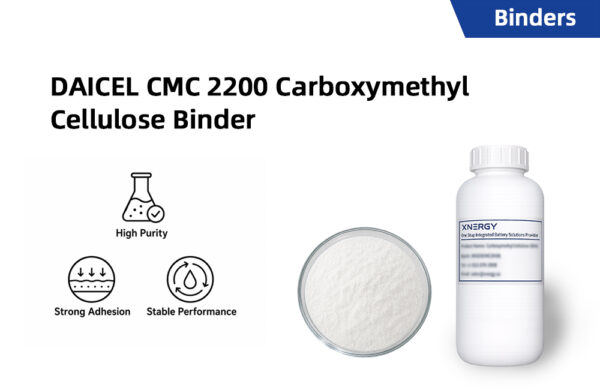
DAICEL CMC 2200 Carboxymethyl Cellulose Binder
SKU: CMC DAICEL 2200
Free Shipping$423.08
DAICEL CMC 2200 Carboxymethyl Cellulose Binder — battery-grade sodium carboxymethyl cellulose (CMC-Na) powder from Daicel Corporation (Japan) for water-based lithium-ion battery anode slurry formulations. Viscosity 1500–3000 mPa·s (1% solution, 25 °C, 60 rpm), degree of substitution 0.80–1.20, pH 6.0–8.5, NaCl ≤ 1.0%, loss on drying ≤ 10.0%. Supplied as dry powder in 1 kg packaging.
Need a bulk order? Request a competitive quote today!
Name: DAICEL CMC 2200 Carboxymethyl Cellulose Binder
Manufacturer: Daicel Corporation (Japan)
Product Code: CMC DAICEL 2200
Product Introduction:
DAICEL CMC 2200 is a battery-grade sodium carboxymethyl cellulose (CMC-Na) powder from Daicel Corporation, Japan. It is used as a co-binder in water-based anode slurry formulations for lithium-ion batteries, typically paired with SBR latex. Each production lot is tested and certified by Daicel Corporation with a Certificate of Analysis (COA) covering viscosity, pH, degree of substitution, NaCl content, and loss on drying.
Key Features:
Battery-grade sodium carboxymethyl cellulose (CMC-Na) powder
Viscosity 1500–3000 mPa·s (1% solution, 25 °C, 60 rpm); pH 6.0–8.5
Degree of substitution 0.80–1.20; NaCl ≤ 1.0%; loss on drying ≤ 10.0%
Water-based co-binder — pairs with SBR latex for water-based anode slurry formulations
Certificate of Analysis (COA) provided with each production lot
Manufacturer: Daicel Corporation (Japan); 1 kg packaging
Physical Properties:
| Parameter | Specification |
|---|---|
| Manufacturer | Daicel Corporation (Japan) |
| Grade | CMC DAICEL 2200 |
| Material Type | Sodium carboxymethyl cellulose (CMC-Na), dry powder |
| Viscosity (1% solution, 25 °C, 60 rpm) | 1500–3000 mPa·s |
| pH (1% solution, 25 °C) | 6.0–8.5 |
| Degree of Substitution | 0.80–1.20 |
| NaCl Content | ≤ 1.0% |
| Loss on Drying | ≤ 10.0% |
| Solvent System | Water-based |
| Packaging | 1 kg per unit |
Specifications per Daicel Corporation Certificate of Analysis. Typical values for reference; actual lot values may vary within the stated specification ranges.
Application:
DAICEL CMC 2200 is used in water-based lithium-ion battery anode slurry preparation as a co-binder, typically combined with SBR latex (e.g., ZEON BM-430B or BM-451B). CMC provides viscosity control, improves slurry homogeneity, and enhances adhesion of active materials to the copper current collector.
Recommended Use Procedure:
1. Pre-dissolve CMC 2200 powder in deionized water before adding to slurry. Add CMC powder slowly to vigorously stirred water to prevent clump formation. 2. Continue stirring until fully dissolved as a clear, homogeneous viscous solution. 3. Use the dissolved CMC solution as a co-binder in standard SBR + CMC water-based anode slurry formulations. 4. Filter the final slurry through a fine-mesh filter to remove any undissolved aggregates before coating. 5. Reseal the CMC container tightly between uses to prevent moisture absorption.
Packaging & Storage:
Supplied as dry powder in 1 kg sealed packaging. Store in a cool, dry place at room temperature, away from moisture, heat, and direct sunlight. CMC powder is hygroscopic — exposure to humid air will increase moisture content and may affect dissolution behavior and solution viscosity. Reseal tightly after each use.
Safety:
For research and industrial laboratory use only. CMC is a low-hazard cellulose derivative. Wear appropriate PPE (safety glasses, gloves, lab coat) when handling CMC powder. Use in a well-ventilated area to avoid inhalation of fine powder. Do not store near strong oxidizers, acids, or bases. Refer to the Daicel MSDS for complete safety information.
Note: Specifications are per Daicel Corporation COA and are for reference only. Actual performance depends on slurry formulation, coating conditions, and downstream cell manufacturing parameters. For complete electrode formulation systems, see also Xnergy’s related products: Carboxymethyl Cellulose-350HC, Carboxymethyl Cellulose-500HC, SBR-430B, SBR-451B, PVDF-5130, PVDF-900, Daikin PTFE D-210C, PTFE Binder Powder, and the full Binders category. See also Anode Materials, Cathode Materials, Conductive Additives, and Current Collectors.
| Carboxymethyl-2200 | 1kg |
|---|
Related products
-
Styrene-Butadiene Rubber (SBR) binder, TRD104A
-
Daikin PTFE Dispersion Resin F-208 / F-208H
-
Polyvinylidene Fluoride(PVDF)-5130
Free Shipping$589.74Select options This product has multiple variants. The options may be chosen on the product page -
Styrene-Butadiene Rubber(SBR)-430B
Free Shipping$409.00Select options This product has multiple variants. The options may be chosen on the product page