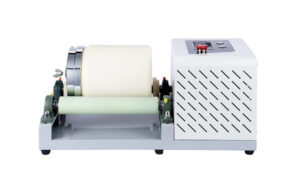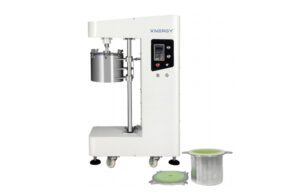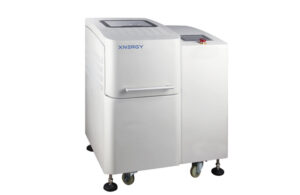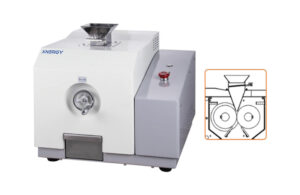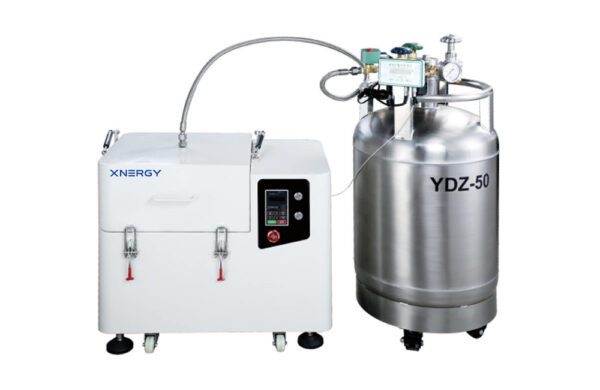
Liquid Nitrogen Cooling Ball Mill XN-YD-XQM Series
SKU: XN-YD-XQM
Liquid Nitrogen Cooling Ball Mill XN-YD-XQM Series is a planetary ball mill cooled by direct liquid-nitrogen feed for ultra-low-temperature grinding of thermally sensitive and cryo-required materials. Chamber temperature is continuously adjustable from −60 °C to −1 °C, with automatic level- and temperature-controlled LN₂ feed for stable cooling and reduced nitrogen consumption.
Five models from 2 L to 20 L total capacity, four grinding modes, supplied with a 30 L self-pressurizing liquid-nitrogen dewar for closed-loop cooling.
Need a bulk order or custom specification? Request a competitive quote today!
Name: Liquid Nitrogen Cooling Ball Mill XN-YD-XQM Series
Equipment Type: Planetary Ball Mill with Direct Liquid-Nitrogen Cooling for Ultra-Low-Temperature Grinding
Product Code: XN-YD-XQM
Brand: Xnergy
Product Introduction:
XN-YD-XQM Series Liquid Nitrogen Cooling Ball Mill is a planetary ball mill cooled by direct liquid-nitrogen feed, designed for ultra-low-temperature grinding of thermally sensitive and cryogenic-required materials. Chamber temperature is continuously adjustable from −60 °C to −1 °C — a temperature range no air-cooled chiller can reach — making this the appropriate choice for materials where ambient or near-ambient grinding causes degradation, phase change, or process failure. A 30 L self-pressurizing liquid-nitrogen dewar is supplied with the system; the LN₂ flow is controlled by an integrated liquid-level and temperature controller for stable cooling and minimized nitrogen consumption.
Key Features:
Direct liquid-nitrogen cooling — chamber temperature adjustable −60 °C to −1 °C
30 L self-pressurizing liquid-nitrogen dewar supplied
Automatic level- and temperature-controlled LN₂ feed — reduces liquid-nitrogen consumption versus open-feed cryomills
Four grinding modes — dry, wet, vacuum, and inert (protective) atmosphere
Five models from 2 L to 20 L total capacity
Available in both laboratory and pilot configurations
Suitable for ultra-fine grinding under cryogenic conditions
Suitable for temperature-sensitive materials requiring grinding in the −60 to −1 °C range
Suitable for ultra-low-temperature R&D experiments in materials science, biology, and aerospace
Series Specifications:
| Model | Grinding Jar | Vacuum Jar | Sun Wheel | Jar Speed | Power | Control Temp | LN₂ Dewar |
|---|---|---|---|---|---|---|---|
| XN-YD-XQM-2L | 50 – 500 mL | 50 – 250 mL | 5 – 400 rpm | 10 – 800 rpm | 0.75 kW | −60 to −1 °C | 30 L self-pressurizing |
| XN-YD-XQM-4L | 50 – 1000 mL | 50 – 500 mL | 5 – 400 rpm | 10 – 800 rpm | 0.75 kW | −60 to −1 °C | 30 L self-pressurizing |
| XN-YD-XQM-8L | 500 – 2000 mL | 500 – 2000 mL | 5 – 320 rpm | 10 – 640 rpm | 1.5 kW | −60 to −1 °C | 30 L self-pressurizing |
| XN-YD-XQM-12L | 1000 – 3000 mL | 1000 – 3000 mL | 5 – 320 rpm | 10 – 640 rpm | 1.5 kW | −60 to −1 °C | 30 L self-pressurizing |
| XN-YD-XQM-20L | 1000 – 5000 mL | 1000 – 5000 mL | 5 – 230 rpm | 10 – 460 rpm | 3 kW | −60 to −1 °C | 30 L self-pressurizing |
The 30 L self-pressurizing liquid-nitrogen dewar is supplied as a matched accessory; consumption depends on grinding time, batch size, and target chamber temperature. Power supply is configurable to local electrical standards.
Operating Modes:
Dry grinding under cryogenic conditions
Wet grinding under cryogenic conditions
Vacuum grinding under cryogenic conditions
Protective-atmosphere grinding under cryogenic conditions
Application Areas:
XN-YD-XQM Series is suitable for:
Ultra-fine grinding under cryogenic conditions where ambient temperature would cause sample degradation
Grinding of temperature-sensitive materials in the −60 °C to −1 °C range
Biological samples and pharmaceutical compounds requiring cryo-grinding (bones, tissues, polymers, drug formulations)
Polymer grinding where ambient-temperature milling would cause softening, smearing, or melting — cryo-grinding embrittles the polymer for clean particle reduction
Aerospace materials research requiring cryogenic mechanochemistry
Solid-state battery research where polymer or sulfide electrolytes must be ground without thermal degradation
General ultra-low-temperature R&D experiments in materials science
Maintenance:
Clean the equipment regularly with a soft cloth lightly moistened with alcohol
Lubricate moving parts periodically to ensure smooth operation
If the equipment is not used for an extended period, clean the moving surfaces and apply a protective anti-rust coating
Periodically inspect screws, nuts, pins, and other fasteners to prevent loosening
Inspect jar seals (especially vacuum jars) before each atmosphere-controlled run
Inspect the LN₂ dewar, transfer line, and control valve before each cryo-run for ice buildup, leaks, or restricted flow
Safety Notes:
Operators handling liquid nitrogen must wear cryogenic gloves, face shield, and closed-toe shoes — direct skin contact with LN₂ causes severe cold burns
Operate in a well-ventilated area — liquid nitrogen displaces oxygen as it evaporates and can cause asphyxiation in enclosed spaces
Do not seal the LN₂ dewar gas outlet under any circumstances — over-pressurization risk
Do not open the safety door while the machine is running — the door is interlocked but should not be forced
Operation should be performed by a single trained operator with cryogenic-handling certification
Disassembly should only be performed by qualified technicians
Allow the chamber to warm to ambient temperature and dry before opening after a cryo-grinding cycle to prevent moisture condensation on internal components
Specifications are provided for reference and may be adjusted to suit specific process requirements. Grinding jars, grinding media, and LN₂ dewar configuration are specified at order time according to the target material and process.
Note: Specifications listed above are typical and for reference only. Actual grinding and cooling performance depend on input material properties, grinding-media selection, jar-fill ratio, ambient conditions, and target chamber temperature. XN-YD-XQM Series is the only planetary ball mill in Xnergy’s range capable of sub-zero chamber temperatures — and it solves a different problem from the air-cooled XN-XH-XQM Circulating Cooling Series (which reaches 1 °C minimum, suitable for room-temperature-sensitive materials but not cryogenic chemistries). Choose XN-YD-XQM when the application requires polymer embrittlement (cryo-grinding plastics, rubbers, fibrous biological tissue), low-temperature mechanochemistry (preserving metastable phases during alloying), or cryo-preservation of thermally labile materials (drug compounds, biological samples). Be aware that LN₂ consumption is a real operating cost — confirm cryogen supply logistics with the local LN₂ vendor before commissioning. For workflows where ambient-temperature grinding is acceptable, the conventional full-range XN-YXQM Series covers 0.4 – 100 L at a significantly lower equipment cost and no cryogen requirement. For “no dead angle” 360° tilting motion, see the XN-QM-QX Full Direction Series. For mechanical alloying at room temperature with 1600 rpm jar speed, see the XN-MAX1600 Ultra High Energy Ball Mill. Milled powders typically proceed to slurry preparation in the XN-PVM-500mL for R&D or XN-PVM-2L for pilot scale. For active materials commonly milled at cryogenic temperature, see our Anode Materials ranges (including metallic lithium and polymer composite series) and the broader Cathode Materials catalog.