
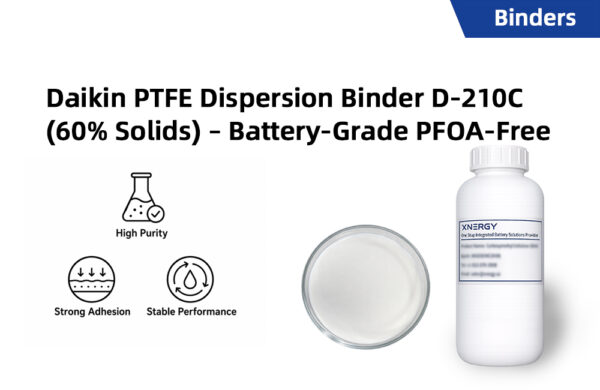
Daikin PTFE Dispersion Binder D-210C (60% Solids) – Battery-Grade PFOA-Free
SKU: XN-BD-D210C
Free Shipping Price range: $358.97 through $364.10
Daikin PTFE Dispersion Binder D-210C — 60% Solids, Battery-Grade, PFOA-Free — high-performance polytetrafluoroethylene (PTFE) aqueous dispersion from Daikin Industries, engineered specifically for lithium-ion battery binder applications including dry electrode manufacturing (4680 cell process, Tesla-style dry-coating workflows). PFOA-free formulation with environmentally friendly surfactant, leaving fewer residues in the substrate than traditional surfactants. Available in 1 kg emulsion or 1 kg powder.
Need a bulk order? Request a competitive quote today!
Name: Daikin PTFE Dispersion Binder D-210C – 60% Solids, Battery-Grade PFOA-Free
Manufacturer: Daikin Industries (Japan)
Product Code: XN-BD-D210C
Product Introduction:
Daikin PTFE D-210C is a high-performance polytetrafluoroethylene (PTFE) homopolymer aqueous dispersion engineered specifically for lithium-ion battery binder applications, including dry electrode manufacturing — the next-generation electrode coating workflow used in Tesla 4680 cells and emerging high-energy-density battery designs. As a result, D-210C represents a step-change in lithium-ion battery binder technology, supporting electrode manufacturing processes that eliminate organic solvents (NMP, DMF) entirely and reduce energy consumption associated with conventional wet-coating drying ovens. The defining performance characteristics of D-210C include its PFOA-free formulation (manufactured without perfluorooctanoic acid, complying with the latest U.S. and EU environmental regulations on PFAS chemicals), an environmentally friendly surfactant system that leaves fewer residues in the substrate than traditional surfactants (supporting cleaner electrode bonding interfaces), and 60% solids content for efficient binder loading in dry-electrode and wet-coating formulations. D-210C is supplied as a stable milky-white aqueous dispersion with 59–61% solids content, ≤ 35 cP viscosity at 25 °C, specific gravity 1.50–1.53, and pH 8.5–10.5. Available in two formats: 1 kg emulsion (aqueous dispersion) or 1 kg powder — supporting both wet-process and dry-process electrode manufacturing workflows.
Key Features:
PTFE homopolymer aqueous dispersion — 60% solids (59–61 wt%)
PFOA-free formulation — compliant with U.S. EPA and EU REACH regulations
Engineered for dry electrode manufacturing (Tesla 4680-style solvent-free processes)
Environmentally friendly surfactant system — fewer substrate residues than traditional PTFE binders
Viscosity ≤ 35 cP (25 °C); specific gravity 1.50–1.53; pH 8.5–10.5
Available in two formats: 1 kg emulsion (wet-process) or 1 kg powder (dry-process)
Manufacturer: Daikin Industries (Japan)
Application:
Daikin D-210C is designed for advanced lithium-ion battery binder applications, including dry electrode manufacturing for Tesla 4680-style cells and other dry-process production lines, high-voltage cathode formulations (NCM 811, NCM 90, NCM 95) where PVDF binder voltage stability is insufficient, lithium iron phosphate (LFP) cathode formulations, lithium-sulfur cell electrode manufacturing where PTFE chemical inertness against polysulfides is required, supercapacitor electrode binder applications (carbon-based electrodes), fuel cell electrode binder applications (catalyst layers, gas diffusion electrodes), filler-loaded composite electrode formulations where PTFE serves as the matrix binder, and academic research into PTFE-based binder systems and dry-electrode manufacturing technology.
Technical Data Sheet:
| Property | Units | Typical Value | Test Method |
|---|---|---|---|
| Viscosity @ 25 °C | cP | ≤ 35 | Daikin Method |
| Specific Gravity @ 25 °C | — | 1.50 – 1.53 | Hydrometer |
| pH @ 25 °C | — | 8.5 – 10.5 | Daikin Method |
| Solids Content | % | 59 – 61 | Daikin Method |
| Surfactant Content | % (on PTFE) | 6.0 – 7.2 | Daikin Method |
| Appearance | — | Milky white liquid | Visual |
Values measured by Daikin Industries. Typical values for reference; not guaranteed unless otherwise specified.
Available Formats:
| Format | Packaging | Best Use Case |
|---|---|---|
| D-210C Emulsion | 1 kg (aqueous dispersion) | Wet-process electrode coating, slurry-based binder formulations, and applications requiring direct dispersion form |
| D-210C Powder | 1 kg (PTFE powder) | Dry electrode manufacturing (Tesla 4680-style processes), filler-loaded composite formulations, and dry-process binder workflows |
Characteristics:
PFOA-free formulation for regulatory compliance
Daikin D-210C is manufactured without the use of PFOA (perfluorooctanoic acid) — a fluorinated chemical now restricted under U.S. EPA regulations, EU REACH framework, and other regional environmental rules. As a result, this binder enables battery cell manufacturers to align with the latest PFAS-related environmental compliance requirements without compromising electrode binder performance. Therefore, D-210C is the regulatory-future-proof choice for cell manufacturers planning long-term production in markets with strict PFAS controls.
Engineered for dry electrode manufacturing
D-210C is specifically designed for use as a battery binder in dry-electrode manufacturing — the next-generation electrode coating process that eliminates organic solvents (NMP, DMF) and conventional wet-coating drying ovens entirely. As a result, this binder supports production processes that achieve substantially lower energy consumption, reduced VOC emissions, and faster manufacturing cycle times compared to conventional wet-coating processes. Furthermore, the powder format of D-210C is particularly well-suited to dry-process workflows where PTFE serves as the fibrillating matrix binder.
Environmentally friendly surfactant system
D-210C incorporates a more environmentally friendly surfactant compared to traditional PTFE dispersion formulations. Consequently, the surfactant leaves fewer residues in the substrate after coating and drying — supporting cleaner electrode-electrolyte interfaces, reduced impedance growth, and improved long-term cycling stability compared to legacy PTFE binders.
High solids content (59–61%) for efficient binder loading
The 59–61% solids content of D-210C enables efficient PTFE binder delivery in both dry-process and wet-process electrode manufacturing — minimizing water content for downstream drying steps in wet-coating workflows and providing high active-PTFE concentration for dry-process applications. As a result, this high solids content reduces drying energy and supports faster production line throughput.
Excellent chemical stability and electrochemical inertness
PTFE is one of the most chemically inert polymers known, providing excellent chemical stability against virtually all battery electrolytes, lithium-metal anodes, sulfur cathodes, and high-voltage transition-metal oxides. Therefore, D-210C delivers binder performance that is essentially independent of electrolyte chemistry — making it suitable for the most demanding battery research applications, including next-generation high-voltage and high-energy-density cells.
Wide application compatibility (batteries, supercapacitors, fuel cells)
Beyond lithium-ion battery binder applications, D-210C is also designed for use in supercapacitor electrode binders (carbon-based electrodes), fuel cell catalyst layer binders, gas diffusion electrode binders, and filler-loaded PTFE composite formulations. Consequently, D-210C serves as a versatile platform binder for the broader electrochemical energy storage and conversion industry.
Stable aqueous dispersion or powder format
D-210C is available in two formats — emulsion (aqueous dispersion) for wet-process applications and powder for dry-process applications. Therefore, manufacturers and researchers can select the format that matches their specific manufacturing workflow without modifying base PTFE chemistry between formats.
Industry-standard Daikin quality and consistency
Daikin Industries is the global market leader in fluorinated chemistries, supplying major lithium-ion cell manufacturers and dry-electrode equipment makers worldwide. As a result, D-210C delivers consistent batch-to-batch performance backed by Daikin’s quality control systems — supporting reliable scale-up from R&D laboratory experiments to industrial production of next-generation lithium-ion cells.
Recommended Use Procedure:
For wet-process slurry coating (D-210C Emulsion): 1. Stir the D-210C aqueous dispersion thoroughly before use to ensure homogeneous distribution of solid content. 2. Filter through a fine-mesh filter to remove any aggregates or contamination. 3. Prepare cathode or anode slurry following the appropriate PTFE-binder formulation protocol — typical formulation: active material (90–95 wt%), conductive additive (2–5 wt%), PTFE binder (1–5 wt% on dry basis from D-210C). 4. Mix the slurry using standard planetary or high-shear mixers. 5. Coat onto current collector foil using standard coating equipment. 6. Dry the coated electrode at recommended temperatures and roll-press to target porosity.
For dry electrode manufacturing (D-210C Powder): 1. Prepare the dry electrode mixture by combining the active material, conductive additive, and D-210C PTFE powder in the recommended weight ratio (consult Daikin technical bulletin for specific dry-process formulations). 2. Apply mechanical fibrillation (high-shear mixing) to develop the PTFE fiber network that binds the electrode components. 3. Form the fibrillated mixture into a self-supporting electrode film using standard dry-electrode roll-pressing or extrusion equipment. 4. Laminate the electrode film onto the current collector using standard hot-press or roll-press lamination. 5. After processing, follow standard cell assembly protocols.
Packaging & Storage:
Daikin D-210C is available in 1 kg packaging (emulsion or powder format), sealed for shipment and storage. Therefore, store in a dry environment (5–25 °C, RH < 60 %) protected from heat, direct sunlight, and freezing. Do not allow the emulsion format to freeze — frozen and thawed emulsion may show coagulation, separation, and irreversible loss of dispersion stability. After opening, reseal tightly between uses and consume within a reasonable time window to maintain performance characteristics. Stir and filter the emulsion before each use to ensure homogeneous distribution.
Safety:
For research and industrial laboratory use only. Daikin D-210C should be handled like other Daikin PTFE resins. When PTFE resins are heated to temperatures above 260 °C, minor amounts of decomposition products are given off — these decomposition products may be harmful, and inhalation of these fumes must be avoided. Ovens, process equipment, and the working area must be adequately ventilated when working with hot PTFE-containing electrodes. Always wear appropriate PPE (safety glasses, chemical-resistant gloves, lab coat) when handling D-210C, and use respiratory protection if working in poorly ventilated areas with heated PTFE materials. Do not store near oxidizers, strong acids, or strong bases. Refer to the Daikin Material Safety Data Sheet (MSDS) for complete safety and handling information.
Note: Specifications listed above are typical values provided by Daikin Industries and are for reference only. Actual performance depends on the specific electrode active material, formulation, manufacturing process parameters (wet-coating, dry-electrode fibrillation, lamination, etc.), and downstream cell manufacturing conditions — consult published literature and Daikin technical bulletins for guidance on optimal binder-formulation protocols for specific battery and electrochemistry applications. For researchers exploring complete lithium-ion battery binder workflows, see also Xnergy’s related products: PTFE Binder Powder (general-grade alternative), ZEON SBR BM-451B (water-based anode binder for Si-C/SiOₓ anodes), ZEON SBR BM-430B (water-based anode binder for graphite anodes), Carboxymethyl Cellulose (CMC) BM-500HC (CMC co-binder for SBR systems), Carboxymethyl Cellulose (CMC) BM-350HC, Polyvinylidene Fluoride (PVDF) 5130 (NMP-based cathode binder), Polyvinylidene Fluoride (PVDF) 900, and the full Binders category. For complete electrode formulation systems, see also Cathode Materials, Anode Materials, Conductive Additives, and Current Collectors.
| Daikin PTFE | 1kg(Emulsion), 1kg(Powder) |
|---|
Related products
-
Carboxymethyl Cellulose-350HC
Free Shipping$316.67Select options This product has multiple variants. The options may be chosen on the product page -
DAICEL CMC 2200 Carboxymethyl Cellulose Binder
Free Shipping$423.08Select options This product has multiple variants. The options may be chosen on the product page -
Styrene-Butadiene Rubber (SBR) binder, TRD104A
-
Aqueous Binder, LA136D