
Guide · Battery Materials
Solid-State Battery Companies to Watch in 2026
Solid-state is the most crowded race in batteries — carmakers, well-funded startups, and the biggest cell makers on earth are all chasing it, along different chemistries. Here’s who’s actually building solid-state batteries in 2026, how their approaches differ, which ones you can buy shares in, and where the whole field really stands.
The solid-state landscape in 2026
The simplest way to make sense of the field is by electrolyte approach, because that’s what really separates the players: sulfide (highest conductivity), oxide/ceramic (most stable), and semi-solid/hybrid (a nearer-term bridge). No single approach has won.
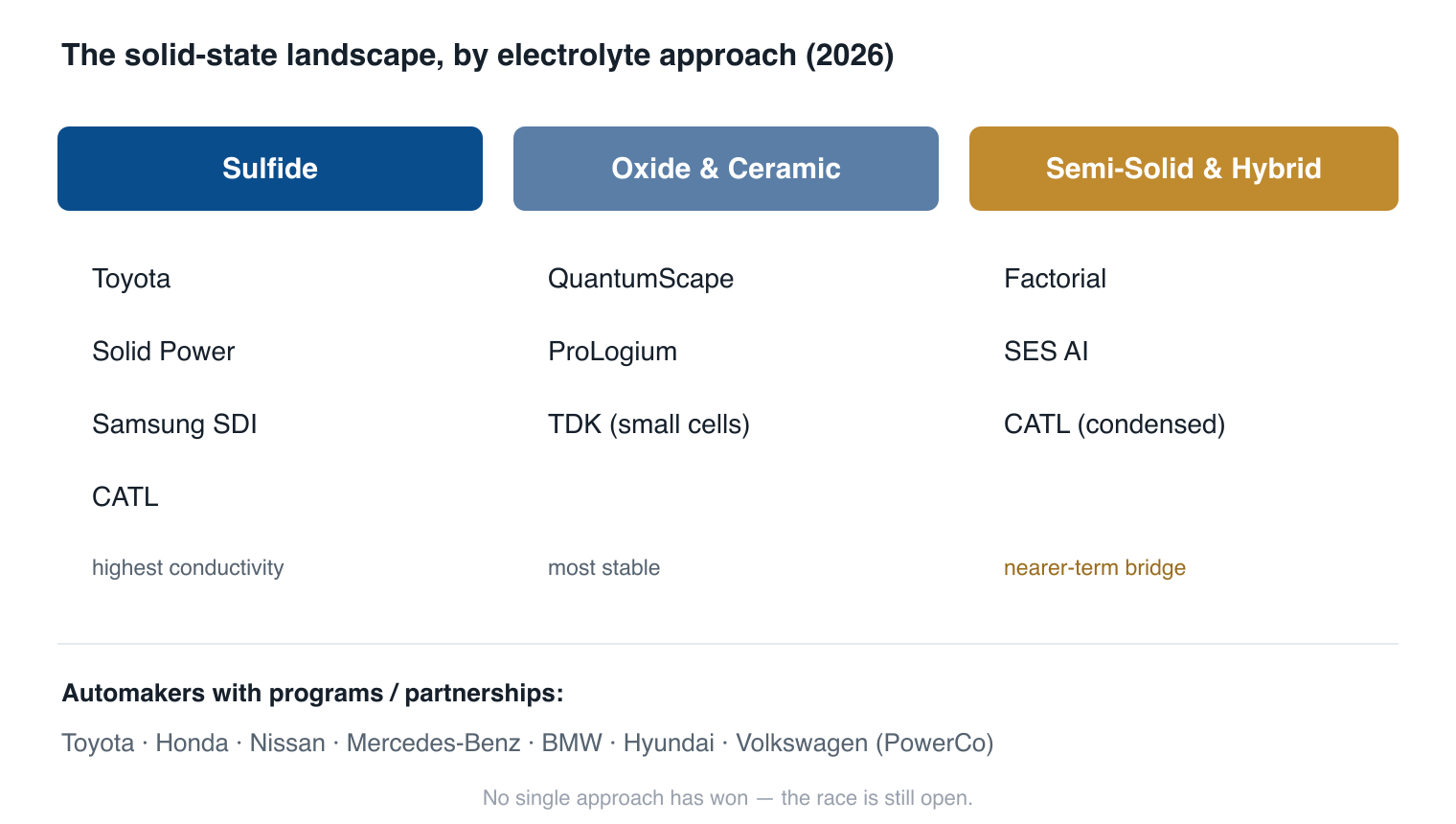
The pure-plays
Companies whose whole business is solid-state (or lithium-metal) cells:
- QuantumScape — the highest-profile Western name; an anode-free design built around a proprietary ceramic (oxide) separator, backed by Volkswagen’s PowerCo, shipping sample cells to automakers.
- Solid Power — sulfide electrolyte, partnered with BMW and Ford, and increasingly positioning itself as a sulfide electrolyte supplier as well as a cell developer.
- ProLogium — Taiwan-based, oxide/ceramic with silicon anodes, building a gigafactory in France.
- Factorial Energy — a semi-solid (FEST) approach with deep automaker partnerships (Mercedes-Benz, Stellantis, Hyundai).
- SES AI — lithium-metal “hybrid” cells; strictly semi-solid rather than fully solid-state, but part of the same race.
Automakers & cell giants
The companies with the manufacturing muscle to scale it:
- Toyota — the patent leader, with a long-running sulfide program and announced plans for EV deployment in the late 2020s.
- Samsung SDI — a sulfide pilot line (“S-line”) with a target around 2027.
- CATL & BYD — the world’s largest cell makers, both with condensed/semi-solid and sulfide roadmaps for the late 2020s.
- Honda, Nissan, Mercedes-Benz, BMW, Hyundai, Volkswagen (PowerCo) — each running in-house programs or backing a pure-play partner.
- Panasonic and TDK — TDK already ships tiny oxide solid-state cells for wearables; Panasonic has active programs.
Which solid-state battery companies are publicly traded?
A lot of the search interest here is really about stocks and tickers, so, factually: the notable pure-plays that trade publicly are QuantumScape (NYSE: QS), Solid Power (NASDAQ: SLDP), and SES AI (NYSE: SES) in the US, plus Ilika (AIM: IKA) in London. ProLogium and Factorial are privately held as of 2026. Toyota, Samsung SDI, CATL, BYD and Panasonic are public companies, but solid-state is a small part of much larger businesses.
This article is technology coverage, not financial or investment advice. Solid-state pure-plays are pre-revenue and volatile; do your own research and consult a licensed advisor before investing.
How to tell them apart
When you read a company’s claims, the questions that actually matter are: which electrolyte family, is it truly solid-state or semi-solid, and is it anode-free? Those choices drive everything downstream. For the underlying science, see our guides to solid-state batteries, sulfide vs halide vs oxide electrolytes, and the lithium-metal anode that most of these designs depend on.
Where the race stands
The honest summary for 2026: real cells, real pilot lines, strong energy-density numbers — but no mass-market solid-state EV yet. Most credible roadmaps point to limited or premium deployment in the late 2020s, with mass-market later, once manufacturing cost and yield catch up. Announced dates have slipped repeatedly across the whole field, so treat any specific year as a target rather than a promise. Expect solid-state to appear first in smaller, higher-value cells and premium vehicles before it reaches an affordable EV pack.
The materials layer behind every cell maker
Every name above sits on top of a materials supply chain — solid electrolytes, cathodes, lithium-metal or silicon anodes, and the tooling to fabricate and test cells. That’s the layer Xnergy works in: we supply sulfide, halide, and oxide solid-electrolyte materials, matched electrodes, and molds, plus cell prototyping — so researchers and developers can evaluate the same chemistries these companies are racing to commercialize. See our solid-state battery guide to go deeper.
Frequently asked questions
Which companies are developing solid-state batteries?
Pure-plays QuantumScape, Solid Power, ProLogium and Factorial; automakers Toyota, Samsung SDI, Honda, Mercedes-Benz, BMW, Hyundai and Volkswagen; and cell giants CATL, BYD and Panasonic — split across sulfide, oxide/ceramic, and semi-solid approaches.
Which solid-state battery companies are publicly traded?
QuantumScape (NYSE: QS), Solid Power (NASDAQ: SLDP) and SES AI (NYSE: SES) in the US, and Ilika (AIM: IKA) in London. This is general information, not investment advice.
Who is the leader in solid-state batteries?
There’s no single leader. Toyota holds the most patents and a long sulfide program; QuantumScape and Solid Power are the highest-profile Western pure-plays; ProLogium and Samsung SDI have pilot lines. The race is still open.
Does Toyota have a solid-state battery?
Toyota has a long-running sulfide solid-state program and plans for EV deployment in the late 2020s, but it isn’t in mass-produced vehicles as of 2026.
When will solid-state batteries be commercialized?
Most roadmaps point to limited or premium deployment in the late 2020s, mass-market later. Dates have slipped repeatedly, so treat specific years as targets.
Where do materials suppliers fit in?
Behind every cell developer is a materials layer — solid electrolytes, cathodes, anodes and tooling. Suppliers like Xnergy provide sulfide, halide and oxide electrolytes and the components to build and test solid-state cells.
Source with Xnergy
Building or benchmarking solid-state cells?
Xnergy supplies sulfide, halide, and oxide solid electrolytes, matched cathodes and anodes, and the molds and tooling to fabricate and test solid-state cells — backed by US-based prototyping and pilot manufacturing.