
Guide · Battery Materials
Cathode vs Anode: What Each Electrode Does—and How to Choose Materials
Cathode vs anode is easiest to understand by starting with the reaction: the anode is where oxidation releases electrons, while the cathode is where reduction accepts them. During battery discharge, the anode is the negative electrode and the cathode is the positive electrode.
For rechargeable batteries, however, one naming detail causes persistent confusion. The formal electrochemical roles reverse during charging, yet battery engineers normally keep calling the positive-electrode material the cathode and the negative-electrode material the anode, based on their roles during discharge. When describing a charging process, “positive electrode” and “negative electrode” remove the ambiguity.
Cathode and anode definitions: reaction first, polarity second
The IUPAC definition of anode is the electrode where oxidation occurs. The IUPAC definition of cathode is the electrode where reduction occurs. Those definitions follow chemistry, not a permanently assigned plus or minus sign.
In a galvanic cell delivering power, oxidation at the anode releases electrons into the external circuit. Reduction at the cathode consumes them. That makes the anode negative and the cathode positive during discharge. An electrolytic process uses external power to drive the opposite direction, so polarity alone is not a universal definition.
A rechargeable battery operates in both directions. Under a strict reaction-based description, its anode and cathode roles swap during charge. In everyday lithium-ion engineering, purchasing and manufacturing, the names usually remain attached to the same coated electrodes:
- Cathode material means the active material on the electrode that is positive during discharge, such as LFP or NMC.
- Anode material means the active material on the electrode that is negative during discharge, such as graphite or silicon.
This convention is practical, but only if the convention is stated. For test procedures and failure analysis, identify the cell state and use positive/negative electrode whenever reaction direction could change the meaning.
What moves during discharge and charge?
In a lithium-ion cell, ions move through the electrolyte and separator while electrons travel through the external circuit. The separator keeps the electrodes from touching electronically but allows ionic transport. Argonne National Laboratory’s Battery Science 101 summarizes the two directions:
- Discharge: lithium ions travel from the anode toward the cathode through the electrolyte. Electrons leave the anode, power the load and arrive at the cathode through the external circuit.
- Charge: the charger drives lithium ions back from the positive electrode toward the negative electrode, while electrons are supplied through the external circuit.
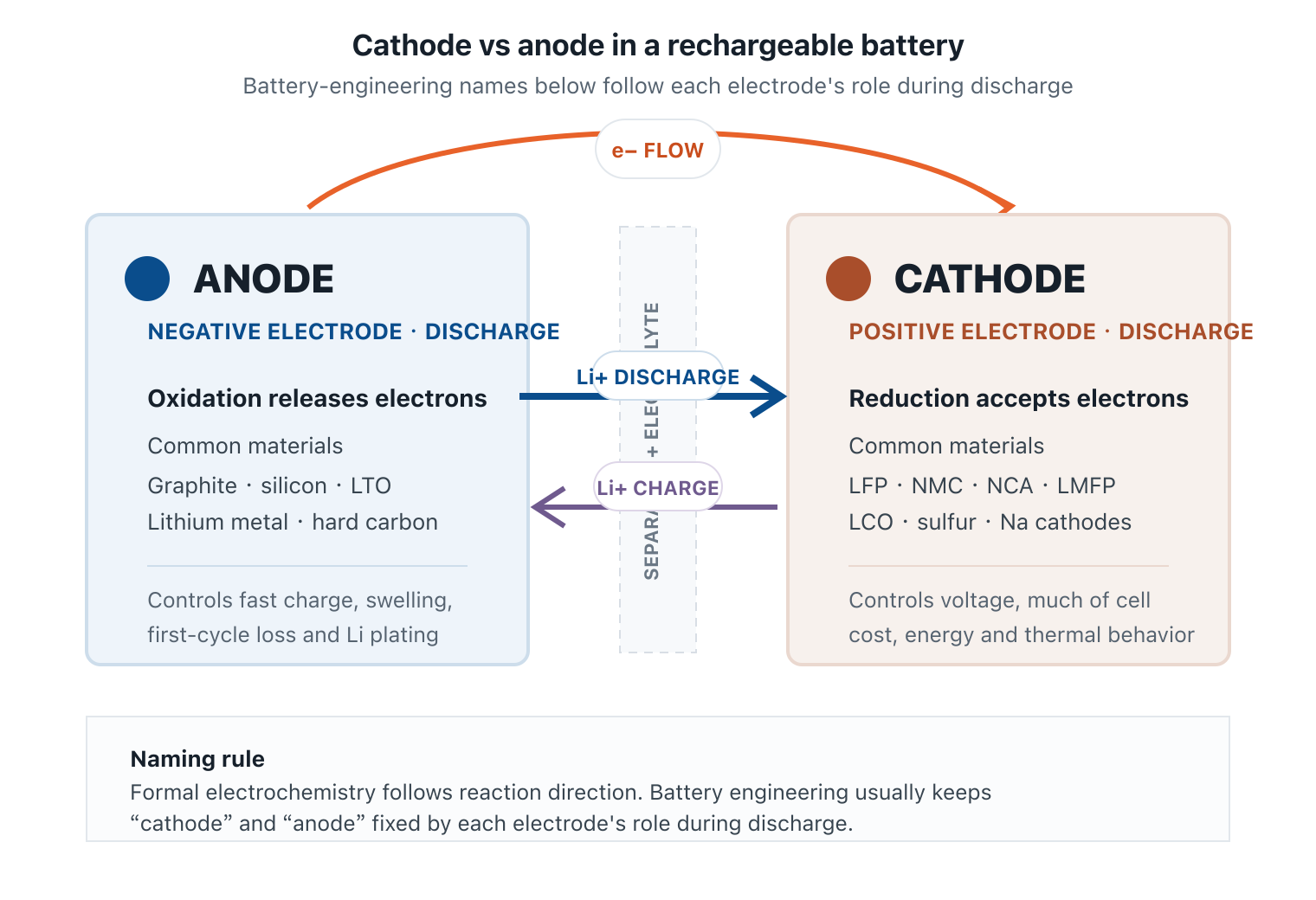
The electrolyte does not carry useful electrons across the cell. If electrons bypass the external circuit through an internal short, the cell converts stored chemical energy into heat rather than controlled electrical work. That is why separator integrity, particle contamination, electrode alignment and dendrite or plating control are central to safety.
Cathode vs anode: side-by-side comparison
| Question | Cathode | Anode |
|---|---|---|
| Formal reaction | Reduction | Oxidation |
| Polarity during discharge | Positive | Negative |
| Electron behavior during discharge | Accepts electrons | Releases electrons |
| Common Li-ion materials | LFP, NMC, NCA, LCO, LMFP | Graphite, silicon-graphite, LTO, lithium metal |
| Strong influence on | Voltage, energy, cost, thermal behavior | Fast charge, first-cycle loss, swelling, plating risk |
| Typical current collector | Aluminum foil in conventional Li-ion cells | Copper foil in conventional graphite-based Li-ion cells |
| Key matching question | Is its voltage window stable with the electrolyte? | Can it accept charge without excessive loss, swelling or plating? |
The table describes common rechargeable-battery practice, not every electrochemical system. Sodium-ion, lithium-metal, solid-state and sulfur cells can use different active materials or collectors. The correct comparison starts with the complete chemistry and intended operating window.
What cathode materials control
The cathode’s redox potential is a major contributor to cell voltage. Its reversible capacity, density and usable state-of-charge window strongly influence energy. Cathode powders can also represent a large portion of cell material cost, and their structural or surface stability affects cycle life and heat release under abuse.
Common cathode families occupy different design spaces:
- LFP: emphasizes cycle life, material cost and a favorable thermal profile, with lower voltage and energy density than nickel-rich layered oxides.
- NMC and NCA: provide higher energy potential but require careful control of composition, surface condition, moisture, electrolyte and upper cutoff voltage.
- LCO: remains associated with compact consumer cells where volumetric energy matters.
- LMFP: aims to raise voltage relative to LFP while retaining a phosphate framework, but manganese-related kinetics and processing need validation.
- Sulfur and sodium cathodes: belong to different cell platforms with distinct electrolytes, anodes and development risks.
Our cathode materials guide compares the major families in more depth. The important point here is that a cathode cannot be selected from capacity alone: voltage profile, tap density, particle morphology, coatings, residual impurities and electrode loading all affect the finished cell.
What anode materials control
The anode receives lithium during charge, making it central to fast-charging capability and lithium-plating risk. It also forms the solid-electrolyte interphase (SEI), which consumes active lithium during initial cycles but must become stable enough to protect the surface. First-cycle efficiency, expansion, porosity and charge-transfer kinetics are therefore system-level variables.
- Graphite: the established lithium-ion baseline, with mature processing and strong efficiency when particle type, loading and formation are well matched.
- Silicon-graphite: raises anode capacity but introduces much greater volume change, interphase growth and formulation challenges. See the silicon anode guide.
- LTO: operates at a higher potential that reduces lithium-plating concerns and supports high-rate operation, while lowering full-cell voltage and energy.
- Lithium metal: offers exceptional theoretical capacity but demands control of deposition morphology, interfacial stability, pressure and safety. Read the lithium metal battery guide.
- Hard carbon: is the prevalent anode partner for sodium-ion systems, where pore structure, surface area and first-cycle loss are key.
Argonne’s work on fast-charging lithium-ion cells illustrates why graphite particle behavior and local lithium distribution matter even when the cathode chemistry is unchanged. A higher-capacity cathode cannot compensate for an anode that plates lithium under the target charge protocol.
Develop with Xnergy
Build a compatible electrode pair
Send us your chemistry, voltage window, capacity, C-rate, temperature, cell format and cycle-life target. Xnergy can help source active materials and electrodes, prepare prototypes and define a validation path for the intended application.
How to pair cathode and anode materials
A cell is not two independent half-cells placed in the same package. The cathode, anode, electrolyte, separator and formation process create one coupled electrochemical system. Use this sequence when moving from promising materials to a full-cell design.
1. Establish the voltage and chemistry window
Combine the cathode and anode operating potentials to estimate the full-cell voltage profile, then confirm that the electrolyte remains sufficiently stable across that range. A high cathode cutoff can accelerate electrolyte oxidation; a low anode potential can encourage reduction, plating or unstable interphase growth.
2. Balance usable capacity, not catalog capacity
The negative-to-positive capacity ratio, often called the N/P ratio, describes the usable anode capacity relative to the usable cathode capacity. Too little anode margin can promote plating or premature limitation. Excess margin adds inactive mass and volume and may change state-of-charge behavior. There is no universal “best” value: it depends on measured electrode capacity, loading variation, formation loss, voltage limits, aging and safety margin.
3. Account for first-cycle lithium loss
SEI formation and other irreversible reactions consume lithium. The loss can be modest for a well-controlled graphite electrode and much larger for high-surface-area silicon or hard carbon. Full-cell balancing must use first-cycle efficiency and retained lithium inventory, not only reversible half-cell capacity.
4. Match electrolyte and formation to both surfaces
An additive that stabilizes one electrode may create gas, resistance or poor wetting elsewhere. Screen electrolyte formulations against both electrodes, then reproduce the intended formation current, temperature and rest steps. The broader electrode essentials guide explains how active material, binder, conductive additive and collector work together.
5. Match loading, porosity and rate
Capacity balance on paper can fail when one electrode is too thick, too dense or poorly wetted. Areal loading, particle size distribution, calendering and porosity control ionic and electronic transport. Validate the pair at the intended C-rate and temperature rather than extrapolating from low-loading coin cells.
Full-cell validation checklist
Before selecting a production material pair, document and test:
- electrode active-material loading, thickness, density and porosity;
- measured reversible capacity and first-cycle efficiency for both electrodes;
- N/P ratio and tolerance across coating and cell assembly;
- electrolyte, separator, binder and current-collector compatibility;
- formation procedure and voltage limits;
- capacity, impedance, efficiency, gas or swelling across temperature;
- charge acceptance and lithium-plating indicators at the target fast-charge rate;
- cycle and calendar aging in the intended state-of-charge window;
- cell-format effects when moving from coin to pouch or cylindrical prototypes.
A battery research materials plan should preserve lot traceability and acceptance criteria across this work. That turns a promising cathode-versus-anode comparison into a repeatable cell specification.
Frequently asked questions
What is the difference between a cathode and an anode?
The anode is where oxidation occurs and electrons are released; the cathode is where reduction occurs and electrons are accepted. During battery discharge, the anode is negative and the cathode is positive.
Is the cathode positive or negative?
During battery discharge, the cathode is positive. During charging, the reaction reverses. Battery engineers usually keep the cathode/anode material names fixed according to discharge and use positive/negative electrode when polarity needs to be explicit.
Why do cathode and anode seem to switch during charging?
Formal electrochemistry assigns the names by the reaction occurring at that moment, so the roles reverse on charge. Battery-industry convention normally leaves the material names attached to the same physical electrodes.
What is the most common cathode material?
There is no universal cathode. LFP, NMC, NCA and LCO are common commercial lithium-ion families. Select among them using voltage, energy, power, thermal behavior, cycle life, cost and supply requirements.
What is the most common anode material?
Graphite is the established anode for most commercial lithium-ion cells. Silicon may be blended with graphite for more capacity; LTO and lithium metal serve different performance targets. Sodium-ion cells commonly use hard carbon.
Which matters more, the cathode or the anode?
Neither can be optimized alone. The cathode strongly influences voltage, energy, cost and thermal behavior. The anode strongly influences fast charge, first-cycle loss, swelling and plating. Performance comes from a compatible, balanced pair.