
Guide · Battery Materials
Anode-Free Batteries: The 2026 Guide
The lightest battery is the one that doesn’t carry an anode at all. Anode-free cells are built with nothing but a bare copper foil where the anode should be — and grow their own lithium metal from the cathode on the very first charge. It’s the highest-energy lithium architecture known, and its Achilles’ heel is cycle life.
This guide explains what an anode-free (or anode-less) battery is, why it reaches record energy density, the cycle-life problem that holds it back, how it relates to lithium-metal and solid-state batteries, and who’s developing it in 2026.
What is an anode-free battery?
An anode-free battery — also called anode-less or zero-excess-lithium — is a cell built with no anode active material at all. Where a normal cell has graphite or silicon, an anode-free cell has only the bare copper current collector. Every lithium atom starts in the cathode.
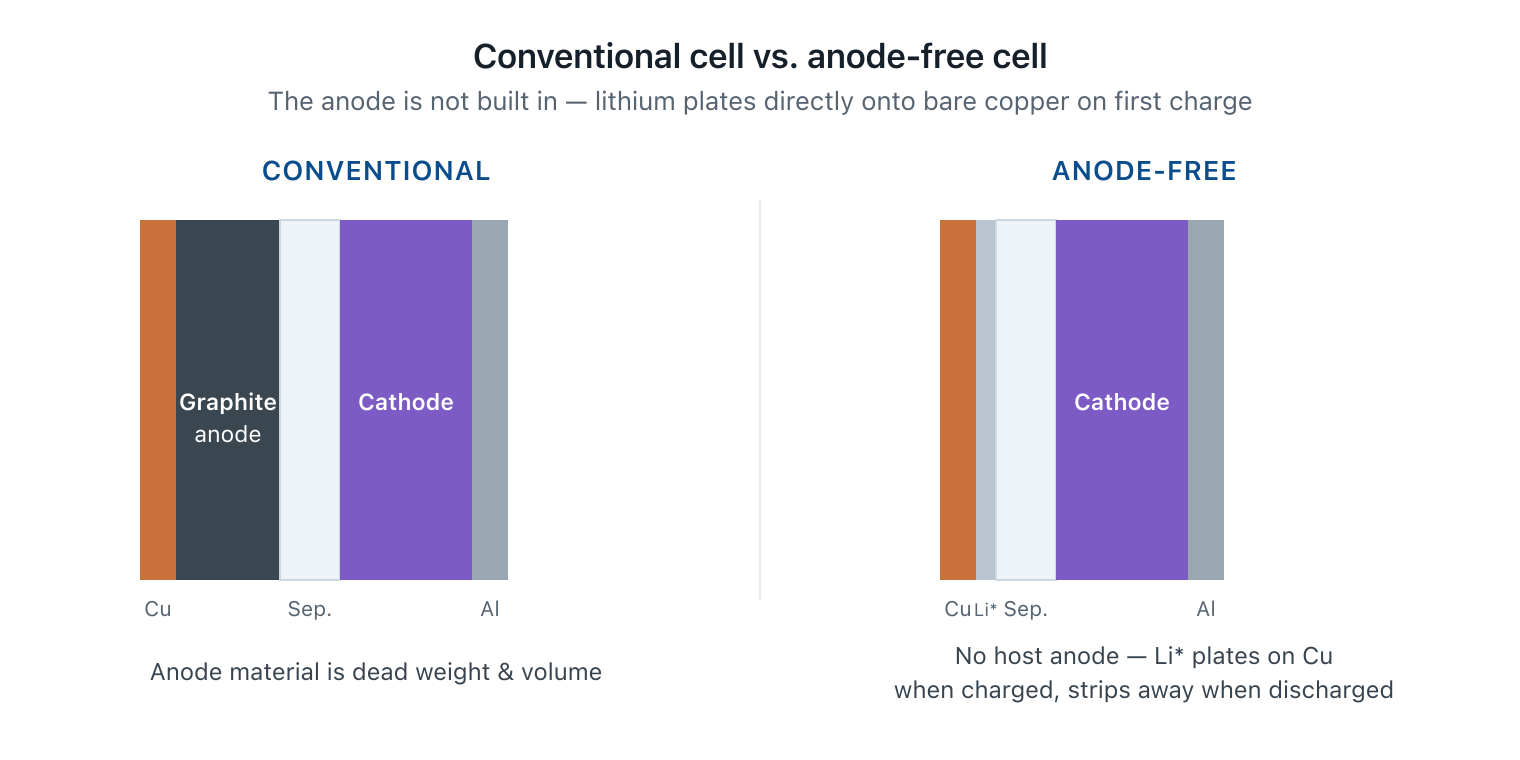
On the first charge, lithium leaves the cathode and plates directly onto the copper as lithium metal. On discharge it strips back off and returns to the cathode. The cell effectively builds its anode in situ, every cycle.
Why the energy density is so high
In a conventional lithium-ion cell, the anode — graphite or silicon, its binder, and often a slug of excess lithium to buffer losses — is dead weight and volume that stores no extra energy of its own. Anode-free design deletes all of it:
- No graphite or silicon host. The single densest way to store lithium is as pure lithium metal, with nothing hosting it.
- No excess lithium reservoir. All lithium is supplied by the cathode, so none is wasted as inventory.
- Thinner, lighter stack. That can lift cell-level energy density roughly 60–80% over conventional lithium-ion, and shrink pack size accordingly.
That’s why anode-free is the theoretical ceiling for a lithium cell — it’s the same idea as a lithium-metal battery, pushed to the limit of carrying no spare lithium at all.
The cycle-life problem
The catch is unforgiving. Plating and stripping lithium metal on bare copper is never 100% efficient. Two things go wrong:
- Coulombic-efficiency loss. A small fraction of lithium is lost to side reactions every cycle. In a normal cell an excess-lithium buffer hides this; an anode-free cell has no buffer, so each loss directly eats into capacity. Even 99.5% efficiency fades fast.
- Dendrites. Uneven plating grows needle-like lithium that can pierce the separator and short the cell. Bare copper makes uniform plating harder to guarantee.
The whole engineering game in anode-free cells is raising the coulombic efficiency of lithium plating toward 99.9%+ and keeping the plated layer smooth.
How researchers fix it
Most anode-free progress attacks the copper surface, the electrolyte, and the mechanics of plating:
- Engineered copper / seed layers. Coatings or lithiophilic seed layers on the copper give lithium an even, well-wetted surface to plate onto.
- Advanced electrolytes. High-concentration and localized-high-concentration electrolytes, plus additives, build a stable interphase that limits lithium loss.
- Solid & quasi-solid electrolytes. A solid-state or semi-solid electrolyte mechanically suppresses dendrites — a major reason anode-free and solid-state research overlap.
- Stack pressure. Uniform external pressure keeps plating dense and flat instead of mossy.
Anode-free vs lithium-metal batteries
The two are close cousins, often confused:
| Attribute | Lithium-metal | Anode-free |
|---|---|---|
| Anode as built | Lithium-metal foil | Bare copper — no lithium |
| Lithium source | Foil + cathode | Cathode only |
| Energy density | Very high | Highest possible |
| Cost / weight | Extra lithium foil | No anode material |
| Cycle-life difficulty | High | Highest (no Li reservoir) |
Put simply: an anode-free cell is a lithium-metal cell that starts with no lithium on the anode side. It’s denser and cheaper in materials, but has zero margin for the lithium it loses each cycle.
Who’s developing anode-free batteries in 2026
Anode-free remains pre-commercial, but the field is active:
- Academic leaders — SLAC/Stanford and other groups have demonstrated anode-free pouch cells with steadily improving cycle life.
- Automakers & cell majors — programs at Nissan, LG Energy Solution and Samsung SDI target anode-free or near-anode-free designs, often alongside solid-state roadmaps.
- Startups — companies such as Coreshell, Adden Energy and others are commercializing lithium-metal and anode-free-adjacent chemistries.
For the broader landscape, see our roundup of solid-state battery companies — many of the same players drive anode-free work.
Source with Xnergy
Building or testing anode-free cells?
Xnergy supplies the materials that make anode-free and lithium-metal designs possible — battery-grade copper foil, high-loading cathodes, advanced and solid electrolytes, and lithium-metal anodes — plus cell prototyping from a US-based team. Tell us your target and we’ll spec the stack.
Frequently asked questions
What is an anode-free battery?
A cell built with no anode active material — only a bare copper current collector. All lithium comes from the cathode and plates onto the copper as lithium metal on charge, giving the highest energy density of any lithium cell.
Why are anode-free batteries so energy dense?
The anode — graphite or silicon, its foil, and any excess lithium — is dead weight. Deleting it means more of the cell is working cathode, lifting energy density roughly 60–80% over conventional lithium-ion.
What is the main problem with anode-free batteries?
Cycle life. Plating and stripping lithium on bare copper isn’t perfectly efficient, and with no excess-lithium buffer, every loss directly shortens life. Dendrites are the second risk.
Are anode-free batteries the same as lithium-metal batteries?
Anode-free is the extreme case: a lithium-metal cell has a lithium foil anode built in, while an anode-free cell starts with no lithium on the anode side and grows it from the cathode.
Are anode-free batteries available in 2026?
They’re pre-commercial. Groups at SLAC/Stanford, LG, Samsung SDI, Nissan and startups like Coreshell and Adden Energy are advancing them, but coulombic efficiency still limits mass-market use.
Do anode-free batteries need solid electrolytes?
Not strictly, but a solid or quasi-solid electrolyte helps suppress dendrites and improve plating efficiency — which is why anode-free and solid-state research overlap.