
Guide · Battery Materials
Semi-Solid-State Batteries: The 2026 Guide
Everyone is waiting for the full solid-state battery. Meanwhile, its pragmatic cousin has quietly started shipping. Semi-solid-state (or quasi-solid) batteries keep just a little liquid to stay manufacturable, while capturing much of solid-state’s safety and energy upside — and they’re already in cars today.
This guide explains what a semi-solid-state battery is, why it’s the bridge the industry can build right now, who’s shipping it in 2026, and how it stacks up against both liquid lithium-ion and full solid-state.
What is a semi-solid-state battery?
A semi-solid-state battery — also called quasi-solid or hybrid — replaces most, but not all, of the liquid electrolyte in a lithium-ion cell with a gel or gel-polymer electrolyte. Think of it as one point on a spectrum, not a category of its own.
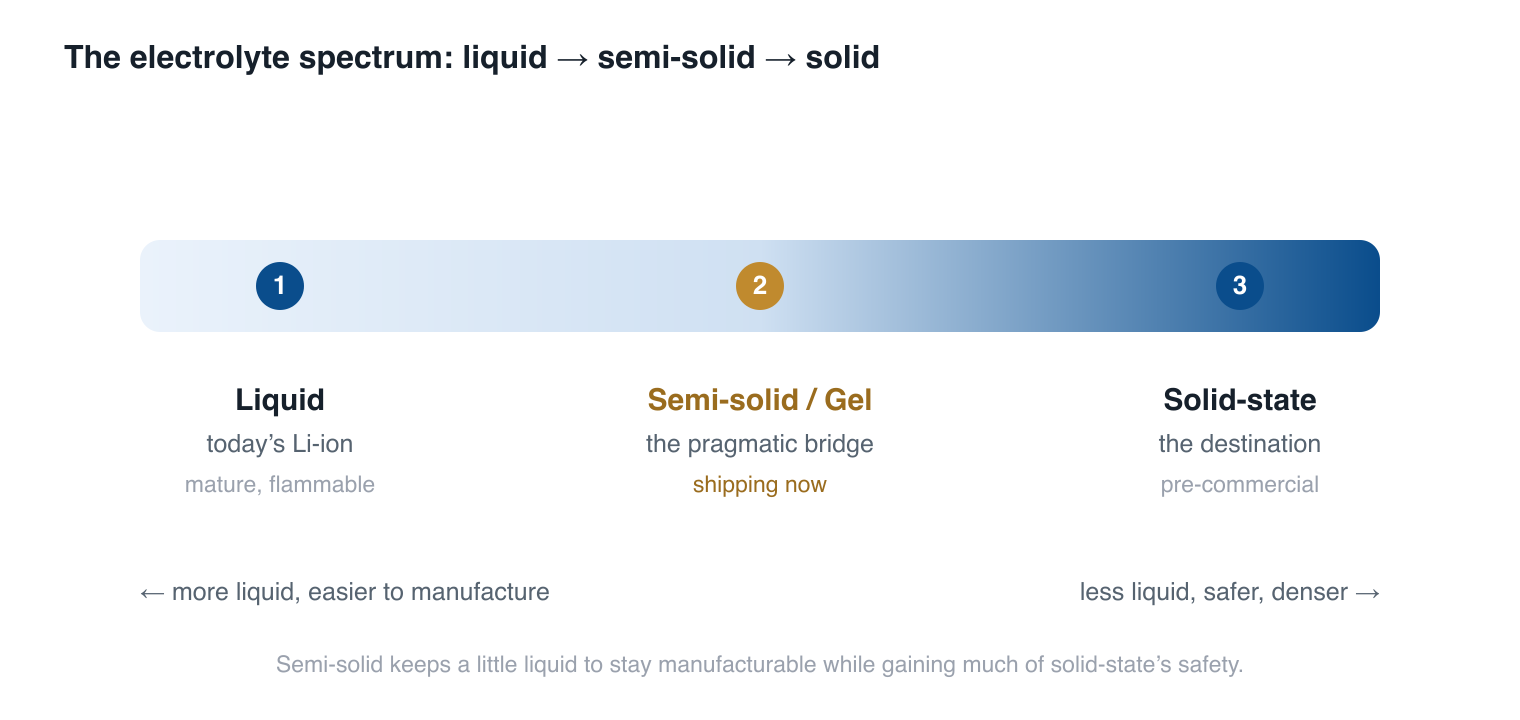
At one end sits today’s liquid lithium-ion — mature but flammable. At the other sits full solid-state — safe and dense, but hard to manufacture. Semi-solid sits deliberately in the middle.
Why semi-solid-state matters now
Its whole appeal is pragmatism:
- Manufacturable today. Semi-solid cells can be made on adapted lithium-ion lines, avoiding the brand-new factories that full solid-state demands. That’s why they ship years ahead of it.
- Safer than liquid. Less liquid means a less flammable, less leak-prone cell — a real step up in abuse tolerance.
- Higher energy. A gel electrolyte can support high-nickel cathodes and even lithium-metal anodes, pushing energy density well above standard lithium-ion.
- A genuine bridge. It lets makers deliver most of the benefit now, and migrate toward fully solid designs later.
The trade-offs
Semi-solid is a compromise, and honest engineering names the costs:
- Still some liquid. It isn’t inherently non-flammable the way a fully solid cell aims to be.
- Partial gains. Energy density and safety improve, but don’t reach solid-state’s ceiling.
- Loose terminology. “Semi-solid,” “quasi-solid,” and even “solid-state” get used interchangeably in marketing — read the actual electrolyte spec, not the label.
Who’s shipping semi-solid-state in 2026
Unlike full solid-state, semi-solid is already in real products:
- WeLion — supplied the semi-solid cells behind premium NIO long-range packs, one of the first mainstream automotive uses.
- Factorial Energy — its FEST semi-solid technology, with Mercedes-Benz, Stellantis and Hyundai backing.
- CATL — the “condensed” battery, a semi-solid design targeting very high energy density for aviation and premium EVs.
- Ganfeng, Farasis and others — several Chinese makers are scaling semi-solid and quasi-solid lines.
For the full field, including full solid-state, see our roundup of solid-state battery companies.
Semi-solid vs solid-state vs liquid
| Attribute | Liquid Li-ion | Semi-Solid | Solid-State |
|---|---|---|---|
| Electrolyte | Liquid | Gel / reduced liquid | Solid |
| Flammability | Higher | Lower | Lowest |
| Energy density | Baseline | Higher | Highest (target) |
| Manufacturability | Mature | Adapted Li-ion lines | New processes |
| 2026 status | Mass-market | Limited / premium (shipping) | Pilot / pre-commercial |
The strategic read: semi-solid is what the industry can deliver now, and a stepping stone toward the fully solid cell it wants to deliver eventually.
How to build and test semi-solid cells
Because semi-solid runs close to conventional cell processes, it’s an accessible way for a lab to move beyond liquid electrolytes. The practical path centers on the gel or quasi-solid electrolyte and its interfaces — often paired with a high-nickel cathode or a lithium-metal anode. See our work on a gel-electrolyte anode for quasi-solid-state lithium-metal batteries, and the fundamentals of how electrolytes work.
Xnergy supplies the materials to explore this middle ground — gel and solid electrolytes, cathodes, and lithium-metal or silicon anodes, plus cell prototyping — so you can test a semi-solid design without rebuilding your line. Browse our battery materials to start.
Frequently asked questions
What is a semi-solid-state battery?
A battery that uses a gel or gel-polymer electrolyte with much less liquid than conventional lithium-ion, but not zero. It sits between liquid lithium-ion and full solid-state, gaining much of solid-state’s safety while staying manufacturable.
What is the difference between semi-solid and solid-state?
A full solid-state cell has no liquid at all; a semi-solid cell keeps a small amount of liquid or gel — easier to make and available sooner, but with somewhat less of solid-state’s safety and energy ceiling.
Are semi-solid-state batteries available now?
Yes. Unlike full solid-state, semi-solid cells are already in limited commercial use, notably in premium EVs such as certain NIO models using WeLion cells.
Who makes semi-solid-state batteries?
WeLion (with NIO), Factorial Energy, CATL (its condensed battery), and Chinese makers like Ganfeng and Farasis are among the most active.
Are semi-solid-state batteries safer?
Generally yes versus liquid lithium-ion — less flammable and less leak-prone — though not as inherently safe as a fully solid cell.
Is semi-solid-state just marketing?
The term is used loosely, so read specs carefully — but the technology is real and shipping. It’s a genuine engineering bridge, not a finished solid-state battery.
Source with Xnergy
Exploring semi-solid or solid electrolytes?
Xnergy supplies gel and solid electrolytes, matched cathodes and anodes, and cell prototyping from a US-based team — so you can test the middle ground without rebuilding your line.