
Buyer’s Guide · Battery Materials
Battery Electrolyte: Types and How to Choose
The electrolyte is the quiet decider of a cell’s safety, energy, temperature range, and cycle life. Pick the wrong one and even a great cathode underperforms. This buyer’s guide covers the three electrolyte families, the spec that actually matters, and how to choose — or commission — the right electrolyte for your cell.
What a battery electrolyte does
The electrolyte carries ions between the cathode and anode while blocking electrons — forcing those electrons through the external circuit to power your device. It touches every electrode surface, so it sets how fast a cell can charge, how cold it can run, how long it lasts, and how safely it fails. For the underlying chemistry and SEI formation, see our explainer on how battery electrolyte works; this page is about choosing one.
The three types of battery electrolyte
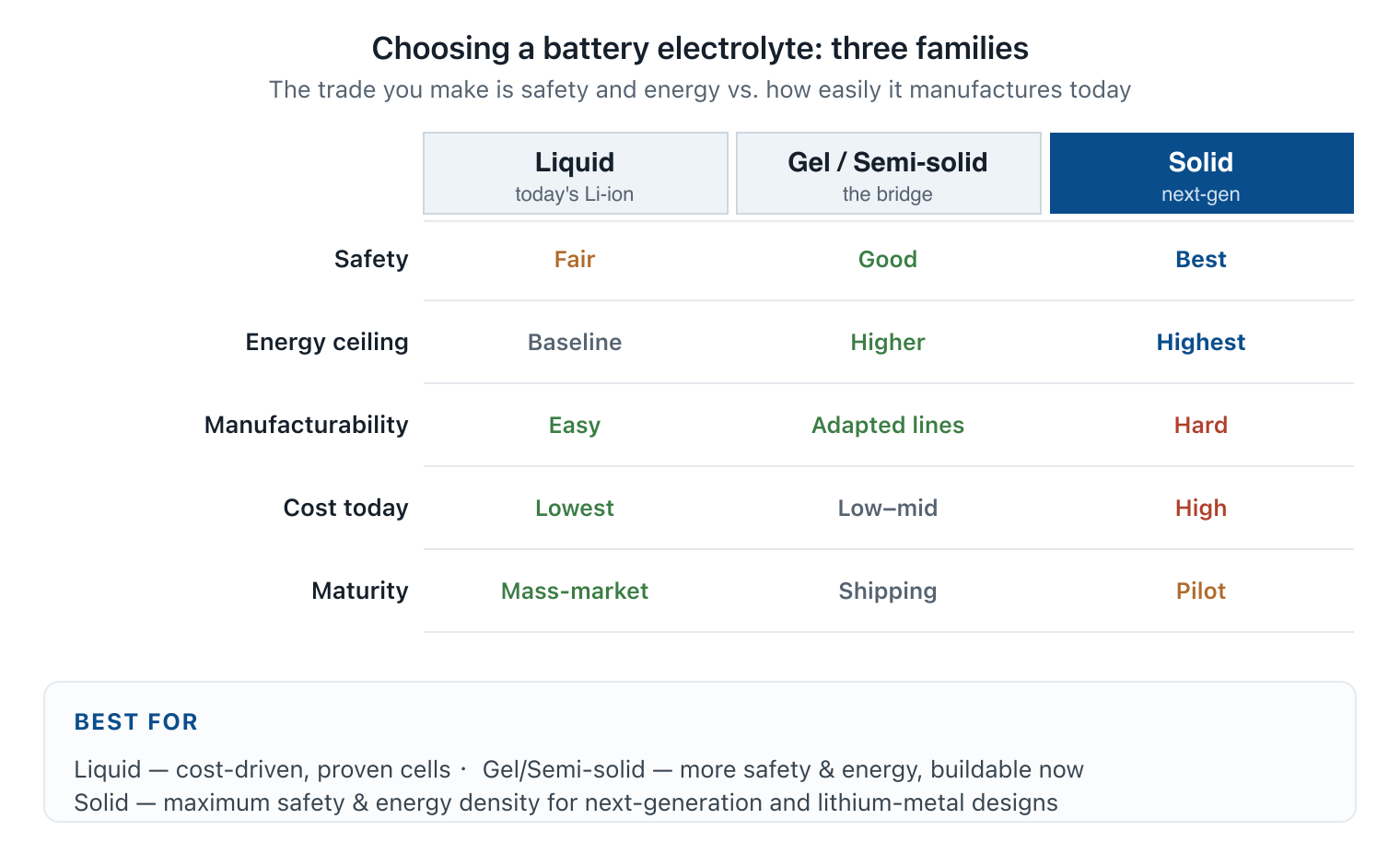
Every electrolyte decision comes down to a single trade: more safety and energy, or easier manufacturing and lower cost.
1. Liquid electrolyte
The standard in today’s lithium-ion cells: a lithium salt in organic solvents. Cheapest, most mature, and easiest to manufacture, but flammable and the limiting factor on ultimate energy density. The right choice for cost-driven, proven cell designs.
2. Gel / semi-solid electrolyte
A gel or gel-polymer with much less free liquid — more abuse-tolerant and higher-energy, yet still buildable on adapted lithium-ion lines. It’s the pragmatic bridge; see our guide to semi-solid-state batteries.
3. Solid electrolyte
Replaces the liquid entirely. The safest and densest option, and the enabler for lithium-metal and anode-free designs — but the hardest to manufacture and still largely pre-commercial. See our solid-state battery guide.
What a lithium-ion electrolyte is made of
When you specify or buy an electrolyte, you’re really specifying three things:
| Component | Common examples | What it controls |
|---|---|---|
| Lithium salt | LiPF6, LiFSI, LiTFSI | Ionic conductivity, high-voltage & thermal stability |
| Solvent(s) | EC, DMC, EMC, PC | Salt dissolution, viscosity, low-temperature behavior |
| Additives | VC, FEC, and others | SEI quality, cycle life, safety, fast-charge tolerance |
Those three levers — salt, solvent blend, additive package — are what a formulator tunes to hit your voltage, temperature, and life targets. Small additive changes can make a large difference in cycle life.
How to choose the right electrolyte
Work from your cell’s requirements, in roughly this order:
- Cathode & anode chemistry. High-voltage cathodes (high-nickel, LMFP) and reactive anodes (silicon, lithium-metal) need salts and additives built for them.
- Voltage window. Above ~4.3 V you need high-voltage-stable salts/additives, or the electrolyte oxidizes.
- Temperature range. Cold-climate or high-temp applications need solvent blends tuned for the extremes.
- Safety target. The more you weight non-flammability, the further you move from liquid toward gel or solid.
- Cycle life & fast charge. Largely an additive-package problem — and where custom formulation pays off.
- Manufacturability & cost. Be honest about the line you’ll actually build on; the best electrolyte you can’t process isn’t the best electrolyte.
Source with Xnergy
Need an electrolyte matched to your cell?
Xnergy supplies liquid, gel and solid electrolytes — and formulates custom recipes (salt, solvent, additive package) for high-voltage, wide-temperature, fast-charge, silicon and lithium-metal cells — from a US-based team, with cell prototyping to validate the choice. Tell us your chemistry and targets and we’ll spec the electrolyte.
Sourcing and custom formulation
Off-the-shelf electrolyte is fine for standard cells, but most performance gains — cold-weather range, high-voltage stability, longer life, safe fast charge — come from tuning the formulation to your design. A practical sourcing path:
- Define targets first — chemistry, voltage, temperature, life, safety — not a brand-name recipe.
- Start from a baseline electrolyte for your chemistry, then iterate the additive package.
- Validate in real cells — coin or pouch prototypes — before scaling, so you compare formulations on your own electrodes.
- Work with a partner who supplies the electrolyte and the matched cathode, anode and prototyping, so the whole stack is consistent.
That last point matters: an electrolyte only performs against a specific cathode and anode, so sourcing the materials together removes a major variable.
Frequently asked questions
What is a battery electrolyte?
The medium that carries ions between cathode and anode while blocking electrons. In lithium-ion cells it’s typically a lithium salt (like LiPF6) in organic solvents plus additives, and it can be liquid, gel/semi-solid, or solid.
What are the main types of battery electrolyte?
Liquid (standard, cheapest, most manufacturable), gel/semi-solid (safer and higher-energy, still buildable on adapted lines), and solid (safest and densest, hardest to manufacture).
What is a lithium-ion battery electrolyte made of?
A lithium salt (LiPF6, LiFSI or LiTFSI), organic carbonate solvents (EC, DMC, EMC), and additives (VC, FEC) tuned to the cathode, anode, voltage and temperature range.
How do I choose the right electrolyte for my cell?
Match it to your cathode/anode chemistry, voltage window, temperature range, and safety and life goals. High-voltage, lithium-metal and cold-temperature cells need specialized formulations.
Can battery electrolyte be customized?
Yes — salt, solvent blend and additive package can all be tailored for high voltage, wide temperature, fast charge, or silicon and lithium-metal anodes. Custom formulation is standard in cell development.
What is the difference between liquid and solid electrolyte?
Liquid wets the electrodes and is easy to make but flammable; solid removes the liquid for the best safety and highest energy (and lithium-metal anodes) at the cost of much harder manufacturing. Gel/semi-solid sits between them.