
Guide · Cell Format Selection
Prismatic Battery Cells: When to Choose Them Over Pouch or Cylindrical Formats
Choose a prismatic battery cell when your project values rectangular space use, rigid mechanical protection and a more production-like housing more than the lightest package or the fastest lab-only iteration. In practice, prismatic sits between pouch and cylindrical formats: it can make pack integration cleaner, but it also raises the bar for swelling control, pressure management, and thermal validation.
That trade-off matters to Xnergy customers because the right format is not just a packaging detail. It changes the electrode stack, current path, separator choice, casing hardware, tab design, fixture strategy, and the type of prototype evidence you need before pilot scale. If the format decision is wrong, the downstream process can fail even when the chemistry is sound.
This guide explains what a prismatic cell does well, where pouch or cylindrical may be the smarter route, and how R&D and procurement teams should validate the choice before committing to tooling or pilot manufacturing.
What is a prismatic battery cell?
A prismatic battery cell is a rechargeable cell packaged in a flat-sided rectangular or square housing, usually a rigid metal can. Samsung SDI’s Battery101 explanation of cell form factors frames prismatic cells as aluminum-encased shapes with stronger impact resistance than pouch cells, while Panasonic positions its prismatic lithium-ion lines around slim form factors and efficient use of limited device space.
That definition matters because a prismatic cell is not simply a pouch cell placed inside a box. Once you move to a rigid enclosure, you change how the cell handles swelling, how stack pressure is applied, how terminals exit the housing, and how heat leaves the active stack. Those are electrochemical and mechanical design changes, not just industrial-design ones.
For Xnergy customers, prismatic cells are most relevant when the final product needs rectangular module geometry, more structural support than a flexible pouch offers, or a prototype path that more closely resembles eventual production packaging. If you only need a quick chemistry readout or a low-cost custom sample, a pouch route may still be faster.
Prismatic vs pouch vs cylindrical: the practical comparison
| Decision factor | Prismatic | Pouch | Cylindrical |
|---|---|---|---|
| Space use in a rectangular pack | Usually strong | Usually strong | Lower due to round geometry |
| Mechanical protection from the cell housing | High, rigid can | Low, needs external support | High, rigid can |
| Inactive packaging mass | Moderate | Lowest | Moderate to high |
| Fast custom prototype flexibility | Moderate | Highest | Usually lowest for custom geometries |
| Swelling and pressure management | Critical inside rigid envelope | Critical with external compression | Usually less format-driven |
| High-volume manufacturing maturity | Strong, but format-specific tooling | Strong, especially stack-based lines | Very strong and highly standardized |
| Thermal path simplicity | Needs careful face and edge management | Needs compression and cooling design | Often easier to repeat cell-to-cell |
The cleanest summary is this: pouch usually wins on lightweight custom prototyping, cylindrical often wins on standardization and industrial maturity, and prismatic wins when rectangular packaging and rigid containment justify the extra mechanical and thermal design work.
That is why this topic should sit next to, not on top of, existing Xnergy content. If you are still comparing lab-scale pouch builds, start with the lab-scale pouch-cell fabrication guide. If you already know you need a rigid rectangular cell envelope, this prismatic guide is the right layer of decision-making.
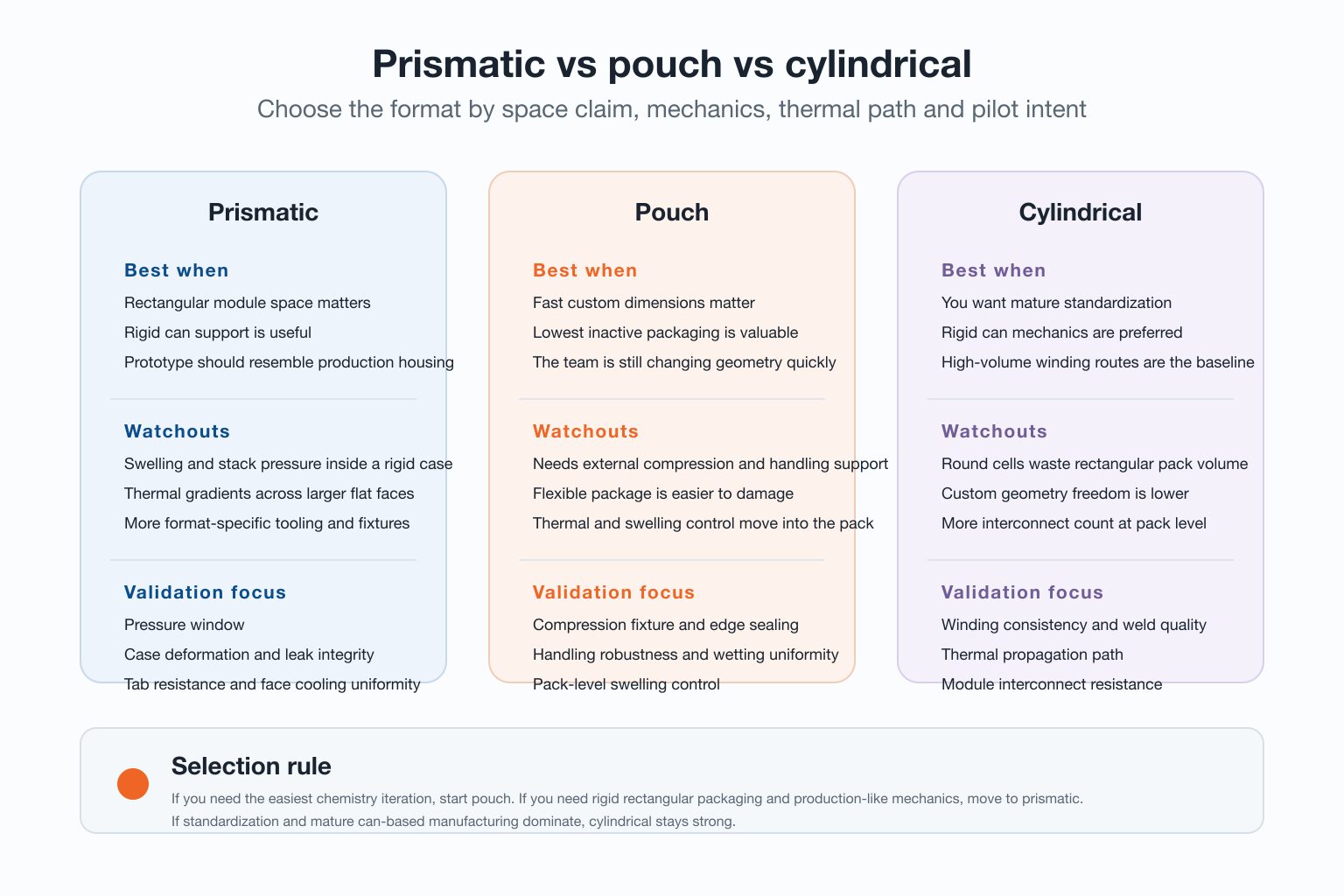
Where prismatic battery cells win
1. Cleaner use of rectangular volume
When the enclosure is rectangular, prismatic geometry usually wastes less space than a cylindrical array. That does not automatically mean the best electrochemical design, but it does simplify the conversation between cell size, busbar routing, cooling plates, and mechanical packaging. Panasonic’s prismatic product positioning around slim, space-limited devices is one expression of the same logic: the format is valuable when the space claim is already constrained.
2. Rigid containment helps handling and integration
A rigid can gives the team a physically protected cell that is easier to fixture, move, inspect and integrate into a module than a bare pouch. Samsung SDI’s prismatic battery overview emphasizes the aluminum can for impact resistance, durability and heat dissipation. For an engineering team, that means prismatic can reduce some external-bracing work that a pouch design would otherwise push into the pack.
3. Better bridge to production-like hardware decisions
If the project is already moving beyond coin cells and early proof-of-concept pouches, prismatic can force earlier discipline on terminal layout, tab welding, leak integrity, stack pressure hardware and module interfaces. That is often valuable for pilot programs because format decisions are no longer theoretical. They become tied to actual manufacturability, service access and safety reviews.
This is also where Xnergy’s one-stop positioning matters. A format decision is more useful when it can be connected to materials selection, custom electrodes, cell hardware, and pilot support rather than left as a packaging-only recommendation.
Where prismatic cells create extra engineering work
Swelling and pressure are not optional details
Prismatic cells still expand during cycling, storage and abusive operating windows. The difference is that expansion now interacts with a rigid enclosure and defined internal clearances. Recent Nature Energy work on stack pressure and degradation pathways reinforces the pressure-window problem clearly: too little pressure accelerates cathode cracking, while too much can drive damaging lithium plating. That does not give one universal pressure target, but it does show why a prismatic build needs a deliberate compression and swelling strategy.
Thermal behavior can be less forgiving than teams expect
Large flat faces and stacked internal layers can create non-uniform temperature fields if current distribution, cooling access or contact resistance are uneven. A recent SAE fire-safety review highlights that thermal-runaway propagation differs by format: cylindrical modules can be less vulnerable in some propagation scenarios, pouch cells can transfer heat quickly through shell contact, and prismatic packs must manage heat through shell conduction, pole connectors and fire spread pathways. The practical message is simple: you cannot assume the thermal story of one format transfers directly to another.
Tooling and pilot fixtures usually get more specific
Pouch cells are often attractive in R&D because custom dimensions and fixture changes are relatively fast. Prismatic development tends to become more hardware-specific earlier. That can be good when the project is serious about pilot readiness, but it can slow teams that are still changing electrode footprint, stack count or terminal location every week.
Failure analysis must include the housing, not just the chemistry
Once you choose prismatic, your post-mortem and qualification work expands. Inspect gas generation, deformation, weld integrity, seal quality, case flatness, pressure history and thermal boundary conditions alongside capacity fade, impedance growth and lithium inventory loss. Many startup programs miss this transition, which is why the pilot-stage failure modes guide is still relevant before committing to the format.
How to choose the right format for R&D, prototype and pilot work
Use a prismatic battery cell when most of the answers below are already leaning rectangular and production-like:
- Space claim: does the final enclosure strongly prefer flat rectangular cells?
- Mechanical strategy: do you want rigid housing support at cell level rather than relying mainly on pack compression?
- Prototype fidelity: is the goal to mimic eventual module geometry rather than just screen chemistry?
- Thermal architecture: can you define realistic cooling boundaries and pressure hardware early?
- Tooling tolerance: is the program ready for more format-specific fixtures, tabs and sealing decisions?
Choose pouch instead when weight, custom dimensions and quick format changes matter more than early hardware realism. That is especially true for exploratory programs, dry-pouch development, or rapid custom dimensions; the existing dry pouch cell page shows why pouch stays attractive for some R&D paths.
Choose cylindrical when you want the broadest industrial precedent, strong can-level mechanics and a path aligned with mature winding and can-sealing infrastructure. Even when the final answer is not cylindrical, the cylindrical reference page is useful as a baseline for what mature rigid-can standardization looks like.
Discuss the format early
Choose the cell format before locking the BOM
Send Xnergy your target chemistry, capacity, outer dimensions, thermal limits, pressure strategy and pilot timeline. We can help match materials, custom electrodes and prototype routes to the right cell format before you commit to the wrong hardware path.
How to validate a prismatic battery cell before pilot scale
A prismatic decision is only real once it survives validation in the intended envelope. A useful plan looks like this:
- Lock the electrochemical stack. Confirm loading, N/P balance, separator, electrolyte and collector choices first. The separator guide is especially relevant because wetting, puncture margin and shutdown behavior show up differently by format.
- Map swelling and pressure. Measure thickness growth, gas generation and pressure sensitivity across SOC, temperature and aging conditions.
- Check current and temperature distribution. Validate tab design, resistance distribution, external cooling conditions and internal gradients under realistic rates.
- Qualify housing integrity. Include seals, leak tightness, case deformation, tab exit durability and abuse handling, not just electrochemical cycling.
- Test manufacturing variation. Lot changes, alignment drift, fill variation and welding differences often appear sooner in rigid packaged cells than in simplified lab builds.
- Run application-specific abuse and safety tests. Use the standards and customer test matrix that match the final use case rather than assuming any format is inherently safe.
The main discipline is to validate the cell as a coupled system. Prismatic format affects housing, pressure, thermal boundaries and assembly decisions at the same time, so you need matched evidence from materials through hardware. That is the point where Xnergy’s integrated model becomes valuable: the decision can move from material supply into custom electrodes, prototype cells and pilot-scale process support without handoffs across multiple vendors.
Frequently asked questions
What is a prismatic battery cell?
A prismatic battery cell is a rectangular or square lithium-ion cell packaged in a rigid housing, typically metal. It is used when a project needs efficient rectangular space use and stronger cell-level structure than a simple pouch provides.
Are prismatic cells better than pouch cells?
Not by default. Prismatic gives rigid containment and tidy module geometry, while pouch usually gives lighter packaging and faster custom prototyping. The right choice depends on swelling control, thermal path, tooling and pilot intent.
Are prismatic cells safer than cylindrical cells?
No single format is automatically safer. Safety depends on electrochemistry, housing, pressure control, thermal propagation behavior, electrical protection and abuse validation in the final design.
What are the main disadvantages of prismatic battery cells?
The biggest watchouts are swelling management, stack-pressure control, thermal gradients across larger flat faces, more specific tooling, and a slower path for programs that still need frequent geometry changes.
When should an R&D team choose a prismatic battery cell?
Choose prismatic when the target product needs a rectangular rigid cell envelope and the team wants a prototype path that better reflects eventual module packaging than coin or simple pouch builds.
How should prismatic battery cells be validated before pilot scale?
Validate matched materials, pressure window, thermal uniformity, leak integrity, tab resistance, swelling behavior and manufacturing variation in the intended housing and duty cycle before committing to pilot tooling.