
Guide · Interface Engineering
Solid Electrolyte Interphase (SEI): Why It Forms and How It Controls Battery Life
The solid electrolyte interphase, usually shortened to SEI, is the protective reaction layer a lithium-based battery builds for itself on the anode side during the first charge. A good SEI is one of the reasons a cell can cycle at all: it slows further electrolyte decomposition while still letting lithium ions move through the interface. A bad SEI keeps consuming lithium, raises impedance, worsens fast-charge and low-temperature behavior, and shortens battery life.
That is why SEI should not be treated as an academic side topic. For battery R&D engineers, materials buyers, labs, and pilot-line teams, SEI quality changes which electrolyte package is viable, how much silicon an anode can tolerate, how conservative the formation protocol must be, and how quickly a program can move from half-cell data to production-relevant prototypes.
This article stays at that engineering layer. Xnergy already covers the broader basics of how battery electrolyte works and the failure-mode logic of electrolyte additives. Here, the goal is narrower and more useful: explain what SEI is, what makes it stable or unstable, and how to decide whether your next lever should be the formation protocol, the electrolyte system, the anode design, or a full matched materials package.
What is the solid electrolyte interphase?
The standard working definition is straightforward: the solid electrolyte interphase is the thin reaction layer that forms when electrolyte components are reduced at low anode potential. A 2023 Advanced Energy Materials review on lithium batteries and the SEI describes it as a necessary interface that enables rechargeable lithium batteries to operate reversibly. Without it, the anode would keep reducing the electrolyte continuously and the cell would fail quickly.
The important detail is that SEI is not a deliberate coating applied by a supplier. It is a self-assembled layer created by the battery’s own chemistry during early charging. That layer usually contains inorganic and organic decomposition products from the electrolyte. In practical terms, it becomes the gatekeeper between the anode and the liquid electrolyte.
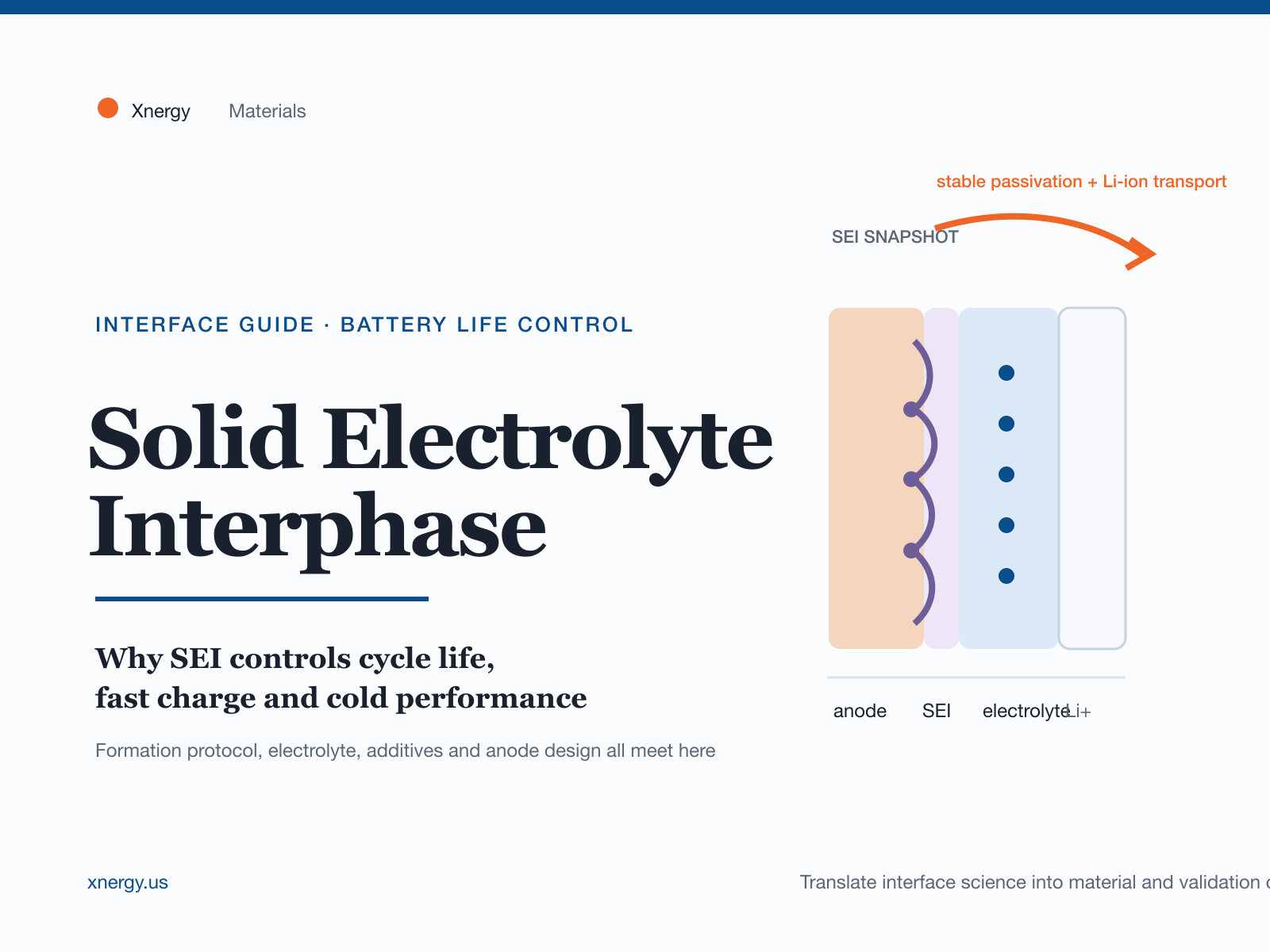
For a conventional graphite cell, that gatekeeper must do two jobs at the same time. First, it must block further parasitic reactions strongly enough to stop endless solvent breakdown. Second, it must remain conductive enough to let lithium ions move in and out with reasonable resistance. That balance is the whole engineering problem. A layer that passivates perfectly but blocks ion transport is still a bad SEI. A layer that transports lithium well but keeps dissolving and reforming is also a bad SEI.
Why SEI controls battery life, fast charge and cold performance
Battery teams often first notice SEI indirectly. The warning signs show up as low first-cycle efficiency, rising impedance, thicker pouch cells after storage, poor cold-charge acceptance, or fast-charge behavior that degrades sooner than expected. Those symptoms look different, but many trace back to the same interface problem: the SEI is either consuming too much lithium, resisting ion transport too strongly, or breaking and reforming under stress.
A 2025 PNAS study on the roles of the solid-electrolyte interphase makes the trade-off especially clear for low-temperature and fast-charging lithium-ion cells. The researchers show that SEI design has to reconcile two competing needs: strong passivation and fast lithium-ion transport. That is exactly why a cell that looks acceptable in room-temperature cycling can become a problem under winter charging or aggressive charge-rate targets.
SEI also changes over time. A 2025 Nature Communications study tracking dynamic changes in the SEI reinforces that the interphase is not a one-time static film frozen after formation. It evolves with cycling. That matters because some development teams still act as if formation data alone tells the whole story. In reality, an SEI that looks reasonable after the first charge can still drift into a high-resistance or mechanically fragile state after repeated cycling, high state-of-charge storage, or a shift in temperature window.
The engineering consequence is simple: you should treat SEI as a live interface that must survive the real duty cycle, not as a box-checking step completed during first charge.
Healthy SEI vs unstable SEI: what the team will actually see
The easiest way to make SEI useful in a development meeting is to stop describing it only with microscopy language. Teams need to know what a healthy SEI looks like in cell behavior and what an unstable SEI looks like in test data, scrap, or pilot risk.
| SEI state | What usually happens in the cell | Most likely operational risk | Best next question |
|---|---|---|---|
| Stable and ion-conductive | Higher first-cycle efficiency, slower impedance growth, more predictable cycling | Normal aging rather than runaway side reaction growth | Can the same behavior survive the target charge rate and temperature window? |
| Too reactive | Continuous lithium loss, gas generation, swelling, poor storage retention | Low life, poor lot consistency, packaging pressure issues | Is the electrolyte or additive package still decomposing after formation? |
| Too resistive | Weak power, poor cold charge, sharp resistance rise under fast charge | Charge-rate failure or lithium plating risk | Is the SEI passivating at the cost of ion transport? |
| Mechanically fragile | Repeated interface repair, especially with silicon-containing anodes | Rapid fade after a promising first screen | Is the anode expansion or porosity window destroying the interface each cycle? |
The key point is that SEI failure rarely means one single root cause. A cell can have a chemically unstable interphase because the additive system is wrong, but it can also have a mechanically unstable interphase because the anode expands too much, or a transport-limited one because the formation window created a layer that is too dense for the intended fast-charge target.
That is why the right response is usually not “buy an SEI additive” in isolation. The right response is “name the symptom, freeze the cell context, and test the smallest number of levers that could actually explain it.”
What shapes the SEI in real battery development?
Formation protocol writes the first version of the SEI
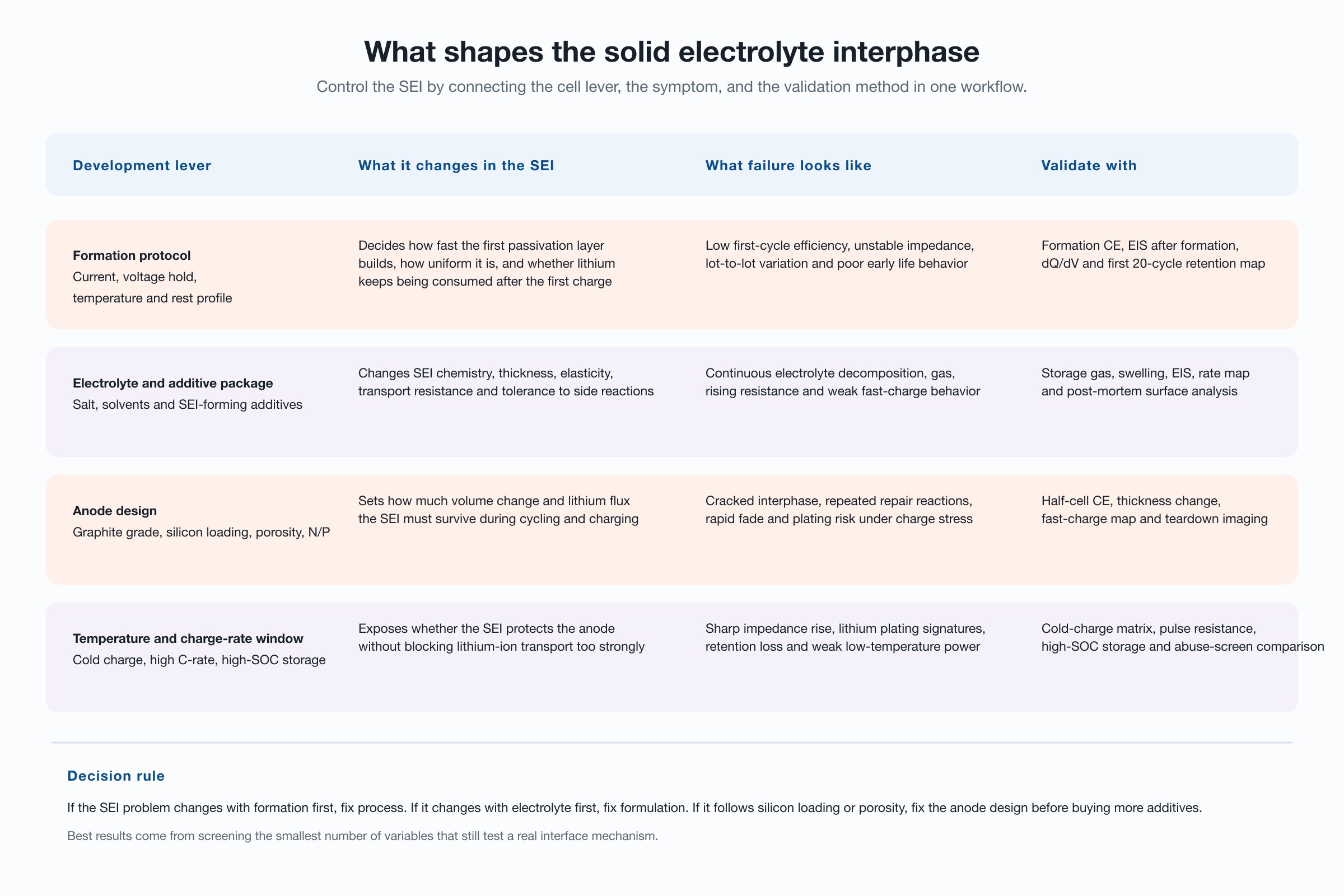
Formation is where the battery teaches itself how to behave. Current, voltage hold, rest periods and temperature all influence how the first passivation layer builds. That is not just theory. A 2024 SLAC-Stanford report on a Joule study showed that changing early charging conditions could improve later battery performance substantially while also compressing formation time. The exact recipe from one study is not universal, but the lesson is: formation protocol is a real SEI design lever, not a back-end manufacturing detail.
Electrolyte chemistry decides what the interface is made from
The base electrolyte and additive package decide which decomposition products are even available to build the SEI. That is why Xnergy’s matched electrolyte formulation work matters more than a one-molecule shopping list. If the solvent system, salt, additive balance, impurity tolerance and anode chemistry are not aligned, the SEI can stay chemically busy long after formation is supposed to be over.
This is also where adjacent content fits cleanly. If your team is debugging interface behavior through additives, the right starting point is the additive failure-mode guide. If the issue is the broader solvent-and-salt system, the better question is whether the program needs a full formulation rather than another incremental additive trial.
Anode design changes how much mechanical abuse the SEI must survive
Graphite is already demanding. Silicon makes the problem much harder. Silicon-bearing anodes expand and contract far more than graphite during cycling, so the SEI has to stretch, crack less, and rebuild less often. That is why high-silicon development frequently ends up being an SEI durability problem as much as an active-material problem. Teams considering silicon should read interface behavior together with the broader silicon anode design trade-offs, not as separate decisions.
The same logic extends to porosity, surface area, N/P ratio and electrode loading. If the anode architecture drives non-uniform current density or repeated surface damage, the SEI may never stay stable enough for the electrolyte package to look competent.
Temperature and charge rate reveal whether the SEI is truly usable
Many cells pass room-temperature cycle tests before failing under the real application window. Cold charging, high C-rate charging and top-of-charge storage expose the difference between a merely acceptable SEI and a robust one. If a program’s real target includes aggressive charge windows or low-temperature operation, those conditions must be part of the SEI validation plan from the beginning. Otherwise the team learns too late that the interface only worked in the easiest lab window.
This is where Xnergy’s related guides become practical support rather than keyword stuffing. A weak SEI often shows up first in fast-charging battery development or in cold-weather lithium battery validation. If those use cases matter, SEI should be discussed in that operating context, not only in a room-temperature coin-cell data package.
How to validate SEI behavior before locking a bill of materials
A useful SEI workflow is usually narrower than teams expect. It does not start by changing formation current, electrolyte solvents, two additives, silicon loading and temperature window all at once. It starts by freezing the cell context and screening the minimum set of variables that can test a real interface hypothesis.
- Name the symptom precisely. Is the problem first-cycle loss, gas, fast-charge resistance, cold-charge weakness, storage swelling, or plating risk?
- Freeze the rest of the cell. Hold cathode loading, anode type, solvent base, N/P ratio, separator, voltage window and test temperature constant during the screen.
- Choose the most likely SEI lever first. If the issue appeared after a process change, start with formation. If it tracks an additive or electrolyte change, start there. If it follows silicon loading or porosity, start with the anode design.
- Use diagnostics that actually see interface behavior. Formation coulombic efficiency, EIS, dQ/dV, thickness growth, gas or swelling, charge maps and post-mortem surface analysis are often more informative than raw cycle count.
- Check the trade-off, not only the improvement. A change that improves room-temperature retention can still hurt low-temperature power or raise charge-transfer resistance.
- Promote only proven packages. Move the surviving combination into custom electrodes, prototype cells, or pilot lots before calling it production-ready.
For procurement teams, this means a supplier discussion about SEI should never stop at additive identity. Ask what anode type, formation protocol, charge rate, temperature window and diagnostics were used to support the claim. If the supplier cannot connect those pieces, the “SEI solution” is probably just a chemical ingredient, not a validated battery-development answer.
Which lever should you change first when SEI is unstable?
Use this decision rule. If the behavior changes strongly when the formation protocol changes, fix process first. If it changes when the electrolyte package changes but the anode architecture stays constant, fix formulation first. If the issue follows silicon loading, surface area or porosity more than it follows the electrolyte, fix the anode design before buying more additives.
In practice, many teams eventually need a combined answer. That is where Xnergy can add value beyond raw materials supply. SEI problems often sit at the intersection of electrolyte formulation, additive balance, anode selection, custom electrode making, and prototype-cell validation. A one-stop partner is useful because the interface does not care how your org chart is divided. The SEI only “sees” the finished cell stack.
If the roadmap extends into gel, quasi-solid or lithium-metal work, treat that as a different interface program rather than a minor extension of a standard carbonate lithium-ion recipe. The interphase logic in lithium-metal batteries is related, but not interchangeable with ordinary graphite or silicon-blend lithium-ion systems.
Build from interface to full cell
Need help debugging an SEI-driven battery-life problem?
Send Xnergy your anode chemistry, electrolyte baseline, formation window, target charge rate, temperature range and the symptoms you are seeing. We can support matched electrolyte packages, additives, custom electrodes, prototype cells and pilot validation from one US-based battery materials partner.
Frequently asked questions
What is the solid electrolyte interphase in a battery?
The solid electrolyte interphase, or SEI, is the reaction layer that forms on the anode side when electrolyte components decompose during the first charge. A useful SEI protects the anode from ongoing side reactions while still allowing lithium ions to move through it.
Does a thicker SEI always mean a better battery?
No. The useful property is stability plus lithium-ion transport, not thickness by itself. An SEI that keeps growing or keeps being repaired consumes lithium and usually raises impedance.
Why is SEI so important for fast charging?
Fast charging increases the stress on lithium transport at the anode interface. If the SEI becomes too resistive or unstable, the cell is more likely to show poor charge acceptance, rising heat, or lithium plating risk.
Why are silicon anodes harder on the SEI?
Silicon changes volume much more than graphite during cycling. That repeated expansion and contraction can crack the SEI and force it to rebuild, which consumes lithium and accelerates fade.
Can electrolyte additives fix every SEI problem by themselves?
No. Additives help shape SEI chemistry, but they do not replace a suitable anode design, a validated formation protocol, controlled impurities, or a matched electrolyte system.
How should a buyer evaluate a supplier’s SEI claim?
Ask which cell chemistry, formation protocol, charge rate, temperature range and diagnostics were used. A serious answer should connect the interface claim to the full cell context, not just list a chemical name.