
Guide · Cell Formation and Validation
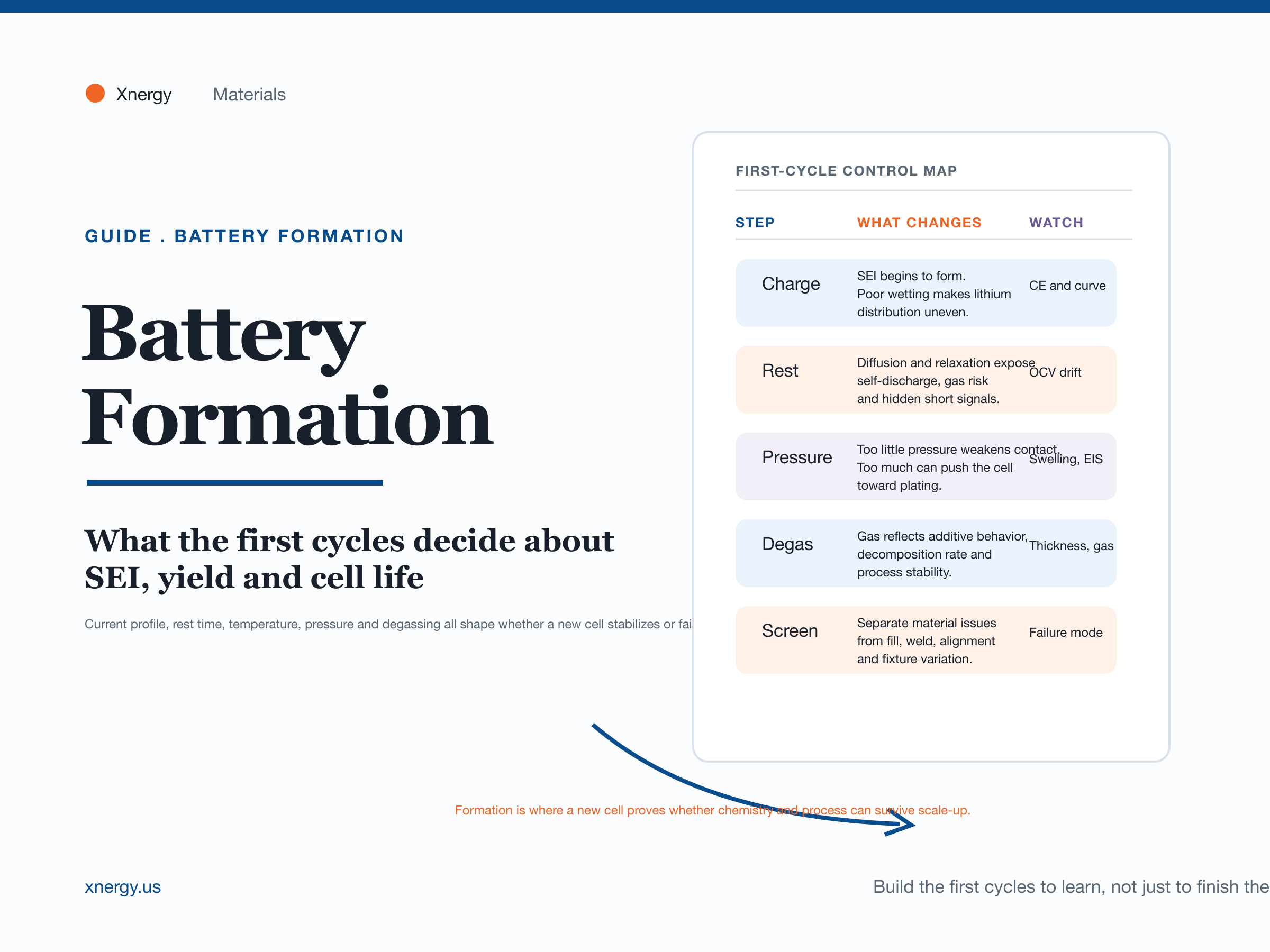
Battery Formation: What the First Cycles Decide About SEI, Yield, and Cell Life
Battery formation is the controlled first-charge process that turns a built cell into a stable working cell. If the first-cycle recipe is wrong, the cell may look acceptable on day one, then fail later as gas, lithium plating, high impedance, weak yield, or short cycle life.
For battery engineers, lab managers, and pilot-scale buyers, the key point is simple: formation is not a housekeeping step after assembly. It is where the first useful solid electrolyte interphase forms, where gas generation becomes measurable, where rest time and temperature begin to matter, and where manufacturing variation first becomes visible in data. The RSC review on lithium-ion battery cell formation and the iScience review on formation challenges in manufacturing both treat formation as one of the costliest and most decisive steps between cell assembly and shipment.
This guide explains what happens during battery formation, which settings matter most, how the early-cycle recipe affects yield and cell life, and how Xnergy customers should decide whether to troubleshoot materials, hardware, or the protocol itself before pilot scale.
What battery formation actually does
At the simplest level, battery formation is the first controlled charge-discharge sequence applied to a newly assembled cell. The sequence is usually slow, includes defined current and voltage limits, and often includes rest periods before and after charging. The purpose is not just to measure capacity. It is to let the cell create a stable electrochemical interface without pushing the electrodes too hard too early.
For lithium-ion cells, the biggest event during battery cell formation is early SEI growth on the anode. If that interphase is thin, uniform, and mechanically stable, the cell is more likely to retain lithium inventory and cycle predictably. If it is patchy or unstable, the cell can keep consuming electrolyte and active lithium, which raises impedance and damages long-term performance. Xnergy’s published SEI guide covers the interface chemistry in more detail; this page stays focused on the formation workflow that shapes it.
The first-cycle step also exposes issues that are easy to miss during assembly:
- Wetting may be incomplete.
- Gas generation may be higher than expected.
- Tab resistance or stack alignment problems may show up as abnormal voltage response.
- Compression strategy may be too weak or too aggressive.
- Electrolyte and additive choices may be incompatible with the current profile.
That is why formation is better understood as the handoff between “cell assembled” and “cell stabilized.”
Why battery formation affects yield more than many teams expect
Teams often talk about battery formation as if it were only about cycle life, but yield is usually where mistakes become expensive first. Formation occupies time, fixtures, channels, climate-controlled space, and data-review effort. The iScience manufacturing review makes this point clearly: formation is a throughput bottleneck because it is slow, energy-intensive, and tightly tied to quality control.
In practice, a weak recipe hurts yield in three ways.
1. It creates real defects
If the early current profile is too aggressive for the chemistry, anode loading, or wetting state, formation cycling can drive uneven SEI growth, lithium plating, or excessive gas. Those are not cosmetic problems. They directly reduce usable cells.
2. It hides upstream defects until late
Many assembly defects do not fail at sealing. They fail during the first cycles. Misalignment, local dry spots, burr-driven microshort risk, poor welding, and electrolyte fill variation often appear first as abnormal voltage, swelling, or impedance behavior during early cycling. That is one reason the pilot-stage failure modes guide remains relevant even for teams with good chemistry.
3. It amplifies lot-to-lot variation
The best formation recipes are tolerant enough to catch bad cells without damaging good ones. A fragile recipe can do the opposite: it makes small material or assembly differences look larger than they need to be. The Joule paper on data-driven battery formation analysis is useful here because it shows that formation data can reveal hidden sensitivity to electrode structure and manufacturing variation.
| Decision area | Conservative formation recipe | Aggressive formation recipe |
|---|---|---|
| Throughput | Slower | Faster |
| Early SEI control | Usually better | More sensitive to chemistry and wetting limits |
| Gas risk | Lower in many systems | Often higher |
| Ability to detect hidden defects | Better signal quality | Can mix process stress with real defects |
| Yield during early scale-up | Often safer | Can drop quickly if upstream variation is not under control |
| Best fit | New chemistry, new supplier lots, new hardware, pilot debugging | Mature chemistry, validated hardware, stable incoming QC |
The point of this comparison is not that slow formation is always better. It is that aggressive recipes only make sense after the materials package, pressure hardware, electrolyte, and upstream process window are already stable.
The process settings that matter most in battery formation
Not every cell needs the same protocol, but the same groups of settings usually matter in every formation program.
Current profile
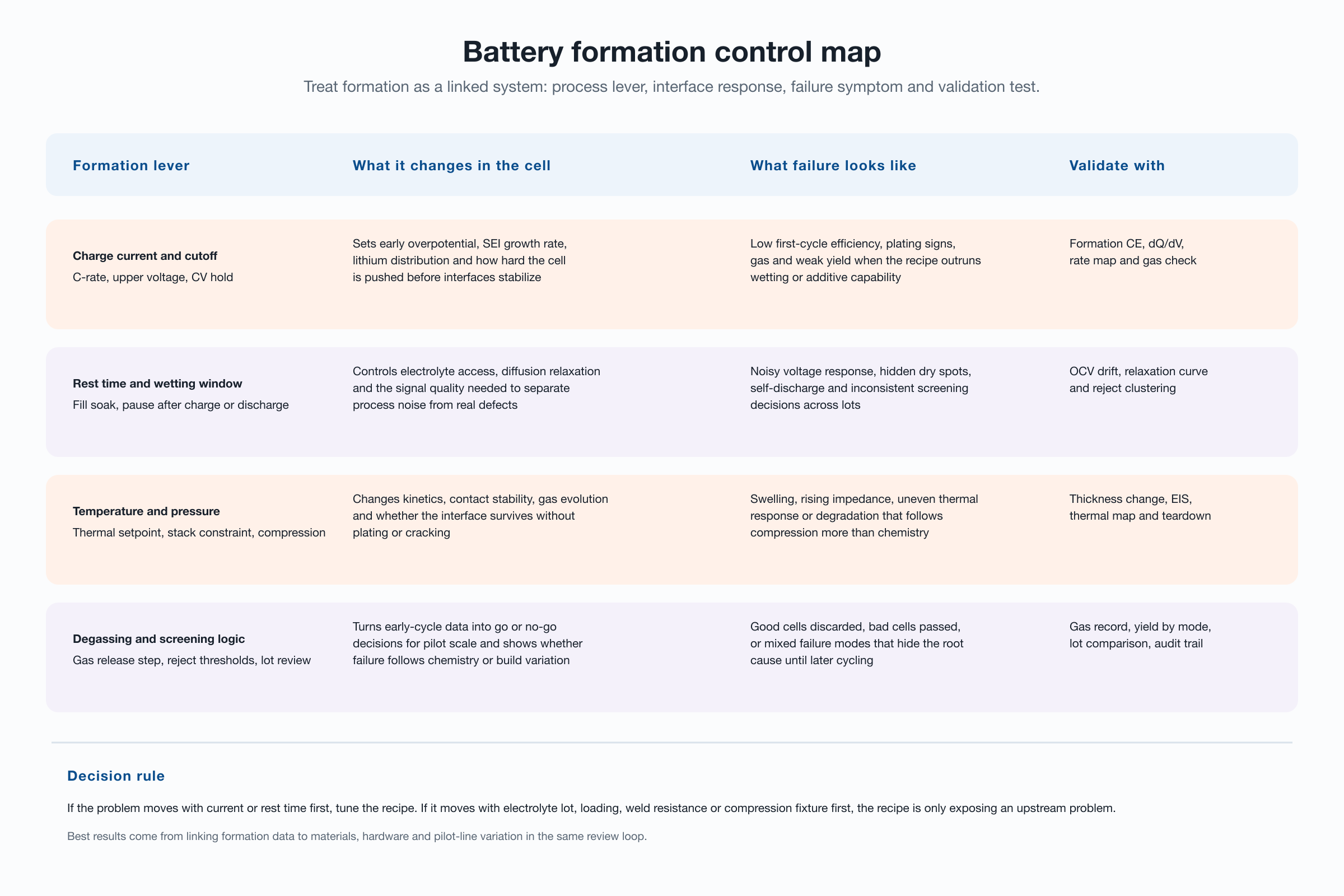
Current is the first obvious lever in the early-cycle recipe. Lower current usually gives the cell more time to wet, distribute lithium more evenly, and build SEI with less local stress. Higher current shortens cycle time, but it can increase overpotential and make early damage easier to trigger. This is especially important in high-loading electrodes, silicon-rich anodes, lithium-metal programs, and fast-charge-oriented designs.
Voltage limits and cutoffs
The charge endpoint in the first cycles determines how far the system is pushed during those first interfacial reactions. A conservative upper cutoff may protect the cell while SEI is still forming, but it may also undertrain the chemistry if the later use case is more demanding. The right answer depends on cathode chemistry, electrolyte, and the purpose of the first-cycle protocol.
Rest periods
Rest steps are easy to dismiss, but they often decide whether formation becomes diagnostic or noisy. Rest periods allow diffusion and relaxation after charge or discharge, which makes it easier to detect abnormal self-discharge, gas behavior, or hidden short-risk signatures. Rest also matters when the cell has limited wetting margin after filling.
Temperature and pressure
Temperature changes kinetics, resistance, gas generation, and SEI chemistry during the first cycles. Pressure is just as important. A 2026 Nature Energy study showed that stack pressure can move degradation behavior in opposite directions: too little pressure can worsen cathode damage, while too much can promote lithium plating. For pouch and stacked formats, this makes compression hardware part of the formation recipe, not just part of later module integration.
Degassing and post-formation handling
Gas is not just a nuisance. During early cycling, gas can reflect electrolyte decomposition, additive behavior, local overpotential, and interface instability. What matters is not only how much gas appears, but when it appears and whether the cell recovers after degassing. Formation data should be reviewed together with swelling, OCV drift, and impedance, not as separate checkboxes.
How battery formation connects to materials and process choices
The most expensive formation mistakes are usually blamed on the recipe alone, even though the real cause sits upstream.
Electrolyte and additives
If the electrolyte system is poorly matched to the voltage window, anode surface, or formation current, the first-cycle protocol becomes the place where the mismatch first appears. That is why the published electrolyte additives guide matters here. Additives that help one formation goal, such as stronger initial passivation, can also change gas behavior, impedance rise, or fast-charge performance later.
Current collectors and tab resistance
Non-uniform current distribution during the first cycles is sometimes caused by hardware, not chemistry. Foil quality, surface coatings, weld consistency, and tab geometry all affect local current density. If those variables are unstable, the formation signature can look like an SEI problem when it is actually a resistance-distribution problem. The battery current collector guide is a good companion reference when current path decisions are still being finalized.
Fast-charge targets
If a customer expects aggressive charge rates later, formation should still stay disciplined. The point is not to imitate field charge rates on day one. It is to stabilize the cell so later fast-charge testing means something. That is why the existing fast-charging battery guide should be linked into any formation decision involving high-rate performance claims.
How to validate a battery formation process before scaling
A good formation protocol is not judged by one capacity number. It should be judged by a matched validation set.
- Track the right signals. At minimum, review first-cycle coulombic efficiency, voltage curves, swelling, gas, impedance growth, OCV drift after rest, and yield by failure mode.
- Separate recipe problems from material problems. If the first-cycle recipe fails, do not assume the current profile is the only lever. Check electrolyte fill, wetting time, electrode loading, N/P balance, pressure hardware, weld resistance, and lot history at the same time.
- Start conservative when the stack is new. For a new chemistry, new anode, new electrolyte family, or new packaging format, a conservative recipe usually saves time overall because it creates clearer data and lowers scrap risk.
- Tighten the protocol only after stability appears. Once the cell shows stable early efficiency, acceptable gas, repeatable impedance, and consistent yield, teams can shorten the process step by step.
If your team already knows the chemistry but is still seeing inconsistent first-cycle behavior, formation may be the wrong place to work alone. The problem could sit in additives, foil choice, compression method, degassing workflow, or the handoff from custom electrodes to pilot hardware. Xnergy supports materials supply, custom electrodes, prototype cells, and pilot manufacturing in one workflow, so the protocol can be debugged together with electrolyte choice, collector spec, stack design, and QC logic instead of being isolated as a charger-setting problem.
Formation support
Need help connecting formation protocol to real build constraints?
Send Xnergy your chemistry, anode system, electrolyte package, pressure setup, and pilot timeline. We can help connect formation settings to materials supply, custom electrodes, prototype cells, and pilot validation support.
Frequently asked questions
What is battery formation?
Battery formation is the first controlled charge-discharge sequence applied to a newly assembled cell so the electrochemical interfaces can stabilize and the cell can be screened for early defects.
Why is battery formation important?
Battery formation is important because it affects SEI quality, gas generation, impedance, yield, and long-term cycle life. A weak formation recipe can damage a cell before normal testing even begins.
What happens during battery cell formation?
During battery cell formation, the cell undergoes low-rate charging and rest steps that help build the SEI, expose wetting and resistance issues, and reveal abnormal gas or voltage behavior.
How long does the battery formation process take?
The battery formation process can take from hours to multiple days depending on chemistry, current profile, rest periods, temperature control, degassing workflow, and the number of screening steps included.
Does battery formation affect cycle life?
Yes. Battery formation strongly affects cycle life because the first cycles help determine how stable the SEI becomes and how much unwanted side reaction or lithium loss occurs early in the cell’s life.
What should engineers monitor during battery formation?
Engineers should monitor first-cycle efficiency, voltage response, impedance, swelling, gas behavior, OCV drift, and yield by failure mode, then compare those results with materials, assembly, and compression conditions.